
Welcome to the 'Scanning and Situational Awareness Techniques' lesson, part of the Hazard Perception and Defensive Riding Strategies unit for your Polish Category A motorcycle licence. This crucial lesson will equip you with the visual skills needed to stay alert and anticipate dangers on the road, preparing you for real-world riding and theory exam questions.

Lesson content overview
Effective visual scanning and robust situational awareness are cornerstones of safe motorcycle riding, particularly on Polish roads. This lesson delves into systematic techniques that empower Category A riders to continuously monitor their environment, anticipate potential hazards, and make timely, informed decisions. By understanding and applying these strategies, you will significantly enhance your safety, reduce reaction times, and ride confidently, fully compliant with Polish traffic regulations.
Visual scanning is more than just looking; it is the active and intentional process of moving your eyes and head to gather comprehensive information about your surroundings. For motorcyclists, whose smaller profile makes them less visible to other road users, this continuous information gathering is paramount. It enables the creation of a dynamic mental map of vehicle positions, speeds, trajectories, and potential conflict points, which is essential for proactive decision-making and hazard prevention.
Remember, human perception has inherent limits, such as narrow central vision and slower processing of peripheral details. Systematic scanning helps overcome these limitations, allowing you to detect hazards earlier and choose safer riding paths.
In Poland, the Prawo o ruchu drogowym (Road Traffic Act) places a legal obligation on all road users to exercise due care and to “pay attention to the development of traffic” (Art. 10). Failure to implement proper scanning techniques can be considered negligence, potentially leading to legal consequences in the event of an incident. This lesson builds upon foundational knowledge of road signs, markings, priority rules, and basic motorcycle control, providing the cognitive basis for advanced defensive riding strategies, including planning escape routes and executing safe overtakes.
Achieving superior situational awareness on a motorcycle involves several interconnected principles that guide your visual strategy. These principles ensure that no critical area of your riding environment is overlooked and that you are constantly updated on evolving traffic conditions.
Definition: 360° situational awareness refers to maintaining a continuous, comprehensive mental model of all relevant traffic elements within your immediate and extended riding environment. This includes vehicles, pedestrians, cyclists, road conditions, and potential hazards in front, to the sides, and behind your motorcycle.
Purpose: This holistic awareness prevents surprise hazards, allowing for proactive rather than reactive decision-making. A rider with strong 360° awareness can anticipate problems before they become critical.
Implications: To achieve this, riders must consciously allocate visual attention across various zones – the road ahead, both sides, and regularly to the rear via mirrors and head checks – without allowing any single area to monopolize focus.
Definition: A scanning pattern is a structured, repeated sequence of eye and head movements designed to cover the entire relevant visual field. This might involve a pattern like forward → peripheral (left) → rear (mirrors) → peripheral (right) → forward, repeated consistently.
Purpose: A defined pattern ensures that no critical area is neglected and helps establish a predictable rhythm for gathering information. It transforms passive observation into active data collection.
Implications: Inconsistent or missed scanning cycles can lead to dangerous blind spot exposures, delayed hazard detection, and a reactive riding style. Developing a habitual pattern is crucial.
Definition: The fixation-saccade cycle describes the natural process of human vision, where the eyes alternate between quick, rapid movements (saccades) to shift focus and brief moments of stable focus (fixations) to gather detailed information from a specific point.
Purpose: This cycle aligns with how our visual system efficiently processes information. Saccades allow for broad coverage, while fixations provide the necessary detail.
Implications: Over-fixation on a single object or point, often referred to as "target fixation," can dangerously reduce peripheral monitoring and overall situational awareness, especially during high-speed or stressful situations.
Definition: Hazard anticipation involves using various environmental cues—such as vehicle speeds, lane changes, brake lights, turn signals, road geometry (curves, intersections), and surface conditions—to predict potential conflicts or dangers before they fully materialize.
Purpose: This proactive approach provides invaluable extra reaction time, allowing riders to make smooth, controlled adjustments to speed or position rather than executing abrupt, emergency maneuvers.
Implications: Effective hazard anticipation requires integrating scanning data with a deep understanding of vehicle dynamics, traffic behavior, and Polish road rules.
Definition: This refers to the minimum recommended or legally mandated frequency for checking your rear-view and side-view mirrors to assess traffic behind you. In Polish driver education, a common guideline is to check every 5 seconds at speeds above 30 km/h.
Purpose: Regular rear-view checks are a legal requirement and are vital for early detection of overtaking vehicles, vehicles approaching from behind at higher speeds, or changes in following distance.
Implications: Inadequate or infrequent mirror checks can lead to unsafe lane changes, turns into the path of another vehicle, or being unprepared for sudden braking by following traffic.
Definition: This principle involves balancing your visual attention between "near-field" scanning (the immediate surroundings, 0-10 metres ahead) and "far-field" scanning (upcoming road conditions and distant traffic, 30 metres and beyond).
Purpose: Balancing these two depths addresses both immediate conflict avoidance (e.g., potholes, sudden stops) and strategic route planning (e.g., upcoming intersections, road curvature, traffic signals).
Implications: Over-emphasis on either near-field or far-field scanning compromises the other. Focusing too much on the immediate path can lead to late detection of distant hazards, while excessive far-field focus can cause you to miss immediate obstacles.
To build comprehensive situational awareness, Category A riders must master several distinct, yet interconnected, scanning techniques.
Definition: Forward vision is your primary visual attention directed straight ahead, encompassing the road segment directly in front of your motorcycle. This area can be mentally divided into near-, mid-, and far-field zones.
Practical Meaning: Maintaining effective forward vision ensures you have an unobstructed view of your immediate path and future trajectory. It enables smooth riding and timely responses to changing conditions. Polish law mandates that a rider must maintain an unobstructed view of the road ahead (Art. 61 § 1).
Common Misunderstandings: Many riders assume peripheral vision alone can provide sufficient forward information, leading to missed braking cues or unexpected road hazards. It is vital to actively shift your central focus through these zones.
Definition: Peripheral vision is your ability to detect motion and objects outside your central line of sight, typically extending up to about 60 degrees from your forward gaze. It allows you to sense what's happening to your sides without directly turning your head.
Practical Meaning: Peripheral vision acts as an invaluable early warning system, alerting you to vehicles approaching from the side or rear that might soon enter your central field of view. It’s critical for maintaining safe following distances, as required by Art. 57 of Polish law, which relies on awareness of surrounding traffic.
Common Misunderstandings: Relying solely on peripheral vision to detect all side and rear traffic. Peripheral vision cannot replace active mirror checks and head-turns, especially for fast-approaching vehicles or those in your blind spots.
Definition: Mirror checks involve regularly glancing into your rear-view and side-view mirrors to assess traffic behind and to the immediate sides of your motorcycle. These can be categorized as a brief "glance" (less than 2 seconds) for quick verification or a more systematic "check" (more than 2 seconds) for detailed assessment.
Practical Meaning: Regular mirror checks provide crucial information for making safe decisions regarding lane changes, overtaking maneuvers, turning, and braking. They are a legal obligation under Polish law (Art. 9 § 1), which requires you to "pay attention to traffic behind."
Common Misunderstandings: Assuming mirrors provide a complete view of your rear. Motorcycle mirrors, by design, have blind spots, meaning they do not cover every area behind you. Relying solely on mirrors without supplementing them with head-turn checks is a common and dangerous mistake.
Definition: Head-turn scanning, often called a "shoulder check," involves physically turning your head to look over your shoulder. This provides a direct, unobstructed view of the blind spot areas that your mirrors cannot cover.
Practical Meaning: Head-turn scanning is indispensable for confirming safety before any lateral movement of the motorcycle. It directly addresses the legal requirement to "ensure safety when changing direction" (Art. 84 § 1).
Common Misunderstandings: Many riders neglect shoulder checks, mistakenly believing their mirrors show the entire rear field. This oversight is a leading cause of side-on collisions. Even a quick glance can prevent an accident.
Definition: Blind spot awareness is the recognition and active compensation for areas around your motorcycle that are not visible through your mirrors or typical peripheral vision. These typically include the rear-right, rear-left, and directly behind zones.
Practical Meaning: Recognizing and actively addressing blind spots requires frequent head-turn checks before changing lanes, turning, or overtaking. Polish traffic law (Art. 85) implicitly requires riders not to linger in other vehicles' blind spots, but it's equally important to manage your own.
Common Misunderstandings: Assuming that because your motorcycle is small, other drivers will always see you. Motorcyclists often disappear into other vehicles' blind spots, emphasizing the need for proactive positioning and scanning.
Definition: Scanning rhythm refers to the consistent timing and order in which you perform your visual checks (e.g., forward → peripheral → rear → side). Scanning frequency dictates how often a full cycle of these checks is completed.
Practical Meaning: Establishing a regular scanning rhythm prevents "tunnel vision" and guarantees a continuous flow of updated traffic information. While there's no explicit legal timing, Polish law's requirement for "continuous attention" (Art. 10) necessitates a disciplined rhythm.
Common Misunderstandings: Maintaining a fixed scanning rhythm regardless of the environment. This can lead to over-checking in low-traffic situations or, more dangerously, under-checking in congested or high-hazard environments.
Definition: Hazard anticipation involves interpreting various environmental clues—such as road layout, signaling devices, other vehicle behavior, and weather conditions—to predict potential conflicts before they actually occur.
Practical Meaning: Proactive hazard anticipation allows you to adjust your speed and trajectory preemptively, minimizing the need for abrupt braking or evasive maneuvers. This aligns with Art. 46, which states that riders must "adjust speed to conditions of the road."
Common Misunderstandings: Reacting only after a hazard becomes obvious. This delay in perception and reaction significantly reduces your safety margin.
Anticipate common hazards like vehicles pulling out from side streets, pedestrians stepping into the road, or doors opening from parked cars, especially in urban areas.
The Polish Road Traffic Act (Prawo o ruchu drogowym) contains several articles that directly or indirectly mandate the use of effective scanning and situational awareness techniques. Understanding these legal requirements is crucial for all Category A riders.
| Regulation | Rule Statement | Applicability | Legal Status | Rationale |
|---|---|---|---|---|
| Art. 9 § 1 | All road users must pay careful attention to the traffic situation and conduct themselves safely. | Continuous while riding. | Mandatory | This foundational duty requires every driver to actively monitor their surroundings, directly supporting the need for scanning. |
| Art. 10 | A driver must anticipate possible dangers and act to avoid them. | All maneuvers (turns, lane changes, overtaking). | Mandatory | This article directly mandates proactive hazard anticipation, which is impossible without effective scanning. |
| Art. 61 § 1 | The rider shall not obstruct their own or any other road user’s field of view. | Vehicle design & riding posture. | Mandatory | This ensures riders maintain a clear view of the road and do not create unnecessary blind spots for themselves or others, emphasizing proper helmet, visor, and mirror adjustment. |
| Art. 84 § 1 | Before changing a lane, the driver must ensure that the maneuver can be performed safely. | Lane changes on any road. | Mandatory | This explicitly requires visual confirmation, meaning riders must use mirrors and perform a head-turn (shoulder check) to verify the lane is clear. |
| Art. 85 | The driver shall keep a safe following distance, considering speed and road conditions. | Following any vehicle. | Mandatory | Maintaining a safe distance relies on continuously scanning the road ahead and behind to judge speed differences and react to sudden braking. |
| Art. 46 | Speed must be adapted to road, traffic, weather, and visibility conditions. | Entire trip. | Mandatory | Effective scanning provides the necessary information to judge these conditions and adjust speed accordingly (e.g., slowing down due to poor visibility or upcoming hazards). |
| Regulation 46/2003 EU | Vehicles must be equipped with mirrors providing a field of view that allows the driver to see at least 200 m to the rear. (This is an EU regulation relevant to vehicle design, but impacts rider behavior.) | Mirror design; indirectly affects rider’s scanning. | Mandatory (EU) | This ensures that proper visual information can be obtained from mirrors, but the rider remains responsible for actively using them and compensating for blind spots. |
Always verify the exact phrasing and article numbers in the latest version of the Prawo o ruchu drogowym to ensure your knowledge is current.
Even experienced riders can fall into bad habits. Recognizing common violations of good scanning practice is the first step toward correcting them.
Effective scanning is not a one-size-fits-all approach; it must be dynamically adjusted to suit varying riding conditions.
| Context | Variation in Principle | Reasoning |
|---|---|---|
| Weather (Rain, Fog, Snow) | Increase scanning frequency, especially to the far-field; broaden your horizon to detect hazards earlier; rely more on head-turns due to mirror obscurity; use appropriate headlamp settings (e.g., low beam in fog). | Reduced visibility inherently shortens your perception distance and increases reaction time, making early detection paramount. |
| Low Light / Night Riding | Emphasize judicious use of headlamps (low beam in traffic, high beam when safe); rely more on peripheral vision to detect moving light sources; increase rear-view checks as depth perception is limited in darkness. | Reduced contrast makes distant objects and road hazards harder to see; effective illumination and constant monitoring are key. |
| Urban vs. Rural Roads | Urban: Faster scanning rhythm, greater focus on intersections, vulnerable road users (pedestrians, cyclists), and frequently changing traffic patterns. Rural: Emphasis on far-field scanning for wildlife, road irregularities, and high-speed overtaking opportunities. | Different traffic densities, speeds, and hazard types require tailored scanning priorities and frequencies. |
| Heavy Traffic (Congestion) | Drastically increase frequency of side-glances and mirror checks; reduce scanning depth, focusing more on immediate gaps and escape routes; utilize "gap-finder" scanning (looking ahead of the vehicle directly in front). | Rapidly changing positions and short distances between vehicles demand continuous updates and quick identification of potential conflicts. |
| Motorcycle with Passenger / Cargo | Adjust mirror positions to compensate for obstruction; increase head-turn checks for the rear blind spot (which may be larger); be aware that a passenger can block direct rearward vision. | Additional mass and altered ergonomics can change visual fields and create new or larger blind zones. |
| Road Surface Conditions (Wet, Gravel, Ice) | Prioritize far-field scanning for surface cues (e.g., pooling water, shiny patches); increase following distance; anticipate significantly longer stopping distances and reduced grip. | Surface conditions directly affect vehicle dynamics; early detection allows for pre-emptive speed and handling adjustments to prevent loss of control. |
| Intersection Types | Roundabout: Focus on peripheral traffic already circulating and vehicles entering from your left/right. Unsignalized: Scan far ahead and to the sides for hidden cross-traffic, assuming others might not yield. Signalized: Monitor light changes and crossing pedestrians. | Different intersection designs present distinct conflict points and require specific scanning priorities. |
| Vulnerable Road Users (VRUs) | Increase peripheral scanning to detect smaller, faster-moving objects (cyclists) or unpredictable movements (pedestrians); anticipate crossing behaviors; use horn sparingly as a warning. | VRUs are often less visible and can be unpredictable; proactive scanning reduces collision risk. |
| Vehicle Maintenance Issues | If a headlight is broken or a mirror is obscured/damaged, compensate with significantly increased head-turn scanning and adjust your speed until repairs can be made. | Equipment failures reduce available visual information, necessitating higher rider vigilance and caution. |
The effectiveness of your scanning directly impacts your safety and riding outcomes. Understanding these cause-and-effect relationships reinforces the importance of disciplined visual habits.
This lesson on scanning and situational awareness is not an isolated topic but a fundamental skill that underpins many aspects of safe motorcycle riding.
Let's look at how scanning principles are applied in real-world Polish riding scenarios.
Understanding the psychological and physical reasons why scanning works can help solidify these techniques in your riding habits.
By diligently practicing these concepts and integrating these systematic scanning techniques into your daily riding habits, you, as a Category A motorcyclist, will not only fulfill your legal duties but also significantly enhance your personal safety and reduce accident risk across all riding environments in Poland.
This lesson covers systematic visual scanning techniques essential for motorcycle safety on Polish roads, covering forward vision zones, peripheral awareness, mirror checks, and head-turn scanning to eliminate blind spots. It establishes a consistent scanning rhythm of full cycles every 2-3 seconds while emphasizing that mirrors alone are insufficient and shoulder checks are mandatory before any lateral maneuver. The content connects scanning directly to Polish legal obligations under the Road Traffic Act and explains how effective scanning enables proactive hazard anticipation using environmental cues, giving riders extra reaction time. Contextual variations for weather, traffic density, road type, and different scenarios like urban intersections, motorway overtaking, and roundabouts demonstrate how scanning adapts to conditions, ultimately reducing collision risk through disciplined visual habits.
A short set of high-value points that capture the most important learning from this lesson.
Effective scanning is a disciplined, continuous visual routine using eyes and head to gather comprehensive traffic information, not passive observation.
A proper scanning pattern divides forward vision into near-field (0-10m), mid-field (10-30m), and far-field (30m+) zones to ensure no critical area is overlooked.
Mirrors alone are insufficient; blind spots require head-turn (shoulder) checks before any lateral movement to prevent side-on collisions.
Maintain a consistent scanning rhythm of at least one full cycle every 2-3 seconds at urban speeds, increasing frequency in dense traffic or adverse conditions.
Hazard anticipation using environmental cues allows proactive speed and position adjustments, significantly extending your reaction window.
Explore all units and lessons included in this driving theory course.
Polish law mandates continuous attention (Art. 9 § 1), hazard anticipation (Art. 10), and safe lane changes with proper visual confirmation (Art. 84 § 1).
Check rear-view mirrors at least every 5 seconds when traveling above 30 km/h, always supplementing with head-turns to cover blind spots.
Peripheral vision detects motion and changes but cannot replace active mirror checks for assessing speed and distance of following vehicles.
Adaptive scanning means increasing frequency in adverse weather, heavy traffic, or reduced visibility, and expanding far-field focus on motorways.
Tunnel vision under stress narrows your visual field; a practiced scanning rhythm counteracts this natural tendency.
Relying solely on mirrors before lane changes, ignoring blind spots that require direct head-turn verification over the shoulder.
Excessive focus on the vehicle directly ahead in heavy traffic, neglecting side and rear zones where overtaking or merging vehicles may appear.
Skipping shoulder checks during low-speed maneuvers assuming no hazards exist, then being surprised by pedestrians or cyclists approaching from the sides.
Neglecting far-field scanning on highways, leading to late detection of upcoming hazards and abrupt braking when smooth speed adjustments would suffice.
Assuming other drivers see your motorcycle because of its small size, forgetting that motorcyclists commonly disappear into vehicles' blind spots.
Lesson content overview
A short set of high-value points that capture the most important learning from this lesson.
Effective scanning is a disciplined, continuous visual routine using eyes and head to gather comprehensive traffic information, not passive observation.
A proper scanning pattern divides forward vision into near-field (0-10m), mid-field (10-30m), and far-field (30m+) zones to ensure no critical area is overlooked.
Mirrors alone are insufficient; blind spots require head-turn (shoulder) checks before any lateral movement to prevent side-on collisions.
Maintain a consistent scanning rhythm of at least one full cycle every 2-3 seconds at urban speeds, increasing frequency in dense traffic or adverse conditions.
Hazard anticipation using environmental cues allows proactive speed and position adjustments, significantly extending your reaction window.
Explore all units and lessons included in this driving theory course.
Polish law mandates continuous attention (Art. 9 § 1), hazard anticipation (Art. 10), and safe lane changes with proper visual confirmation (Art. 84 § 1).
Check rear-view mirrors at least every 5 seconds when traveling above 30 km/h, always supplementing with head-turns to cover blind spots.
Peripheral vision detects motion and changes but cannot replace active mirror checks for assessing speed and distance of following vehicles.
Adaptive scanning means increasing frequency in adverse weather, heavy traffic, or reduced visibility, and expanding far-field focus on motorways.
Tunnel vision under stress narrows your visual field; a practiced scanning rhythm counteracts this natural tendency.
Relying solely on mirrors before lane changes, ignoring blind spots that require direct head-turn verification over the shoulder.
Excessive focus on the vehicle directly ahead in heavy traffic, neglecting side and rear zones where overtaking or merging vehicles may appear.
Skipping shoulder checks during low-speed maneuvers assuming no hazards exist, then being surprised by pedestrians or cyclists approaching from the sides.
Neglecting far-field scanning on highways, leading to late detection of upcoming hazards and abrupt braking when smooth speed adjustments would suffice.
Assuming other drivers see your motorcycle because of its small size, forgetting that motorcyclists commonly disappear into vehicles' blind spots.
Explore search topics learners often look for when studying Scanning and Situational Awareness Techniques. These topics reflect common questions about road rules, driving situations, safety guidance, and lesson level theory preparation for learners in Poland.
Browse additional driving theory lessons that cover connected traffic rules, road signs, and common driving situations related to this topic. Improve your understanding of how different rules interact across everyday traffic scenarios.
Explore advanced visual scanning patterns and techniques for superior situational awareness on Polish roads. Learn to anticipate hazards proactively by mastering forward, peripheral, and rearward observation for Category A theory.

In this lesson, learners study warning signs that alert drivers to potential hazards, focusing on those that are particularly relevant to motorcyclists. The content includes signs indicating curves, slippery surfaces, animal crossings, tram tracks, and construction zones, each requiring specific riding adjustments. The lesson teaches riders how to interpret these signs to anticipate hazards, adjust speed appropriately, and maintain a safe distance from potential dangers.

In this lesson, learners focus on the identification and management of blind spots that affect motorcyclists, particularly when sharing the road with larger vehicles such as trucks and buses. The content covers the use of side mirrors, head-turn techniques, and optimal rider positioning to minimize blind-spot exposure. Learners will also study the characteristics of blind spots at intersections and during overtaking maneuvers to reduce collision risk.

This lesson outlines strategies for planning escape routes and adopting protective positioning to avoid potential collisions. Learners will study the concept of a defensive riding line that maximizes visibility and provides an optimal safety corridor. The content emphasizes maintaining adequate distance buffers, choosing lanes that reduce exposure to hazards, and preparing for emergency maneuvers such as swift swerves, allowing riders to react quickly in critical situations.

This lesson examines the variety of pavement markings that define lane structures, traffic flow, and special zones on Polish roads. Learners will study solid and broken lines, lane division markings, and the distinct symbols for bicycle lanes, bus lanes, and tram tracks, all of which affect motorcyclist positioning. The lesson also addresses surface texture indicators that signal changing road conditions, enabling riders to maintain correct lane discipline.

This lesson introduces hazard perception concepts specific to agricultural vehicles, teaching learners how to identify potential dangers such as unexpected farm equipment or changing road conditions. It outlines a systematic approach to visual scanning, risk evaluation, and timely decision-making to avoid accidents. The lesson provides guidelines for interpreting scenario simulations that mirror real-world rural road hazards.

This lesson focuses on the unique demands of urban riding within Polish cities, addressing traffic lights, pedestrian zones, one-way streets, and the presence of tram tracks. Learners will study safe lane positioning on narrow roads, blind-spot management, and how to share the road with buses and cyclists. The content also covers strategies for navigating stop-and-go traffic, anticipating signal changes, and maintaining visibility in dense urban environments.
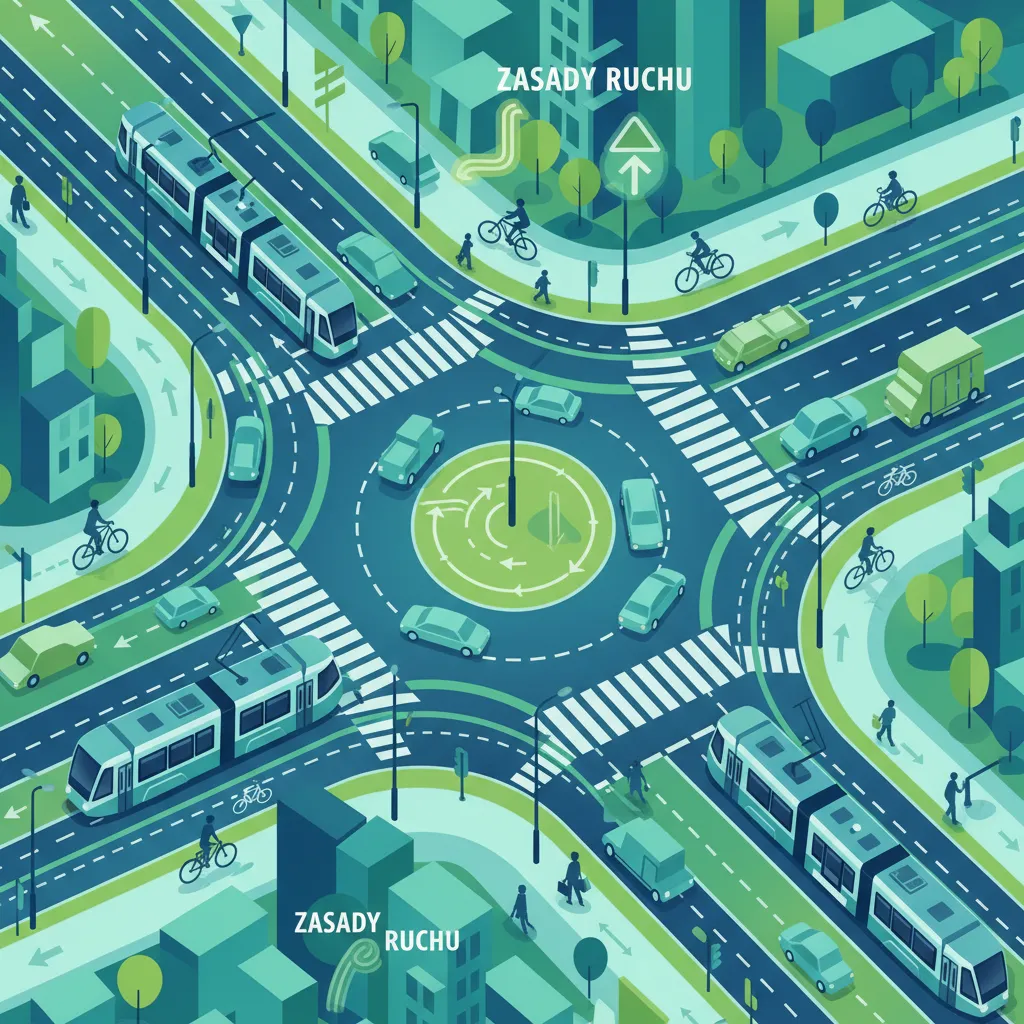
In this lesson, learners investigate complex junctions and intersections found across urban, rural, and highway environments, focusing on multi-lane configurations, traffic light coordination, and roundabout navigation. The content emphasizes priority rules, blind-spot assessment when merging, and safe lane selection for turning maneuvers. Learners will also consider interactions with cyclists and pedestrians, and the importance of adjusting approach speed for safe navigation.

In this lesson, learners explore riding on rural and countryside roads, where road markings may be sparse and surface conditions varied. The content covers safe overtaking in single-lane sections, interaction with agricultural vehicles and animals, and the handling of gravel or uneven surfaces. Learners will also study the importance of anticipating curves and adjusting speed to light conditions, equipping them with the skills needed for safe countryside travel.

This lesson equips learners with a structured approach to risk assessment and decision-making when facing adverse weather or seasonal conditions. The content introduces a hazard perception framework, guiding riders to assess weather forecasts, evaluate road surface conditions, and calculate safety margins. Learners will learn how to make go/no-go decisions, adjust speed dynamically, and plan contingencies for unexpected events to prioritize safety.
Identify and understand common errors in visual scanning and situational awareness for motorcyclists. Learn the correct techniques and strategies to avoid these mistakes and improve hazard perception in Polish traffic.
In this lesson, learners focus on the identification and management of blind spots that affect motorcyclists, particularly when sharing the road with larger vehicles such as trucks and buses. The content covers the use of side mirrors, head-turn techniques, and optimal rider positioning to minimize blind-spot exposure. Learners will also study the characteristics of blind spots at intersections and during overtaking maneuvers to reduce collision risk.
In this lesson, learners study warning signs that alert drivers to potential hazards, focusing on those that are particularly relevant to motorcyclists. The content includes signs indicating curves, slippery surfaces, animal crossings, tram tracks, and construction zones, each requiring specific riding adjustments. The lesson teaches riders how to interpret these signs to anticipate hazards, adjust speed appropriately, and maintain a safe distance from potential dangers.
This lesson outlines strategies for planning escape routes and adopting protective positioning to avoid potential collisions. Learners will study the concept of a defensive riding line that maximizes visibility and provides an optimal safety corridor. The content emphasizes maintaining adequate distance buffers, choosing lanes that reduce exposure to hazards, and preparing for emergency maneuvers such as swift swerves, allowing riders to react quickly in critical situations.
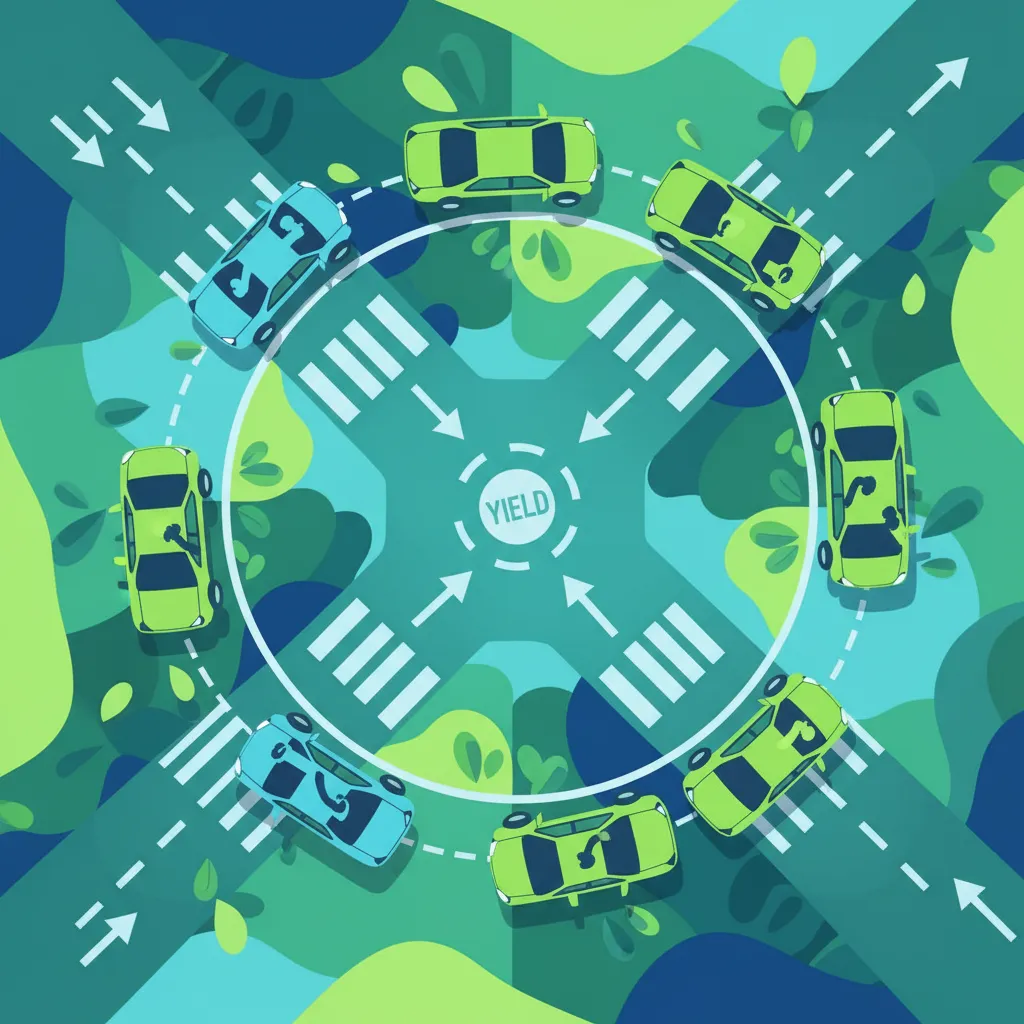
This lesson emphasizes the importance of systematic observation for safe driving. It teaches how to correctly adjust and use rearview and side mirrors to monitor traffic, and explains why shoulder checks are essential for detecting hazards in blind spots. These techniques are fundamental for safe lane changes, turns, and overall situational awareness.
This lesson examines the variety of pavement markings that define lane structures, traffic flow, and special zones on Polish roads. Learners will study solid and broken lines, lane division markings, and the distinct symbols for bicycle lanes, bus lanes, and tram tracks, all of which affect motorcyclist positioning. The lesson also addresses surface texture indicators that signal changing road conditions, enabling riders to maintain correct lane discipline.
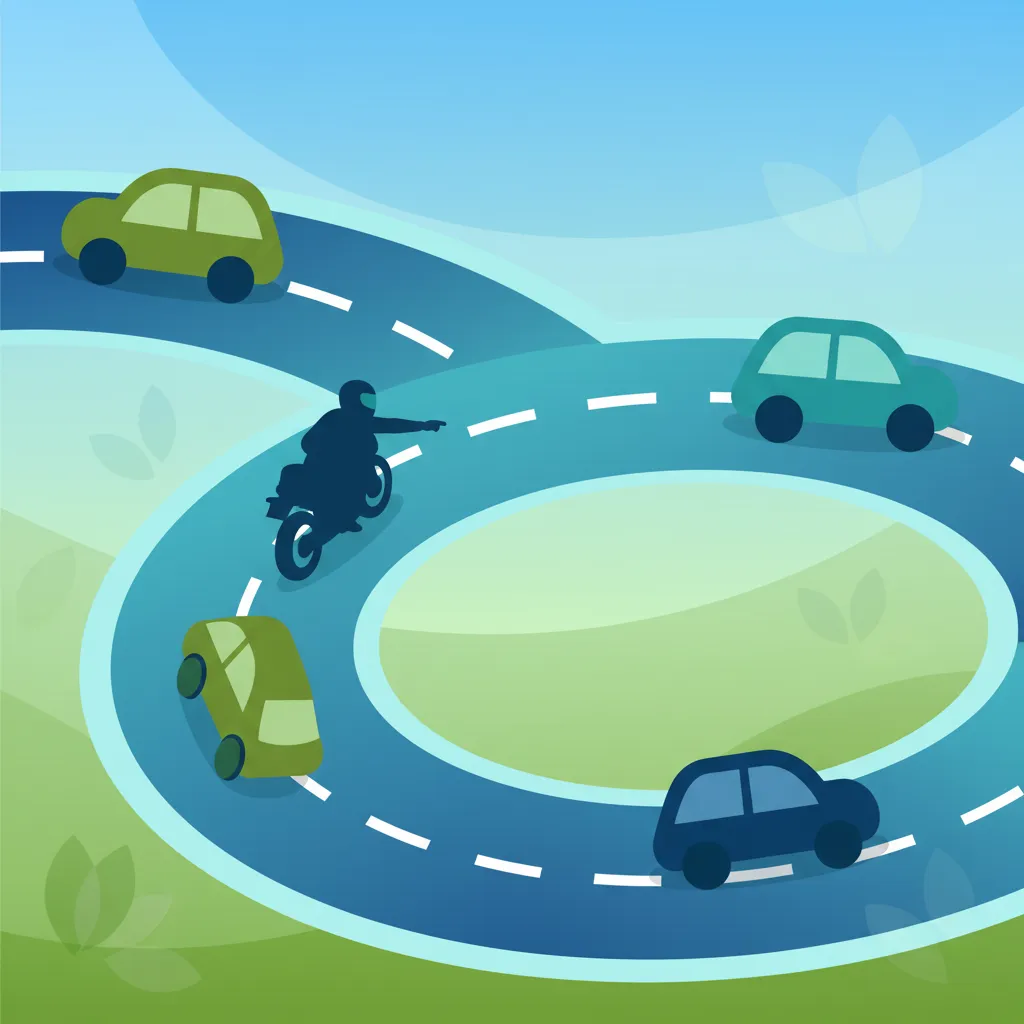
This lesson focuses on the proper techniques for negotiating roundabouts, which are common in Polish urban environments. Learners will learn the correct approach to entering a roundabout, yielding to circulating traffic, selecting the appropriate lane, and signaling intentions when exiting. The lesson also discusses speed adaptation for safe circulation and blind-spot checks before changing lanes within the roundabout, ensuring smooth and legal navigation.
In this lesson, learners investigate complex junctions and intersections found across urban, rural, and highway environments, focusing on multi-lane configurations, traffic light coordination, and roundabout navigation. The content emphasizes priority rules, blind-spot assessment when merging, and safe lane selection for turning maneuvers. Learners will also consider interactions with cyclists and pedestrians, and the importance of adjusting approach speed for safe navigation.

In this lesson, learners examine defensive overtaking practices, focusing on when and how to safely pass other road users. The content covers speed differential calculations, appropriate passing distances, and the importance of maintaining clear visibility during overtaking. Learners will also study the impact of road curvature, traffic flow, and lane selection on overtaking safety, allowing them to minimize risks associated with passing maneuvers.

This lesson addresses environmental factors that impact rider visibility, such as low light, night conditions, fog, and glare from headlights. Learners will explore strategies for riding safely in reduced visibility, including the use of reflective gear, proper headlamp settings, and appropriate eye protection. The content also covers hazard detection techniques in adverse weather and how to adjust speed to maintain safety, enhancing rider safety across all conditions.
In this lesson, learners explore riding on rural and countryside roads, where road markings may be sparse and surface conditions varied. The content covers safe overtaking in single-lane sections, interaction with agricultural vehicles and animals, and the handling of gravel or uneven surfaces. Learners will also study the importance of anticipating curves and adjusting speed to light conditions, equipping them with the skills needed for safe countryside travel.
Find clear answers to common questions learners have about Scanning and Situational Awareness Techniques. Learn how the lesson is structured, which driving theory objectives it supports, and how it fits into the overall learning path of units and curriculum progression in Poland. These explanations help you understand key concepts, lesson flow, and exam focused study goals.
Regularly checking your mirrors, especially your rear-view mirror, is critical for motorcyclists because you have significant blind spots. It allows you to be aware of traffic approaching from behind, vehicles that might be planning to overtake, or cars that are following too closely. This awareness helps you make safer decisions about lane positioning, speed, and when it's safe to manoeuvre.
In urban Polish environments, scanning needs to be more rapid and frequent due to higher traffic density, more potential hazards like pedestrians and cyclists, and frequent junctions. On rural roads, you might scan less frequently but need to be more alert to potential hazards appearing from hidden driveways, farm entrances, or animals crossing the road, and be aware of higher speeds.
Environmental cues include things like the direction a car's wheels are pointing when stopped at an intersection, a pedestrian looking towards the road, the behaviour of other vehicles (sudden braking, swerving), or even changes in road surface that might indicate a hazard. Learning to 'read' these subtle signs is a key part of situational awareness.
Absolutely. The Polish theory exam for Category A frequently includes questions that test your understanding of hazard perception, safe riding practices, and situational awareness. By mastering scanning techniques, you'll be much better prepared to answer these questions correctly and demonstrate a solid understanding of road safety principles.
You can practice scanning by observing traffic from a stationary position, such as a park bench or café. Watch how drivers and motorcyclists navigate intersections, change lanes, and react to traffic signals. Mentally review what potential hazards you see and what actions other road users might take. This mental rehearsal helps build the habit.
Build custom practice sessions tailored precisely to your needs. Focus on areas requiring improvement, review specific Polish road signs, or master complex traffic rules to ensure full preparation for your official driving license exam.