
Driving in darkness significantly impacts your ability to perceive distances, identify hazards, and react quickly. In Spain, DGT regulations emphasize specific precautions, from proper headlight use to adapting your speed, to mitigate these increased risks. Mastering night driving is crucial for both your theory exam and real-world safety.
Theory topic content overview
Read the full theory topic guide for Night Driving Safety with structured, easy-to-scan content built for learners in Spain. This detailed section explains the exact rule, meaning, traffic context, comparison points, and exam logic behind this Spanish driving theory topic so you can study faster, understand the concept more clearly, and avoid common interpretation mistakes on the theory test.
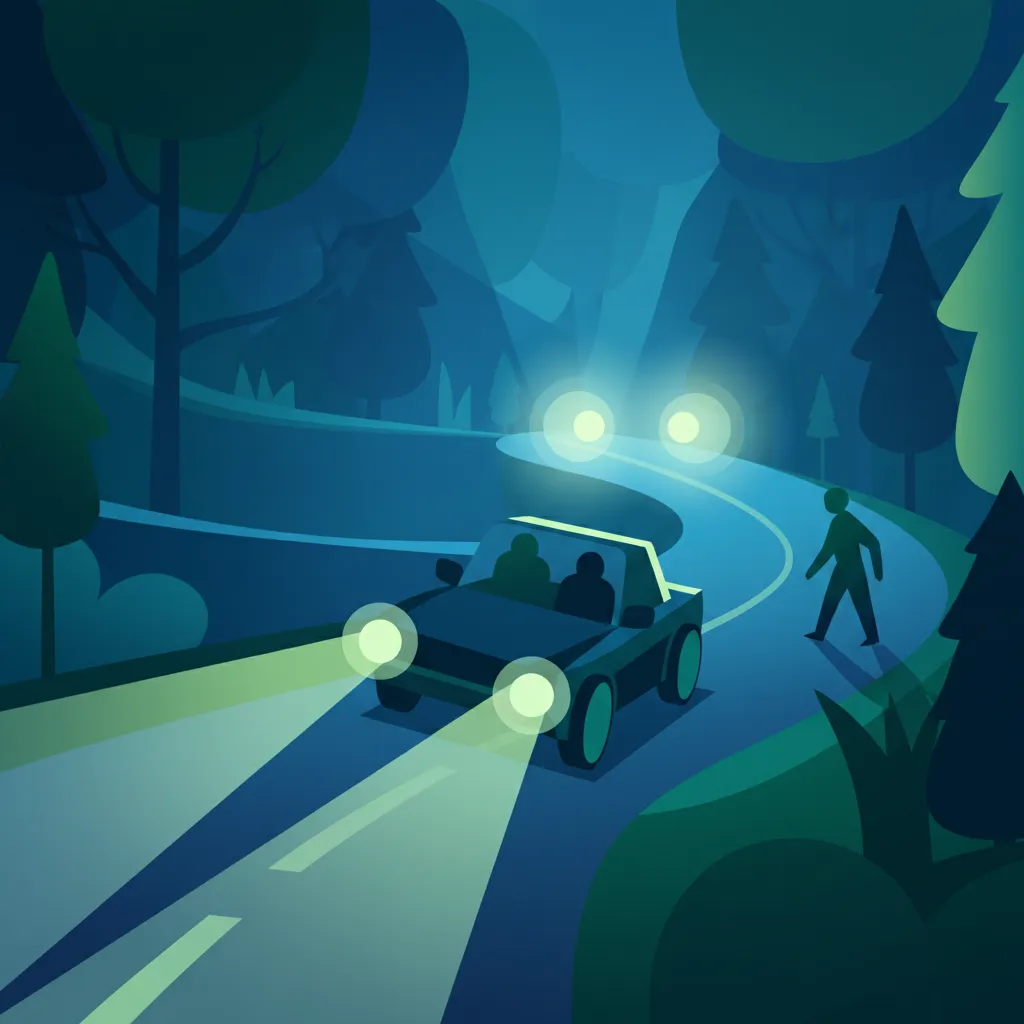
Driving at night presents a set of unique challenges that significantly increase the risks compared to daytime driving. The fundamental issue is reduced visibility, which profoundly impacts a driver's ability to perceive, react, and make safe decisions. In Spain, like anywhere, navigating in darkness demands heightened awareness and specific adaptations from every driver.
The human eye is simply not as effective at night. Our depth perception, ability to distinguish colours, and peripheral vision are all diminished. This means:
Understanding the nuances of driving at night is critical for several reasons, especially for aspiring drivers taking their DGT theory exam in Spain:
Darkness doesn't just reduce what you see; it changes how you see and process information.
To counteract the dangers of night driving, specific adjustments to your driving style and vehicle use are essential under DGT regulations.
The most critical rule for night driving is that your speed must always allow you to stop within the visible distance illuminated by your headlights.
Your vehicle's lighting system is your most vital tool for both seeing and being seen. DGT rules on light use are strict:
When faced with dazzling headlights:
Many learners and even experienced drivers make critical errors when driving at night:
Consider these common situations to apply your night driving knowledge:
Mastering driving at night in Spain boils down to a few core principles:
By adhering to these principles and the specific DGT regulations, you'll significantly enhance your safety and confidence when driving after dark on Spanish roads.
Night driving in Spain significantly reduces visibility, depth perception, and reaction time, requiring drivers to always adjust their speed so they can stop within the illuminated distance of their headlights. Correct use of luces de cruce (low beam) and luces de largo alcance (high beam) is strictly regulated by DGT, with low beam mandatory whenever dazzling other users is a risk. Managing headlight glare, maintaining a clean windshield and lights, and recognizing early signs of fatigue are all essential adaptations for safe nighttime driving on Spanish roads.
A short set of high-value points that capture the most important ideas from this theory explanation.
Your speed must always allow you to stop within the distance illuminated by your headlights, not just within the speed limit.
Use luces de cruce (low beam) whenever there is a risk of dazzling other road users, including in urban areas with street lighting.
Fatigue sets in faster at night because your brain works harder to process limited visual information, directly slowing reaction time.
Keep your windshield, mirrors, and all vehicle lights scrupulously clean; dirt significantly reduces visibility and increases glare.
When dazzled by oncoming headlights, shift your gaze to the right edge of the road rather than looking directly at the lights.
Low beam (luces de cruce) is mandatory from sunset to sunrise, in tunnels, and any reduced visibility conditions.
High beam (luces de largo alcance) is only for unlit roads outside built-up areas above 40 km/h when it won't dazzle others.
Fog lights are for severe fog, heavy rain, or snow only—not as a substitute for regular headlights at night.
Heavy loads in the rear can cause headlights to point upwards, dazzling oncoming drivers.
Pedestrians, cyclists, and animals are much harder to spot at night and may lack reflective gear.
Assuming the posted speed limit is always safe at night, ignoring that visibility determines the safe maximum speed.
Failing to switch from high beam to low beam when approaching other vehicles, causing dangerous deslumbramiento.
Relying solely on automatic lights without understanding that they may not activate in all low-light conditions.
Pushing through fatigue on long night journeys, leading to dangerously slowed reaction times and reduced concentration.
Not actively scanning for vulnerable road users who are difficult to see in dim light, especially on poorly lit streets.
Start with a short, direct summary of Night Driving Safety before reading the full explanation below.
Driving at night is inherently more dangerous due to reduced visibility, increased risk of glare from other vehicles, and heightened fatigue. Drivers must lower their speed to ensure they can stop within the illuminated area of their headlights, maintain a clean windshield, and correctly use their vehicle's lighting systems. Special attention to detecting pedestrians and other vulnerable road users is also essential under Spanish traffic law.
Review the most important terms, rule signals, and traffic concepts linked to Night Driving Safety.
Explore related theory topic pages connected to Night Driving Safety and continue with the next useful rule explanation.
See the common search queries learners use when trying to understand Night Driving Safety in Spain.

Continue your preparation by exploring specific Spanish driving theory topics in depth. Review road signs, understand priority rules, and master DGT traffic laws. This section provides the essential knowledge to pass your exam and drive safely across Spain.
Explore Spanish Driving Theory TopicsTheory topic content overview
A short set of high-value points that capture the most important ideas from this theory explanation.
Your speed must always allow you to stop within the distance illuminated by your headlights, not just within the speed limit.
Use luces de cruce (low beam) whenever there is a risk of dazzling other road users, including in urban areas with street lighting.
Fatigue sets in faster at night because your brain works harder to process limited visual information, directly slowing reaction time.
Keep your windshield, mirrors, and all vehicle lights scrupulously clean; dirt significantly reduces visibility and increases glare.
When dazzled by oncoming headlights, shift your gaze to the right edge of the road rather than looking directly at the lights.
Low beam (luces de cruce) is mandatory from sunset to sunrise, in tunnels, and any reduced visibility conditions.
High beam (luces de largo alcance) is only for unlit roads outside built-up areas above 40 km/h when it won't dazzle others.
Fog lights are for severe fog, heavy rain, or snow only—not as a substitute for regular headlights at night.
Heavy loads in the rear can cause headlights to point upwards, dazzling oncoming drivers.
Pedestrians, cyclists, and animals are much harder to spot at night and may lack reflective gear.
Assuming the posted speed limit is always safe at night, ignoring that visibility determines the safe maximum speed.
Failing to switch from high beam to low beam when approaching other vehicles, causing dangerous deslumbramiento.
Relying solely on automatic lights without understanding that they may not activate in all low-light conditions.
Pushing through fatigue on long night journeys, leading to dangerously slowed reaction times and reduced concentration.
Not actively scanning for vulnerable road users who are difficult to see in dim light, especially on poorly lit streets.
Start with a short, direct summary of Night Driving Safety before reading the full explanation below.
Driving at night is inherently more dangerous due to reduced visibility, increased risk of glare from other vehicles, and heightened fatigue. Drivers must lower their speed to ensure they can stop within the illuminated area of their headlights, maintain a clean windshield, and correctly use their vehicle's lighting systems. Special attention to detecting pedestrians and other vulnerable road users is also essential under Spanish traffic law.
Review the most important terms, rule signals, and traffic concepts linked to Night Driving Safety.
Explore related theory topic pages connected to Night Driving Safety and continue with the next useful rule explanation.
See the common search queries learners use when trying to understand Night Driving Safety in Spain.
Continue your preparation by exploring specific Spanish driving theory topics in depth. Review road signs, understand priority rules, and master DGT traffic laws. This section provides the essential knowledge to pass your exam and drive safely across Spain.
Explore Spanish Driving Theory TopicsUse this exam-focused revision tip to understand how Night Driving Safety is likely to appear in theory questions for learners in Spain. This section helps you identify the most testable part of the rule, avoid common traps, and remember the concept more effectively during Spanish driving theory exam preparation.
Remember that your stopping distance must always be less than the visible distance illuminated by your headlights. The DGT exam frequently tests scenarios involving speed adaptation and correct light usage when driving in darkness, especially when encountering other vehicles or curves. Pay attention to questions about dazzling and reaction times.
Read direct answers to the most common learner questions about Night Driving Safety in Spain. This FAQ focuses on rule confusion, practical meaning, comparison with similar concepts, and the exact uncertainties that appear most often in Spanish driving theory revision and exam preparation.
Driving at night is riskier due to significantly reduced visibility, making it harder to spot objects, people, and judge distances. Drivers also face glare from other vehicles' headlights and are more susceptible to fatigue, increasing reaction times.
You must reduce your speed to ensure you can always stop within the distance illuminated by your headlights. This allows sufficient time to react to any unseen hazards or obstacles.
If dazzled, avoid looking directly at the lights. Instead, focus your gaze slightly towards the right edge of your lane or the road markings until the vehicle has passed. You may also need to reduce speed.
In Spain, vehicle lights must be used from sunset to sunrise, or whenever visibility is poor. This includes using appropriate lighting (e.g., dipped beam, or main beam when safe) to see and be seen without dazzling others.
Fatigue increases significantly at night, particularly on long journeys. It impairs concentration, slows reaction times, and can lead to microsleeps, dramatically increasing the risk of an accident.
Overtaking at night is more dangerous because of reduced visibility and difficulty in judging speeds and distances. It requires careful assessment and correct use of lights by both the overtaking and overtaken vehicles to prevent dazzling.
Use our powerful search functionality to pinpoint specific Spanish DGT driving theory practice sets. Filter by road sign categories, traffic law topics, or question difficulty to build custom study sessions and reinforce your knowledge precisely where it matters for your official exam.