
Driving near schools in Spain demands a unique level of vigilance. These areas, often marked with specific signs, require drivers to drastically reduce speed and anticipate unexpected movements from children. Understanding the DGT's emphasis on protecting vulnerable road users is fundamental for both your theory exam and real-world safe driving.
Theory topic content overview
Read the full theory topic guide for School Zones Safety Rules with structured, easy-to-scan content built for learners in Spain. This detailed section explains the exact rule, meaning, traffic context, comparison points, and exam logic behind this Spanish driving theory topic so you can study faster, understand the concept more clearly, and avoid common interpretation mistakes on the theory test.
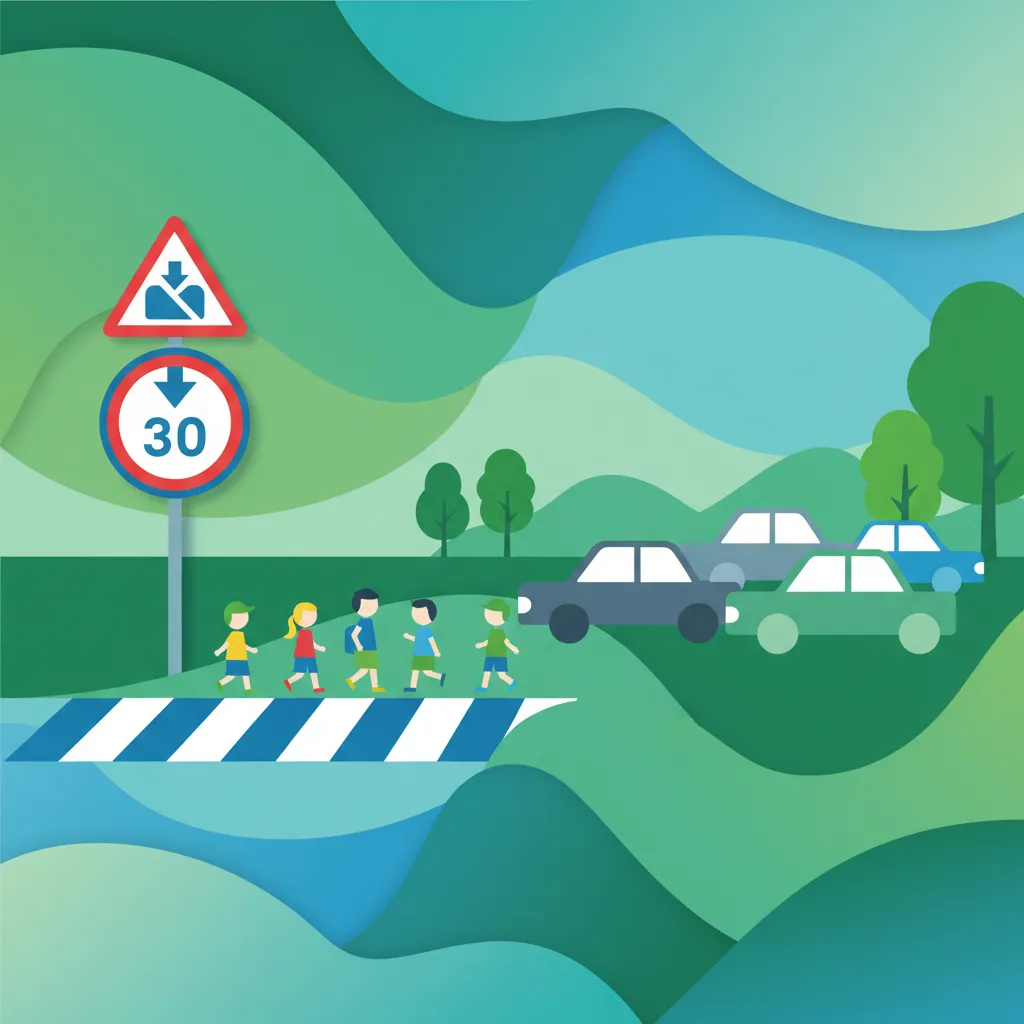
A school zone in Spain refers to any area near an educational facility, such as a school, kindergarten, or playground, where children are frequently present and may interact with traffic. These zones are designated with specific DGT (Dirección General de Tráfico) signage to alert drivers to the heightened risk posed by vulnerable road users – specifically children.
The primary reason these areas demand extreme caution is the unpredictable behaviour of children. Unlike adults, children have limited awareness of traffic dangers, a reduced ability to judge vehicle speed and distance, and are often easily distracted. For drivers, a school zone isn't just a place with a lower speed limit; it's a critical area requiring constant vigilance and a proactive approach to safety.
The DGT places a significant emphasis on the protection of vulnerable road users, with children being among the most at risk. Misjudging the hazards in a school zone can lead to severe consequences, making this topic crucial for both your Spanish driving theory exam and real-world safe driving.
Key reasons for extreme caution include:
Navigating school zones safely in Spain requires a specific set of driving behaviours that go beyond general vigilance.
The most critical precaution is to reduce your speed drastically. Even if a specific lower speed limit sign isn't present, the presence of school zone warning signs (Peligro, niños or Atención, niños) dictates that you should drive at a speed that allows you to stop instantly. A common mistake is to only slow down slightly; the DGT expects you to be prepared for an immediate stop.
Adopt a defensive driving posture:
Cover your brake pedal (rest your foot lightly on it) as you approach and drive through school zones. This reduces your reaction time if you need to brake suddenly. Maintain a safe following distance from vehicles ahead, as they might also need to stop abruptly.
School arrival and dismissal times are periods of maximum risk. The volume of children and parents is highest, and distractions can be prevalent. Adjust your route or timing if possible, or allocate extra time to pass through these areas with extreme caution.
In Spain, you will encounter specific warning signs:
Several factors can increase the risk in school zones:
Theory exams often test your understanding of these specific hazards. Common mistakes include:
The Dirección General de Tráfico (DGT), Spain's traffic authority, places a strong emphasis on the safety of vulnerable road users, especially children and the elderly. This commitment is reflected in driving theory curriculum and practical test assessments. When answering exam questions related to school zones, remember the DGT's core principle: the driver is always responsible for ensuring the safety of pedestrians, particularly those most vulnerable. Your actions must demonstrate maximum caution and anticipation.
When driving in school zones in Spain, always remember: children are highly unpredictable. Your primary responsibility as a driver is to anticipate every potential hazard and prioritize their safety above all else. Drive slowly, scan your surroundings continuously, eliminate distractions, and always be prepared to stop. By adopting this mindset, you not only ensure compliance with DGT regulations but, more importantly, contribute to the safety of the youngest members of our community.
Driving in Spanish school zones requires extreme vigilance due to children's unpredictable behavior, limited traffic awareness, and reduced ability to judge vehicle speed and distance. The DGT mandates that drivers reduce speed drastically, maintain constant scanning of all areas including between parked cars, and always be prepared to stop immediately. Key signage includes the P-20 'Peligro, niños' warning triangle, and special caution is needed during school arrival and dismissal times and when school buses are present. The core principle is that drivers carry full responsibility for the safety of child pedestrians, meaning every exam answer should reflect maximum caution and anticipation rather than assuming children will follow rules.
A short set of high-value points that capture the most important ideas from this theory explanation.
Children in school zones are fundamentally unpredictable and cannot be relied upon to follow traffic rules or look before crossing
Speed must be reduced to a level that allows you to stop almost instantly at any moment
Drivers must continuously scan pavements, driveways, and the spaces between parked vehicles for hidden hazards
School arrival and dismissal times represent the periods of maximum risk due to high pedestrian volume
Under DGT regulations, drivers bear full responsibility for protecting child pedestrians in these zones
The P-20 triangular warning sign 'Peligro, niños' indicates proximity to areas frequented by children requiring maximum caution
Rest your foot over the brake pedal when approaching school zones to minimize reaction time
When a school bus activates its warning lights, children may run across the road in front of or behind it
Children's smaller stature restricts both their view of traffic and drivers' ability to see them
Adverse weather conditions compound hazards in school zones by reducing visibility and increasing braking distances
Assuming children will behave rationally and follow traffic rules like adults would
Only reducing speed marginally instead of maintaining speed that permits immediate stopping
Suffering 'tunnel vision' by focusing only on the road ahead while ignoring pavements and parked vehicles
Failing to react appropriately when a school bus stops and activates its warning lights
Allowing any distraction such as mobile phones, radio adjustments, or passenger conversations in school zones
Start with a short, direct summary of School Zones Safety Rules before reading the full explanation below.
When driving in Spanish school zones, always reduce your speed significantly and be prepared to stop instantly. Children may cross the road unexpectedly, emerge from behind parked cars, or not be fully aware of traffic dangers. Your primary responsibility is to prioritize their safety by maintaining extreme caution, especially during school arrival and dismissal times, and by respecting all specific signage.
Review the most important terms, rule signals, and traffic concepts linked to School Zones Safety Rules.
Explore related theory topic pages connected to School Zones Safety Rules and continue with the next useful rule explanation.
See the common search queries learners use when trying to understand School Zones Safety Rules in Spain.

Continue your preparation by exploring specific Spanish driving theory topics in depth. Review road signs, understand priority rules, and master DGT traffic laws. This section provides the essential knowledge to pass your exam and drive safely across Spain.
Explore Spanish Driving Theory TopicsTheory topic content overview
A short set of high-value points that capture the most important ideas from this theory explanation.
Children in school zones are fundamentally unpredictable and cannot be relied upon to follow traffic rules or look before crossing
Speed must be reduced to a level that allows you to stop almost instantly at any moment
Drivers must continuously scan pavements, driveways, and the spaces between parked vehicles for hidden hazards
School arrival and dismissal times represent the periods of maximum risk due to high pedestrian volume
Under DGT regulations, drivers bear full responsibility for protecting child pedestrians in these zones
The P-20 triangular warning sign 'Peligro, niños' indicates proximity to areas frequented by children requiring maximum caution
Rest your foot over the brake pedal when approaching school zones to minimize reaction time
When a school bus activates its warning lights, children may run across the road in front of or behind it
Children's smaller stature restricts both their view of traffic and drivers' ability to see them
Adverse weather conditions compound hazards in school zones by reducing visibility and increasing braking distances
Assuming children will behave rationally and follow traffic rules like adults would
Only reducing speed marginally instead of maintaining speed that permits immediate stopping
Suffering 'tunnel vision' by focusing only on the road ahead while ignoring pavements and parked vehicles
Failing to react appropriately when a school bus stops and activates its warning lights
Allowing any distraction such as mobile phones, radio adjustments, or passenger conversations in school zones
Start with a short, direct summary of School Zones Safety Rules before reading the full explanation below.
When driving in Spanish school zones, always reduce your speed significantly and be prepared to stop instantly. Children may cross the road unexpectedly, emerge from behind parked cars, or not be fully aware of traffic dangers. Your primary responsibility is to prioritize their safety by maintaining extreme caution, especially during school arrival and dismissal times, and by respecting all specific signage.
Review the most important terms, rule signals, and traffic concepts linked to School Zones Safety Rules.
Explore related theory topic pages connected to School Zones Safety Rules and continue with the next useful rule explanation.
See the common search queries learners use when trying to understand School Zones Safety Rules in Spain.
Continue your preparation by exploring specific Spanish driving theory topics in depth. Review road signs, understand priority rules, and master DGT traffic laws. This section provides the essential knowledge to pass your exam and drive safely across Spain.
Explore Spanish Driving Theory TopicsUse this exam-focused revision tip to understand how School Zones Safety Rules is likely to appear in theory questions for learners in Spain. This section helps you identify the most testable part of the rule, avoid common traps, and remember the concept more effectively during Spanish driving theory exam preparation.
In Spanish driving theory questions about school zones, remember the golden rule: 'children are unpredictable.' Always choose the answer that prioritizes the highest level of caution, slowest speed, and readiness to stop. Never assume a child will follow traffic rules or see your vehicle.
Read direct answers to the most common learner questions about School Zones Safety Rules in Spain. This FAQ focuses on rule confusion, practical meaning, comparison with similar concepts, and the exact uncertainties that appear most often in Spanish driving theory revision and exam preparation.
A school zone in Spain refers to any area near an educational facility or playground where children are likely to be present, particularly on sidewalks and crossing points. These areas are often indicated by specific road signs (e.g., 'Peligro, niños' - Danger, children) and may have reduced speed limits.
While specific limits can vary, the general rule in Spain is to moderate your speed significantly in areas frequented by children. This means driving well below the urban speed limit, often around 20-30 km/h, to ensure you can react to any sudden movements.
Children are vulnerable because they are smaller, harder to see, have limited peripheral vision, a developing sense of danger, and may behave unpredictably (e.g., chasing a ball, running into the street without looking). They may also not fully understand traffic rules.
Drivers should reduce speed, increase their observation, be prepared to stop, avoid distractions, yield to pedestrians at marked crossings, and be extra cautious when school buses are present or when parking near school entrances.
Yes, Spanish road signs like R-301 (Speed Limit) might indicate a low speed, and warning signs such as P-21 ('Peligro, niños' - Danger, children) are commonly used to alert drivers to the proximity of a school zone or area with children.
The DGT (Dirección General de Tráfico) places a high priority on protecting vulnerable road users, especially children. They emphasize that drivers have a greater responsibility to adapt their driving to ensure the safety of those who are most susceptible to serious injury in an accident.
The Spanish driving theory exam often includes scenarios testing your understanding of pedestrian priority, speed moderation, and hazard perception in areas with children. It's a common topic to ensure future drivers are prepared for real-world risks.
Yes, extreme caution is required during school drop-off and pick-up times, as these are periods of highest pedestrian activity, with many children and parents around school entrances and crossings. Visibility may also be reduced due to parked vehicles.
Use our powerful search functionality to pinpoint specific Spanish DGT driving theory practice sets. Filter by road sign categories, traffic law topics, or question difficulty to build custom study sessions and reinforce your knowledge precisely where it matters for your official exam.