
In Spain, drivers hold a significant responsibility towards pedestrians, who are among the most vulnerable road users. This page explains the specific situations, as defined by DGT regulations, where vehicles must yield priority to people on foot. Recognizing these rules is crucial for both passing your driving theory test and ensuring safety on Spanish roads.
Theory topic content overview
Read the full theory topic guide for Pedestrian Priority Rules with structured, easy-to-scan content built for learners in Spain. This detailed section explains the exact rule, meaning, traffic context, comparison points, and exam logic behind this Spanish driving theory topic so you can study faster, understand the concept more clearly, and avoid common interpretation mistakes on the theory test.
Pedestrian priority, or prioridad de paso de los peatones in Spanish traffic law, refers to specific situations where drivers are legally obliged to yield to people on foot. In Spain, the Dirección General de Tráfico (DGT) regulations place a strong emphasis on protecting vulnerable road users, making a thorough understanding of these rules essential for every driver. This isn't just about courtesy; it's a fundamental aspect of road safety and a key area tested in the DGT driving theory exam.
At its core, pedestrian priority in Spain means that while vehicles generally have priority on the roadway, this priority is reversed in specific, defined circumstances. These rules are designed to mitigate the inherent vulnerability of pedestrians, who lack the protection of a vehicle. Drivers must always be prepared to stop and allow pedestrians to cross or proceed safely when these conditions apply.
The DGT's framework outlines precise scenarios where this yielding obligation arises, moving beyond just marked crossings to encompass a broader range of real-world traffic situations.
Understanding and applying pedestrian priority rules is vital for several reasons:
Under Spanish traffic law, particularly Article 65 of the Reglamento General de Circulación (General Traffic Regulations), drivers must yield to pedestrians in the following critical situations:
At Marked Pedestrian Crossings (Pasos para Peatones)
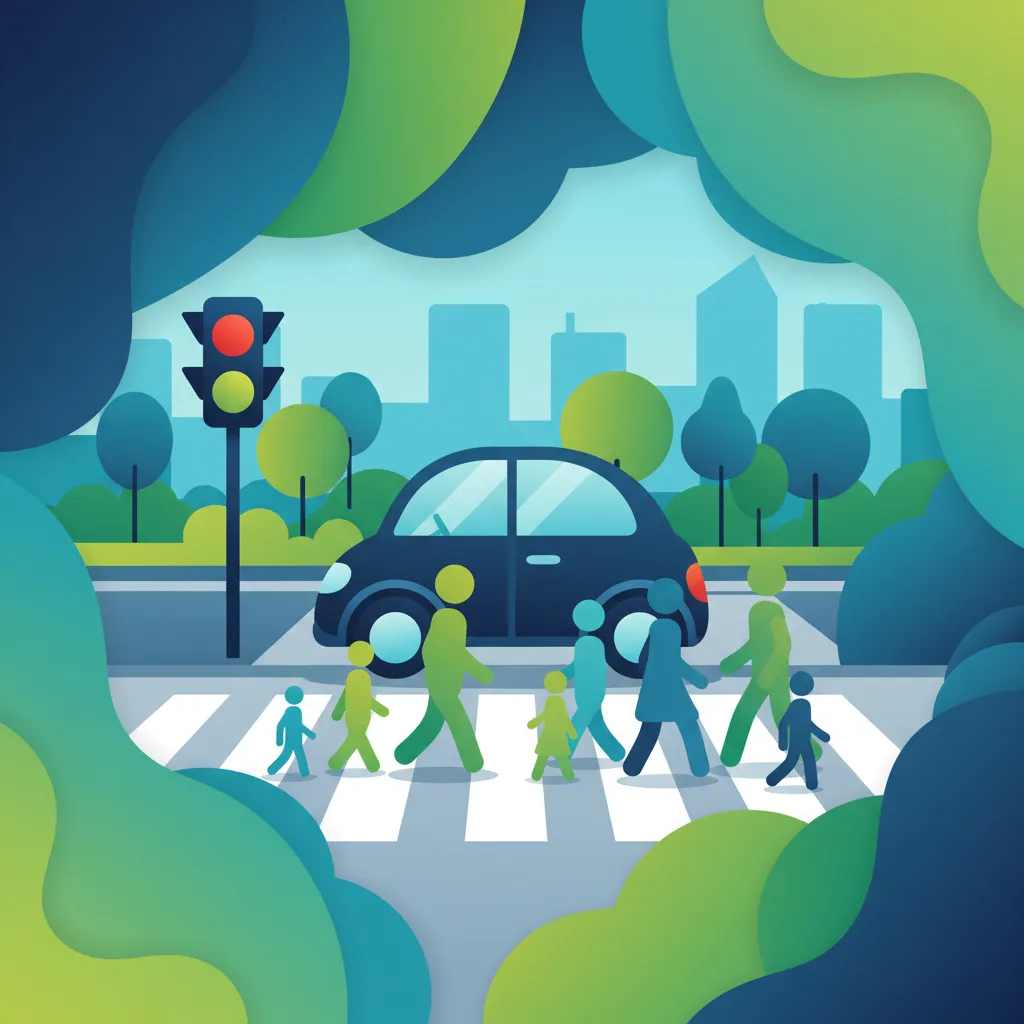
pasos para peatones, commonly identified by white zebra stripes across the road, mandate that drivers stop and allow pedestrians who are on the crossing, or clearly intending to cross, to proceed safely.paso para peatones.When Turning into Another Road (Al Girar en una Intersección)
paso para peatones, drivers turning to enter another street (entrar en otra vía) must yield to pedestrians who are already crossing that street, or beginning to cross it.Within Designated Pedestrian Zones (Zonas Peatonales)
zonas peatonales, drivers are obliged to yield to any pedestrian circulating within them.aceras). If parked on a sidewalk, this forces pedestrians into the roadway, increasing danger.At Bus Stops (Paradas de Transporte Colectivo de Viajeros)
parada señalizada). This applies when these pedestrians are moving between the vehicle and the nearest sidewalk or safety refuge.Crossing Hard Shoulders (Arcenes)
arcén) that is being used by pedestrians (and there isn't a dedicated pedestrian zone), the driver must yield to those pedestrians. This is more common on rural roads where pedestrians may use the arcén for safety.It's vital to understand the nuance:
pasos para peatones, priority is clear. However, the rule about turning at intersections extends pedestrian priority even to unmarked crossing points. This is a common area of DGT exam questions.DGT learners frequently make errors related to pedestrian priority:
pasos para peatones are the only place to yield. The rules for turning at intersections and bus stops are often overlooked.parada señalizada. As the bus doors open, people start to alight and walk towards the pavement. You must stop and wait until these passengers have safely reached the zona peatonal before proceeding, even if they are not on a paso para peatones.zona residencial or zona 30 where vehicles have limited access. Pedestrians are walking freely in the street. You must drive slowly, be constantly vigilant, and yield to any pedestrian, treating the entire area as a potential pedestrian crossing point.In Spain, the core principle regarding pedestrian priority is the driver's ultimate responsibility towards vulnerable road users. Always adopt a defensive driving mindset:
Mastering pedestrian priority rules in the Spanish context is fundamental not only for passing your DGT theory exam but, more importantly, for ensuring the safety of everyone on carreteras españolas.
Pedestrian priority rules under Spanish DGT regulations establish specific situations where drivers must yield to people on foot, extending beyond marked crossings to include turning at intersections, bus stops, pedestrian zones, and hard shoulders. Article 65 of the Reglamento General de Circulación makes these yielding obligations legally binding, with drivers bearing ultimate responsibility for preventing harm to vulnerable road users. The DGT exam frequently tests candidates on the distinction between marked and unmarked crossing obligations, particularly regarding turning scenarios. A defensive driving mindset—anticipating pedestrians, observing constantly, and being prepared to stop—forms the practical foundation for both exam success and safe driving on Spanish roads.
A short set of high-value points that capture the most important ideas from this theory explanation.
Pedestrian priority applies not only at marked crossings but also when drivers turn into a road where pedestrians are already crossing or beginning to cross
Drivers must yield to passengers getting on or off public transport at designated bus stops, even without a marked crossing present
In pedestrian zones (zonas peatonales), drivers must yield to any pedestrian circulating within the area, not just at specific crossing points
The driver's ultimate responsibility is to prevent harm to pedestrians, regardless of whether the pedestrian technically has priority in that spot
Drivers must yield when crossing hard shoulders (arcenes) being used by pedestrians on rural roads
Marked pedestrian crossings (pasos para peatones) are the primary locations where drivers must stop for pedestrians with white zebra stripes
At unmarked intersections, the obligation to yield to crossing pedestrians still applies when a driver is turning into another road
Bus stop (parada señalizada) yielding applies when pedestrians are moving between the vehicle and the nearest sidewalk or safety refuge
The DGT differentiates between the general vehicle priority on carriageways and the specific exceptions created by pedestrian priority rules
Drivers hold primary responsibility for preventing accidents with pedestrians, even when pedestrians also have duties under traffic law
Assuming pedestrian priority only exists at marked zebra crossings and overlooking intersection turning rules
Failing to anticipate pedestrians near busy intersections, shops, and public transport areas where they may step out unexpectedly
When turning, focusing only on vehicle traffic and missing pedestrians crossing the street being entered, especially in larger vehicles with blind spots
Misjudging pedestrian intent by assuming someone standing near a crossing will wait rather than crossing
Not reducing speed sufficiently when approaching potential conflict points, leaving insufficient reaction time
Start with a short, direct summary of Pedestrian Priority Rules before reading the full explanation below.
Pedestrian priority in Spain means drivers must yield to pedestrians in specific situations, primarily at marked pedestrian crossings ('pasos para peatones'), when turning into a road where pedestrians are already crossing, and within designated pedestrian zones. These rules are fundamental for road safety, ensuring that drivers prioritize the protection of vulnerable road users according to DGT regulations.
Review the most important terms, rule signals, and traffic concepts linked to Pedestrian Priority Rules.
Explore related theory topic pages connected to Pedestrian Priority Rules and continue with the next useful rule explanation.
See the common search queries learners use when trying to understand Pedestrian Priority Rules in Spain.

Continue your preparation by exploring specific Spanish driving theory topics in depth. Review road signs, understand priority rules, and master DGT traffic laws. This section provides the essential knowledge to pass your exam and drive safely across Spain.
Explore Spanish Driving Theory TopicsTheory topic content overview
A short set of high-value points that capture the most important ideas from this theory explanation.
Pedestrian priority applies not only at marked crossings but also when drivers turn into a road where pedestrians are already crossing or beginning to cross
Drivers must yield to passengers getting on or off public transport at designated bus stops, even without a marked crossing present
In pedestrian zones (zonas peatonales), drivers must yield to any pedestrian circulating within the area, not just at specific crossing points
The driver's ultimate responsibility is to prevent harm to pedestrians, regardless of whether the pedestrian technically has priority in that spot
Drivers must yield when crossing hard shoulders (arcenes) being used by pedestrians on rural roads
Marked pedestrian crossings (pasos para peatones) are the primary locations where drivers must stop for pedestrians with white zebra stripes
At unmarked intersections, the obligation to yield to crossing pedestrians still applies when a driver is turning into another road
Bus stop (parada señalizada) yielding applies when pedestrians are moving between the vehicle and the nearest sidewalk or safety refuge
The DGT differentiates between the general vehicle priority on carriageways and the specific exceptions created by pedestrian priority rules
Drivers hold primary responsibility for preventing accidents with pedestrians, even when pedestrians also have duties under traffic law
Assuming pedestrian priority only exists at marked zebra crossings and overlooking intersection turning rules
Failing to anticipate pedestrians near busy intersections, shops, and public transport areas where they may step out unexpectedly
When turning, focusing only on vehicle traffic and missing pedestrians crossing the street being entered, especially in larger vehicles with blind spots
Misjudging pedestrian intent by assuming someone standing near a crossing will wait rather than crossing
Not reducing speed sufficiently when approaching potential conflict points, leaving insufficient reaction time
Start with a short, direct summary of Pedestrian Priority Rules before reading the full explanation below.
Pedestrian priority in Spain means drivers must yield to pedestrians in specific situations, primarily at marked pedestrian crossings ('pasos para peatones'), when turning into a road where pedestrians are already crossing, and within designated pedestrian zones. These rules are fundamental for road safety, ensuring that drivers prioritize the protection of vulnerable road users according to DGT regulations.
Review the most important terms, rule signals, and traffic concepts linked to Pedestrian Priority Rules.
Explore related theory topic pages connected to Pedestrian Priority Rules and continue with the next useful rule explanation.
See the common search queries learners use when trying to understand Pedestrian Priority Rules in Spain.
Continue your preparation by exploring specific Spanish driving theory topics in depth. Review road signs, understand priority rules, and master DGT traffic laws. This section provides the essential knowledge to pass your exam and drive safely across Spain.
Explore Spanish Driving Theory TopicsUse this exam-focused revision tip to understand how Pedestrian Priority Rules is likely to appear in theory questions for learners in Spain. This section helps you identify the most testable part of the rule, avoid common traps, and remember the concept more effectively during Spanish driving theory exam preparation.
The DGT exam frequently tests your understanding of pedestrian priority, especially at unmarked turns and bus stops. Always assume pedestrians are vulnerable and be prepared to stop, even if it seems they are not explicitly on a marked crossing. Focus on defensive driving scenarios and the driver's ultimate responsibility to prevent harm to those on foot.
Read direct answers to the most common learner questions about Pedestrian Priority Rules in Spain. This FAQ focuses on rule confusion, practical meaning, comparison with similar concepts, and the exact uncertainties that appear most often in Spanish driving theory revision and exam preparation.
Pedestrians always have priority at duly marked pedestrian crossings ('pasos para peatones') and when crossing a road into which a vehicle is turning, even if there is no specific marking.
It's a marked area, often with white stripes (zebra crossing), where pedestrians have priority to cross the road, and drivers must stop to let them pass. When regulated by traffic lights, drivers must obey the light signals.
You must slow down and be prepared to stop if pedestrians are on the crossing or clearly intending to cross. It's about ensuring safety and yielding when they have preference, avoiding any risk to them.
If you are turning with your vehicle to enter another road and there are pedestrians crossing it, you must yield to them, even if there is no specific marked crossing for them.
No, generally drivers are prohibited from circulating on sidewalks or dedicated pedestrian zones. If vehicles cross pedestrian zones via enabled passages, drivers must yield to pedestrians circulating within them.
Drivers must yield to pedestrians who are boarding or alighting from public transport at a marked stop, especially if they are moving between the vehicle and the nearest pedestrian zone or refuge.
Yes, generally vehicles have priority over pedestrians unless one of the specific exceptions (like marked crossings, turning into a street, or pedestrian zones) applies, as detailed in Article 65 of Spanish traffic regulations.
The DGT exam frequently assesses your understanding of situations involving vulnerable road users. Questions often test your ability to identify priority scenarios and your responsibility as a driver to prevent accidents involving pedestrians, especially in contexts like turns or crossings.
Use our powerful search functionality to pinpoint specific Spanish DGT driving theory practice sets. Filter by road sign categories, traffic law topics, or question difficulty to build custom study sessions and reinforce your knowledge precisely where it matters for your official exam.