
Stopping distance is the total distance your vehicle travels from the moment you detect a hazard until it comes to a complete stop. This includes two critical phases: reaction distance and braking distance. Mastering this concept is fundamental for hazard perception, maintaining safe following distances, and successfully navigating traffic in Spain, especially given varied road conditions and speed limits.
Theory topic content overview
Read the full theory topic guide for Stopping Distance Explained with structured, easy-to-scan content built for learners in Spain. This detailed section explains the exact rule, meaning, traffic context, comparison points, and exam logic behind this Spanish driving theory topic so you can study faster, understand the concept more clearly, and avoid common interpretation mistakes on the theory test.
Stopping distance (distancia de detención) is one of the most fundamental concepts in Spanish driving theory, crucial for both passing your DGT exam and ensuring safety on carreteras españolas. It represents the total distance your vehicle travels from the very moment you detect a hazard until it comes to a complete halt. This single measurement is a compound of two distinct, yet interconnected, phases: reaction distance and braking distance.
Mastering the difference between these components and understanding the factors that influence them is not just about answering exam questions; it's about anticipating dangers, maintaining appropriate distancia de seguridad, and preventing collisions in real-world traffic scenarios across Spain.
To truly grasp stopping distance, it's essential to break it down into its two primary components:
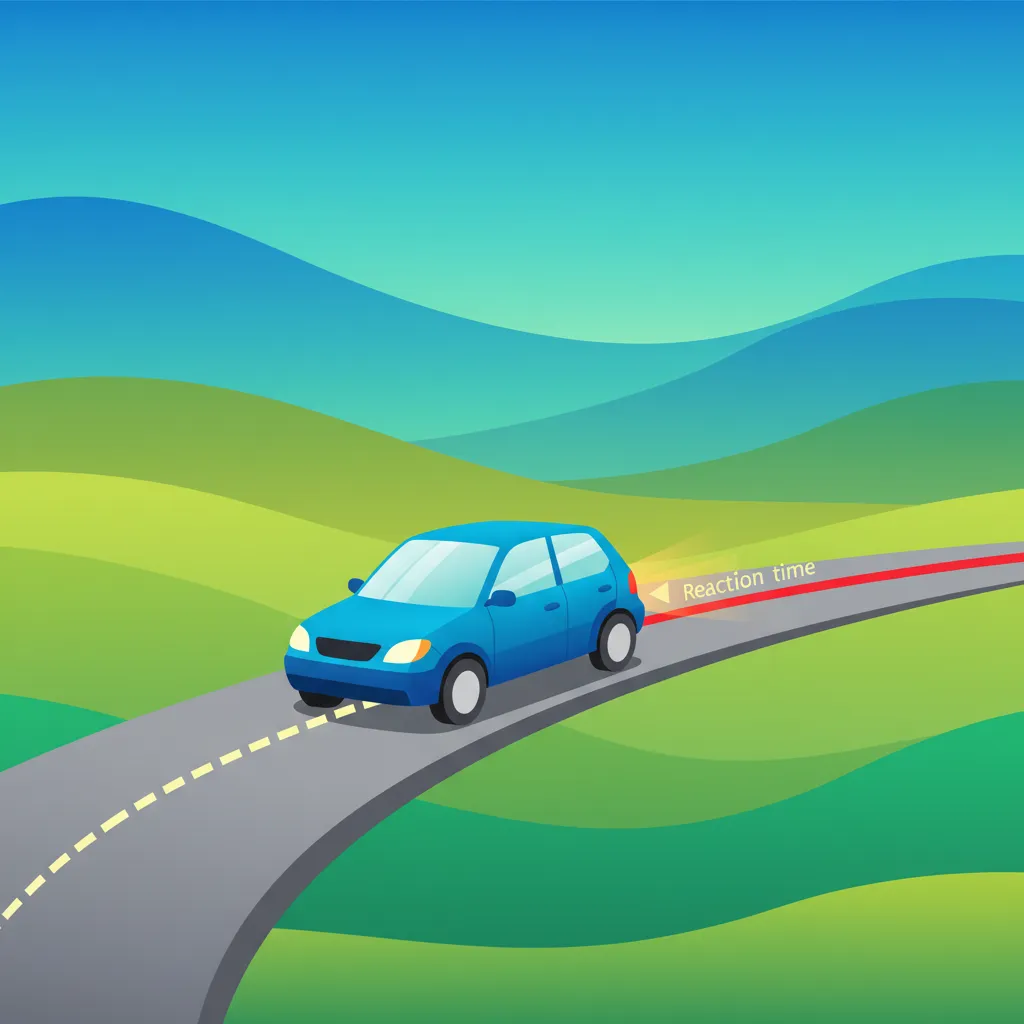
This is the distance your vehicle covers from the moment you perceive a hazard (e.g., a child running into the road, traffic lights turning red) until you actually begin to apply the brakes. During this phase, you are processing information, deciding on a course of action, and moving your foot from the accelerator to the brake pedal.
This is the distance your vehicle travels from the moment you start applying the brakes until the vehicle comes to a complete stop. This phase is about the vehicle's ability to shed speed, controlled by the friction between your tires and the road surface, and the efficiency of your braking system.
Understanding stopping distance (distancia de detención) is not an abstract theoretical exercise. It's the foundation for several critical aspects of safe driving and is heavily emphasized in the DGT theory test.
reaction distance.autovías to wet mountain carreteras convencionales or even ice in winter. A strong understanding of stopping distance allows you to adjust your speed and following distance accordingly.One of the most critical aspects of stopping distance, frequently tested by the DGT, is its relationship with speed. This relationship is not linear, particularly for braking distance.
Reaction distance increases proportionally with speed. If you double your speed, you will cover double the distance during your reaction time.Braking distance increases roughly with the square of your speed. This means if you double your speed (e.g., from 50 km/h to 100 km/h), your braking distance doesn't just double; it can quadruple (2x2 = 4).This principle is fundamental: higher speed means significantly longer stopping distances.
Beyond speed, several other elements can critically extend your distancia de detención. Awareness of these factors is vital for adapting your driving behaviour in Spain.
Distancia de Reacción and overall perception)Distancia de Frenado)Distancia de Frenado)carretera mojada): Braking distance can double compared to dry roads.hielo en la calzada): Braking distance can increase tenfold.Consider these common scenarios on Spanish roads where understanding stopping distance is vital:
autovía surface is wet, your braking distance could easily double. This means your total stopping distance could now be 150-180 metres or more. If you're following a vehicle too closely, your chance of a collision is extremely high.Paso de Peatones) in a Town (Población): You're driving through a town where the speed limit is 50 km/h. A pedestrian unexpectedly steps onto a paso de peatones. Even if your reaction time is quick (say, 0.75 seconds), you'll cover several meters before your brakes even engage. If the road is cobbled or slightly wet, your braking distance will be longer than on smooth, dry asphalt, potentially leading to a critical situation.Carretera Convencional): On a carretera convencional with winding sections, visibility can be limited. If you come around a bend and find a stationary obstacle or an animal, your reaction distance is dictated by how quickly you spot it and react. Your braking distance then depends on your speed, the road surface (which might be less maintained than an autovía), and your vehicle's condition. Always adaptar la velocidad (adapt your speed) to visibility and road conditions.The DGT exam frequently targets common misconceptions about stopping distance. Be aware of these pitfalls:
distancia de frenado is the total distance. Remember, it's always distancia de reacción + distancia de frenado.reaction distance. The DGT heavily emphasizes the human factor in accidents.The core lesson from stopping distance is that you must always drive at a speed that allows you to stop safely within the visible, clear distance ahead. This principle underpins hazard perception and safe following distances, which are key for passing your Spanish driving test and becoming a responsible driver.
Remember:
distancia de seguridad accordingly, especially in adverse weather or heavy traffic on carreteras españolas.Stopping distance in Spanish driving theory consists of two phases: reaction distance (travelled while perceiving and responding to a hazard) and braking distance (travelled while the brakes actually slow the vehicle). The critical principle learners must grasp is that while reaction distance grows proportionally with speed, braking distance grows with the square of speed — meaning doubling your speed can quadruple your total stopping distance. Beyond speed, stopping distance is heavily influenced by driver state, vehicle condition, road surface, and weather, making it essential to constantly adapt speed and following distance to conditions on Spanish roads. This concept is a frequent DGT exam topic and the foundation for safe hazard perception and legal following distance requirements.
A short set of high-value points that capture the most important ideas from this theory explanation.
Stopping distance is the sum of reaction distance (perceiving and reacting) plus braking distance (actual deceleration to a stop)
Braking distance increases with the square of speed, not proportionally — doubling your speed can quadruple braking distance
Reaction distance increases linearly with speed and is entirely driver-dependent, averaging 0.75 to 1 second for a focused driver
Road conditions dramatically affect braking distance — wet roads can double it, ice can increase it tenfold
Safe following distance in Spain must always account for your total stopping distance, not just braking distance
Reaction Distance = Speed × Reaction Time; this phase happens before brakes are even applied
Braking Distance is a physical/mechanical process governed by tire grip, road surface, and vehicle condition
Speed is the single most powerful factor — even small increases cause disproportionately large stopping distance growth
Driver state (fatigue, distraction, alcohol) directly increases reaction distance by slowing perception and response
Total stopping distance = Reaction distance + Braking distance — never one or the other
Confusing braking distance alone with total stopping distance and choosing wrong answers on DGT exam questions
Assuming stopping distance increases only linearly with speed, missing the exponential braking relationship
Thinking fixed stopping distances apply regardless of weather, tire condition, or vehicle load
Focusing only on the vehicle directly ahead instead of scanning further ahead to maximize reaction time
Underestimating how driver condition (fatigue, stress, minor illness) affects reaction distance and hazard perception
Start with a short, direct summary of Stopping Distance Explained before reading the full explanation below.
Stopping distance is the sum of reaction distance (travelled while perceiving and reacting) and braking distance (travelled while the brakes are applied). Factors like speed, driver condition, and road surface significantly influence it, making it critical for safety. In Spain, understanding this concept is vital for passing your DGT theory exam and ensuring responsible driving.
Review the most important terms, rule signals, and traffic concepts linked to Stopping Distance Explained.
Explore related theory topic pages connected to Stopping Distance Explained and continue with the next useful rule explanation.
See the common search queries learners use when trying to understand Stopping Distance Explained in Spain.

Continue your preparation by exploring specific Spanish driving theory topics in depth. Review road signs, understand priority rules, and master DGT traffic laws. This section provides the essential knowledge to pass your exam and drive safely across Spain.
Explore Spanish Driving Theory TopicsTheory topic content overview
A short set of high-value points that capture the most important ideas from this theory explanation.
Stopping distance is the sum of reaction distance (perceiving and reacting) plus braking distance (actual deceleration to a stop)
Braking distance increases with the square of speed, not proportionally — doubling your speed can quadruple braking distance
Reaction distance increases linearly with speed and is entirely driver-dependent, averaging 0.75 to 1 second for a focused driver
Road conditions dramatically affect braking distance — wet roads can double it, ice can increase it tenfold
Safe following distance in Spain must always account for your total stopping distance, not just braking distance
Reaction Distance = Speed × Reaction Time; this phase happens before brakes are even applied
Braking Distance is a physical/mechanical process governed by tire grip, road surface, and vehicle condition
Speed is the single most powerful factor — even small increases cause disproportionately large stopping distance growth
Driver state (fatigue, distraction, alcohol) directly increases reaction distance by slowing perception and response
Total stopping distance = Reaction distance + Braking distance — never one or the other
Confusing braking distance alone with total stopping distance and choosing wrong answers on DGT exam questions
Assuming stopping distance increases only linearly with speed, missing the exponential braking relationship
Thinking fixed stopping distances apply regardless of weather, tire condition, or vehicle load
Focusing only on the vehicle directly ahead instead of scanning further ahead to maximize reaction time
Underestimating how driver condition (fatigue, stress, minor illness) affects reaction distance and hazard perception
Start with a short, direct summary of Stopping Distance Explained before reading the full explanation below.
Stopping distance is the sum of reaction distance (travelled while perceiving and reacting) and braking distance (travelled while the brakes are applied). Factors like speed, driver condition, and road surface significantly influence it, making it critical for safety. In Spain, understanding this concept is vital for passing your DGT theory exam and ensuring responsible driving.
Review the most important terms, rule signals, and traffic concepts linked to Stopping Distance Explained.
Explore related theory topic pages connected to Stopping Distance Explained and continue with the next useful rule explanation.
See the common search queries learners use when trying to understand Stopping Distance Explained in Spain.
Continue your preparation by exploring specific Spanish driving theory topics in depth. Review road signs, understand priority rules, and master DGT traffic laws. This section provides the essential knowledge to pass your exam and drive safely across Spain.
Explore Spanish Driving Theory TopicsUse this exam-focused revision tip to understand how Stopping Distance Explained is likely to appear in theory questions for learners in Spain. This section helps you identify the most testable part of the rule, avoid common traps, and remember the concept more effectively during Spanish driving theory exam preparation.
Remember, the DGT exam often tries to trick you by asking about *only* braking distance or *only* reaction distance. Always consider total stopping distance as the sum of both. Pay close attention to scenario details involving speed, driver state, or road conditions, as these will directly impact the correct answer.
Read direct answers to the most common learner questions about Stopping Distance Explained in Spain. This FAQ focuses on rule confusion, practical meaning, comparison with similar concepts, and the exact uncertainties that appear most often in Spanish driving theory revision and exam preparation.
Reaction distance is the distance covered from noticing a hazard until you apply the brakes. Braking distance is the distance covered from applying the brakes until the vehicle stops completely.
Stopping distance increases exponentially with speed. While reaction distance increases proportionally, braking distance increases with the square of speed, meaning higher speeds require significantly more distance to stop.
Key factors include driver condition (fatigue, distraction, alcohol), vehicle condition (tires, brakes, load), and road conditions (wet, icy, gravel, worn pavement).
The DGT exam frequently tests your knowledge of stopping distance, its components, and the factors that influence it, often in scenario-based questions related to safety and hazard avoidance.
"Distancia de detención" is the Spanish term for total stopping distance, which is the sum of "distancia de reacción" (reaction distance) and "distancia de frenado" (braking distance).
Wet roads drastically increase braking distance because they reduce tire grip. On a wet surface, your braking distance can be double or more compared to dry conditions, and much more on ice.
Use our powerful search functionality to pinpoint specific Spanish DGT driving theory practice sets. Filter by road sign categories, traffic law topics, or question difficulty to build custom study sessions and reinforce your knowledge precisely where it matters for your official exam.