
Right of way, or "prioridad de paso" in Spain, dictates which road user has the legal right to proceed first when paths conflict. This fundamental principle prevents collisions and ensures smooth traffic flow. Understanding the precise hierarchy of rules – from traffic agents to general norms – is vital for every driver navigating Spanish roads.
Theory topic content overview
Read the full theory topic guide for Spanish Priority Rules with structured, easy-to-scan content built for learners in Spain. This detailed section explains the exact rule, meaning, traffic context, comparison points, and exam logic behind this Spanish driving theory topic so you can study faster, understand the concept more clearly, and avoid common interpretation mistakes on the theory test.
Prioridad de Paso) in Spanish TrafficIn Spain, right of way, known as prioridad de paso, is a fundamental concept that dictates which road user has the legal right to proceed first when their paths converge or conflict. Mastering these rules is not just about avoiding fines; it's critical for preventing accidents, ensuring smooth traffic flow, and is a frequently tested area on the Dirección General de Tráfico (DGT) theory exam. Every driver must understand and apply these rules consistently to navigate Spanish roads safely.
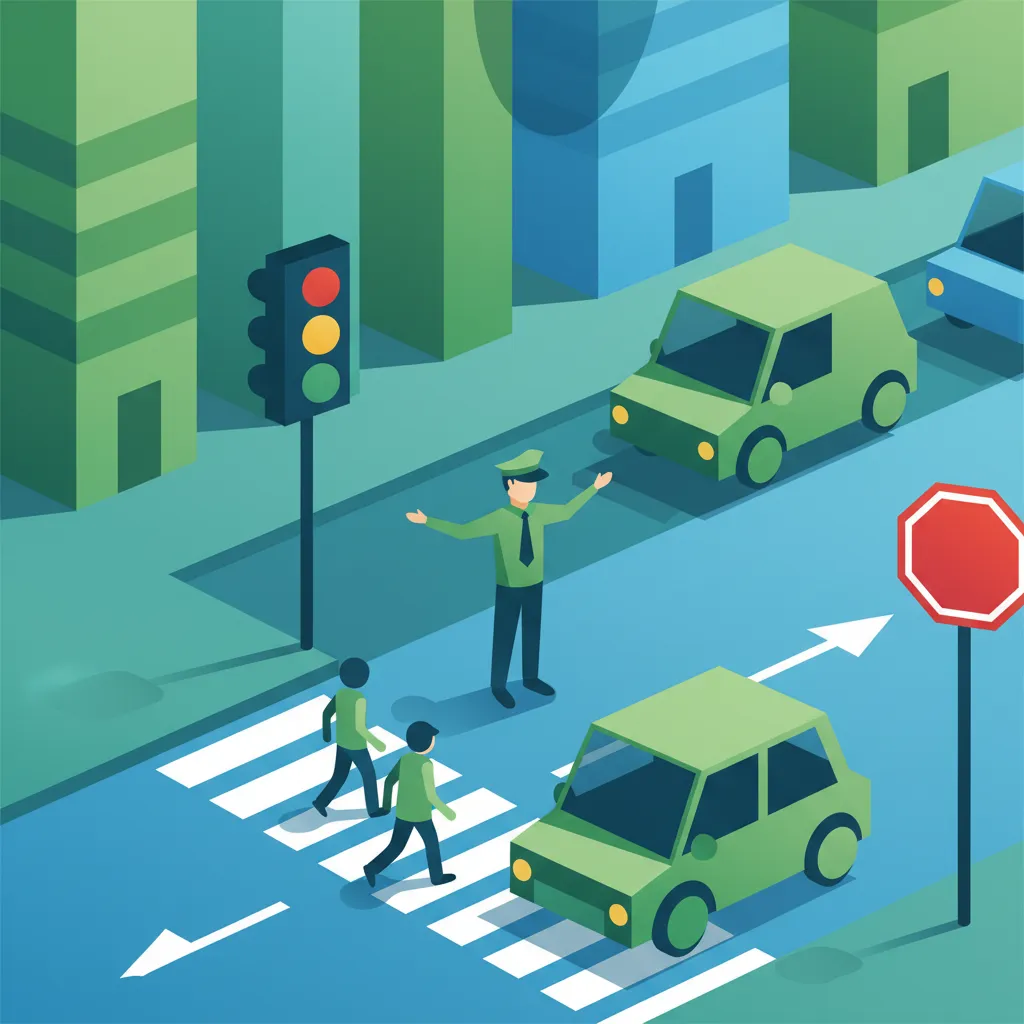
The DGT establishes a clear, hierarchical order for determining prioridad de paso. When multiple forms of regulation are present, drivers must always obey the highest authority first. A common and crucial mnemonic for DGT learners is "Abajo se ve el mar":
Agentes de Tráfico (Traffic Agents): The signals and instructions given by a traffic police officer or agente de tráfico always override all other signs, signals, or rules. Their directions must be obeyed immediately.
agente directs you to proceed through a red light, you must follow the agente's instruction.Semáforos (Traffic Lights): Functional traffic lights take precedence over vertical signs and road markings.
STOP sign is also present at the intersection. However, a flashing yellow light (caution, yield) or a flashing white light (stop, like a fixed yellow light) indicates that other priority rules, usually vertical signs or general rules, must then be observed.Señales Verticales (Vertical Signs): Fixed road signs, such as STOP, Ceda el paso (Give Way), or Calzada con prioridad (Road with Priority), come next in the hierarchy. These signs determine priority where traffic lights are absent or not functioning, or when a flashing light directs drivers to observe signs.
STOP sign means you must stop completely and yield to all cross-traffic.Marcas Viales (Road Markings): Lines and symbols painted on the road surface, such as líneas de detención (stop lines), pasos de cebra (zebra crossings), or flechas de dirección, provide priority instructions. They are subservient to agents, lights, and vertical signs.
línea de detención at a STOP sign indicates where you must stop. A paso de cebra gives priority to pedestrians.Intersecciones sin Señalizar)When an intersection in Spain lacks any of the above regulatory elements (no agents, no traffic lights, no vertical signs, and no relevant road markings), general rules apply.
Regla de la Derecha): Vehicles approaching from the right typically have priority. Drivers must yield to traffic coming from their right.Glorietas): Vehicles already inside a roundabout always have priority over those attempting to enter it. This is a very common DGT exam question and practical scenario in Spain.vehículos prioritarios) operating in an urgent service have priority, but only if they pose no danger to other road users.carril de aceleración) must yield to traffic already on the main road.In Spain, vulnerable road users, especially pedestrians and cyclists, have specific protections:
Pasos de Cebra): Drivers must yield to pedestrians who are on or clearly about to step onto a designated paso de cebra.Glorietas)Roundabouts are prevalent in Spain. The cardinal rule is that vehicles already circulating within the roundabout have priority over any vehicle trying to enter it. Drivers entering a roundabout must look for safe gaps and yield. When exiting, drivers should signal their exit once past the preceding exit and ensure no conflict with other lanes or vulnerable users.
Estrechamientos)When two vehicles meet on a narrow section of road or where an obstruction exists, specific rules or signs apply:
Paso estrecho con prioridad (R-5, square blue sign with white arrows) indicates you have priority. Ceda el paso en estrechamiento (R-6, circular sign with red border and black arrows) means you must yield.STOP vs. Ceda el paso: A STOP sign (R-2) requires a complete stop before the stop line (or intersection if no line) and yielding to all cross-traffic. A Ceda el paso (R-1) sign means you must yield to cross-traffic but are not required to stop if the way is clear and you can proceed safely without forcing others to change speed or direction. The DGT tests this distinction rigorously.STOP: If, after stopping at a STOP line, visibility is insufficient, you must advance cautiously and make a second stop at a point where you have a clear view, without endangering others.glorieta without correctly yielding to traffic already inside is a frequent error.When approaching any conflict point on Spanish roads, adopt a systematic approach:
agentes de tráfico directing traffic? Follow their instructions.señales verticales such as STOP, Ceda el paso, or Calzada con prioridad? Observe them.marcas viales that indicate priority (e.g., líneas de detención, pasos de cebra)?Always drive defensively, even when you have priority. Be prepared for other road users to make mistakes or misinterpret the rules. Your primary goal is always safety, not just asserting your right of way.
The "Abajo se ve el mar" hierarchy is your most powerful tool for DGT exam questions on prioridad de paso. Memorize it and understand the nuances of each level, especially the distinctions between STOP and Ceda el paso, and the specific rules for roundabouts, pedestrians, and unmarked intersections in Spain. Always prioritize safety and anticipate the actions of others, even when you technically have the right of way.
In Spain, right of way follows a strict hierarchy: agents of traffic, then traffic lights, then vertical signs, and finally road markings. The mnemonic 'Abajo se ve el mar' (A-Agentes, Se-Semáforos, Ve-Verticales, Mar-Marcas) helps recall this order for the DGT exam. At unmarked intersections, the rule of the right generally applies, but exceptions exist for paved versus unpaved roads, roundabouts, and special vehicles. A crucial distinction exists between STOP signs, which require a complete stop, and 'Ceda el paso' signs, which only require yielding. Drivers must also always yield to vulnerable road users including pedestrians on zebra crossings and when turning, as well as cyclists and disabled pedestrians.
A short set of high-value points that capture the most important ideas from this theory explanation.
Right of way in Spain follows the fixed hierarchy: Traffic Agents → Traffic Lights → Vertical Signs → Road Markings, known as 'Abajo se ve el mar'
At unmarked intersections without any signals or signs, vehicles approaching from the right have priority (Rule of the Right)
A STOP sign requires a complete stop and yielding to all cross-traffic, while 'Ceda el paso' only requires yielding without mandatory stopping
Vehicles already inside a roundabout always have priority over those attempting to enter
Drivers must yield to pedestrians on or about to enter a paso de cebra, and also when turning even without a marked crossing
Traffic agents override all other signals; if an agente directs you through a red light, obey the agente
On flashing yellow lights, observe vertical signs and general rules; on flashing white lights, stop as you would for a fixed yellow
The rule of the right does NOT apply when agents, lights, or vertical signs are present
Vehicles on rails (trams) always have priority, and emergency vehicles have priority when operating urgently without danger to others
When two vehicles meet at an unmarked narrowing with no signs, the vehicle that entered first has priority
Assuming the rule of the right applies universally, even when traffic signs or lights are present
Confusing STOP (full stop required) with Ceda el paso (yield only) and applying the wrong procedure
Failing to yield to pedestrians or cyclists when turning, even without a designated crossing
Entering a roundabout without yielding to traffic already circulating inside it
Misinterpreting flashing yellow lights as 'proceed with caution' rather than 'observe other priority rules'
Start with a short, direct summary of Spanish Priority Rules before reading the full explanation below.
In Spain, right of way is determined by a clear hierarchy: traffic agents, then traffic lights, followed by vertical signs, and finally road markings. If none of these are present, general rules apply, often giving priority to vehicles approaching from the right at unmarked intersections. Vulnerable road users like pedestrians often have specific priority at designated crossings or when vehicles are turning. Drivers must always be prepared to yield to prevent accidents.
Review the most important terms, rule signals, and traffic concepts linked to Spanish Priority Rules.
Explore related theory topic pages connected to Spanish Priority Rules and continue with the next useful rule explanation.
See the common search queries learners use when trying to understand Spanish Priority Rules in Spain.

Continue your preparation by exploring specific Spanish driving theory topics in depth. Review road signs, understand priority rules, and master DGT traffic laws. This section provides the essential knowledge to pass your exam and drive safely across Spain.
Explore Spanish Driving Theory TopicsTheory topic content overview
A short set of high-value points that capture the most important ideas from this theory explanation.
Right of way in Spain follows the fixed hierarchy: Traffic Agents → Traffic Lights → Vertical Signs → Road Markings, known as 'Abajo se ve el mar'
At unmarked intersections without any signals or signs, vehicles approaching from the right have priority (Rule of the Right)
A STOP sign requires a complete stop and yielding to all cross-traffic, while 'Ceda el paso' only requires yielding without mandatory stopping
Vehicles already inside a roundabout always have priority over those attempting to enter
Drivers must yield to pedestrians on or about to enter a paso de cebra, and also when turning even without a marked crossing
Traffic agents override all other signals; if an agente directs you through a red light, obey the agente
On flashing yellow lights, observe vertical signs and general rules; on flashing white lights, stop as you would for a fixed yellow
The rule of the right does NOT apply when agents, lights, or vertical signs are present
Vehicles on rails (trams) always have priority, and emergency vehicles have priority when operating urgently without danger to others
When two vehicles meet at an unmarked narrowing with no signs, the vehicle that entered first has priority
Assuming the rule of the right applies universally, even when traffic signs or lights are present
Confusing STOP (full stop required) with Ceda el paso (yield only) and applying the wrong procedure
Failing to yield to pedestrians or cyclists when turning, even without a designated crossing
Entering a roundabout without yielding to traffic already circulating inside it
Misinterpreting flashing yellow lights as 'proceed with caution' rather than 'observe other priority rules'
Start with a short, direct summary of Spanish Priority Rules before reading the full explanation below.
In Spain, right of way is determined by a clear hierarchy: traffic agents, then traffic lights, followed by vertical signs, and finally road markings. If none of these are present, general rules apply, often giving priority to vehicles approaching from the right at unmarked intersections. Vulnerable road users like pedestrians often have specific priority at designated crossings or when vehicles are turning. Drivers must always be prepared to yield to prevent accidents.
Review the most important terms, rule signals, and traffic concepts linked to Spanish Priority Rules.
Explore related theory topic pages connected to Spanish Priority Rules and continue with the next useful rule explanation.
See the common search queries learners use when trying to understand Spanish Priority Rules in Spain.
Continue your preparation by exploring specific Spanish driving theory topics in depth. Review road signs, understand priority rules, and master DGT traffic laws. This section provides the essential knowledge to pass your exam and drive safely across Spain.
Explore Spanish Driving Theory TopicsUse this exam-focused revision tip to understand how Spanish Priority Rules is likely to appear in theory questions for learners in Spain. This section helps you identify the most testable part of the rule, avoid common traps, and remember the concept more effectively during Spanish driving theory exam preparation.
A crucial DGT exam tip for priority is remembering the hierarchy: Agents, Traffic Lights, Vertical Signs, and Road Markings. A common mnemonic in Spain is "Abajo se ve el mar" (Below you see the sea), where A=Agentes, Se=Semáforos, Ve=Verticales, Mar=Marcas. This helps you recall the order of priority quickly in test scenarios.
Read direct answers to the most common learner questions about Spanish Priority Rules in Spain. This FAQ focuses on rule confusion, practical meaning, comparison with similar concepts, and the exact uncertainties that appear most often in Spanish driving theory revision and exam preparation.
In Spain, the hierarchy of priority rules is: 1. Traffic Agents (e.g., police), 2. Traffic Lights, 3. Vertical Road Signs (e.g., STOP, Ceda el Paso), and 4. Road Markings. General rules apply if none of these are present.
At an unmarked intersection in Spain, the general rule is to yield to vehicles approaching from your right, unless specific exceptions apply, such as vehicles on a paved road having priority over those on an unpaved road.
A 'STOP' sign requires you to come to a complete halt before the stop line or intersection, even if there is no traffic. A 'Ceda el Paso' sign requires you to slow down and yield to traffic on the road you are joining or crossing, stopping only if necessary.
In a roundabout in Spain, vehicles already circulating within the roundabout always have priority over vehicles attempting to enter, unless traffic signals or agents indicate otherwise.
Pedestrians typically have priority at designated pedestrian crossings, when crossing a road that a vehicle is turning into, and in pedestrian zones. Drivers must always be vigilant and yield to pedestrians in these situations.
Yes, emergency vehicles (police, ambulance, fire) operating in an urgent service, using their distinctive lights and siren, have priority over all other road users, who must yield the way safely.
Use our powerful search functionality to pinpoint specific Spanish DGT driving theory practice sets. Filter by road sign categories, traffic law topics, or question difficulty to build custom study sessions and reinforce your knowledge precisely where it matters for your official exam.