
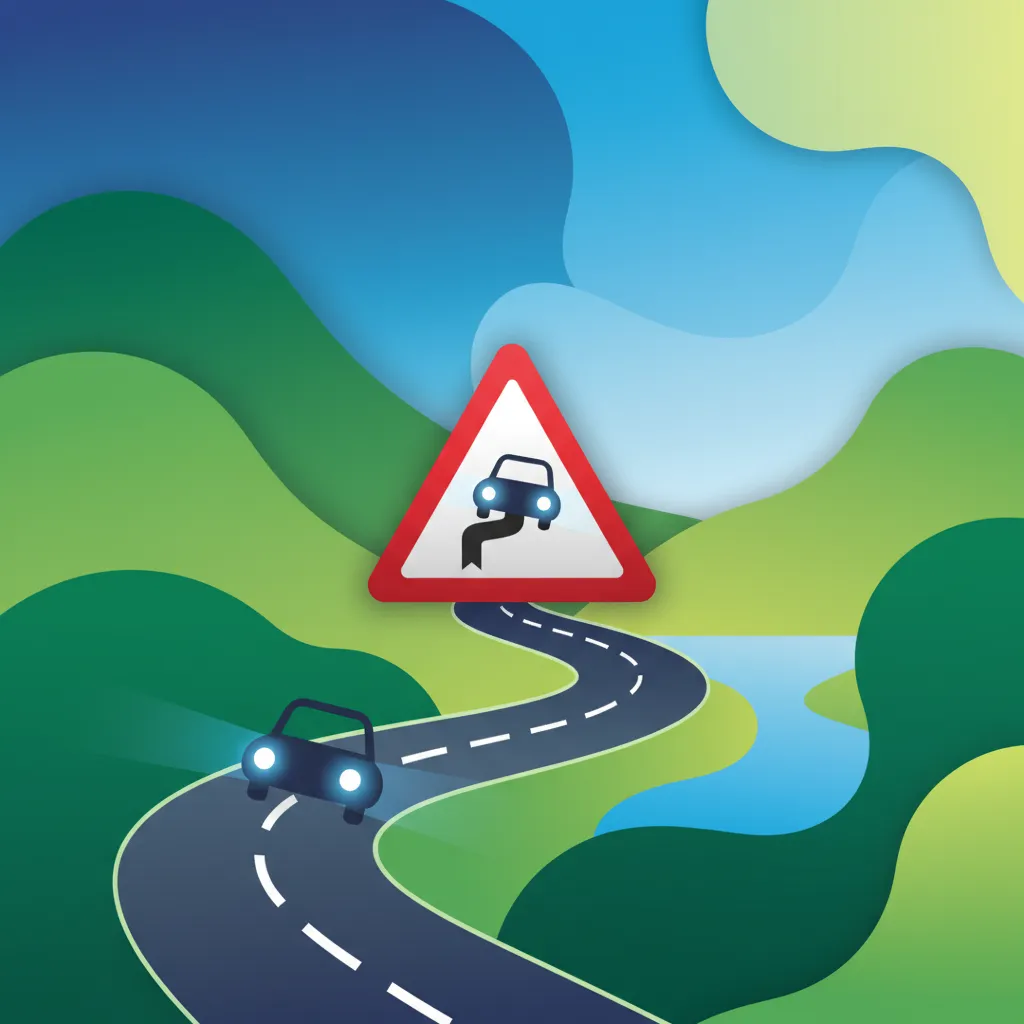
In Spain, warning signs, officially known as 'Señales de Advertencia de Peligro,' play a vital role in road safety by alerting drivers to dangers or special conditions ahead. These signs are designed to give you enough time to react appropriately, whether it means reducing speed, increasing vigilance, or preparing for a specific maneuver. Ignoring them can lead to dangerous situations and jeopardize your safety and that of others.
Theory topic content overview
Read the full theory topic guide for Warning Signs with structured, easy-to-scan content built for learners in Spain. This detailed section explains the exact rule, meaning, traffic context, comparison points, and exam logic behind this Spanish driving theory topic so you can study faster, understand the concept more clearly, and avoid common interpretation mistakes on the theory test.
Warning signs, known in Spanish traffic theory as Señales de Advertencia de Peligro, are crucial road signals designed to alert drivers to the presence of an upcoming hazard or a special road condition that might be difficult to perceive in time otherwise. Their primary purpose is to provide advance notice, giving you sufficient time to react appropriately and adjust your driving behaviour for safety.
According to the Dirección General de Tráfico (DGT), these signs are not regulatory (they don't prohibit or mandate specific actions), but rather informative warnings that demand increased attention and a proactive response. They are a fundamental tool for hazard perception and risk management on Spanish roads.
Visually, most warning signs in Spain, and indeed across Europe, are easily identifiable. They are typically triangular in shape, with a white or yellow background, a prominent red border, and a black pictogram symbolizing the specific danger. When these signs are luminous, the symbols appear illuminated in white on a dark, non-luminous background.
Understanding and correctly interpreting warning signs is paramount for both passing the DGT driving theory exam and for ensuring safety on the diverse road network of Spain.
Warning signs are strategically placed before the actual hazard, providing a critical "window" for drivers to process the information and take action. The typical distance varies based on the type of road and the nature of the hazard, giving more lead time on faster roads.
When you encounter a Señal de Advertencia de Peligro, your mental process should be:
Often, warning signs are accompanied by complementary panels (paneles complementarios) located below the main sign. These panels provide additional information that refines the warning:
It's vital for DGT learners to distinguish between a panel indicating the distance to a hazard and one indicating the length of a hazard, as this impacts how you plan your driving.
The DGT categorizes Señales de Advertencia de Peligro into various types, each with its own specific code (starting with 'P-'). Here are some common categories and examples encountered in Spain:
A common source of confusion for DGT learners is mistaking warning signs for other types of traffic signals.
Remember, a warning sign never gives a direct instruction like "STOP" or "MAX SPEED 50 km/h." Instead, it warns you of a condition that might require you to take such an action.
Let's look at how Señales de Advertencia de Peligro guide driver behaviour:
Many learner drivers make mistakes with warning signs, particularly in the DGT exam:
Warning signs are your advanced notice system on the road. For safe driving in Spain and success in your DGT theory exam, adopt the "Anticipate and Adapt" principle:
Whenever you see a Señal de Advertencia de Peligro, actively consider:
By proactively responding to these crucial DGT warning signs, you'll become a safer, more confident, and more competent driver on Spanish roads.
Spanish warning signs (Señales de Advertencia de Peligro) are triangular signals with red borders that alert drivers to upcoming hazards requiring proactive adaptation rather than direct obedience. They are distinguished from regulatory signs by their shape and purpose, and their meanings can be refined by complementary panels indicating distance or length of the hazard. The DGT codes these signs with 'P-' prefixes across categories including road geometry (P-13, P-14), intersections (P-1 variants, P-2, P-3, P-4), road conditions (P-26, P-33), and vulnerable road users (P-20, P-21, P-22). Mastering these signs requires understanding their visual characteristics, interpreting complementary information correctly, and responding with appropriate speed and attention adjustments before reaching the danger zone.
A short set of high-value points that capture the most important ideas from this theory explanation.
Warning signs in Spain are triangular with a red border, white or yellow background, and black pictograms—they are informative, not regulatory
These signs provide advance notice of hazards difficult to perceive in time, requiring you to anticipate and adapt your driving behaviour
DGT warning signs use codes beginning with 'P-' (e.g., P-13 for curves, P-1 for intersections, P-20 for pedestrians)
Complementary panels below warning signs clarify whether they indicate the distance to a hazard or the length of an affected section
Warning signs demand increased attention and proactive response but do not give direct instructions like STOP or speed limits
Triangular shape + red border = warning sign (Señales de Advertencia de Peligro); circular + red border = prohibitory; blue = mandatory
Complementary panels: a distance value means 'hazard starts in X metres'; a length value means 'hazard lasts for X metres'
P-1 variants (P-1a through P-1e) indicate different intersection priority situations and must be distinguished carefully
P-26 (slippery road) and P-33 (reduced visibility) require context-dependent response—caution level varies with weather conditions
Warning signs require judgment and adaptation, unlike regulatory signs which mandate specific actions
Treating warning signs as optional information rather than a call to action—failing to reduce speed when a slippery road sign is visible
Confusing warning signs with prohibitory regulatory signs—warning signs advise, they do not directly command
Misreading complementary panels by interpreting a length indicator as a distance to the hazard, or vice versa
Generalising all P-1 intersection variants as identical—they each indicate specific priority configurations with different implications
Over-relying on signs alone without considering external factors like weather, time of day, or road conditions when reacting
Start with a short, direct summary of Warning Signs before reading the full explanation below.
Warning signs in Spain are traffic signals, typically triangular with a red border, that alert drivers to the proximity and nature of a hazard difficult to perceive in time. Their primary purpose is to inform you about upcoming road conditions or potential dangers like sharp curves, intersections, or slippery roads, enabling you to adjust your driving behavior proactively and ensure safety. They are not prohibitory but demand increased attention and appropriate action.
Review the most important terms, rule signals, and traffic concepts linked to Warning Signs.
Explore related theory topic pages connected to Warning Signs and continue with the next useful rule explanation.
See the common search queries learners use when trying to understand Warning Signs in Spain.

Continue your preparation by exploring specific Spanish driving theory topics in depth. Review road signs, understand priority rules, and master DGT traffic laws. This section provides the essential knowledge to pass your exam and drive safely across Spain.
Explore Spanish Driving Theory TopicsTheory topic content overview
A short set of high-value points that capture the most important ideas from this theory explanation.
Warning signs in Spain are triangular with a red border, white or yellow background, and black pictograms—they are informative, not regulatory
These signs provide advance notice of hazards difficult to perceive in time, requiring you to anticipate and adapt your driving behaviour
DGT warning signs use codes beginning with 'P-' (e.g., P-13 for curves, P-1 for intersections, P-20 for pedestrians)
Complementary panels below warning signs clarify whether they indicate the distance to a hazard or the length of an affected section
Warning signs demand increased attention and proactive response but do not give direct instructions like STOP or speed limits
Triangular shape + red border = warning sign (Señales de Advertencia de Peligro); circular + red border = prohibitory; blue = mandatory
Complementary panels: a distance value means 'hazard starts in X metres'; a length value means 'hazard lasts for X metres'
P-1 variants (P-1a through P-1e) indicate different intersection priority situations and must be distinguished carefully
P-26 (slippery road) and P-33 (reduced visibility) require context-dependent response—caution level varies with weather conditions
Warning signs require judgment and adaptation, unlike regulatory signs which mandate specific actions
Treating warning signs as optional information rather than a call to action—failing to reduce speed when a slippery road sign is visible
Confusing warning signs with prohibitory regulatory signs—warning signs advise, they do not directly command
Misreading complementary panels by interpreting a length indicator as a distance to the hazard, or vice versa
Generalising all P-1 intersection variants as identical—they each indicate specific priority configurations with different implications
Over-relying on signs alone without considering external factors like weather, time of day, or road conditions when reacting
Start with a short, direct summary of Warning Signs before reading the full explanation below.
Warning signs in Spain are traffic signals, typically triangular with a red border, that alert drivers to the proximity and nature of a hazard difficult to perceive in time. Their primary purpose is to inform you about upcoming road conditions or potential dangers like sharp curves, intersections, or slippery roads, enabling you to adjust your driving behavior proactively and ensure safety. They are not prohibitory but demand increased attention and appropriate action.
Review the most important terms, rule signals, and traffic concepts linked to Warning Signs.
Explore related theory topic pages connected to Warning Signs and continue with the next useful rule explanation.
See the common search queries learners use when trying to understand Warning Signs in Spain.
Continue your preparation by exploring specific Spanish driving theory topics in depth. Review road signs, understand priority rules, and master DGT traffic laws. This section provides the essential knowledge to pass your exam and drive safely across Spain.
Explore Spanish Driving Theory TopicsUse this exam-focused revision tip to understand how Warning Signs is likely to appear in theory questions for learners in Spain. This section helps you identify the most testable part of the rule, avoid common traps, and remember the concept more effectively during Spanish driving theory exam preparation.
In the DGT exam, pay close attention to the specific symbol on each triangular warning sign. Many learners confuse similar-looking signs, especially those for different types of intersections or animal crossings. Always consider the context of the hazard and how it demands a change in your speed or attention, not just what the sign looks like.
Read direct answers to the most common learner questions about Warning Signs in Spain. This FAQ focuses on rule confusion, practical meaning, comparison with similar concepts, and the exact uncertainties that appear most often in Spanish driving theory revision and exam preparation.
The main purpose of warning signs (Señales de Advertencia de Peligro) in Spain is to inform drivers about the proximity and nature of a hazard that might not be easily perceived in time, allowing them to adapt their driving behaviour and take necessary precautions.
Most Spanish warning signs are triangular with a red border and a white background, featuring a black symbol representing the specific hazard. This design makes them easily recognizable as alerts for danger.
Upon seeing a warning sign, a driver should immediately assess the indicated hazard and adjust their speed, position, and attention accordingly. For instance, a curve warning sign means slowing down before the bend, while a pedestrian crossing sign requires increased vigilance for people.
No, warning signs themselves do not directly impose obligations or prohibitions. Their function is purely informative, alerting drivers to a situation that requires a change in driving behavior, but they don't carry the force of a regulatory or prohibitory sign.
Common hazards include sharp curves, steep descents, intersections, pedestrian crossings, level crossings, falling rocks, narrow roads, slippery surfaces, and areas with children or animals. Each hazard has a specific symbol on the sign.
A 'panel complementario' (complementary panel) is an additional sign placed below a warning sign. It provides further details, such as the distance to the hazard or the length of the road section affected by the danger, like a series of curves or a long stretch of bad road.
Yes, warning signs are very important for the DGT driving exam. Questions often test your ability to identify different warning signs, understand their specific meaning, and know the appropriate reaction a driver should take to the indicated hazard.
Use our powerful search functionality to pinpoint specific Spanish DGT driving theory practice sets. Filter by road sign categories, traffic law topics, or question difficulty to build custom study sessions and reinforce your knowledge precisely where it matters for your official exam.