
This unit equips you with the essential technical skills for safely manoeuvring large passenger vehicles in Switzerland. Covering complex turns, blind spot management, precise reversing, and the specific challenges of driving with trailers (D1E/DE), this section is crucial for passing your Category D theory exam and ensuring passenger safety.
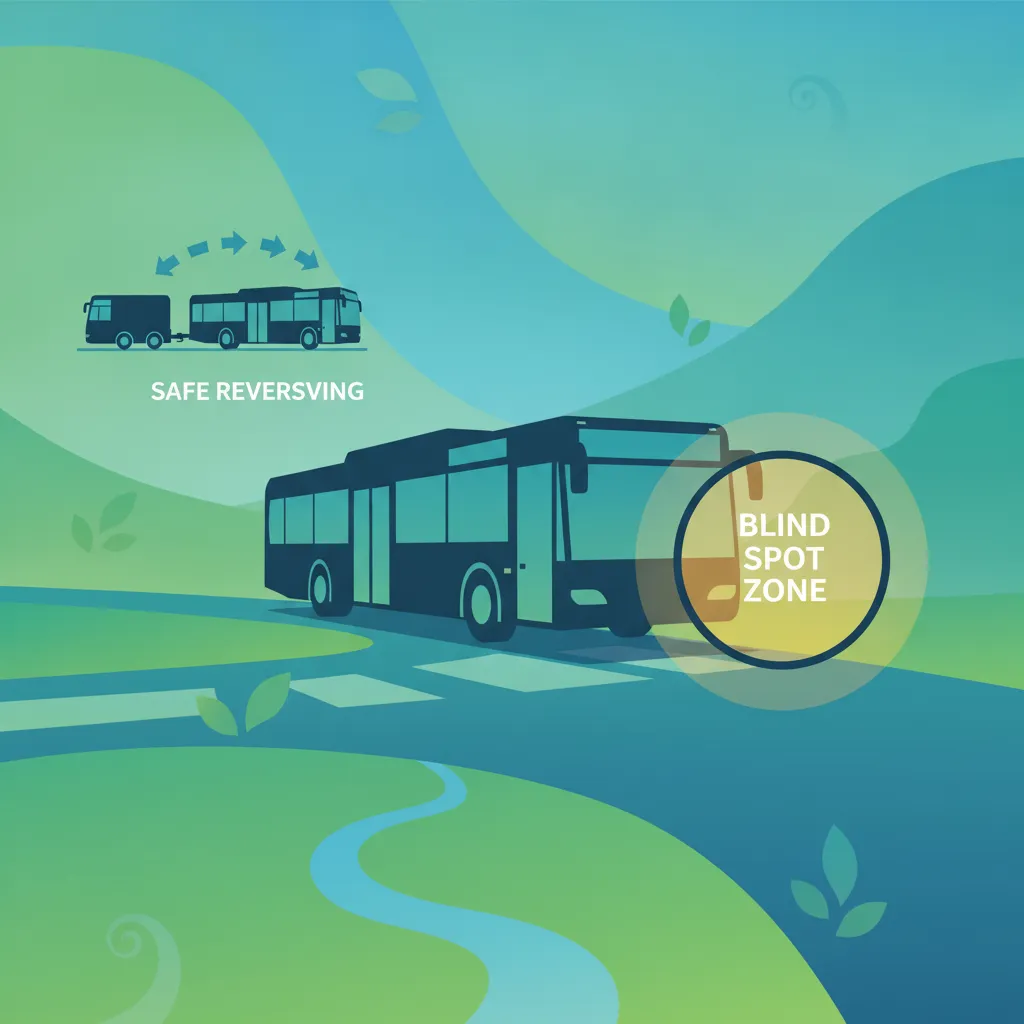
Browse all lessons that make up Advanced Manoeuvring: Turns, Blind Spots, Reversing, and Vehicle Combinations. Each lesson focuses on specific topics, learning objectives, and core concepts, helping you build essential knowledge and follow a clear, structured progression toward your study goals in Switzerland.
When a long vehicle turns, the rear wheels follow a shorter path than the front wheels (swept path), and the rear of the vehicle swings outwards (tail swing). This lesson explains these critical concepts. You will learn how to position the vehicle before a turn to avoid mounting the kerb or striking objects like signs and pedestrians with the rear corner.
Buses and coaches have significant blind spots to the front, sides, and rear. This lesson maps out these 'no-zones' and teaches a continuous and active scanning process using all available mirrors and direct vision. The goal is to minimize the time any other road user spends undetected in a blind spot.
Passenger vehicles are equipped with multiple mirrors, each designed for a specific purpose. This lesson explains how to correctly use standard, wide-angle, and kerb-side mirrors to build a complete picture of the surroundings. It also covers how modern camera systems supplement, but do not replace, the fundamental skill of effective mirror use.
Reversing is the most dangerous manoeuvre a large vehicle can perform and should be avoided whenever possible. This lesson details a safe system of work for when reversing is unavoidable. It covers the importance of a 360-degree check before starting, the use of a banksman, and how to interpret standard hand signals.
Terminals and depots are busy environments with other large vehicles, maintenance staff, and cleaning crews. This lesson focuses on the specific hazards present in these off-road locations. It emphasizes adherence to site-specific rules, maintaining low speeds, and being highly aware of people working around vehicles.
Adding a trailer (D1E) or driving an articulated bus (DE) changes the vehicle's dynamics significantly. This lesson covers the key differences in handling, braking, and reversing. It explains the concept of the pivot point and how to manage the increased length and swept path when turning and manoeuvring.
Explore high-intent keywords and long-tail search topics learners use when researching Advanced Manoeuvring: Turns, Blind Spots, Reversing, and Vehicle Combinations. These terms reflect how people search for reliable study materials, structured explanations, and unit-level theory preparation support in Switzerland.
Find clear answers to the most common questions learners ask about Advanced Manoeuvring: Turns, Blind Spots, Reversing, and Vehicle Combinations. Understand how the unit is organized, what learning goals it supports, and how it contributes to your study progression with structured explanations and practical guidance tailored for learners in Switzerland.
Swept path refers to the area around a vehicle that is traversed by its body and wheels during a turn. For large vehicles like buses and coaches in Switzerland, understanding this is critical to avoid collisions with curbs, other vehicles, or pedestrians. It's a key concept tested in the Category D theory exam.
Managing blind spots involves a combination of using your mirrors correctly, employing onboard camera systems if available, and performing physical head checks. The theory exam will test your knowledge of these techniques and your ability to describe safe practices for lane changes and turns, ensuring you account for these hidden areas.
Safe reversing in Switzerland requires slow, controlled movements, constant observation of your surroundings (including checking mirrors and looking back), and often the assistance of a guide or the use of reversing aids like cameras. The theory exam assesses your understanding of how to prevent accidents during these manoeuvres.
Driving a D1E or DE combination means you are controlling a vehicle plus a trailer. This significantly impacts handling, braking distances, turning radius, and reversing. You must account for the trailer's movement, its 'cut-in' effect during turns, and its own blind spots. These aspects are crucial for the Category D theory test.
While the theory test primarily consists of multiple-choice questions, it covers the principles and rules behind safe manoeuvring. You will be asked scenario-based questions testing your understanding of how to handle turns, blind spots, reversing, and trailer combinations safely and legally according to Swiss traffic law.
A confined space typically refers to areas with limited room to manoeuvre, such as bus terminals, depots, narrow streets, or tight parking bays. The theory exam will evaluate your knowledge of the systematic approach required to navigate these spaces safely, minimizing risks of collision.
All included lessons
Lessons in Advanced Manoeuvring: Turns, Blind Spots, Reversing, and Vehicle Combinations
See who benefits most from studying Advanced Manoeuvring: Turns, Blind Spots, Reversing, and Vehicle Combinations. This overview explains how the unit supports different learning needs, what level of knowledge is helpful before starting, and how it fits into the overall study path in Switzerland.
This unit is designed for individuals preparing for the Swiss Category D, D1, D1E, or DE driving theory exams. It is particularly beneficial for those who need to develop a strong understanding of large vehicle dynamics and precise control, essential for professional passenger or goods transport.

Begin your structured preparation for the official Swiss driving licence theory test today. Browse our comprehensive curriculum, choose your ideal course, and start mastering essential traffic laws, road signs, and practical driving knowledge with confidence.
Browse Swiss Theory CoursesExplore all units and lessons included in this driving theory course.
Begin your structured preparation for the official Swiss driving licence theory test today. Browse our comprehensive curriculum, choose your ideal course, and start mastering essential traffic laws, road signs, and practical driving knowledge with confidence.
Browse Swiss Theory Courses