
Adding a passenger or extra luggage changes your motorcycle's center of gravity and braking dynamics. This lesson provides the essential knowledge to safely manage these physical changes and maintain control in various riding conditions for your A, A1, or A2 licence.

Lesson content overview
Motorcycling offers an unparalleled sense of freedom, but this freedom comes with significant responsibilities, especially when the motorcycle's inherent dynamics are altered by external factors. Carrying a passenger or additional luggage fundamentally changes how a motorcycle behaves, affecting its stability, steering, and crucially, its braking performance. Understanding these changes is not merely about comfort; it is paramount for safe operation and passing your Danish motorcycle theory exam.
This lesson delves into the physical effects of adding weight to a motorcycle, explaining how passengers or cargo influence the vehicle's center of gravity, suspension, tyre loading, and overall handling characteristics. By grasping these principles, you will learn how to anticipate changes, make necessary adjustments to your motorcycle, and adapt your riding inputs to maintain control and safety on Danish roads.
Every motorcycle is engineered with a specific balance in mind, optimized for a single rider and minimal cargo. When this balance is disturbed by extra weight, the physical laws governing its motion remain constant, but their effects become more pronounced. A heavier motorcycle requires more effort to accelerate, steer, and, most importantly, to stop. These factors demand a comprehensive understanding from any responsible rider.
The interaction between added load and motorcycle dynamics is governed by principles of mass distribution and inertia. A heavier load changes the motorcycle's balance, influencing its turning radius, stability during cornering, and its deceleration characteristics under braking. These alterations are not always immediately obvious but can have profound effects on rider control.
The concept of kinetic energy is particularly relevant here. Kinetic energy is directly proportional to both mass and the square of velocity. This means that even a small increase in speed or a moderate increase in mass significantly raises the energy that needs to be dissipated during braking, directly impacting stopping distances.
Effective load management on a motorcycle revolves around several core principles. These principles explain how the motorcycle's setup and its interaction with the road change when carrying extra weight, guiding riders on how to compensate and maintain safety.
Weight distribution refers to how the total mass of the motorcycle, rider, passenger, and luggage is allocated between the front and rear wheels. For optimal handling and braking, a balanced distribution is crucial. Adding a passenger typically shifts a significant portion of weight rearward, which can reduce the effective load on the front tyre. An excessively light front end can lead to diminished front tyre grip, affecting steering precision and braking effectiveness, as the front brake provides most of the stopping power.
The Center of Gravity (CG) is the theoretical point where the entire weight of the motorcycle and its load can be considered to act. It plays a critical role in determining the motorcycle's stability and how easily it can be tilted or steered. A lower CG generally contributes to greater stability, making the motorcycle feel more planted. Conversely, raising the CG, such as by placing heavy luggage in a high top box, can increase the risk of instability, especially during sudden maneuvers, hard braking, or when leaning into corners.
Suspension compression, often referred to as "sag," is the amount the suspension compresses under static load. Proper sag ensures the suspension can effectively absorb road irregularities, maintain tyre contact with the road surface, and allow for adequate suspension travel in both compression and rebound. When additional weight is added, the suspension compresses further. If not adjusted, this can lead to insufficient sag, reducing the suspension's ability to absorb bumps, potentially causing the motorcycle to bottom out, and diminishing tyre grip.
Motorcycle tyres are designed to operate within an optimal load range for maximum traction and contact patch. Tyre load sensitivity describes how the tyre's grip varies with the amount of weight pressing down on it. Overloading a tyre, or not adjusting its pressure for the increased load, can reduce its contact area with the road and compromise its ability to generate grip. This effect is particularly dangerous for the front tyre, as its grip is essential for both steering and effective braking. Incorrect tyre pressure, especially underinflation, exacerbates this issue, leading to reduced stability and increased tyre wear.
Braking distance is the total distance a motorcycle travels from the moment the brakes are applied until it comes to a complete stop. This distance is directly influenced by the motorcycle's overall weight due to the principle of kinetic energy. A heavier motorcycle possesses more kinetic energy at any given speed, meaning more energy must be dissipated through the brakes to bring it to a halt. Consequently, increased weight proportionally lengthens braking distances. This necessitates an adjustment in riding behavior, requiring riders to anticipate hazards earlier and maintain greater following distances.
Carrying a passenger, often referred to as a "pillion rider," is a common aspect of motorcycling, but it requires careful preparation and adaptation. The presence of another person fundamentally alters the motorcycle's dynamics and necessitates adjustments from both the rider and the passenger.
Before embarking on a journey with a passenger, several checks and preparations are essential. Ensure your motorcycle is legally equipped to carry a passenger, which typically means having a designated passenger seat and footrests. In Denmark, passengers must wear an approved helmet, just like the rider.
Before starting your journey, communicate clearly with your passenger. Explain how they should mount and dismount, the importance of leaning with the rider through turns, and to avoid sudden movements. A well-briefed passenger is a safer passenger.
A passenger's position and movements significantly impact the motorcycle's balance. The passenger should sit as close to the rider as comfortably possible, with their weight centered. They should hold onto the rider's waist or the motorcycle's grab handles, if available, and keep their feet firmly on the footrests. Crucially, passengers should avoid leaning independently. Instead, they should try to move with the rider, looking over the rider's shoulder in the direction of the turn. This synchronicity maintains the motorcycle's natural lean angle and stability.
Rider-to-passenger communication is vital. Simple signals for "slow down," "stop," or "okay" can prevent misunderstandings and abrupt actions. For longer trips, an intercom system can greatly enhance safety and comfort.
Danish traffic legislation specifies clear rules for carrying passengers. These regulations are designed to ensure the safety of both the rider and the pillion passenger.
Motorcycle touring often involves carrying luggage, which, like a passenger, alters the bike's handling. Proper selection, placement, and securing of cargo are critical to maintaining control and preventing hazardous situations.
Motorcycles offer various options for carrying luggage, each with implications for weight distribution and the center of gravity:
The golden rule for loading luggage is to keep the weight low, central, and balanced.
Heavy Items Low and Central: Place the heaviest items at the bottom of panniers or soft luggage, as close to the motorcycle's centerline as possible.
Balance Side Loads: If using panniers, distribute weight evenly between both sides to prevent the motorcycle from pulling to one side.
Minimize High Weight: Avoid placing heavy items in a top box. Use it for lighter, bulkier items. If a top box is unavoidable, ensure it's not overloaded.
Secure Everything: All luggage must be securely fastened to the motorcycle. Use bungee cords, cargo nets, or straps that are rated for the weight and will not loosen with vibration or movement. Loose luggage can shift unexpectedly, creating a dangerous imbalance, or even fall off, posing a hazard to other road users.
Common mistakes include overloading, placing heavy items too high, and failing to secure luggage properly. Overloading can push the motorcycle beyond its manufacturer-specified maximum load limit, leading to poor handling, increased braking distances, and potential component failure (e.g., tyres, suspension). Placing all weight on one side creates an imbalance that can make the motorcycle harder to steer and prone to instability. Always check your motorcycle manual for specific load limits.
Never allow luggage to obstruct your view in the mirrors, interfere with the operation of controls (e.g., handlebars, foot levers), or extend beyond the legal limits of the motorcycle's width or length.
Once a passenger or luggage is added, the motorcycle is no longer operating under its standard conditions. Therefore, specific adjustments to the motorcycle and the rider's inputs are necessary to maintain safety and control.
The motorcycle's suspension system is designed to provide a comfortable ride and maintain tyre contact with the road. When additional weight is added, the suspension compresses more. To compensate for this, riders should adjust the suspension preload, particularly on the rear shock.
Preload adjustment increases the initial stiffness of the spring, reducing sag and maintaining the motorcycle's intended ride height. This ensures the suspension has adequate travel to absorb bumps and that the motorcycle's geometry remains optimal for handling. Refer to your motorcycle's owner's manual for specific instructions on adjusting preload for loaded conditions. Ignoring these adjustments can lead to a "squishy" or unstable ride, especially in corners, and reduced braking effectiveness.
Tyre pressure is one of the most critical adjustments when carrying extra weight. Underinflated tyres, when loaded, overheat, wear unevenly, and significantly reduce grip and stability. Overinflated tyres can lead to a harsh ride and reduced contact patch.
Consult Manufacturer's Manual: Always refer to your motorcycle's owner's manual for the recommended tyre pressures for solo riding, riding with a passenger, and carrying luggage. There are often different specifications for these scenarios.
Check Cold Tyres: Tyre pressure should always be checked when the tyres are cold, before riding, for the most accurate reading.
Adjust Accordingly: Inflate your tyres to the higher pressures specified for loaded conditions. This ensures the tyres maintain their intended shape, maximize their contact patch, and operate safely under the increased weight.
The added weight of passengers or luggage necessitates a significant change in rider input, particularly for braking and steering.
Practice riding with your passenger or loaded luggage in a safe, controlled environment (e.g., an empty car park) before embarking on a long journey. This allows you to get a feel for the altered dynamics.
Adherence to Danish traffic legislation regarding passengers and luggage is not just a matter of safety but also a legal obligation. Violating these rules can lead to fines, licence points, and, in severe cases, even the revocation of your driving licence.
Every motorcycle has a maximum permissible weight, specified by the manufacturer. This limit includes the weight of the motorcycle itself, the rider, any passenger, and all luggage. Exceeding this limit is illegal and compromises the motorcycle's structural integrity, handling, and braking performance.
Your Danish motorcycle licence category (A1, A2, or A) might also impose restrictions. For instance, an A1 licence (light motorcycles) has lower power and weight limits, which could indirectly restrict the practical ability to carry a passenger and luggage efficiently. Always be aware of the limitations of your licence and your specific motorcycle.
Beyond the general requirements for helmets and suitable seating, Danish law emphasizes the secure fastening and sensible distribution of cargo. Luggage must be secured in a way that prevents it from shifting, falling off, or obstructing the rider's view or control. It must also not project unduly beyond the motorcycle's dimensions in a way that creates a hazard for other road users.
Violations of these regulations can have serious consequences:
Understanding the theory is one thing, but applying it in real-world driving situations, especially under varying conditions, is crucial.
Studies and accident analyses often reveal that riders underestimate the profound effect of added weight on their motorcycle's performance. This underestimation can stem from several factors:
Recognizing this common cognitive bias is the first step towards safer riding. Always assume that the motorcycle's performance is significantly altered, and adjust your riding style accordingly.
This lesson explains how carrying passengers or luggage fundamentally alters motorcycle physics by shifting the center of gravity and increasing kinetic energy, which proportionally lengthens braking distances and reduces stability. Proper preparation includes adjusting suspension preload to maintain correct sag, inflating tyres to the higher load-specific pressures, and distributing cargo low and centrally while keeping the load balanced side-to-side. Riders must adapt their technique by anticipating hazards earlier, maintaining greater following distances, and applying all inputs more smoothly and progressively. Danish law mandates helmets, proper passenger seating with footrests, and secure cargo fastening, with violations potentially resulting in fines, insurance issues, or licence penalties.
A short set of high-value points that capture the most important learning from this lesson.
Adding a passenger or luggage raises the center of gravity and increases kinetic energy, directly lengthening braking distances
Weight shift to the rear when carrying a passenger reduces front tyre load, diminishing the grip that provides most braking power
Heavy luggage placed high (e.g., top boxes) increases instability during cornering and sudden maneuvers
Tyre pressure and suspension preload must be adjusted to manufacturer specifications for loaded conditions to maintain safe handling
All rider inputs—braking, steering, and acceleration—must be smoother and more gradual when the motorcycle is loaded
Explore all units and lessons included in this driving theory course.
Kinetic energy equals mass multiplied by velocity squared, so even moderate weight increases require significantly longer stopping distances
Front brake provides the majority of stopping force; compromised front tyre grip is a critical safety issue
Golden rule for luggage: keep weight low, central, and balanced side-to-side
Tyre pressure recommendations differ between solo and loaded riding—always consult your owner's manual
Danish law requires helmets, proper passenger seating with footrests, and securely fastened cargo that does not obstruct controls or mirrors
Assuming the motorcycle feels and handles similarly once a passenger or luggage is added
Placing heavy items in a top box because it is convenient, without considering the raised center of gravity
Failing to adjust tyre pressure for the increased load, leading to reduced grip and overheating
Using abrupt or harsh braking inputs that can overwhelm the suspension and cause loss of control
Not communicating with passengers about proper positioning, leaning with the bike, and avoiding sudden movements
Lesson content overview
A short set of high-value points that capture the most important learning from this lesson.
Adding a passenger or luggage raises the center of gravity and increases kinetic energy, directly lengthening braking distances
Weight shift to the rear when carrying a passenger reduces front tyre load, diminishing the grip that provides most braking power
Heavy luggage placed high (e.g., top boxes) increases instability during cornering and sudden maneuvers
Tyre pressure and suspension preload must be adjusted to manufacturer specifications for loaded conditions to maintain safe handling
All rider inputs—braking, steering, and acceleration—must be smoother and more gradual when the motorcycle is loaded
Explore all units and lessons included in this driving theory course.
Kinetic energy equals mass multiplied by velocity squared, so even moderate weight increases require significantly longer stopping distances
Front brake provides the majority of stopping force; compromised front tyre grip is a critical safety issue
Golden rule for luggage: keep weight low, central, and balanced side-to-side
Tyre pressure recommendations differ between solo and loaded riding—always consult your owner's manual
Danish law requires helmets, proper passenger seating with footrests, and securely fastened cargo that does not obstruct controls or mirrors
Assuming the motorcycle feels and handles similarly once a passenger or luggage is added
Placing heavy items in a top box because it is convenient, without considering the raised center of gravity
Failing to adjust tyre pressure for the increased load, leading to reduced grip and overheating
Using abrupt or harsh braking inputs that can overwhelm the suspension and cause loss of control
Not communicating with passengers about proper positioning, leaning with the bike, and avoiding sudden movements
Explore search topics learners often look for when studying Impact of Passengers and Luggage on Handling and Braking. These topics reflect common questions about road rules, driving situations, safety guidance, and lesson level theory preparation for learners in Denmark.
Browse additional driving theory lessons that cover connected traffic rules, road signs, and common driving situations related to this topic. Improve your understanding of how different rules interact across everyday traffic scenarios.
Understand the core physics behind how passengers and luggage alter a motorcycle's center of gravity, stability, and braking performance. Essential theory for safe loaded riding in Denmark.

This lesson addresses how to safely carry luggage or a passenger on a motorcycle. It explains the effects of added weight on the vehicle's balance, steering, and braking performance. Learners will understand correct procedures for securing loads and adjusting their riding technique to maintain control and stability.

This lesson explains the physics of motorcycle braking, highlighting the primary role of the front brake in stopping power. It covers techniques for smooth, progressive brake application to avoid wheel lock-up. Learners will also understand how body position and weight transfer affect braking efficiency and stability.
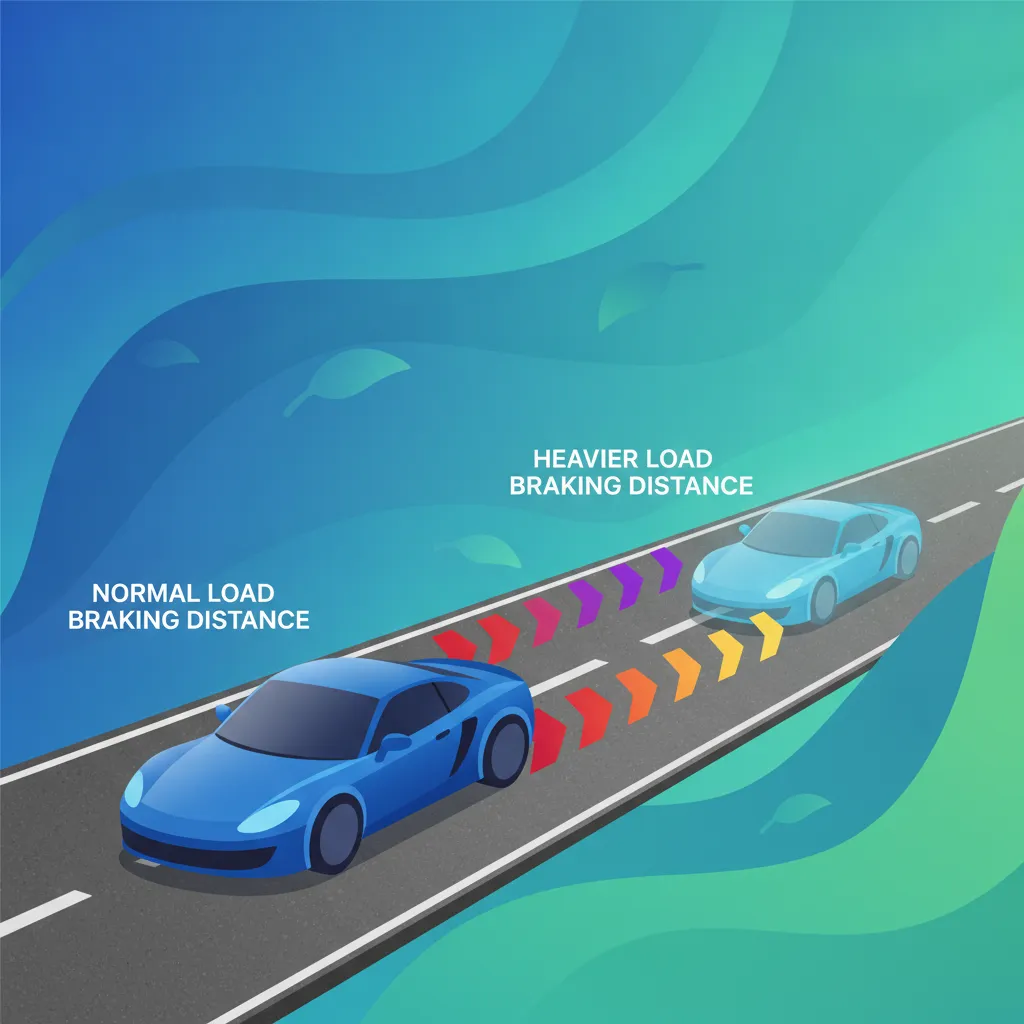
This lesson explores the direct relationship between a vehicle's mass, its speed, and the distance required to stop. It explains how increased load significantly lengthens the braking distance and details how road conditions like gradient and surface friction further affect this calculation. Learners will understand the importance of anticipating stops and maintaining a greater following distance to ensure safety.

This lesson focuses on the challenges of braking in adverse conditions like rain or on icy patches. It teaches riders to increase their following distance and apply brakes smoothly and gently to prevent traction loss. The role of ABS in these scenarios and strategies for maintaining control are also explained.

This lesson delves into the science of traction, explaining the relationship between the tyre and the road surface. It covers how factors like water, oil, gravel, and painted lines can significantly reduce grip. Learners will develop the ability to 'read' the road surface and anticipate potential traction loss.

This lesson explains the fundamental physics of load distribution and its direct impact on a heavy vehicle's centre of gravity. It details how the positioning of cargo—whether high, low, forward, or back—alters handling characteristics and overall stability. The content emphasizes the importance of achieving a balanced load to minimize rollover risk and comply with Danish regulations for safe weight distribution.

This lesson provides instruction on how to execute a quick and controlled emergency stop. It covers the correct body posture to maintain stability and how to apply maximum braking force without losing control. Understanding how to manage weight transfer and the function of an ABS system is crucial for these situations.

This lesson focuses on the fundamental skills of balance and steering. It explains how body position affects the vehicle's center of gravity and stability. The concept of counter-steering is introduced as the primary method for initiating turns at moderate to high speeds, a key skill for effective control.

This lesson outlines a step-by-step procedure for managing a mechanical breakdown on the road. It covers moving the motorcycle to a safe location, using hazard lights, and wearing high-visibility clothing. The goal is to ensure personal safety while minimizing disruption and danger to other traffic.

This lesson examines the specific risks inherent to motorcycling, emphasizing a rider's vulnerability due to reduced physical protection compared to other vehicles. It covers the heightened severity of injuries in accidents and the critical role of protective gear in mitigating harm. Learners will understand how to adopt defensive strategies, such as proper road positioning, to counteract these risks.
Learn essential adjustments for suspension, tyre pressure, and riding style when carrying a passenger or luggage. Master Danish motorcycle theory on safe load management and control.
This lesson addresses how to safely carry luggage or a passenger on a motorcycle. It explains the effects of added weight on the vehicle's balance, steering, and braking performance. Learners will understand correct procedures for securing loads and adjusting their riding technique to maintain control and stability.

This lesson equips riders with the knowledge to handle imperfect road surfaces safely. It covers how to adjust speed, steering, and braking inputs when encountering loose gravel, slippery wet leaves, or other hazards. The focus is on smooth control inputs to avoid upsetting the motorcycle's stability.

This lesson details the systematic pre-ride inspection process that all motorcyclists must perform. It covers critical safety checks, including verifying correct tyre pressure, assessing brake pad wear, and ensuring all lights are functional. Regular completion of these checks is essential for preventing mechanical failures and ensuring rider safety.

This lesson focuses on the safe transportation of both passengers and cargo. It details the legal requirements for using seat belts and the mandatory use of appropriate child restraints for younger passengers. Additionally, it explains the principles of proper load distribution and securing methods to prevent cargo from shifting, which could dangerously affect the vehicle's stability and handling.
This lesson focuses on the critical connection between the motorcycle and the road: the tyres. It explains how to check for proper inflation, inspect tread depth, and recognize signs of wear. Understanding how different tyre compounds and patterns perform in various conditions is key to managing traction.

This lesson focuses on techniques for riding when visibility and traction are compromised by weather. It explains how to adjust speed, increase following distance, and use lights to see and be seen in rain or fog. Understanding the risk of hydroplaning and making smooth control inputs are key takeaways.
This lesson delves into the science of traction, explaining the relationship between the tyre and the road surface. It covers how factors like water, oil, gravel, and painted lines can significantly reduce grip. Learners will develop the ability to 'read' the road surface and anticipate potential traction loss.

This lesson provides practical guidance for motorcyclists using ferries, a common mode of transport in Denmark. It covers the process of riding onto the ferry, securing the motorcycle with straps to prevent it from falling, and navigating potentially slippery decks. Safe procedures for disembarking into traffic are also explained.

This lesson covers the safe and correct method for attaching a trailer to your vehicle, including all necessary safety checks. It explains the importance of proper load distribution to maintain trailer stability and prevent dangerous swaying. The content also revisits the critical rules for passenger safety, with a focus on selecting and using the correct child restraint systems according to Danish law.
This lesson highlights the rider's responsibility for ensuring their vehicle is in a safe, roadworthy condition. It provides a systematic guide to pre-ride checks, including inspecting tyres for correct pressure and wear, testing brakes, and verifying all lights work. Regular maintenance is presented as a critical component of overall rider safety.
Find clear answers to common questions learners have about Impact of Passengers and Luggage on Handling and Braking. Learn how the lesson is structured, which driving theory objectives it supports, and how it fits into the overall learning path of units and curriculum progression in Denmark. These explanations help you understand key concepts, lesson flow, and exam focused study goals.
A passenger adds significant mass to the motorcycle, which increases the momentum you need to counteract. Because the tyres' grip is finite, the extra weight requires more distance to decelerate safely, and you must apply the brakes earlier and more progressively.
Yes, always consult your motorcycle owner's manual. Most manufacturers specify a higher rear tyre pressure when carrying a passenger or heavy load to prevent sidewall deformation and maintain proper handling characteristics.
A passenger shifts the center of gravity higher and further back, which can make the steering feel heavier and slower. You should adjust your cornering speed and avoid abrupt inputs to keep the motorcycle stable and predictable for both the rider and passenger.
Ensure luggage is mounted as low and as close to the center of the bike as possible to minimize the impact on handling. Improperly secured or top-heavy luggage can cause the motorcycle to wobble at speed or become unstable during turns.
Use our powerful search tool to pinpoint specific Danish driving theory topics, road signs, or traffic situations you need to review. Start exploring relevant practice sets now to reinforce your knowledge and build confidence for your upcoming driving licence exam.