
This lesson guides you through the specific StVO regulations for navigating roundabouts and mini-roundabouts safely. You will learn the essential priority rules and correct signaling procedures that are frequently tested in the German Category B theory exam.

Lesson content overview
Roundabouts, known as Kreisverkehr in German, are a fundamental part of the road network across Germany and Europe. These circular intersections are designed to improve traffic flow, reduce congestion, and enhance safety by minimizing direct conflict points between vehicles. Understanding the specific rules for approaching, entering, navigating, and exiting roundabouts is crucial for all drivers, particularly those preparing for their German Category B driving license theory exam. This lesson provides detailed guidance on mastering these unique intersections, including the specifics of smaller Mikro-Kreisverkehr (mini-roundabouts) and interaction with vulnerable road users.
A roundabout is a type of circular intersection where traffic flows in one direction around a central island. Instead of traffic lights or stop signs at every entry, roundabouts generally require vehicles entering to yield to traffic already circulating within the circle. This design promotes a continuous flow of traffic, as drivers only need to stop if there is no safe gap to enter.
A Kreisverkehr is a specifically designed intersection where multiple roads meet at a central point, around which traffic travels counter-clockwise. This structure is intended to manage traffic efficiently by transforming potential head-on or right-angle collisions into less severe glancing blows, significantly reducing injury severity in the event of an accident. Drivers must adapt their speed and prepare to yield as they approach.
Roundabouts offer several advantages over traditional signalized intersections or junctions with complex priority rules. By requiring drivers to slow down and yield, they inherently reduce vehicle speeds, which is a major factor in accident severity. The continuous flow design also minimizes idling and associated emissions, making them more environmentally friendly. Furthermore, the fewer conflict points (typically 8 for a four-way intersection compared to 32 for a conventional one) translate directly into fewer opportunities for collisions and greater overall safety for all road users.
The most critical rule in German roundabouts is the principle of yielding. Unlike some other intersections where the vehicle from the right might have priority, in a roundabout, the traffic already circulating always has the right of way. This rule is designed to ensure smooth, continuous movement within the circle.
Vehicles already circulating within the roundabout have absolute priority over those wishing to enter. This means that if you are approaching a roundabout, you must yield to any vehicle that is currently in the process of driving around the central island, regardless of their direction of origin or destination. This rule is usually reinforced by specific signage at the entry points.
At the entry of nearly all German roundabouts, you will encounter a yield sign, often combined with a circular blue sign featuring three white arrows (sign 215) indicating a roundabout. The primary yield sign (sign 205) is triangular with a red border and an inverted white center, clearly communicating the need to give way.
The presence of this sign means you must adjust your speed and be prepared to stop if necessary to allow circulating traffic to pass safely before you enter. You should only proceed when there is a clear, sufficient gap in traffic.
Approaching a roundabout requires careful observation and speed adjustment. You must reduce your speed significantly to be able to assess the traffic within the roundabout and react appropriately. Look both to your left (from where circulating traffic will approach) and ahead to gauge speeds and positions of other vehicles.
Reduce Speed: Slow down well in advance to a speed that allows you to stop comfortably at the entry line if needed.
Observe: Look to your left for oncoming traffic within the roundabout. Also, observe any vehicles planning to exit at the entry point before yours.
Yield: If there is traffic in the roundabout, stop before the yield line and wait for a safe gap. Do not block the entry or force your way in.
Enter: When a safe gap appears, proceed into the roundabout. Do not use your turn signal when entering the roundabout, as this could confuse other drivers regarding your intentions.
Entering at an appropriate speed also gives you more time to react to unexpected situations, such as a sudden stop by the vehicle in front or a pedestrian crossing.
Once you have safely entered the roundabout, your focus shifts to navigating the circular path and preparing for your exit. The key is to maintain a consistent flow and communicate your intentions clearly.
In Germany, as in other right-hand traffic countries, vehicles must always travel counter-clockwise around the central island. This standard direction ensures predictability and safety. Never attempt to drive clockwise, as this would put you in direct conflict with all other traffic and lead to dangerous situations.
A critical rule in German roundabouts is the requirement to signal your intention to exit. You must activate your right turn signal (Blinker) shortly before the exit you intend to take. This alerts following vehicles and those waiting to enter your specific exit point that you will be leaving the roundabout.
Failing to signal before exiting is a common violation and can lead to confusion, near-misses, and even collisions, as other drivers might assume you are continuing in the roundabout.
Start signaling once you have passed the exit immediately before yours. Maintain the signal until you have fully exited the roundabout. This clear communication helps maintain a smooth traffic flow and enhances overall safety.
While many German roundabouts are single-lane, you will also encounter multi-lane Kreisverkehr. In multi-lane roundabouts, proper lane choice is essential.
It is crucial to avoid changing lanes within the roundabout itself. Decide on your lane before entering based on your intended exit. If you find yourself in the wrong lane, it is safer to go around again to reach your desired exit rather than attempting a dangerous lane change. When exiting from an inner lane, you must ensure that the outer lane is clear and that you can safely merge or cross to exit.
When in doubt in a multi-lane roundabout, choose the rightmost available lane for your exit and if you miss your exit, go around again. Safety always comes first.
Mini-roundabouts (Mikro-Kreisverkehr) are smaller versions of roundabouts, typically found in urban or residential areas with lower traffic volumes. They share many rules with standard roundabouts but have some distinct features.
Mini-roundabouts are characterized by their smaller central island, which may often be traversable by larger vehicles (like trucks or buses) or simply a painted circle on the road. They are still marked with the circular blue roundabout sign (StVO sign 215) and yield signs (StVO sign 205) at their entries, signifying the same priority rules. Their compact size means less space for maneuvering, requiring even greater caution and lower speeds.
A unique aspect of some mini-roundabouts is the interaction with pedestrians. Due to their smaller size, pedestrians may cross directly over the central island or very close to it. In such scenarios, drivers must be particularly vigilant. If pedestrians are using or clearly intending to use the central island as a crossing point, drivers must yield to them. This is a critical safety aspect, as pedestrians are highly vulnerable.
Even if the central island is traversable, smaller vehicles should generally avoid driving over it unless absolutely necessary (e.g., for very long vehicles turning). Treat the central island as a physical barrier whenever possible.
Roundabouts are designed to improve safety, but they present unique challenges for vulnerable road users such as cyclists and pedestrians. Drivers must exercise extra caution and be prepared to yield to them.
The rules for cyclists in roundabouts can vary slightly depending on the specific design and signage, but generally, cyclists are treated as vehicles within the roundabout.
Always assume cyclists may not be as predictable as other motorized traffic and be ready to react. A good rule of thumb is to expect cyclists, particularly when you are preparing to exit, as they might be continuing in the roundabout or taking a different exit.
Pedestrians often cross the entrances and exits of roundabouts. Drivers must always be aware of pedestrians and yield to them when they are crossing or clearly intending to cross. This is especially true at marked pedestrian crossings (Zebrastreifen) which may be located at the roundabout entries or exits. Even without a marked crossing, German traffic law (StVO) requires drivers to show consideration for pedestrians and yield if they are in the process of crossing the road or clearly indicating their intention to do so.
Understanding the rules is one thing; applying them correctly in dynamic traffic situations is another. Many common mistakes can lead to dangerous situations or penalties.
Activate your right turn signal just as you pass the exit immediately before the one you intend to take.
This is a direct violation of the fundamental priority rule and a high-risk maneuver. Entering a roundabout without ensuring a safe gap in circulating traffic forces other drivers to brake sharply or swerve, leading to potential side-impact or rear-end collisions. Always be patient and wait for a clear opening.
Approaching a roundabout at high speed reduces your reaction time and ability to assess the situation. It also makes it difficult to stop safely if you need to yield. Maintain a controlled, reduced speed upon approach, and constantly scan for circulating traffic, pedestrians, and cyclists. Poor observation means you might miss a crucial gap or fail to see a vulnerable road user.
Excessive speed in a roundabout or at its entry can lead to loss of control, especially in wet conditions, and is a significant factor in serious accidents.
The rules governing roundabouts in Germany are enshrined in the Straßenverkehrs-Ordnung (StVO), the German Road Traffic Act. Adherence to these regulations is not just about safety but also about legal compliance.
Violations of roundabout rules can lead to various penalties, including fines (Bußgelder), points on your driving license (Punkte in Flensburg), and in severe cases, even a driving ban (Fahrverbot).
To further solidify your understanding, consider the following complex scenario:
In such a scenario, the driver intending to take the third exit must first reduce speed and yield to the circulating car from the left. Upon finding a safe gap, they would enter the roundabout, likely choosing an inner lane if available for a 'left' turn equivalent. They would circulate counter-clockwise, and as they pass the second exit, they would activate their right turn signal. As they approach their intended exit, they must be extremely vigilant for a cyclist on a separate path crossing the exit and for pedestrians using a marked crossing, yielding to both before completing their exit maneuver.
Mastering roundabouts and mini-roundabouts is a cornerstone of safe and efficient driving in Germany. By consistently applying the core principles—yielding to circulating traffic, traveling counter-clockwise, and signaling correctly before exiting—drivers contribute significantly to traffic safety and smooth flow. Always prioritize anticipation, observation, and communication, especially when interacting with vulnerable road users. Regular practice and adherence to StVO regulations will ensure you navigate these common intersections with confidence and competence.
German roundabouts (Kreisverkehr) require yielding to circulating traffic, counter-clockwise travel, and mandatory right-turn signaling before your exit. The key is to approach slowly, observe all directions, enter without signaling, then signal right only after passing the exit immediately before yours. Multi-lane roundabouts require lane choice before entry—right lane for early exits, left lane for later turns—and never changing lanes inside. Mini-roundabouts follow identical priority rules but demand extra caution around pedestrians and smaller central islands. Adherence to StVO rules prevents accidents and exam failures.
A short set of high-value points that capture the most important learning from this lesson.
Traffic already circulating in a German roundabout (Kreisverkehr) always has priority over vehicles entering, regardless of direction.
Never use your turn signal when entering a roundabout—signal only when you are ready to exit.
Activate your right turn signal (Blinker) just after passing the exit immediately before your intended exit.
In multi-lane roundabouts, use the outer lane for the first or second exit, inner lane for later exits, and never change lanes within the circle.
Mini-roundabouts (Mikro-Kreisverkehr) operate under the same priority rules but require extra vigilance due to their compact size and potential pedestrian crossings over the central island.
Explore all units and lessons included in this driving theory course.
Counter-clockwise (Gegen den Uhrzeigersinn) is the mandatory direction of travel in all German roundabouts.
Yield signs (StVO sign 205) combined with roundabout signs (StVO sign 215) mark roundabout entries—always yield to circulating traffic.
If you enter a multi-lane roundabout in the wrong lane, go around again rather than attempting a dangerous lane change.
Cyclists already in the roundabout have priority over entering vehicles, and drivers exiting must yield to cyclists on separate paths crossing the exit.
Pedestrians crossing near mini-roundabout exits or using the central island must be yielded to by drivers.
Failing to signal before exiting, which is the most common roundabout violation and causes confusion for other drivers.
Signaling too early (before passing the preceding exit), misleading drivers waiting to enter the roundabout.
Entering without yielding to circulating traffic, creating high-risk side-impact collision scenarios.
Approaching at excessive speed, reducing reaction time and making it difficult to assess gaps or see vulnerable road users.
Changing lanes within a multi-lane roundabout, which is dangerous and prohibited.
Lesson content overview
A short set of high-value points that capture the most important learning from this lesson.
Traffic already circulating in a German roundabout (Kreisverkehr) always has priority over vehicles entering, regardless of direction.
Never use your turn signal when entering a roundabout—signal only when you are ready to exit.
Activate your right turn signal (Blinker) just after passing the exit immediately before your intended exit.
In multi-lane roundabouts, use the outer lane for the first or second exit, inner lane for later exits, and never change lanes within the circle.
Mini-roundabouts (Mikro-Kreisverkehr) operate under the same priority rules but require extra vigilance due to their compact size and potential pedestrian crossings over the central island.
Explore all units and lessons included in this driving theory course.
Counter-clockwise (Gegen den Uhrzeigersinn) is the mandatory direction of travel in all German roundabouts.
Yield signs (StVO sign 205) combined with roundabout signs (StVO sign 215) mark roundabout entries—always yield to circulating traffic.
If you enter a multi-lane roundabout in the wrong lane, go around again rather than attempting a dangerous lane change.
Cyclists already in the roundabout have priority over entering vehicles, and drivers exiting must yield to cyclists on separate paths crossing the exit.
Pedestrians crossing near mini-roundabout exits or using the central island must be yielded to by drivers.
Failing to signal before exiting, which is the most common roundabout violation and causes confusion for other drivers.
Signaling too early (before passing the preceding exit), misleading drivers waiting to enter the roundabout.
Entering without yielding to circulating traffic, creating high-risk side-impact collision scenarios.
Approaching at excessive speed, reducing reaction time and making it difficult to assess gaps or see vulnerable road users.
Changing lanes within a multi-lane roundabout, which is dangerous and prohibited.
Explore search topics learners often look for when studying Roundabouts and Mini-roundabouts. These topics reflect common questions about road rules, driving situations, safety guidance, and lesson level theory preparation for learners in Germany.
Browse additional driving theory lessons that cover connected traffic rules, road signs, and common driving situations related to this topic. Improve your understanding of how different rules interact across everyday traffic scenarios.
Understand the specific right-of-way rules and correct procedures for navigating German roundabouts (Kreisverkehr) and mini-roundabouts. Learn how to safely enter, signal, and yield to other traffic, including cyclists.
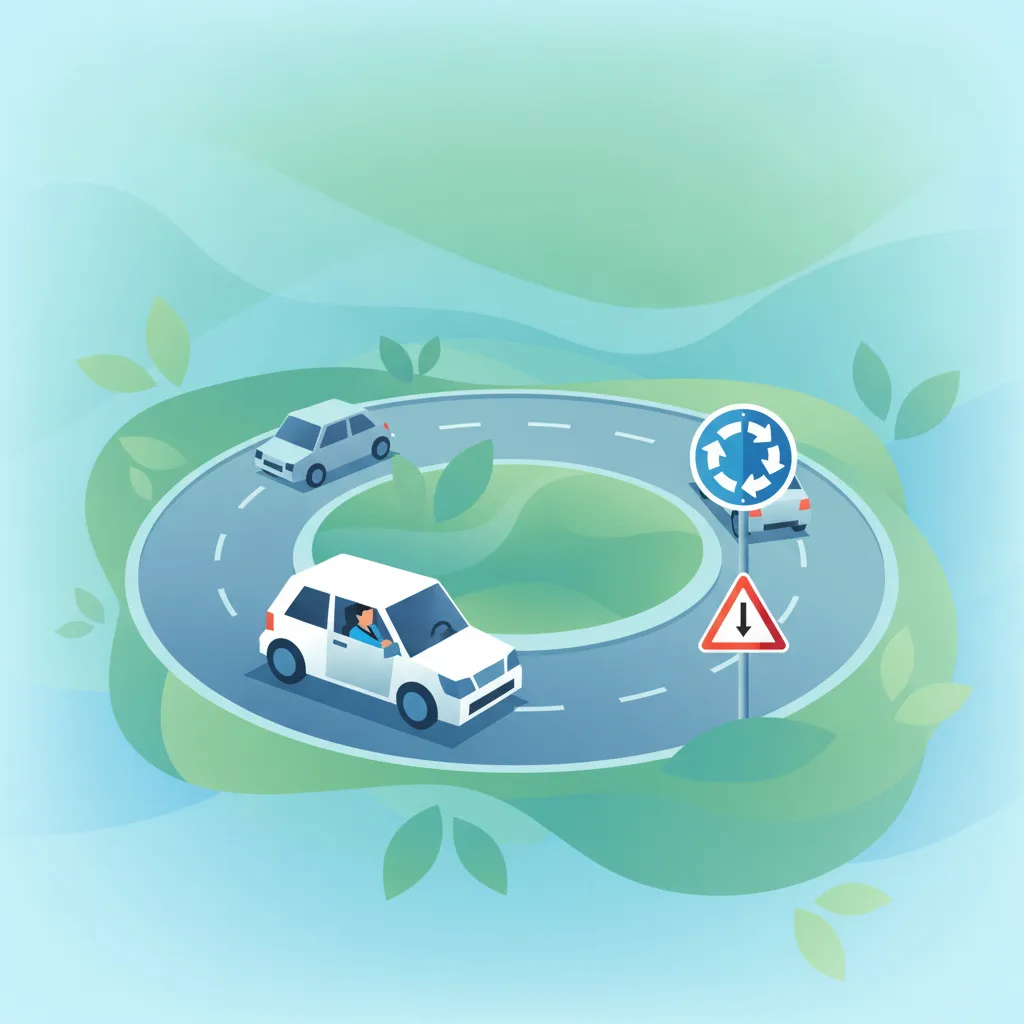
This lesson provides clear instructions on how to navigate roundabouts in Germany. It explains the crucial rule of yielding to traffic already inside the circle, proper lane choice for your intended exit, and the correct use of signals. Safe interaction with cyclists and pedestrians at roundabout exits is also covered.
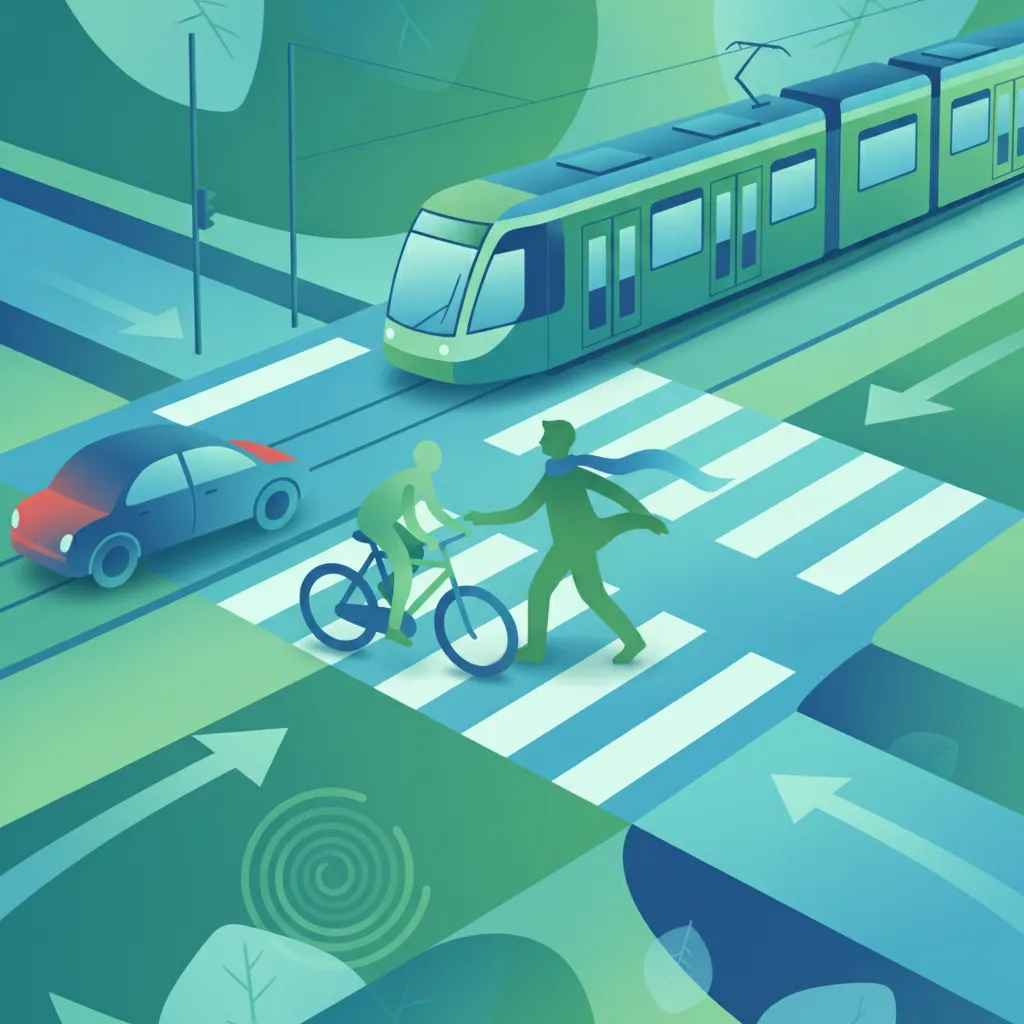
This lesson details the critical right-of-way regulations according to the German StVO. It covers the default 'right before left' rule, the meaning of priority road signs, and specific rules for roundabouts and yielding to pedestrians. A thorough understanding of these priority rules is fundamental for preventing accidents at junctions.
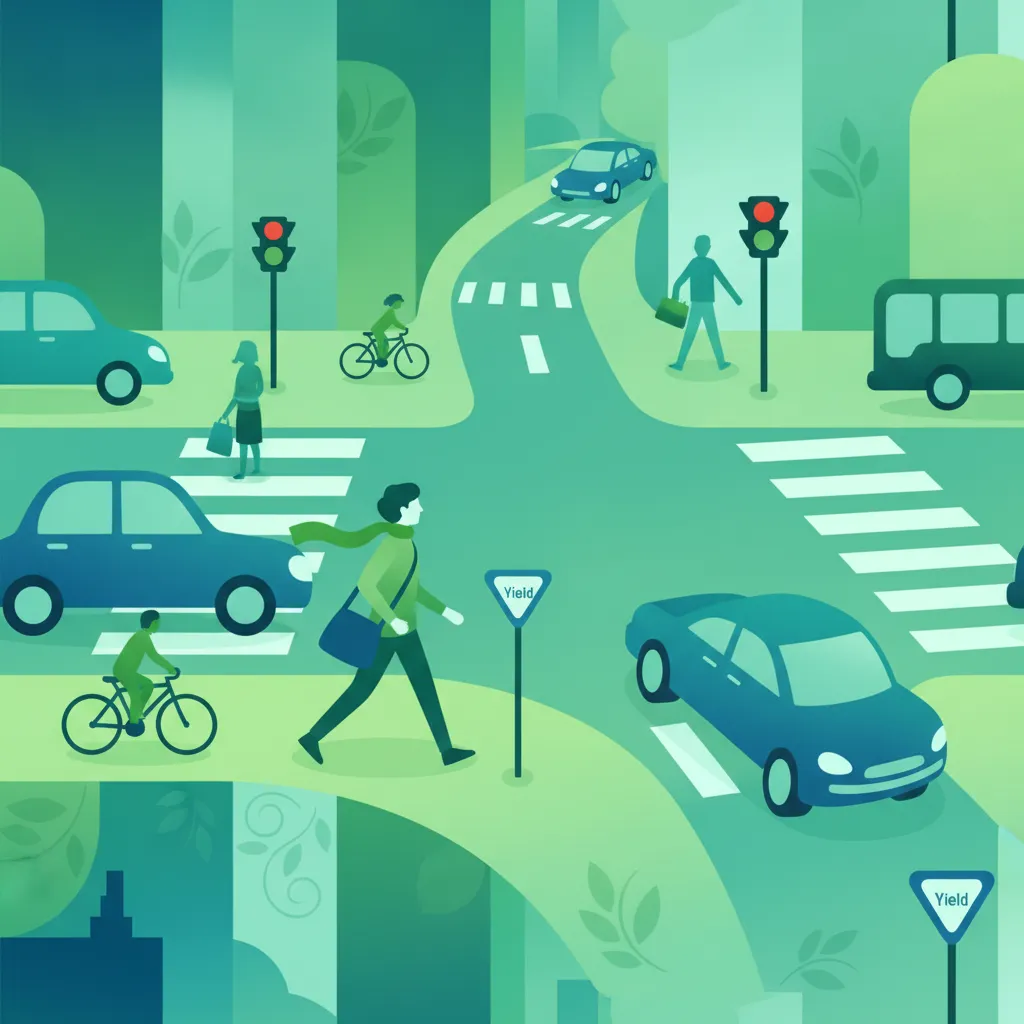
This lesson introduces the foundational concept of right-of-way ('Vorfahrt') in German traffic law. It explains the default priority rule, 'Rechts vor Links' (right before left), which applies at intersections without any regulating signs or signals. You will learn to identify situations where this rule applies and understand the basic principles of yielding to ensure safe passage at junctions.
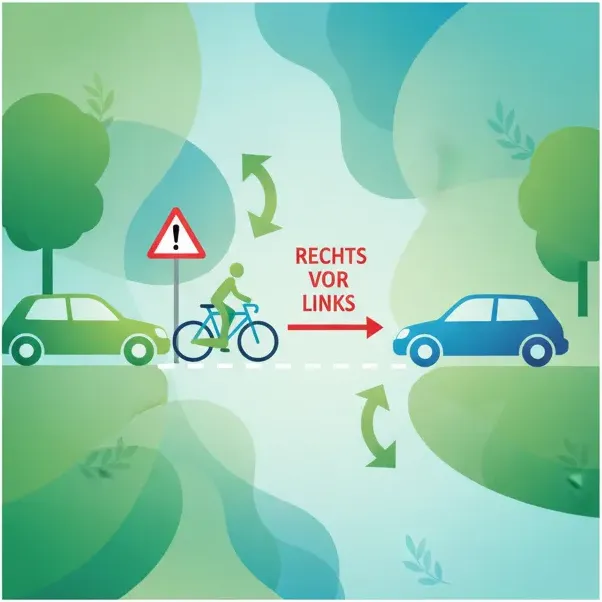
This lesson provides a detailed guide to navigating various types of intersections safely and correctly. It explains how priority is determined by traffic signs (such as the priority road, yield, and stop signs) and traffic lights. The lesson also covers complex scenarios, including the rules for turning left across oncoming traffic, to ensure you can handle any junction with confidence.

This lesson provides a step-by-step guide to executing turns safely at intersections and other locations. It details the full observation sequence (mirrors, signal, blind spot check) required before initiating a turn. The lesson covers correct lane positioning for both left and right turns and explains the rules for performing U-turns or three-point turns where permitted.
This lesson details the safe approach and navigation of various intersection types, including those controlled by traffic lights, stop signs, and give-way signs. Emphasis is placed on comprehensive observation of traffic flow, establishing eye contact with other road users, and ensuring clear visibility before proceeding. The lesson also covers correct lane positioning for turning and the importance of anticipating pedestrian movements.
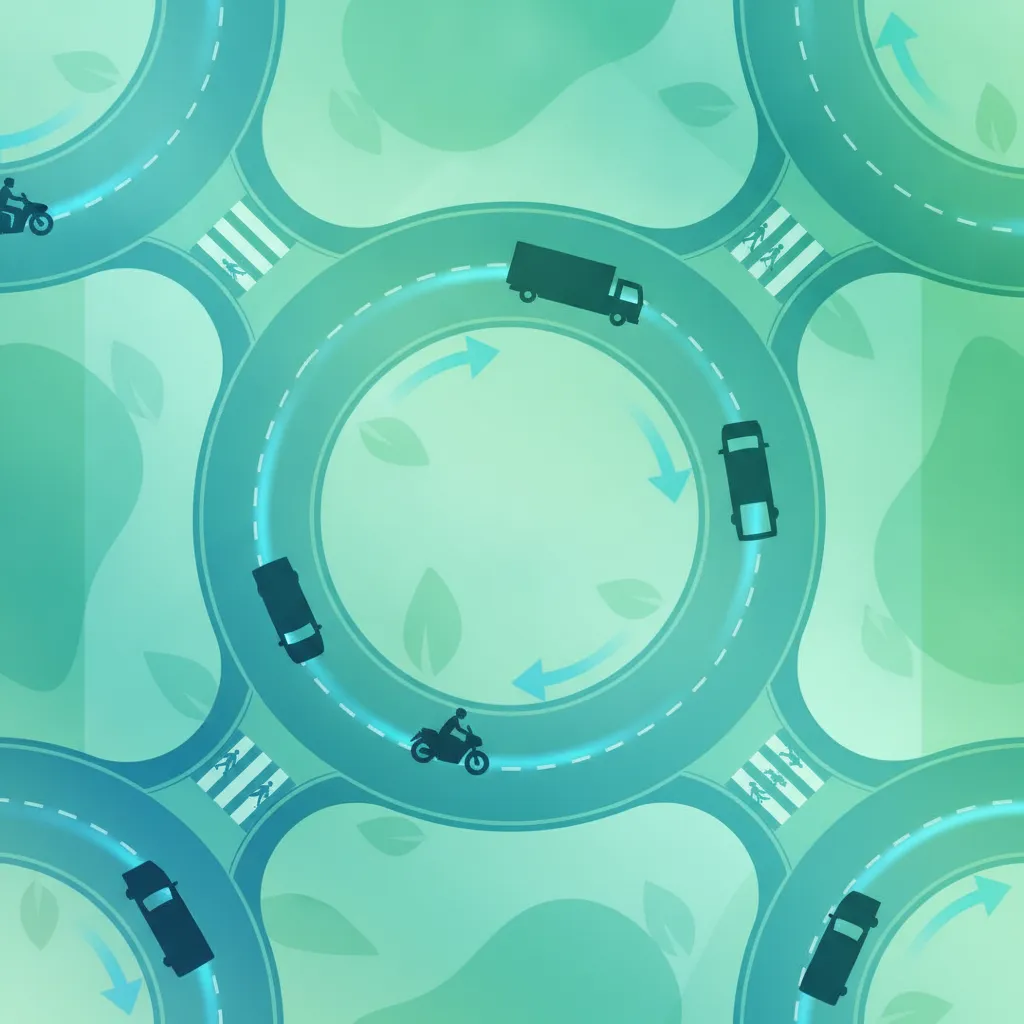
This lesson focuses on the specific techniques for safely navigating roundabouts, a common feature in urban traffic. Learners are taught the correct lane selection for their intended exit, the importance of proper signaling upon entry and exit, and maintaining an appropriate speed. The content highlights the need to yield to circulating traffic and to be aware of other vehicles changing lanes within the roundabout.
This lesson teaches a structured method for approaching any intersection. It covers identifying the type of junction, determining who has the right-of-way based on signs or rules, and performing thorough visual checks. The focus is on developing a safe and decisive approach to reduce risk in these high-conflict areas.
This lesson focuses on the right-of-way rules that heavy vehicles must follow when interacting with cyclists and pedestrians, particularly at intersections and crossings. It emphasizes the need for trucks to yield appropriately and maintain safe distances. The content also covers the interpretation of traffic signs governing priority in urban areas.
This lesson explains the concept of a priority road ('Vorfahrtstraße'), where you have right-of-way over traffic from intersecting roads. You will learn to recognize the signs that mark the beginning and end of a priority road. The lesson also covers how priority is managed through signals, including standard traffic lights, the special 'Grünpfeil' (green arrow) sign, and the overriding authority of a police officer directing traffic.
Learn how to safely interact with vulnerable road users like cyclists and pedestrians when driving through German roundabouts and mini-roundabouts. Covers essential safety considerations and communication strategies in shared traffic spaces.
This lesson provides clear instructions on how to navigate roundabouts in Germany. It explains the crucial rule of yielding to traffic already inside the circle, proper lane choice for your intended exit, and the correct use of signals. Safe interaction with cyclists and pedestrians at roundabout exits is also covered.

This lesson covers the correct and safe way to interact with cyclists. It explains the different types of bicycle infrastructure, such as dedicated cycle paths and advisory bike lanes on the road. Key topics include maintaining the legally required minimum passing distance, checking for cyclists before turning right, and being aware of the risk of 'dooring' when parked.
This lesson provides specific guidance on how to safely share the road with pedestrians and cyclists, who are among the most vulnerable road users. It covers the rules of conduct at zebra crossings, traffic lights for pedestrians, and designated cycle lanes. The content emphasizes the importance of vigilance, yielding right-of-way, and maintaining a safe distance to prevent accidents in urban and rural environments.

This lesson teaches riders how to interact safely and predictably with pedestrians, cyclists, and public transport vehicles. It highlights the importance of yielding at designated crossings, maintaining a safe passing distance, and anticipating the movements of buses and trams. The content emphasizes using eye contact and clear signaling to foster safe and respectful interactions with all road users.
This lesson focuses on the critical moments of interaction with pedestrians and cyclists near bus stops, a common location for accidents. It reinforces the importance of reducing speed, yielding right-of-way, and constantly monitoring blind spots during the stopping process. Learners will practice techniques like making eye contact and using signals to communicate intentions, creating a safer environment for everyone around the vehicle.

This lesson addresses the critical skill of safely interacting with other road users, particularly vulnerable ones like pedestrians and cyclists. It covers rules for yielding at crosswalks, maintaining a safe passing distance, and being aware of the limited visibility of a moped to car drivers. The focus is on fostering a defensive and cooperative mindset in mixed traffic.
This lesson details the safe approach and navigation of various intersection types, including those controlled by traffic lights, stop signs, and give-way signs. Emphasis is placed on comprehensive observation of traffic flow, establishing eye contact with other road users, and ensuring clear visibility before proceeding. The lesson also covers correct lane positioning for turning and the importance of anticipating pedestrian movements.
This lesson focuses on the specific techniques for safely navigating roundabouts, a common feature in urban traffic. Learners are taught the correct lane selection for their intended exit, the importance of proper signaling upon entry and exit, and maintaining an appropriate speed. The content highlights the need to yield to circulating traffic and to be aware of other vehicles changing lanes within the roundabout.

This lesson focuses on the particular care required when driving near pedestrians, with a special emphasis on children and the elderly, whose behavior can be unpredictable. It covers the rules for yielding at zebra crossings and the importance of reducing speed near schools, playgrounds, and residential areas. The goal is to instill a habit of constant vigilance and readiness to stop.
This lesson focuses on the interaction between heavy vehicles and vulnerable road users at crossings, particularly when turning right. It covers the need for heightened vigilance, the importance of properly using mirrors, and correct signaling to alert others. The content highlights legal responsibilities and safe distance requirements to prevent accidents.
Find clear answers to common questions learners have about Roundabouts and Mini-roundabouts. Learn how the lesson is structured, which driving theory objectives it supports, and how it fits into the overall learning path of units and curriculum progression in Germany. These explanations help you understand key concepts, lesson flow, and exam focused study goals.
No, you do not signal when entering a roundabout. You must only signal when you are intending to leave the roundabout, just before you reach the exit you wish to take.
The rule is simple: vehicles already inside the roundabout have priority over vehicles trying to enter. Always look for the blue 'give way' sign which reinforces this.
Mini-roundabouts function like normal ones, but their small size often means you must drive over the central mountable apron if your vehicle is large. Always prioritize those already circulating and watch carefully for cyclists.
In the theory exam, this is a common reason for losing points as it misleads other drivers. On the road, failing to signal prevents following traffic from moving safely, which can lead to unnecessary congestion or accidents.
Begin your targeted revision now. Use our practice search to quickly find specific German driving theory questions. Filter by StVO rules, road signs, or hazard perception to create your focused study plan. Master challenging areas and prepare confidently for your theoretical driving test.