
This lesson guides you through the systematic process of changing lanes safely, an essential skill for both the Italian Patente B theory test and practical driving. Building on your understanding of visual scanning and vehicle positioning, you will learn how to effectively combine signaling, mirror use, and blind spot checks to navigate Italian roads with confidence.

Lesson content overview
Changing lanes is a fundamental maneuver in daily driving, essential for navigating traffic, preparing for turns, or overtaking slower vehicles. However, it is also a common source of accidents if not executed correctly. This lesson provides a thorough, systematic procedure for safely changing lanes, with a particular focus on understanding and eliminating blind spots, crucial for all drivers preparing for their Italian Patente B theory test and practical examination.
Our goal is to equip you with the knowledge to perform lane changes with confidence, ensuring not only your safety but also that of other road users. This involves a precise sequence of actions, keen observation skills, and sound judgment of speed and distance.
Before attempting any lane change, always ensure you have a clear understanding of your vehicle's controls and how to effectively use your mirrors. This lesson builds upon the principles discussed in "Visual Scan and Mirror Use" and "Vehicle Positioning in Lanes and Road Geometry."
A lane change involves moving your vehicle from one lane to an adjacent one while traveling in the same direction. This maneuver is integral to maintaining smooth traffic flow and adapting to varying road conditions. Whether you are moving from the right lane to the left to overtake, or from a left lane to a right lane to exit a motorway, the underlying safety principles remain the same.
The primary objective of a safe lane change is to execute the maneuver without causing other drivers to alter their speed or direction abruptly. This requires a comprehensive understanding of your surroundings, clear communication of your intentions, and accurate judgment of available space and time. Failure to follow a systematic procedure can lead to dangerous situations, including side collisions, which are frequently caused by undetected vehicles in blind spots.
Performing a lane change is not a single action but a sequence of deliberate steps. Adhering to this sequence ensures that all necessary safety checks are performed, significantly reducing the risk of a collision. Each step plays a vital role in gathering information, communicating intentions, and executing the maneuver smoothly.
Signal Your Intent: Clearly communicate your intention to change lanes using your turn indicator.
Check Your Mirrors: Scan your interior rear-view mirror and the appropriate exterior side mirror.
Perform a Shoulder Check: Briefly turn your head to directly check your vehicle's blind spot.
Assess the Gap: Judge the distance and speed of surrounding vehicles to determine a safe space in the target lane.
Execute the Lane Change: Steer smoothly into the new lane while maintaining your speed.
Maintain Situational Awareness and Cancel Signal: Continuously monitor traffic and turn off your indicator once the maneuver is complete.
The very first step in any lane change is to communicate your intentions to other drivers. This is done by activating the appropriate turn signal, also known as the indicator. This simple action is crucial for safety as it alerts surrounding drivers, allowing them to anticipate your maneuver and adjust their speed or position accordingly.
According to the Italian Codice della Strada, the turn signal must be activated well in advance:
This advance warning provides sufficient time for other drivers to react, preventing sudden braking or swerving. Premature signaling, or failing to signal at all, can create confusion and increase the risk of an accident.
Never initiate a lane change without signaling. It is a common mistake that can lead to dangerous misunderstandings on the road. Also, ensure your signal is for the intended maneuver; don't signal left if you plan to change lanes to the right, for instance.
After signaling your intention, the next critical step is to check your mirrors. Mirrors provide a quick overview of the traffic behind and to the sides of your vehicle. They are your primary tools for initially assessing the traffic flow and identifying potential gaps.
Before starting your journey, always ensure your mirrors are correctly positioned. The side mirrors should be adjusted so that you can just barely see the side of your own vehicle, maximizing your view of adjacent lanes. While mirrors are indispensable, it's crucial to remember their limitations; they do not cover every angle around your vehicle.
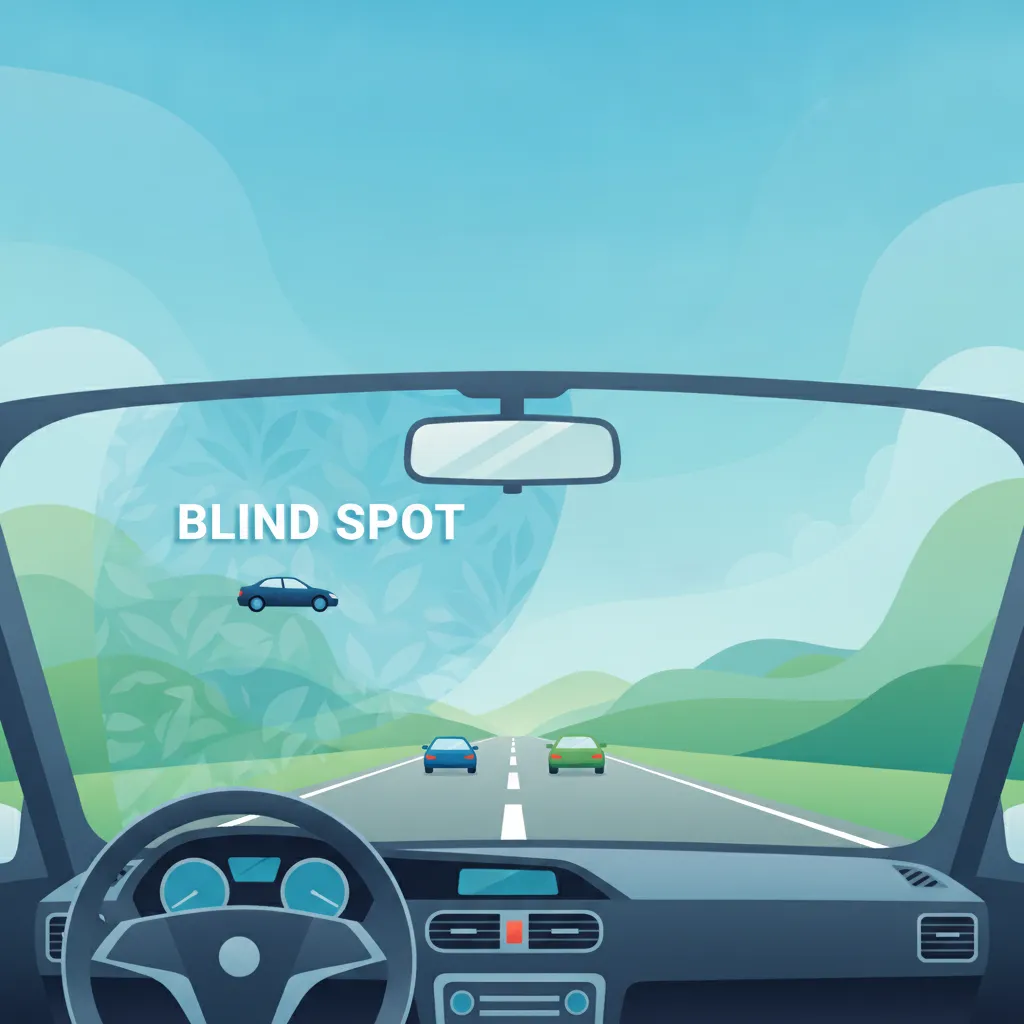
Despite proper mirror adjustment, there will always be areas around your vehicle that are not visible through any of the mirrors. These areas are known as blind spots. They are typically located alongside and slightly behind your vehicle, where a vehicle in an adjacent lane can disappear from view. Failing to check these blind spots is a leading cause of side-swipe collisions during lane changes.
A shoulder check is a brief, but essential, head turn to directly view the area alongside your vehicle that your mirrors cannot see.
This direct visual confirmation is mandatory and must be performed immediately before initiating the lane change, even if your mirrors appear clear. A vehicle, especially a motorcycle or a small car, can easily be hidden in your blind spot.
An area adjacent to a vehicle that cannot be seen directly through the interior or exterior mirrors, necessitating a direct visual check (shoulder check) to ensure it is clear.
Never rely solely on your mirrors. A thorough shoulder check is non-negotiable for safe lane changes, regardless of traffic density or road type. A quick glance is not enough; ensure you fully verify the lane is clear.
Once you've signaled and confirmed the lane is clear via mirrors and a shoulder check, the next critical step is to assess the gap. This involves evaluating the distance and relative speed of vehicles in the target lane to ensure there is sufficient space and time for your vehicle to move into it without forcing other drivers to brake or swerve.
The safe space required between vehicles, evaluated by considering not only the distance but also the relative speeds of vehicles, ensuring adequate time for a maneuver without impeding others.
A general rule of thumb for a safe gap is to ensure that the vehicle behind you in the target lane is far enough away that it doesn't have to brake or decelerate when you move in front of it. On faster roads like motorways, vehicles approach quickly, so the required gap will be significantly larger. Underestimating the speed of an approaching vehicle is a common mistake that can lead to hazardous situations.
With your intentions signaled, mirrors checked, blind spots cleared, and a safe gap confirmed, you can now execute the lane change. This phase requires smooth and controlled vehicle handling to maintain stability and predictability for other drivers.
The goal is to complete the lane change in a fluid, continuous motion, conveying confidence and control to those around you.
A lane change isn't complete the moment your vehicle crosses the lane line. You must maintain continuous situational awareness throughout and immediately after the maneuver.
Keep monitoring your mirrors and surroundings even after you have fully entered the new lane. This helps you detect any unexpected movements from other vehicles or identify if your maneuver created an unforeseen hazard. This ongoing observation ensures that the lane change was successful and safe, and allows for quick corrective actions if needed.
Once your vehicle is fully established in the new lane, you must cancel your turn indicator. Leaving the signal on can confuse other drivers, making them believe you intend to perform another maneuver, such as another lane change or a turn. Most modern vehicles have automatic signal cancellation, but always double-check it has turned off.
Maintaining continuous observation and communication is key to defensive driving, ensuring you are always aware of potential hazards and other drivers' intentions.
The Italian Codice della Strada (Highway Code) outlines specific rules that govern lane changes, emphasizing safety and clear communication. Adhering to these regulations is mandatory for all drivers.
Despite the clear procedures, certain errors and challenging scenarios often lead to unsafe lane changes. Understanding these can help you avoid them.
Safe driving requires adapting your maneuvers to various external conditions. Lane changes are particularly sensitive to changes in weather, lighting, road type, and vehicle characteristics.
Understanding the direct consequences of correct and incorrect lane change procedures reinforces the importance of each step.
Let's examine a few real-world situations to illustrate the correct and incorrect application of lane change principles.
Setting: You are driving on a busy two-lane urban street in Italy with moderate traffic. You are in the right lane, but you need to turn left at the upcoming intersection.
Correct Behavior:
Incorrect Behavior & Potential Outcome: You signal late or not at all, skip the shoulder check, and quickly veer into the left lane. A small delivery scooter, which was in your left blind spot, is suddenly cut off. The scooter rider has to brake sharply, loses balance, and crashes, resulting in a side-swipe collision and potential injuries.
Setting: You are accelerating on an on-ramp, preparing to merge onto an Italian motorway (autostrada) where traffic is flowing at 110 km/h, under light rain conditions.
Correct Behavior:
Incorrect Behavior & Potential Outcome: You fail to accelerate sufficiently to match motorway speed, don't perform a shoulder check, and attempt to merge into a small gap without signaling. A fast-approaching vehicle, not expecting you, has to brake hard and swerve to avoid a collision, potentially causing a multi-vehicle pile-up due to the wet conditions.
Setting: You are on a two-lane rural road (one lane in each direction, undivided) with a gentle curve. You want to overtake a slower farm vehicle ahead.
Correct Behavior:
Incorrect Behavior & Potential Outcome: You initiate the lane change too early on the curve, reducing your visibility of oncoming traffic. Without properly checking for oncoming vehicles, you pull out to overtake. An oncoming vehicle suddenly appears, leading to a head-on collision or forcing you into a dangerous maneuver to return to your lane, potentially hitting the farm vehicle.
Mastering safe lane changes is a cornerstone of responsible driving and a critical skill for your Italian Patente B. It requires a blend of technical procedure, keen observation, and good judgment.
By consistently applying these principles, you will significantly reduce the risk of accidents and contribute to safer roads for everyone.
Safe lane changes require following a strict 6-step procedure: signal your intention, check mirrors, perform a mandatory shoulder check to clear blind spots, assess the dynamic gap accounting for relative speeds, execute smoothly while maintaining speed, and finally cancel your signal while staying alert. Italian law mandates turn signals activate at least 5 seconds before on urban roads and 3 seconds on motorways. The shoulder check is non-negotiable because mirrors cannot see all angles, and gap judgment must consider vehicle speeds rather than just distances. Adapt your technique for adverse weather, night driving, heavy loads, and vulnerable road users like motorcyclists and cyclists.
A short set of high-value points that capture the most important learning from this lesson.
Always follow the 6-step sequence: signal, check mirrors, perform shoulder check, assess gap, execute smoothly, then maintain awareness and cancel signal
Shoulder checks are mandatory and non-negotiable because mirrors alone cannot eliminate blind spots where vehicles, especially motorcycles, can hide
Signal timing is legally required: at least 5 seconds on urban roads and 3 seconds on autostrade and superstrade
Dynamic gap assessment that accounts for relative vehicle speeds is more important than measuring static distance, especially at higher speeds
Lane changes must never force other drivers to alter their speed or direction abruptly
Explore all units and lessons included in this driving theory course.
Turn indicator timing: 5 seconds before lane change on urban roads, 3 seconds on motorways and expressways
Shoulder check is required immediately before moving, regardless of mirror clearance or traffic density
Dynamic gap rule: vehicle behind in target lane should take 2-3 seconds (motorway) or 1-2 seconds (urban) to reach your position
Always cancel your signal after completing the lane change to avoid misleading other drivers
Reduce speed and increase gap when conditions are poor: rain, fog, night, heavy load, or following large vehicles with larger blind spots
Skipping or performing the shoulder check too late (after beginning to steer), leaving the blind spot unchecked at the critical moment
Underestimating the speed of approaching vehicles, especially on motorways where closing speeds are much faster
Canceling the turn signal before fully completing the lane change, misleading other drivers about your intentions
Failing to signal or signaling too late, reducing reaction time for surrounding drivers
Not adjusting mirror position correctly before starting, reducing visible area of adjacent lanes
Lesson content overview
A short set of high-value points that capture the most important learning from this lesson.
Always follow the 6-step sequence: signal, check mirrors, perform shoulder check, assess gap, execute smoothly, then maintain awareness and cancel signal
Shoulder checks are mandatory and non-negotiable because mirrors alone cannot eliminate blind spots where vehicles, especially motorcycles, can hide
Signal timing is legally required: at least 5 seconds on urban roads and 3 seconds on autostrade and superstrade
Dynamic gap assessment that accounts for relative vehicle speeds is more important than measuring static distance, especially at higher speeds
Lane changes must never force other drivers to alter their speed or direction abruptly
Explore all units and lessons included in this driving theory course.
Turn indicator timing: 5 seconds before lane change on urban roads, 3 seconds on motorways and expressways
Shoulder check is required immediately before moving, regardless of mirror clearance or traffic density
Dynamic gap rule: vehicle behind in target lane should take 2-3 seconds (motorway) or 1-2 seconds (urban) to reach your position
Always cancel your signal after completing the lane change to avoid misleading other drivers
Reduce speed and increase gap when conditions are poor: rain, fog, night, heavy load, or following large vehicles with larger blind spots
Skipping or performing the shoulder check too late (after beginning to steer), leaving the blind spot unchecked at the critical moment
Underestimating the speed of approaching vehicles, especially on motorways where closing speeds are much faster
Canceling the turn signal before fully completing the lane change, misleading other drivers about your intentions
Failing to signal or signaling too late, reducing reaction time for surrounding drivers
Not adjusting mirror position correctly before starting, reducing visible area of adjacent lanes
Explore search topics learners often look for when studying Lane Changes and Checking Blind Spots. These topics reflect common questions about road rules, driving situations, safety guidance, and lesson level theory preparation for learners in Italy.
Browse additional driving theory lessons that cover connected traffic rules, road signs, and common driving situations related to this topic. Improve your understanding of how different rules interact across everyday traffic scenarios.
Explore specific scenarios and advanced techniques for lane changes, including multi-lane maneuvers, merging onto motorways, and adapting strategies for various road geometries and conditions in Italian driving theory.

This lesson provides essential rules and techniques for driving on Italian motorways (autostrade) and major extra-urban roads. It explains how to safely merge onto the motorway from an entry ramp, the strict lane discipline required (drive right, overtake left), and how to exit correctly. The content also covers speed regulations, maintaining a safe following distance at high speed, and procedures for using service areas and handling emergencies.

This lesson explains how to execute left turns, right turns, and U-turns safely while maintaining correct lane discipline. It covers interpreting road markings and arrows, selecting the proper vehicle position, and using signals in a timely manner. Performing shoulder checks to monitor blind spots before and during a turn is a key focus for preventing collisions.

This lesson introduces the philosophy and techniques of defensive driving, a proactive approach focused on anticipating and mitigating potential hazards. It teaches drivers to maintain constant situational awareness by scanning the road ahead, behind, and to the sides. The content covers how to manage the space around the vehicle, identify potential escape routes, and predict the actions of other road users to prevent dangerous situations from developing.

This lesson focuses on the principles of correct vehicle positioning to enhance safety and stability. It teaches how to maintain a central position within the lane and how to adjust this position to navigate curves, prepare for turns, or create more space from potential hazards. Understanding how to adapt to the road's geometry is crucial for smooth and safe driving.

This lesson provides detailed instructions on how to correctly execute various turning maneuvers, including right turns, left turns, and U-turns where permitted. It emphasizes the importance of early signaling to communicate intentions, selecting the correct lane in advance, and adjusting speed before entering the turn. The content also covers the visual checks required before and during the maneuver to ensure it is safe to proceed.

This lesson explains the principles of maintaining proper lane discipline and strategic positioning in an urban context. It covers how to adapt your position within the lane to enhance visibility, avoid road surface hazards, and prepare for turns or lane changes. The content also provides awareness of specific urban features like restricted traffic zones (ZTL) and how to navigate them legally and safely.

This lesson provides a comprehensive guide to riding on high-speed motorways, or autostrade. It details the correct procedures for safely merging into traffic from an entry ramp and exiting via a deceleration lane. The content reinforces strict lane discipline, rules for overtaking, and the importance of maintaining a significantly larger following distance to compensate for higher speeds and potential wind gusts.

This lesson provides a step-by-step guide to safely and efficiently navigating roundabouts (rotatorie). It explains the primary rule of yielding to traffic already circulating within the roundabout before entering. The content covers correct lane positioning based on the intended exit, the proper use of turn signals when entering and exiting, and how to handle multi-lane roundabouts.

This lesson provides an in-depth focus on sharing the road with the most vulnerable users. It teaches drivers to be acutely aware of pedestrians at crossings, cyclists filtering through traffic, and motorcyclists who may be in blind spots. The lesson emphasizes the importance of leaving extra space, signaling intentions clearly, and exercising extreme caution at junctions, where the majority of serious incidents occur.

This lesson addresses the increased complexity of overtaking in urban environments with dense traffic and frequent intersections. It stresses the importance of thorough observation, including mirror and blind spot checks, to ensure a safe gap is available. The content covers judging speed differentials and the necessity of clear signalling to execute the maneuver without causing conflict with other road users.
Understand the typical errors drivers make during lane changes, the critical risks associated with blind spots and poor judgment, and how to avoid dangerous situations based on Italian traffic law.
This lesson explains how to execute left turns, right turns, and U-turns safely while maintaining correct lane discipline. It covers interpreting road markings and arrows, selecting the proper vehicle position, and using signals in a timely manner. Performing shoulder checks to monitor blind spots before and during a turn is a key focus for preventing collisions.
This lesson highlights the large blind spots—or 'no-zones'—that exist to the front, back, and sides of a heavy vehicle, where smaller vehicles, cyclists, and pedestrians can disappear from view. It teaches proactive scanning techniques, the importance of anticipating hazards, and how to use mirrors and direct vision effectively to manage these high-risk areas. Awareness and mitigation of blind spots are crucial for preventing collisions, especially in urban traffic.
This lesson focuses on the principles of correct vehicle positioning to enhance safety and stability. It teaches how to maintain a central position within the lane and how to adjust this position to navigate curves, prepare for turns, or create more space from potential hazards. Understanding how to adapt to the road's geometry is crucial for smooth and safe driving.
This lesson provides an in-depth focus on sharing the road with the most vulnerable users. It teaches drivers to be acutely aware of pedestrians at crossings, cyclists filtering through traffic, and motorcyclists who may be in blind spots. The lesson emphasizes the importance of leaving extra space, signaling intentions clearly, and exercising extreme caution at junctions, where the majority of serious incidents occur.
This lesson explains the principles of maintaining proper lane discipline and strategic positioning in an urban context. It covers how to adapt your position within the lane to enhance visibility, avoid road surface hazards, and prepare for turns or lane changes. The content also provides awareness of specific urban features like restricted traffic zones (ZTL) and how to navigate them legally and safely.

This lesson provides comprehensive guidance on the rules and best practices for safe overtaking. It explains how to assess whether it is legal and safe to pass, considering road markings, signs, and the distance of oncoming traffic. The content details the correct procedure, including signaling, accelerating, maintaining a safe distance during the maneuver, and returning to the original lane safely.
This lesson provides a step-by-step guide to safely and efficiently navigating roundabouts (rotatorie). It explains the primary rule of yielding to traffic already circulating within the roundabout before entering. The content covers correct lane positioning based on the intended exit, the proper use of turn signals when entering and exiting, and how to handle multi-lane roundabouts.

This lesson explains the concept of using lane positioning as a proactive safety tool. It details how to select a position within the lane to maximize visibility to other drivers, especially at junctions, and to create a buffer of space from potential dangers. The content emphasizes the 'see and be seen' principle, teaching riders to constantly adjust their position based on traffic, road conditions, and potential escape routes.

This lesson teaches riders how to strategically position their vehicle within a lane for maximum visibility to others. It explains how to avoid riding in the blind spots of larger vehicles and how to maintain a safe buffer zone. Proper positioning enhances a rider's presence on the road and is a key component of defensive driving in mixed traffic.

This lesson teaches the correct and safe technique for reversing a vehicle. It emphasizes the importance of performing a full 360-degree check for hazards before starting and maintaining slow, controlled movement. The content covers how to use mirrors and direct observation effectively, how to steer accurately while looking backward, and the increased need for caution regarding pedestrians and cyclists in the vehicle's blind areas.
Find clear answers to common questions learners have about Lane Changes and Checking Blind Spots. Learn how the lesson is structured, which driving theory objectives it supports, and how it fits into the overall learning path of units and curriculum progression in Italy. These explanations help you understand key concepts, lesson flow, and exam focused study goals.
Mirrors have inherent blind spots that cannot be covered regardless of how well they are adjusted. The shoulder check is a critical final safety scan to ensure no vehicle, particularly a motorcycle or cyclist, is hidden in the area beside you before you commit to the move.
You must never change lanes where there is a solid white line, in many intersection areas, or where specific regulatory signs prohibit overtaking or lane changes. Always check the road markings before signaling your intention.
You must ensure there is a safe gap that allows you to move into the lane without forcing the driver behind you to brake or change their course. The gap should be sufficient to account for the speed of the traffic flow and your own vehicle's acceleration.
The fundamental principles of signaling, mirror checking, and the blind spot check remain the same, but you must be extra vigilant due to the significantly higher speeds of traffic. Always check for vehicles approaching quickly from behind in the fast lane before initiating your maneuver.
Start searching now to pinpoint exactly which Italian driving theory topics, road signs, or traffic rules you need to master. Use our advanced filters to build a custom practice session and ensure you're fully prepared for every aspect of your official driving licence exam.