
Braking distance refers to the space your vehicle travels from the moment you apply the brakes until it comes to a complete halt. This crucial safety concept is heavily influenced by factors such as your speed, the road surface condition, and the state of your vehicle. In Spain, understanding 'distancia de frenado' is key to maintaining adequate safety margins and correctly interpreting DGT test questions related to speed and stopping.
Theory topic content overview
Read the full theory topic guide for Braking Distance with structured, easy-to-scan content built for learners in Spain. This detailed section explains the exact rule, meaning, traffic context, comparison points, and exam logic behind this Spanish driving theory topic so you can study faster, understand the concept more clearly, and avoid common interpretation mistakes on the theory test.
Braking distance, known in Spanish driving theory as distancia de frenado, is the precise measurement of how far your vehicle travels from the exact moment you apply the brakes until it comes to a complete standstill. It's the physical path your vehicle covers while the braking system is actively slowing it down.
This distance is a critical component of safe driving, as it directly determines the space you need to stop your vehicle in an emergency. In the context of your DGT driving theory exam, understanding distancia de frenado is fundamental for assessing safe speeds, maintaining adequate following distances, and anticipating hazards.
Mastering the concept of braking distance is not just an academic exercise for passing your DGT exam; it's a cornerstone of defensive driving on Spanish roads. Its importance stems from several key aspects:
When you apply the brakes, your vehicle's kinetic energy (the energy of motion) is converted into heat through friction between the brake pads and discs, and between the tires and the road surface. The more kinetic energy your vehicle possesses, the more work the braking system and tire grip must do to bring it to a stop, meaning a longer braking distance.
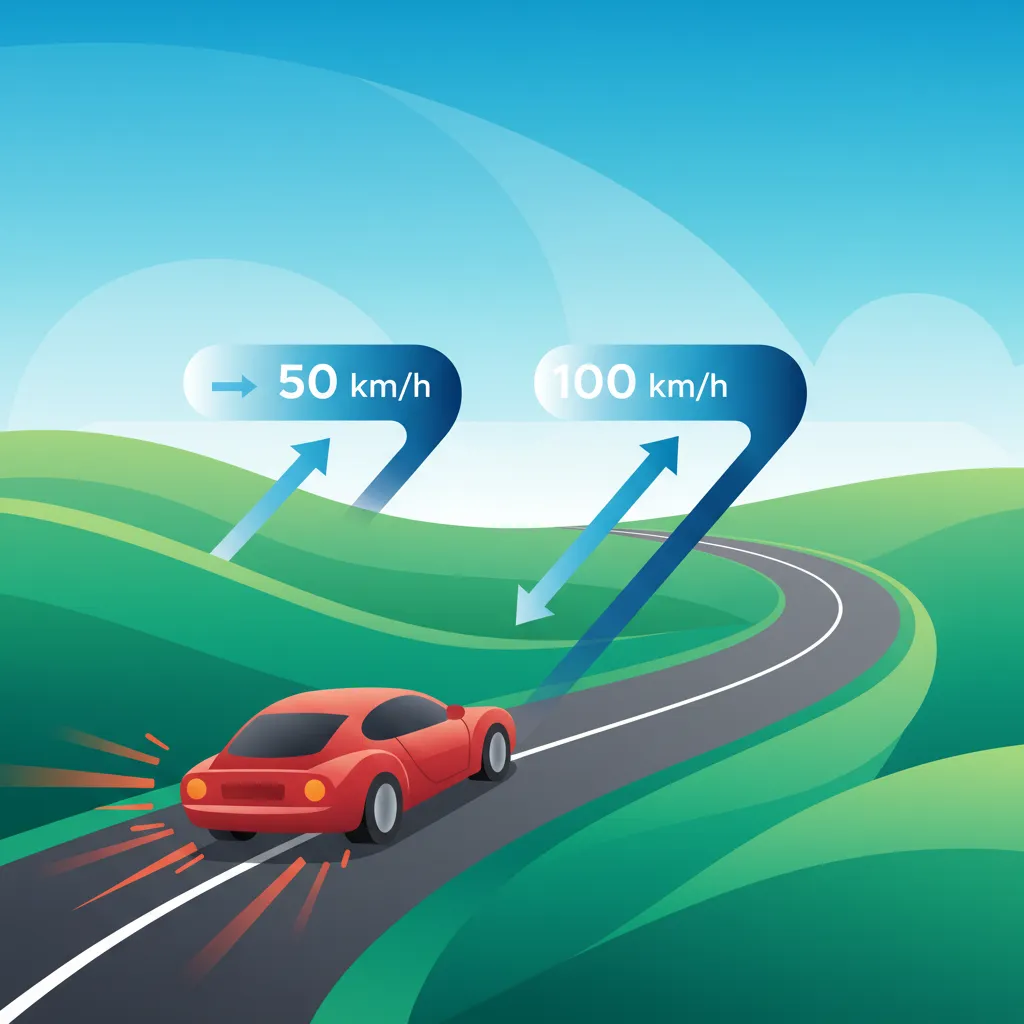
Crucially, kinetic energy increases with the square of your speed. This means that if you double your speed, your kinetic energy quadruples, and your braking distance will increase by approximately four times, assuming all other factors remain constant. This non-linear relationship is a key concept for both safe driving and DGT questions.
Several factors significantly influence how quickly your vehicle can come to a stop after the brakes are applied. Understanding these is vital for predicting braking distance and driving safely in Spain.
This is the most critical factor. As explained, braking distance increases exponentially with speed.
This dramatic increase means that even a small increase in speed can have a profound effect on your ability to stop, especially on high-speed Spanish autovías and autopistas.
The friction between your tires and the road surface, known as grip or adherencia, is paramount.
Drivers must always adjust their speed to the road conditions, particularly during Spain's varying weather, from heavy summer storms to icy winter mornings in mountainous regions.
Your tires are the only part of your vehicle in contact with the road. Their condition directly impacts grip.
The overall health of your vehicle's braking system and suspension plays a vital role.
A heavier vehicle requires more force to slow down and stop due to its increased mass.
It's crucial for DGT exam success and real-world safety to distinguish between these terms:
In simplified DGT calculations, a typical healthy driver's reaction time is often estimated at one second. This means at 100 km/h, the vehicle travels approximately 28 meters before the driver even begins to brake. The distancia de frenado then adds to this.
Consider these everyday situations where understanding braking distance is critical:
Learners frequently make mistakes related to braking distance, both in theory and practice:
To drive safely and confidently on Spanish roads, always remember these principles related to braking distance:
By understanding distancia de frenado and its influencing factors, you empower yourself to make safer driving decisions, prevent accidents, and confidently navigate your DGT driving theory exam.
Braking distance is the distance a vehicle travels from brake application until stopping completely, and it increases exponentially with speed—doubling speed roughly quadruples braking distance. This distance is distinct from reaction distance (distance traveled before braking begins) and together they form total stopping distance, a key DGT exam concept. Road conditions dramatically affect braking: wet asphalt can double braking distance while icy surfaces can increase it up to ten times compared to dry roads. Maintaining adequate following distance, keeping tires and brakes in good condition, and adjusting speed to conditions are essential practices for safe driving in Spain and for passing the DGT theory exam.
A short set of high-value points that capture the most important ideas from this theory explanation.
Braking distance (distancia de frenado) is the distance from brake application to full stop, distinct from reaction distance and total stopping distance
Kinetic energy increases with the square of speed, so doubling your speed roughly quadruples your braking distance
Road surface conditions dramatically affect braking: wet roads can double and icy roads can extend braking distance up to ten times compared to dry asphalt
Total stopping distance equals reaction distance plus braking distance, with the DGT often testing this distinction in exams
Vehicle load, tire condition, and brake system condition all directly impact how far your vehicle travels while braking
Braking distance clock starts when brakes are applied; reaction distance clock starts when hazard is perceived
At 100 km/h, a typical reaction time of one second already covers approximately 28 meters before braking begins
Tire tread depth and pressure directly affect road grip and therefore braking distance
Heavily loaded vehicles require longer braking distances due to increased mass
Maintain adequate distancia de seguridad to account for both reaction and braking phases
Assuming doubling speed only doubles braking distance, when it actually quadruples it
Confusing distancia de frenado with distancia de detención on DGT exam questions
Failing to adjust speed sufficiently for wet roads, ice, or loose surfaces
Overestimating vehicle capabilities and not accounting for worn tires or poor maintenance
Following too closely without leaving space for the combined reaction and braking distance required to stop safely
Start with a short, direct summary of Braking Distance before reading the full explanation below.
Braking distance is the distance a vehicle covers after the driver applies the brakes until it stops. It increases significantly with speed, often quadrupling when speed doubles. Factors like wet roads, worn tires, or heavy loads also extend this distance. It is a critical component of total stopping distance, distinct from the initial reaction distance.
Review the most important terms, rule signals, and traffic concepts linked to Braking Distance.
Explore related theory topic pages connected to Braking Distance and continue with the next useful rule explanation.
See the common search queries learners use when trying to understand Braking Distance in Spain.

Continue your preparation by exploring specific Spanish driving theory topics in depth. Review road signs, understand priority rules, and master DGT traffic laws. This section provides the essential knowledge to pass your exam and drive safely across Spain.
Explore Spanish Driving Theory TopicsTheory topic content overview
A short set of high-value points that capture the most important ideas from this theory explanation.
Braking distance (distancia de frenado) is the distance from brake application to full stop, distinct from reaction distance and total stopping distance
Kinetic energy increases with the square of speed, so doubling your speed roughly quadruples your braking distance
Road surface conditions dramatically affect braking: wet roads can double and icy roads can extend braking distance up to ten times compared to dry asphalt
Total stopping distance equals reaction distance plus braking distance, with the DGT often testing this distinction in exams
Vehicle load, tire condition, and brake system condition all directly impact how far your vehicle travels while braking
Braking distance clock starts when brakes are applied; reaction distance clock starts when hazard is perceived
At 100 km/h, a typical reaction time of one second already covers approximately 28 meters before braking begins
Tire tread depth and pressure directly affect road grip and therefore braking distance
Heavily loaded vehicles require longer braking distances due to increased mass
Maintain adequate distancia de seguridad to account for both reaction and braking phases
Assuming doubling speed only doubles braking distance, when it actually quadruples it
Confusing distancia de frenado with distancia de detención on DGT exam questions
Failing to adjust speed sufficiently for wet roads, ice, or loose surfaces
Overestimating vehicle capabilities and not accounting for worn tires or poor maintenance
Following too closely without leaving space for the combined reaction and braking distance required to stop safely
Start with a short, direct summary of Braking Distance before reading the full explanation below.
Braking distance is the distance a vehicle covers after the driver applies the brakes until it stops. It increases significantly with speed, often quadrupling when speed doubles. Factors like wet roads, worn tires, or heavy loads also extend this distance. It is a critical component of total stopping distance, distinct from the initial reaction distance.
Review the most important terms, rule signals, and traffic concepts linked to Braking Distance.
Explore related theory topic pages connected to Braking Distance and continue with the next useful rule explanation.
See the common search queries learners use when trying to understand Braking Distance in Spain.
Continue your preparation by exploring specific Spanish driving theory topics in depth. Review road signs, understand priority rules, and master DGT traffic laws. This section provides the essential knowledge to pass your exam and drive safely across Spain.
Explore Spanish Driving Theory TopicsUse this exam-focused revision tip to understand how Braking Distance is likely to appear in theory questions for learners in Spain. This section helps you identify the most testable part of the rule, avoid common traps, and remember the concept more effectively during Spanish driving theory exam preparation.
For the DGT exam, remember that braking distance is most critically affected by speed, increasing disproportionately when speed doubles or triples. Don't confuse it with reaction distance; braking distance starts when the brake pedal is pressed. Always consider adverse road conditions like rain or ice, which drastically multiply the distance needed to stop safely.
Read direct answers to the most common learner questions about Braking Distance in Spain. This FAQ focuses on rule confusion, practical meaning, comparison with similar concepts, and the exact uncertainties that appear most often in Spanish driving theory revision and exam preparation.
Distancia de frenado is the distance a vehicle travels from the instant the driver presses the brake pedal until the vehicle comes to a complete stop.
In Spain, as in all driving, braking distance increases exponentially with speed. Doubling your speed can roughly quadruple your braking distance due to the increase in kinetic energy.
Braking distance is only the distance covered during active braking. Stopping distance (distancia de detención) is the total distance, combining reaction distance (distancia de reacción) and braking distance.
Wet, icy, snowy, or gravelly roads significantly reduce tire grip, leading to much longer braking distances. Poor road surfaces in Spain require extra caution.
Yes, a heavier vehicle or one with worn tires, incorrect tire pressure, or faulty brakes will require a longer braking distance. Regular vehicle maintenance is essential.
Absolutely. The DGT exam frequently tests your knowledge of braking distance, especially how it changes with speed and environmental factors, as it's vital for safe driving.
While exact numbers are less important than understanding factors, on a dry road at 50 km/h, the braking distance is significantly less than at 100 km/h, illustrating the exponential relationship with speed.
Use our powerful search functionality to pinpoint specific Spanish DGT driving theory practice sets. Filter by road sign categories, traffic law topics, or question difficulty to build custom study sessions and reinforce your knowledge precisely where it matters for your official exam.