
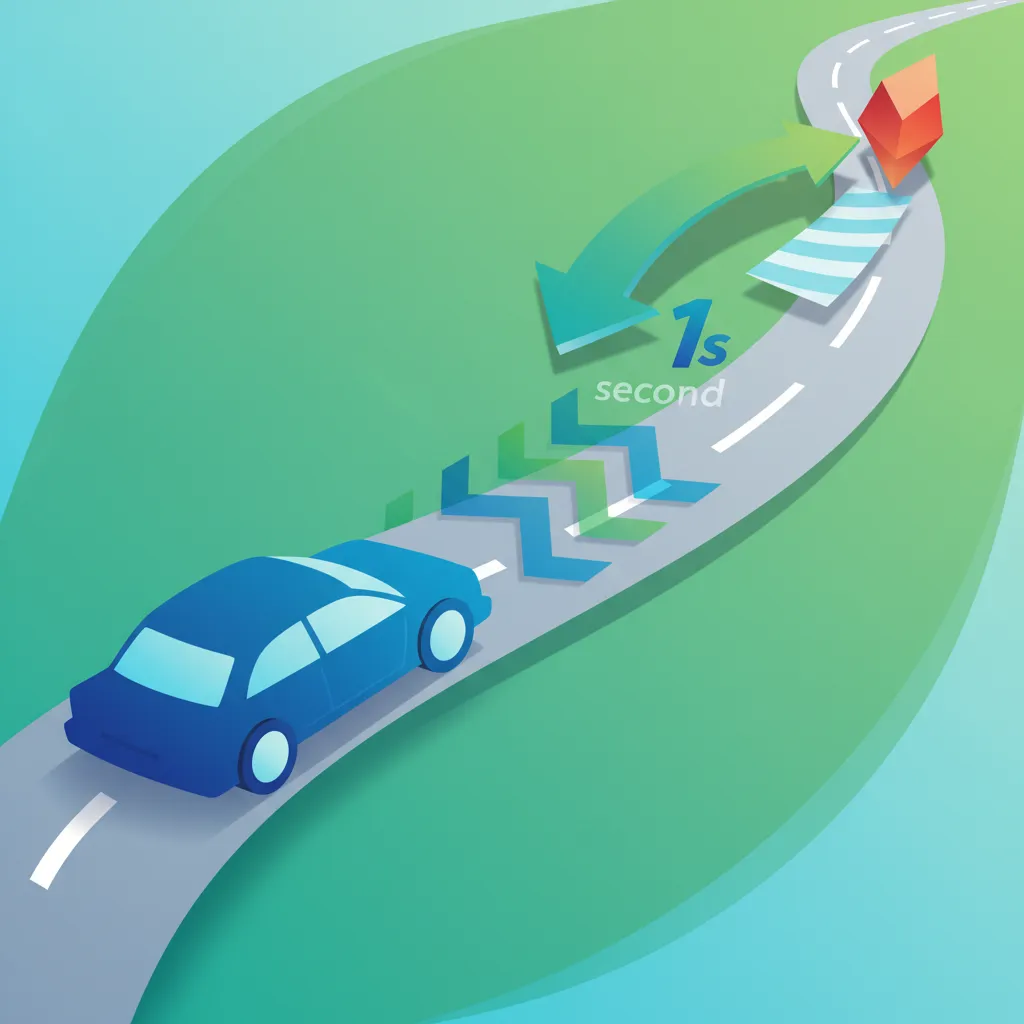
Reaction distance is the meters your vehicle travels from the moment you perceive a hazard until you physically begin to apply the brakes. This critical period is directly influenced by your speed and your state as a driver, distinct from the actual braking process. In Spain, DGT guidelines emphasize mastering this concept for effective hazard management and exam readiness.
Theory topic content overview
Read the full theory topic guide for Reaction Distance Explained with structured, easy-to-scan content built for learners in Spain. This detailed section explains the exact rule, meaning, traffic context, comparison points, and exam logic behind this Spanish driving theory topic so you can study faster, understand the concept more clearly, and avoid common interpretation mistakes on the theory test.
Reaction distance, known in Spanish driving theory as distancia de reacción, is the space your vehicle travels from the moment a driver first perceives a hazard until they initiate a physical response, such as pressing the brake pedal or steering to avoid it. It is the distance covered before any actual braking or evasive manoeuvre takes effect.
This critical period is governed by your reaction time (tiempo de reacción), which is the duration of a three-phase cognitive and physical process:
For an attentive driver in normal conditions, the average reaction time is generally estimated by the DGT (Dirección General de Tráfico) to be between 0.5 and 1 second, often cited around 0.75 seconds or "almost a second." During this seemingly short interval, your vehicle continues its journey at its current speed.
Mastering the concept of distancia de reacción is not just an academic exercise for your DGT theory exam; it's fundamental for road safety across Spain's diverse driving conditions, from bustling urban areas to high-speed autovías and autopistas.
distancia de reacción are common in the Spanish driving theory test, often involving scenarios that test your understanding of how various factors affect it.distancia de seguridad) from the vehicle in front, especially at higher speeds on motorways.The most important practical aspect of distancia de reacción is its direct, linear relationship with speed. This means that if you double your speed, you double your reaction distance.
Let's illustrate:
This linear increase is critical because many drivers underestimate how far their vehicle travels during their reaction time, especially at higher speeds typical on Spanish autovías. The faster you drive, the more critical a quick and clear perception-decision-action process becomes.
While an attentive driver has an average reaction time, many factors can significantly lengthen this period, directly increasing your distancia de reacción and, consequently, your overall distancia de detención (total stopping distance). The DGT places a strong emphasis on understanding these human factors:
Fatiga): Tiredness dramatically slows down perception and decision-making. Symptoms like drowsiness, blurred vision, and difficulty concentrating are major hazards.Distracciones): Any activity that takes your attention away from the road, such as using a mobile phone, adjusting the radio, or talking to passengers, can delay your reaction by crucial seconds. This is a primary concern for the DGT.Alcohol y Drogas): Even small amounts of alcohol or certain drugs impair judgment, coordination, and reaction speed. These substances are severely regulated in Spain due to their profound impact on driving ability.Estrés y Estado de Ánimo Alterado): Strong emotions like anger, anxiety, or sadness can reduce concentration and lead to slower, less effective reactions.Medicamentos): Many prescription and over-the-counter medications can cause drowsiness or impair cognitive function. Always check for driving warnings.Edad Avanzada): While not universally true, reaction times can naturally slow with age.Mala Visibilidad): Conditions like heavy rain, fog, or darkness can make hazards harder to perceive, effectively delaying the start of your reaction time.One of the most common confusions for DGT learners is distinguishing between distancia de reacción and distancia de frenado (braking distance). Understanding this difference is fundamental for the exam and safe driving.
Reaction Distance (Distancia de Reacción):
Braking Distance (Distancia de Frenado):
Together, these two distances combine to form the total stopping distance (distancia de detención):
Distancia de Detención = Distancia de Reacción + Distancia de Frenado
This equation highlights that even with excellent brakes, a slow reaction significantly increases the overall distance needed to stop.
Consider these everyday situations on Spanish roads where distancia de reacción plays a critical role:
Rotonda): You're at 40 km/h on a city street (vía urbana). If a vehicle unexpectedly enters the roundabout, your 0.75-second reaction time means you've covered about 8.3 meters before your foot even reaches the brake pedal. If you were distracted, this distance could easily double.Autovía at 120 km/h: A sudden obstruction appears (e.g., a tyre blowout from another vehicle). At this speed, even a fast 1-second reaction means your car travels approximately 33.3 meters – the length of almost three articulated lorries – before you begin to slow down.Carretera Convencional) with Poor Visibility: Driving at 80 km/h on a foggy morning. A deer suddenly darts onto the road. The delay in perceiving the hazard due to fog will significantly extend your effective reaction time, leading to a much greater distancia de reacción than on a clear day, making an impact much more likely.Drivers, especially new learners preparing for their DGT exam, often make these errors regarding distancia de reacción:
reacción is before braking, frenado is during braking.velocidad adecuada (appropriate speed) takes into account reaction distance and all other conditions, meaning you might need to drive slower than the limit to be safe.The Dirección General de Tráfico (DGT) places considerable importance on distancia de reacción within its driving theory curriculum, largely because it falls under the "human factor" (factor humano) in accident causation.
Spanish driving theory emphasizes that the driver's physical and mental state is the primary determinant of reaction time. This is why sections on fatigue, distractions (especially mobile phone use), and the effects of alcohol and drugs are so prominent in DGT materials. The DGT wants to instill in future drivers that control starts within themselves before any interaction with the vehicle's mechanics or road conditions.
Questions in the examen teórico de conducir often link distancia de reacción directly to these driver-related factors, rather than just vehicle mechanics or road surface conditions (which primarily affect distancia de frenado). This underscores the DGT's commitment to promoting proactive and responsible driving behaviour for enhanced seguridad vial across Spain.
Your distancia de reacción is a non-negotiable part of safe driving in Spain. To minimise it and ensure maximum safety:
velocidad adecuada that accounts for your own state, road conditions, and potential hazards, ensuring you have ample time to perceive, decide, and act.Remember the DGT's core message: A responsible driver understands their limits and the inherent delays in human reaction, adapting their driving to compensate and ensure the safety of all road users.
Reaction distance (distancia de reacción) is the space a vehicle travels during the perception-decision-action process before braking, typically lasting 0.5 to 1 second for an attentive driver, during which the vehicle continues at full speed. This distance increases linearly with speed, making higher speeds particularly dangerous as the vehicle covers substantially more ground before deceleration begins. Factors such as fatigue, distraction, alcohol, poor visibility, and stress can significantly lengthen reaction time, directly increasing the distance traveled before braking starts. The DGT emphasizes the human factor in road safety, teaching that driver alertness and state are the primary determinants of reaction distance, distinguishing it from vehicle-dependent braking distance which is affected by road surface, tyre condition, and vehicle mechanics.
A short set of high-value points that capture the most important ideas from this theory explanation.
Reaction distance is the distance your vehicle travels from hazard perception to initiating braking, before any deceleration begins.
The relationship between speed and reaction distance is linear: doubling your speed doubles your reaction distance.
Average reaction time for an attentive driver is 0.5 to 1 second, during which the vehicle continues at full speed.
Driver state directly determines reaction distance; fatigue, distraction, alcohol, and stress all lengthen it significantly.
Reaction distance combined with braking distance equals total stopping distance, making driver alertness critical for safety.
Reaction time follows a three-phase process: perception (identifying hazard), decision (choosing response), and action (physical response).
At 100 km/h, a 1-second reaction time means your vehicle travels approximately 28 meters before braking begins.
Factors that increase reaction distance include fatigue, mobile phone use, alcohol, stress, certain medications, age, and poor visibility.
Reaction distance increases linearly with speed, while braking distance increases quadratically; they are fundamentally different concepts.
A safe following distance must account for your reaction distance, not just your braking distance.
Confusing reaction distance with braking distance: reaction distance is before braking, braking distance is during braking.
Assuming you can react almost instantly to hazards, underestimating the distance traveled during reaction time.
Believing that speed limits always represent safe speeds without adjusting for driver state or road conditions.
Ignoring personal factors like fatigue or mild distraction that can significantly increase reaction time.
Failing to maintain adequate following distance based on the full stopping distance, not just braking distance.
Start with a short, direct summary of Reaction Distance Explained before reading the full explanation below.
Reaction distance is the space your vehicle covers from the moment you detect a hazard until you physically start to brake. This crucial period, typically around one second for an attentive driver, is significantly influenced by your speed, alertness, and external factors. In Spain, mastering this concept is fundamental for safe driving and avoiding common pitfalls in DGT theory exams.
Review the most important terms, rule signals, and traffic concepts linked to Reaction Distance Explained.
Explore related theory topic pages connected to Reaction Distance Explained and continue with the next useful rule explanation.
See the common search queries learners use when trying to understand Reaction Distance Explained in Spain.

Continue your preparation by exploring specific Spanish driving theory topics in depth. Review road signs, understand priority rules, and master DGT traffic laws. This section provides the essential knowledge to pass your exam and drive safely across Spain.
Explore Spanish Driving Theory TopicsTheory topic content overview
A short set of high-value points that capture the most important ideas from this theory explanation.
Reaction distance is the distance your vehicle travels from hazard perception to initiating braking, before any deceleration begins.
The relationship between speed and reaction distance is linear: doubling your speed doubles your reaction distance.
Average reaction time for an attentive driver is 0.5 to 1 second, during which the vehicle continues at full speed.
Driver state directly determines reaction distance; fatigue, distraction, alcohol, and stress all lengthen it significantly.
Reaction distance combined with braking distance equals total stopping distance, making driver alertness critical for safety.
Reaction time follows a three-phase process: perception (identifying hazard), decision (choosing response), and action (physical response).
At 100 km/h, a 1-second reaction time means your vehicle travels approximately 28 meters before braking begins.
Factors that increase reaction distance include fatigue, mobile phone use, alcohol, stress, certain medications, age, and poor visibility.
Reaction distance increases linearly with speed, while braking distance increases quadratically; they are fundamentally different concepts.
A safe following distance must account for your reaction distance, not just your braking distance.
Confusing reaction distance with braking distance: reaction distance is before braking, braking distance is during braking.
Assuming you can react almost instantly to hazards, underestimating the distance traveled during reaction time.
Believing that speed limits always represent safe speeds without adjusting for driver state or road conditions.
Ignoring personal factors like fatigue or mild distraction that can significantly increase reaction time.
Failing to maintain adequate following distance based on the full stopping distance, not just braking distance.
Start with a short, direct summary of Reaction Distance Explained before reading the full explanation below.
Reaction distance is the space your vehicle covers from the moment you detect a hazard until you physically start to brake. This crucial period, typically around one second for an attentive driver, is significantly influenced by your speed, alertness, and external factors. In Spain, mastering this concept is fundamental for safe driving and avoiding common pitfalls in DGT theory exams.
Review the most important terms, rule signals, and traffic concepts linked to Reaction Distance Explained.
Explore related theory topic pages connected to Reaction Distance Explained and continue with the next useful rule explanation.
See the common search queries learners use when trying to understand Reaction Distance Explained in Spain.
Continue your preparation by exploring specific Spanish driving theory topics in depth. Review road signs, understand priority rules, and master DGT traffic laws. This section provides the essential knowledge to pass your exam and drive safely across Spain.
Explore Spanish Driving Theory TopicsUse this exam-focused revision tip to understand how Reaction Distance Explained is likely to appear in theory questions for learners in Spain. This section helps you identify the most testable part of the rule, avoid common traps, and remember the concept more effectively during Spanish driving theory exam preparation.
Remember for your DGT exam: Reaction distance increases *linearly* with speed, while braking distance increases *quadratically*. Don't confuse the two, and always consider factors like fatigue or distractions which directly lengthen your reaction time, making your vehicle travel much farther before you even start to slow down.
Read direct answers to the most common learner questions about Reaction Distance Explained in Spain. This FAQ focuses on rule confusion, practical meaning, comparison with similar concepts, and the exact uncertainties that appear most often in Spanish driving theory revision and exam preparation.
Reaction distance is the meters a vehicle travels from the moment a driver identifies a hazard until they physically initiate braking or steering action. It's the distance covered during the driver's reaction time.
Reaction distance increases proportionally with speed. If you double your speed, your reaction distance also doubles, because the vehicle covers more ground in the same amount of reaction time.
In Spain, as per DGT guidelines, factors like fatigue, distraction (e.g., mobile phone use), alcohol or drugs, certain medications, stress, and poor visibility significantly lengthen a driver's reaction time and thus the reaction distance.
For an alert and healthy driver in normal conditions, the average reaction time is typically between 0.5 to 1 second. However, this can vary greatly depending on individual circumstances and external factors.
Reaction distance is the distance traveled *before* braking begins. Braking distance is the distance traveled *after* the brakes are applied until the vehicle stops. Together, they make up the total stopping distance.
The DGT exam frequently tests your knowledge of reaction distance, especially how it's affected by speed and driver condition. It's crucial for understanding total stopping distance and demonstrating hazard awareness for questions related to safe following distances and accident prevention.
No, the condition of your vehicle (like brakes or tires) primarily affects braking distance, not reaction distance. Reaction distance is solely dependent on the driver's time to perceive and react, and the vehicle's speed during that time.
A common rule of thumb (though not exact) for a normal reaction time of 1 second is to divide your speed in km/h by 3 to get an approximate reaction distance in meters. For example, at 90 km/h, reaction distance is approximately 30 meters. This is a simplified estimate often used in theory to understand the concept.
Use our powerful search functionality to pinpoint specific Spanish DGT driving theory practice sets. Filter by road sign categories, traffic law topics, or question difficulty to build custom study sessions and reinforce your knowledge precisely where it matters for your official exam.