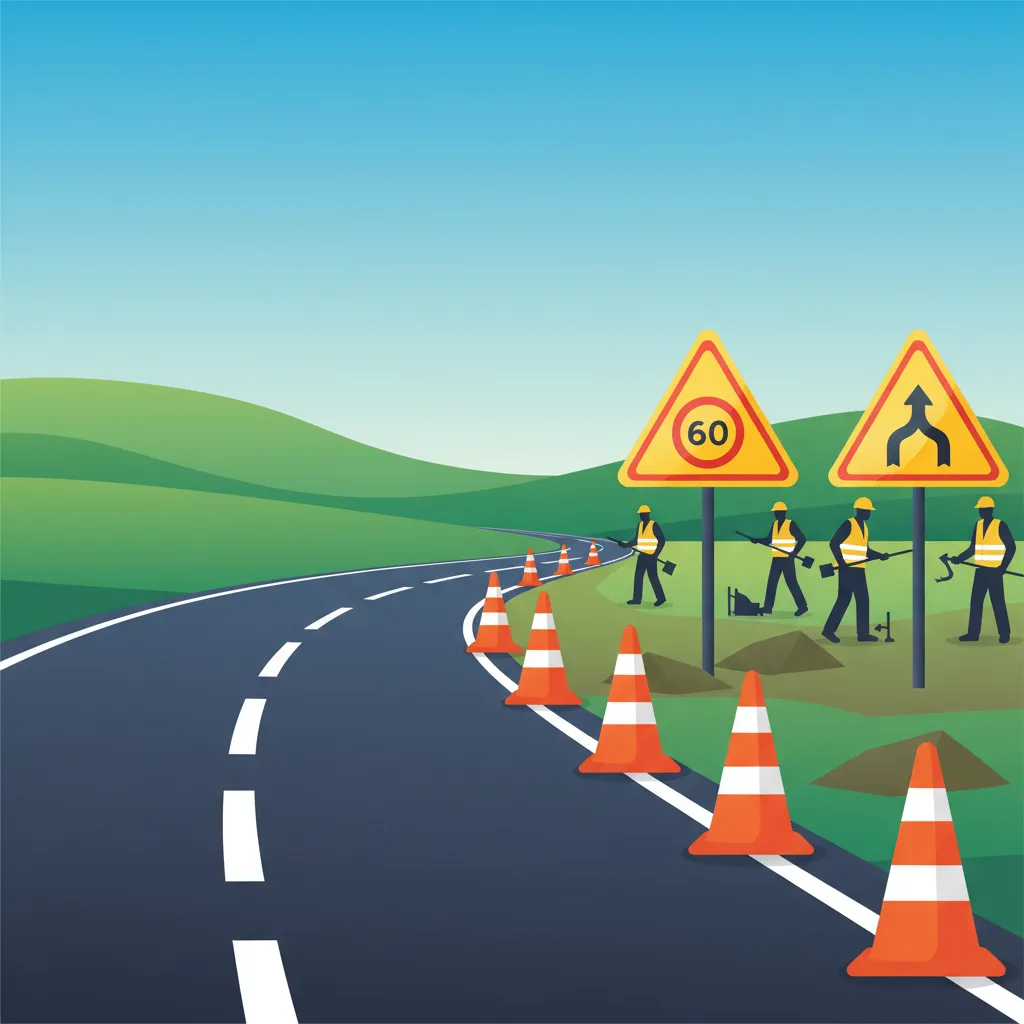
When encountering road work zones on Spanish roads, drivers must recognize the temporary nature of these areas and the specific dangers they pose. This includes understanding special signage, often with a yellow background, adapting your speed, and being vigilant for workers and construction equipment. Your ability to safely navigate these areas is vital for both your safety and that of others.
Theory topic content overview
Read the full theory topic guide for Road Work Zones with structured, easy-to-scan content built for learners in Spain. This detailed section explains the exact rule, meaning, traffic context, comparison points, and exam logic behind this Spanish driving theory topic so you can study faster, understand the concept more clearly, and avoid common interpretation mistakes on the theory test.
Road work zones, or zonas de obra as they are known in Spain, are temporary sections of road where construction, maintenance, or repair activities are actively taking place. These areas introduce significant and dynamic changes to the normal driving environment, demanding heightened awareness and strict adherence to specific temporary rules from all drivers on Spanish roads. Recognizing and safely navigating these zones is not only crucial for road safety but also a key component of the Spanish driving theory exam.
Driving through zonas de obra presents a unique set of hazards that significantly increase the risk of accidents if proper caution is not exercised. The DGT (Dirección General de Tráfico) places strong emphasis on understanding these risks for several reasons:
señalización de obras (work zone signage) and conditions within these zones.The primary way to identify road work zones in Spain is through their distinctive temporary señalización circunstancial (circumstantial signage) and road markings. These temporary rules always override permanent signage and regulations when there is a conflict.
obras will have a yellow background instead of the usual white or blue. This fondo amarillo immediately signals a temporary situation due to road works. Examples include señales de peligro (danger signs) like P-18 (Proximity of works), señales de reglamentación (regulatory signs) indicating temporary speed limits, or señales de indicación (information signs) guiding lane changes.marcas viales indicate the active lanes and traffic flow through the work zone. If white and yellow lines are present, the yellow lines are the ones you must follow.balizas luminosas), and arrow boards are commonly used to channel traffic and mark the boundaries of the work area.Personal de Obras): Workers directing traffic with flags or hand signals must be obeyed immediately and without question. Their instructions override all other signage.señales de obras (yellow signs) and marcas viales amarillas. They provide crucial information about lane closures, merges, detours, and temporary speed limits.zonas de obra. Remain calm and avoid aggressive driving, which only increases risk.A crucial concept for the DGT driving theory exam and safe driving in Spain is the hierarchy of road signs. In road work zones:
señalización de obras (yellow signs or yellow markings) always takes precedence over permanent white signs or markings that might contradict them. For example, a yellow speed limit of 60 km/h will override a permanent white sign indicating 120 km/h on an autovía.personal de obras (site personnel) directing traffic supersede all other signs and markings. You must obey their signals even if they seem to contradict a posted sign.This principle ensures that drivers adapt to the immediate, changing conditions of the work site, prioritizing safety.
You are driving on an autovía (motorway) in Spain, typically with a 120 km/h speed limit. You see a series of yellow warning signs (señales de peligro) indicating "Obras" (works ahead), followed by a yellow regulatory sign (señal de reglamentación) with a 80 km/h speed limit, and then another with 60 km/h. Cones (conos) begin to narrow the right lane.
Correct Action: Immediately begin reducing your speed smoothly and significantly, preparing to reach 60 km/h. Check your mirrors, signal early, and safely merge left as the right lane narrows. Be alert for workers on the shoulder or machinery entering/exiting. Maintain the reduced speed and increased following distance throughout the marked zone.
You are in a town, approaching an intersection. The usual white lane lines are faded, but new bright yellow marcas viales direct traffic into a temporary single lane that curves around a trench. There are no vertical signs, but orange barriers are present.
Correct Action: Treat the yellow lines as the definitive guide for your lane. Ignore the faded white lines. Reduce speed, as the lane may be narrower and the surface uneven. Be prepared for pedestrians who might not expect the altered path and for any equipment or material stored near the roadway.
Learners and even experienced drivers often make critical errors when encountering road work zones:
When you encounter road work zones in Spain, remember that they are dynamic, high-risk environments. Your mantra should be "Yellow means caution and temporary rules." Always prioritize safety for yourself, other road users, and especially the workers.
señales verticales de fondo amarillo and marcas viales amarillas. These are your primary indicators of temporary rules.personal de obras.Mastering these behaviors for driving in road work zones is essential for passing your Spanish driving licence theory test and, more importantly, for safe driving on Spanish roads.
Road work zones (zonas de obra) in Spain are temporary high-risk areas requiring strict adherence to specific DGT regulations. The most critical principle is that temporary yellow signage and markings always override permanent white ones, and site personnel instructions supersede all other controls. Drivers must reduce speed significantly before entering, increase following distance, and maintain constant vigilance for workers and machinery in altered road conditions. Mastering these behaviors is essential for both the Spanish driving theory exam and safe real-world driving.
A short set of high-value points that capture the most important ideas from this theory explanation.
Temporary yellow signs and markings always override permanent white signs when they conflict in work zones
Instructions from site personnel (personal de obras) supersede all signage and road markings
Speed must be reduced significantly and well in advance of entering the work zone
Yellow road markings indicate the active lane configuration and take priority over white markings
Worker safety depends entirely on driver vigilance and adherence to temporary rules
Yellow background on vertical signs indicates temporary señalización circunstancial specific to road works
Yellow marcas vials (road markings) are the definitive guide when both yellow and white lines exist
The hierarchy is: personnel instructions > temporary signs > permanent signs
Even without posted speed limits, drivers must adapt speed to conditions in work zones
Orange cones, barriers, and flashing lights (balizas luminosas) mark work area boundaries
Ignoring yellow signs as warnings rather than mandatory regulatory instructions for speed and lane use
Waiting too long to reduce speed, only braking once already inside the work zone
Driving distracted through complex work zones, increasing reaction time to sudden hazards
Assuming workers are stationary or aware of approaching vehicles at all times
Following faded white lane lines instead of bright yellow temporary markings in city work zones
Start with a short, direct summary of Road Work Zones before reading the full explanation below.
Road work zones in Spain are temporary areas where construction or maintenance activities take place, requiring drivers to exercise extreme caution. You must follow all temporary traffic controls, including reduced speed limits, special yellow road signs and markings, and the instructions of site personnel. These zones often feature altered road layouts and the presence of workers, making vigilance essential to prevent accidents.
Review the most important terms, rule signals, and traffic concepts linked to Road Work Zones.
Explore related theory topic pages connected to Road Work Zones and continue with the next useful rule explanation.
See the common search queries learners use when trying to understand Road Work Zones in Spain.

Continue your preparation by exploring specific Spanish driving theory topics in depth. Review road signs, understand priority rules, and master DGT traffic laws. This section provides the essential knowledge to pass your exam and drive safely across Spain.
Explore Spanish Driving Theory TopicsTheory topic content overview
A short set of high-value points that capture the most important ideas from this theory explanation.
Temporary yellow signs and markings always override permanent white signs when they conflict in work zones
Instructions from site personnel (personal de obras) supersede all signage and road markings
Speed must be reduced significantly and well in advance of entering the work zone
Yellow road markings indicate the active lane configuration and take priority over white markings
Worker safety depends entirely on driver vigilance and adherence to temporary rules
Yellow background on vertical signs indicates temporary señalización circunstancial specific to road works
Yellow marcas vials (road markings) are the definitive guide when both yellow and white lines exist
The hierarchy is: personnel instructions > temporary signs > permanent signs
Even without posted speed limits, drivers must adapt speed to conditions in work zones
Orange cones, barriers, and flashing lights (balizas luminosas) mark work area boundaries
Ignoring yellow signs as warnings rather than mandatory regulatory instructions for speed and lane use
Waiting too long to reduce speed, only braking once already inside the work zone
Driving distracted through complex work zones, increasing reaction time to sudden hazards
Assuming workers are stationary or aware of approaching vehicles at all times
Following faded white lane lines instead of bright yellow temporary markings in city work zones
Start with a short, direct summary of Road Work Zones before reading the full explanation below.
Road work zones in Spain are temporary areas where construction or maintenance activities take place, requiring drivers to exercise extreme caution. You must follow all temporary traffic controls, including reduced speed limits, special yellow road signs and markings, and the instructions of site personnel. These zones often feature altered road layouts and the presence of workers, making vigilance essential to prevent accidents.
Review the most important terms, rule signals, and traffic concepts linked to Road Work Zones.
Explore related theory topic pages connected to Road Work Zones and continue with the next useful rule explanation.
See the common search queries learners use when trying to understand Road Work Zones in Spain.
Continue your preparation by exploring specific Spanish driving theory topics in depth. Review road signs, understand priority rules, and master DGT traffic laws. This section provides the essential knowledge to pass your exam and drive safely across Spain.
Explore Spanish Driving Theory TopicsUse this exam-focused revision tip to understand how Road Work Zones is likely to appear in theory questions for learners in Spain. This section helps you identify the most testable part of the rule, avoid common traps, and remember the concept more effectively during Spanish driving theory exam preparation.
In the Spanish theory exam, remember that temporary rules in road work zones, indicated by yellow signs and markings, always override permanent ones. Always be extra vigilant for workers and machinery, and be ready to reduce your speed significantly. Prioritize safety above all else, as these are high-risk areas.
Read direct answers to the most common learner questions about Road Work Zones in Spain. This FAQ focuses on rule confusion, practical meaning, comparison with similar concepts, and the exact uncertainties that appear most often in Spanish driving theory revision and exam preparation.
In Spain, vertical road signs and temporary road markings used in work zones have a yellow background to clearly indicate their temporary nature and to differentiate them from permanent signage. This alerts drivers to temporary changes in traffic rules or road conditions.
The most important rule is to reduce your speed, pay extreme attention to all temporary signage and road markings, and follow the instructions of any road work personnel. Expect unexpected changes and potential hazards.
Yes, it is common for speed limits to be significantly reduced in road work zones to ensure the safety of both drivers and workers. Always adhere to the posted temporary speed limits.
Key hazards include the presence of workers and heavy machinery, temporary lane shifts, uneven road surfaces, loose gravel, and sudden obstacles. Be prepared for abrupt stops or changes in traffic flow.
Yes, temporary yellow road markings in construction zones always take precedence over permanent white markings. You must follow the temporary markings to navigate the work area safely.
Slow down significantly, maintain a safe distance, and be ready to stop if necessary. Always obey any hand signals or directions given by the road work personnel, as they are directing traffic for safety.
The DGT emphasizes that road work zones (`obras`) require heightened vigilance, adapted speed, and strict adherence to temporary signaling and personnel instructions to protect both drivers and workers. This is a critical aspect of safe driving behavior.
Overtaking is generally prohibited and extremely dangerous in road work zones due to reduced lane widths, potential oncoming traffic, and the presence of obstacles or workers. Always assume overtaking is forbidden unless explicitly permitted by clear signage.
Balizamiento luminoso refers to illuminated beacons or reflective elements used to mark road work zones, especially at night or in adverse weather conditions. They enhance visibility of the work area and guide drivers, as mandated by Spanish regulations.
Use our powerful search functionality to pinpoint specific Spanish DGT driving theory practice sets. Filter by road sign categories, traffic law topics, or question difficulty to build custom study sessions and reinforce your knowledge precisely where it matters for your official exam.