
This lesson covers the fundamental speed regulations for AM licence holders on various German road types and the critical art of adjusting your riding style. By mastering how environmental factors influence your moped's stability and braking, you will be prepared for both the theoretical exam and real-world safety.

Lesson content overview
Operating a moped, scooter, or light quadricycle under an AM licence in Germany requires a fundamental understanding of speed limits and the crucial skill of adapting your speed to prevailing road and environmental conditions. This lesson, part of your German Driving Theory Course for AM Licence, will equip you with the knowledge to navigate German roads safely and legally, ensuring you always maintain appropriate control over your vehicle. Beyond simply adhering to posted signs, a responsible rider must consistently evaluate factors such as weather, road surface, visibility, and traffic density to choose a speed that prioritizes safety for themselves and other road users.
Understanding and correctly applying speed limits is not merely a matter of legal compliance; it is a critical skill for accident prevention, ensuring smooth traffic flow, and managing your vehicle's stopping distance effectively. This lesson builds upon your foundational knowledge of traffic signs and the purpose of speed limits as defined by the German Road Traffic Act (Straßenverkehrs-Ordnung – StVO).
Statutory speed limits are the maximum legally permissible speeds for specific categories of roads under normal driving conditions. These limits are established by law, primarily by § 3 StVO, to standardize vehicle behavior and reduce the risk of accidents across various road environments. For AM licence holders, it is crucial to remember that while these are the maximum legal speeds, your moped, scooter, or light quadricycle may have a lower maximum design speed (often 45 km/h for mopeds), which you must never exceed. Therefore, you always adhere to the lower of the two: the road's legal maximum or your vehicle's design maximum.
In Germany, different types of roads have default speed limits that apply unless otherwise indicated by traffic signs. Familiarity with these basic limits is essential for all drivers, including those with an AM licence:
Germany's famous Autobahnen (motorways) are known for not having a general speed limit for cars and motorcycles. However, for mopeds and scooters (Kleinkrafträder) with a maximum design speed of 45 km/h, access to Autobahnen is prohibited. Only vehicles that can reach a minimum speed of 60 km/h are permitted on Autobahnen. Therefore, as an AM licence holder, you will not typically drive on Autobahnen.
When a speed limit is posted on an Autobahn, it is a legally binding maximum. In sections without a mandatory limit, an advisory speed limit (Richtgeschwindigkeit) of 130 km/h is recommended. While not legally enforceable as a maximum, exceeding it may result in higher liability in case of an accident.
As mentioned, mopeds and scooters (Kleinkrafträder) covered by the AM licence typically have a maximum design speed of 45 km/h. This is a crucial factor that overrides the general road speed limits if those limits are higher.
Always observe the lower of the two speed limits: the legally posted limit for the road or your vehicle's maximum design speed. For most AM vehicles, this means you will not exceed 45 km/h, even on roads with a higher posted limit like 50 km/h or 100 km/h.
This means that while the urban speed limit is 50 km/h, your moped should still not exceed 45 km/h. On rural roads, where the default is 100 km/h, your effective maximum is still 45 km/h. Understanding this distinction is vital for legal and safe operation.
Speed limit signs are indispensable tools for traffic regulation, informing drivers of the current maximum permissible speed. It's essential to not only recognize these signs but also understand their hierarchy and how they interact with default limits.
Speed limit signs typically feature a black number inside a red circle, indicating the maximum speed in kilometers per hour. These can be:
On modern road networks, especially motorways or busy urban arteries, electronic signs are increasingly used to display variable speed limits. These digital signs can change dynamically based on real-time traffic flow, weather conditions (e.g., fog, heavy rain), or incidents ahead.
Drivers must adhere to the speed displayed on these electronic signs as if they were fixed, physical signs. These variable limits are legally binding and supersede any permanent speed limits in the affected section. They are designed to manage traffic flow, prevent congestion, and enhance safety under changing conditions.
Understanding when a speed limit ends is as important as knowing when it begins. Various signs indicate the cessation of a speed restriction:
It is crucial to be attentive to these signs, as missing an "end of limit" sign could lead to unintended speeding or dangerously slow driving if the conditions improve and a higher speed is appropriate.
Beyond strictly following posted signs, one of the most fundamental principles of safe driving in Germany, explicitly enshrined in StVO § 3, is the absolute necessity to adjust your speed to prevailing conditions. This means that even if you are below the posted speed limit, you are legally obligated to drive slower if conditions demand it. This principle is especially vital for AM licence holders, as mopeds and scooters can be more susceptible to adverse conditions due to their lighter weight and two-wheeled nature.
The legal maximum speed limits assume ideal driving conditions: dry roads, good visibility, light traffic, and a vehicle in perfect working order. When any of these ideal factors change, your ability to control the vehicle, react to hazards, and stop safely is compromised. Reducing your speed proactively in such situations is not merely a recommendation; it is a legal requirement and a cornerstone of responsible driving. Failing to adjust your speed to conditions is a common cause of accidents and carries severe legal penalties.
The mandatory reduction of driving speed below the posted maximum limit when adverse conditions (such as poor weather, low visibility, heavy traffic, or hazardous road surfaces) compromise safe vehicle operation, as required by StVO § 3.
Rain significantly reduces tire grip, making braking and steering more challenging. Wet roads drastically increase stopping distances and raise the risk of hydroplaning (aquaplaning), where tires lose contact with the road surface due to a layer of water.
Fog, snow, and ice present some of the most challenging driving conditions. Visibility can drop to mere meters, and traction can be severely compromised.
Beyond specific weather events, other factors demand a reduction in speed:
The condition of your vehicle and the road surface itself also mandate speed adjustments:
The relationship between speed and stopping distance is critical to understand. Higher speeds dramatically increase the distance required to bring a vehicle to a complete stop, making timely speed adjustments indispensable. Total stopping distance is comprised of two main components: reaction distance and braking distance.
Reaction distance is the distance your vehicle travels from the moment you perceive a hazard to the moment you actually apply the brakes. This distance depends directly on your speed and your reaction time.
A common rule of thumb for calculating reaction distance in metres is:
For example:
It is important to remember that this formula assumes an average reaction time. Factors such as fatigue, distraction, alcohol, or medication will significantly lengthen your actual reaction time and, consequently, your reaction distance.
Braking distance is the distance your vehicle travels from the moment you apply the brakes until it comes to a complete stop. Unlike reaction distance, braking distance increases quadratically with speed, meaning if you double your speed, your braking distance quadruples.
A simple rule of thumb for braking distance in metres under ideal conditions (dry road, good tires, effective brakes) is:
For example:
The total stopping distance is the sum of the reaction distance and the braking distance.
As you can see, a relatively small increase in speed from 30 km/h to 50 km/h more than doubles your total stopping distance. Furthermore, these calculations are for ideal conditions. In adverse conditions like rain, ice, or on poor road surfaces, the braking distance (and thus total stopping distance) will be significantly longer. For example, on a wet road, braking distance can easily double. On icy roads, it can be ten times longer or more. This dramatic increase is why conditional speed adjustment is non-negotiable for safe driving.
High speeds dramatically increase total stopping distance and the severity of potential impacts. Always assume your stopping distance will be longer than calculated by simple rules of thumb, especially under less-than-ideal conditions.
Adhering to speed limits and adjusting speed to conditions is not merely a suggestion for safety; it is a legally binding obligation under German traffic law. Violations can lead to significant penalties and severe consequences.
Several paragraphs of the StVO directly address speed:
These regulations collectively ensure that drivers are always responsible for their speed, balancing legal maximums with real-world safety considerations.
For AM licence holders, common violations related to speed include:
Penalties for speed violations in Germany can range from fines and points in the Flensburg register to driving bans, depending on the severity of the transgression. For new drivers, particularly AM licence holders who are often younger, such penalties can have a significant impact.
The legal framework places the full responsibility for choosing a safe and legal speed squarely on the driver. This includes:
By consistently applying these principles, you contribute not only to your own safety but also to the safety of everyone else on the road.
Effective speed management is a cornerstone of safe driving. It involves a combination of legal adherence, physical understanding, and responsible decision-making.
Know the Limits: Memorize default speed limits for different road types and always check for posted signs.
Observe Your Surroundings: Continuously scan the road ahead, behind, and to the sides for changes in conditions, potential hazards, and vulnerable road users.
Anticipate and Adjust: Reduce speed before entering a hazardous situation (e.g., approaching a curve, entering a residential area, before rain starts to fall heavily).
Respect Your Vehicle's Limits: Never exceed your moped's maximum design speed. Understand how its handling changes with load and adverse conditions.
Maintain Adequate Stopping Distance: Always ensure you can stop your vehicle safely within the distance you can see clearly ahead.
Prioritize Safety: When in doubt, drive slower. It is always better to arrive late than not at all.
By mastering the art of speed management, AM licence holders demonstrate a high level of responsibility and competence, making them safer and more confident riders on German roads. This integration of legal knowledge, practical skills, and a safety-first mindset is what defines a truly skilled and responsible driver.
This lesson covers the German speed regulations for AM licence holders, emphasizing that mopeds with 45 km/h maximum design speed must never exceed this limit even on roads with higher posted limits. Key statutory defaults include 50 km/h in urban areas and 100 km/h on rural roads, with residential zones often set at 30 km/h. The critical principle from StVO § 3 mandates that drivers must always adjust their speed to match prevailing conditions, meaning even posted limits can become illegal if weather, visibility, or road surface make them unsafe. The lesson also teaches how to calculate reaction and braking distances, demonstrating that stopping distance increases quadratically with speed and can be dramatically longer in adverse conditions. Understanding these rules is essential for both passing the German theory exam and developing safe, legally compliant riding habits on German roads.
A short set of high-value points that capture the most important learning from this lesson.
AM licence vehicles with a maximum design speed of 45 km/h cannot exceed this limit regardless of higher posted road limits
Statutory default speed limits are 50 km/h in urban areas, 30 km/h in residential zones, and 100 km/h on rural roads, but mopeds must always observe their lower design maximum
StVO § 3 legally requires drivers to adjust speed below posted limits when conditions such as rain, fog, ice, or poor visibility demand it
Total stopping distance equals reaction distance plus braking distance, with braking distance increasing quadratically with speed
Mopeds and scooters with 45 km/h maximum design speed are prohibited from Autobahnen, which require a minimum capability of 60 km/h
Explore all units and lessons included in this driving theory course.
When visibility drops to 50 meters or less (e.g., heavy fog), the maximum permissible speed is 50 km/h regardless of any higher posted limit
Reaction distance in metres can be estimated as (speed ÷ 10) × 3, while braking distance is (speed ÷ 10)² under ideal conditions
The Zeichen 278 sign ends a specific speed limit, while Zeichen 282 ends all restrictions and reverts to general default limits
Wet road conditions can double braking distance, while icy conditions can increase it tenfold or more
Variable speed limits on electronic signs are legally binding and override any previously posted permanent limits
Assuming the posted speed limit is always the maximum safe speed rather than recognizing that StVO § 3 requires conditional adjustment
Forgetting that your vehicle's maximum design speed (typically 45 km/h) is the effective limit when road limits are higher
Not recognizing when a speed limit ends, including failing to distinguish between Zeichen 278 (end of specific limit) and Zeichen 282 (end of all restrictions)
Underestimating how dramatically braking distance increases with speed, thinking doubling speed only doubles stopping distance
Driving at the legal limit in adverse weather (e.g., heavy rain or fog) when conditions require significantly lower speeds
Lesson content overview
A short set of high-value points that capture the most important learning from this lesson.
AM licence vehicles with a maximum design speed of 45 km/h cannot exceed this limit regardless of higher posted road limits
Statutory default speed limits are 50 km/h in urban areas, 30 km/h in residential zones, and 100 km/h on rural roads, but mopeds must always observe their lower design maximum
StVO § 3 legally requires drivers to adjust speed below posted limits when conditions such as rain, fog, ice, or poor visibility demand it
Total stopping distance equals reaction distance plus braking distance, with braking distance increasing quadratically with speed
Mopeds and scooters with 45 km/h maximum design speed are prohibited from Autobahnen, which require a minimum capability of 60 km/h
Explore all units and lessons included in this driving theory course.
When visibility drops to 50 meters or less (e.g., heavy fog), the maximum permissible speed is 50 km/h regardless of any higher posted limit
Reaction distance in metres can be estimated as (speed ÷ 10) × 3, while braking distance is (speed ÷ 10)² under ideal conditions
The Zeichen 278 sign ends a specific speed limit, while Zeichen 282 ends all restrictions and reverts to general default limits
Wet road conditions can double braking distance, while icy conditions can increase it tenfold or more
Variable speed limits on electronic signs are legally binding and override any previously posted permanent limits
Assuming the posted speed limit is always the maximum safe speed rather than recognizing that StVO § 3 requires conditional adjustment
Forgetting that your vehicle's maximum design speed (typically 45 km/h) is the effective limit when road limits are higher
Not recognizing when a speed limit ends, including failing to distinguish between Zeichen 278 (end of specific limit) and Zeichen 282 (end of all restrictions)
Underestimating how dramatically braking distance increases with speed, thinking doubling speed only doubles stopping distance
Driving at the legal limit in adverse weather (e.g., heavy rain or fog) when conditions require significantly lower speeds
Explore search topics learners often look for when studying Speed Limits and Adjustments for Road Conditions. These topics reflect common questions about road rules, driving situations, safety guidance, and lesson level theory preparation for learners in Germany.
Browse additional driving theory lessons that cover connected traffic rules, road signs, and common driving situations related to this topic. Improve your understanding of how different rules interact across everyday traffic scenarios.
Learn how German traffic law (StVO) requires adjusting your speed for rain, fog, ice, and poor road surfaces. Understand the impact on braking distances and vehicle control for your AM license.
This lesson explains the physics behind stopping a vehicle, breaking down the total stopping distance ('Anhalteweg') into its two key components: reaction distance and braking distance. It provides formulas for estimating these distances at various speeds and discusses the critical factors that can increase them, such as driver fatigue, poor weather, and worn tires. Understanding this relationship is vital for appreciating the need for safe speeds and distances.
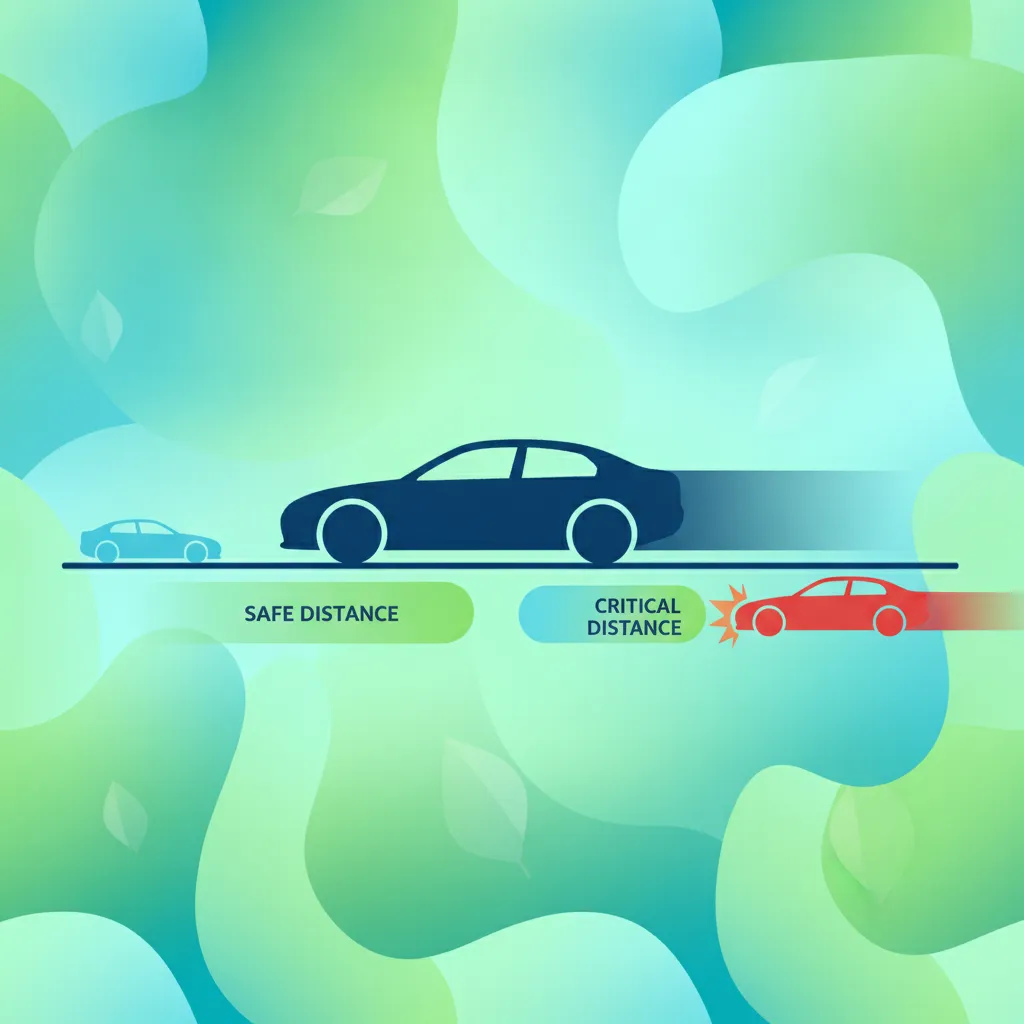
This lesson breaks down the concept of total stopping distance into reaction distance and braking distance. It teaches various braking techniques, including how to perform an emergency stop safely and the function of an Anti-lock Braking System (ABS). The relationship between speed, road condition, and braking effectiveness is a central theme.

This lesson explains the two components of total stopping distance: reaction distance and braking distance. It teaches learners how factors like speed, road conditions, and rider attentiveness influence how far the motorcycle travels before coming to a complete stop. By understanding these principles, riders can make better decisions about safe speeds and following distances to ensure they can stop in time.

This lesson explores how different weather conditions impact driving safety and vehicle performance. It discusses the risks of hydroplaning in heavy rain, reduced visibility in fog, and loss of traction on snow and ice. Drivers will learn how to adapt their speed, increase following distances, and make smooth control inputs to maintain vehicle stability and prevent skids in these challenging conditions.

This lesson teaches drivers how to safely manage their vehicle in challenging weather. It explains the dangers of aquaplaning in heavy rain, the loss of traction on snow and ice (including 'black ice'), and the severely reduced visibility in fog. You will learn to adjust your speed, increase following distances, and use lights correctly to suit these conditions.

This lesson covers the crucial skills of managing speed and maintaining a safe buffer from other vehicles. It teaches methods for calculating an appropriate following distance, such as the time-gap method, which adapts to different speeds and conditions. Learners will understand how to adjust their speed based on traffic flow, road surface, and weather to ensure they always have enough time and space to stop safely.
This lesson examines the specific hazards posed by different weather conditions. It explains how rain can lead to hydroplaning and reduced grip, how fog impairs visibility, and how strong winds can affect stability. Riders will learn practical strategies, such as reducing speed and increasing following distance, to mitigate these risks.

This lesson explores the critical role of visibility in safe driving, covering topics such as sight distance, managing blind spots, and the correct use of mirrors. It provides guidance on how to adjust your driving in conditions of reduced visibility, such as at night, in fog, or during heavy rain, including the proper use of headlights. The importance of the over-the-shoulder check ('Schulterblick') is also a key focus.
This lesson provides a complete guide to driving on the German Autobahn. It covers the correct procedure for entering and exiting via acceleration and deceleration lanes, the strict lane discipline rule of keeping right ('Rechtsfahrgebot'), and the principle of overtaking only on the left. It also explains the recommended speed limit and the critical procedure for forming an emergency corridor ('Rettungsgasse') in a traffic jam.
This lesson details the statutory speed limits in Germany, including the standard limits within built-up areas, on rural roads, and on the Autobahn. It emphasizes that the posted limit is a maximum and that drivers must always adapt their speed to traffic, weather, and visibility conditions. The concept of the recommended speed ('Richtgeschwindigkeit') on the Autobahn is also explained.
Explore the nuances between official German speed limits for AM license holders and the concept of safe, appropriate speed based on traffic density, visibility, and road hazards. Essential theory for hazard perception.
This lesson details the statutory speed limits in Germany, including the standard limits within built-up areas, on rural roads, and on the Autobahn. It emphasizes that the posted limit is a maximum and that drivers must always adapt their speed to traffic, weather, and visibility conditions. The concept of the recommended speed ('Richtgeschwindigkeit') on the Autobahn is also explained.
This lesson covers the crucial skills of managing speed and maintaining a safe buffer from other vehicles. It teaches methods for calculating an appropriate following distance, such as the time-gap method, which adapts to different speeds and conditions. Learners will understand how to adjust their speed based on traffic flow, road surface, and weather to ensure they always have enough time and space to stop safely.
This lesson provides a complete guide to driving on the German Autobahn. It covers the correct procedure for entering and exiting via acceleration and deceleration lanes, the strict lane discipline rule of keeping right ('Rechtsfahrgebot'), and the principle of overtaking only on the left. It also explains the recommended speed limit and the critical procedure for forming an emergency corridor ('Rettungsgasse') in a traffic jam.
This lesson introduces the classification of rural roads and explains how speed limits are determined in these non-urban areas. It covers the German national speed limit for rural roads and how to identify local or temporary restrictions. Learners will understand the importance of adapting their speed to the road's characteristics, such as width, surface condition, and visibility, not just the posted limit.
This lesson focuses on the importance of maintaining a safe following distance ('Sicherheitsabstand') to the vehicle ahead. It teaches practical methods for judging this distance, including the universally applicable two-second rule and the German 'halber Tacho' (half the speedometer reading in meters) rule. The lesson stresses the need to increase this distance in poor weather or when visibility is reduced.

This lesson provides an overview of the German system for penalizing traffic offenses. It explains the catalogue of fines ('Bußgeldkatalog'), the system of demerit points ('Punkte in Flensburg') for more serious violations, and the conditions under which a temporary driving ban ('Fahrverbot') or a full revocation of the license can be imposed. Understanding these consequences reinforces the importance of lawful driving.
This lesson teaches the importance of adhering to speed limits and how to manage speed effectively, especially when hauling heavy loads. It covers the function of speed-limiters to ensure compliance with legal restrictions. The content also discusses the relationship between speed, fuel consumption, and its effect on braking distance.
This lesson explains the specific regulations for operating heavy vehicles on Autobahnen, including speed limits, lane discipline, and overtaking rules. It discusses the use of dedicated truck lanes and the importance of maintaining appropriate following distances. The content also covers procedures for merging and exiting high-speed roads safely.
This lesson details the correct procedures for entering a motorway, using the acceleration lane to match traffic speed, and merging safely. It reinforces the strict lane discipline required, including keeping to the right lane except when overtaking. The content also provides guidance on maintaining increased following distances and performing safe lane changes at high speeds.
This lesson covers the rules and safety considerations for overtaking ('Überholen'). It explains where overtaking is prohibited and how to assess whether it is safe and necessary to do so. The procedure for checking traffic, signaling, moving out, passing, and safely returning to the lane is detailed, with a strong focus on judging the speed and distance of oncoming traffic.
Find clear answers to common questions learners have about Speed Limits and Adjustments for Road Conditions. Learn how the lesson is structured, which driving theory objectives it supports, and how it fits into the overall learning path of units and curriculum progression in Germany. These explanations help you understand key concepts, lesson flow, and exam focused study goals.
In Germany, the general speed limit for motor vehicles in built-up areas is 50 km/h. However, AM riders must always prioritize safety and adjust to specific signage or hazardous conditions, as mopeds have different stability characteristics.
Rain reduces tyre grip and increases braking distances significantly. As an AM rider, you should decrease your speed to account for these conditions, especially on corners or when near cyclists who are also struggling with low traction.
Yes, you may encounter questions regarding braking distance and how it changes with speed. Understanding the basic physics of how doubling your speed quadruples your braking distance is a key concept for your exam.
You must reduce your speed well in advance and avoid sudden braking or sharp steering inputs, which can easily cause a loss of balance on a lightweight AM vehicle. Always look further ahead to identify these road surfaces early.
Begin your targeted revision now. Use our practice search to quickly find specific German driving theory questions. Filter by StVO rules, road signs, or hazard perception to create your focused study plan. Master challenging areas and prepare confidently for your theoretical driving test.