
This lesson explores critical strategies for ensuring you are visible to other road users, a vital skill for every motorcyclist in Belgium. We cover mandatory lighting regulations and how to optimize your conspicuity using reflective gear and positioning to enhance your safety on the road.
Lesson content overview
Visibility is paramount for motorcyclists, who are inherently more vulnerable on the road due to their smaller size. This lesson, part of the Comprehensive Belgian Motorcycle Theory Course: Licence A, A1 & A2, delves into the essential techniques and equipment designed to significantly enhance a rider's presence and perception by other road users. It covers everything from the strategic use of reflective materials on your gear and motorcycle to the specific legal requirements for lighting systems under Belgian law. By mastering these principles, you will learn to reduce the risk of collisions and ensure you are a safer, more conspicuous rider in all conditions.
Conspicuity, in the context of road safety, refers to how easily a vehicle or road user is detected and identified by others. For motorcyclists, achieving high conspicuity is not just a recommendation; it is a fundamental aspect of defensive riding and accident prevention. A motorcycle's slim profile can make it challenging for other drivers to accurately judge its speed and distance, especially in complex traffic environments or at night. Enhancing your visibility helps compensate for these inherent challenges, giving other road users more time to react and avoid potential conflicts. This lesson integrates three core ideas: reflectivity, illumination, and legal obligations, providing a comprehensive framework for maximizing your presence on the road.
Reflectivity is the property of a surface to reflect light back towards its source. For motorcyclists, this means using materials that efficiently return light from other vehicles' headlights, making the rider and motorcycle visible from a greater distance, particularly in low-light conditions or at night.
Reflective materials work by bouncing light directly back to the source. This is especially effective at night when a vehicle's headlights illuminate a rider or motorcycle. The correct application of reflective elements can dramatically increase the distance at which a motorcyclist is detected, providing crucial extra seconds for other drivers to perceive, process, and react.
Your riding gear is your first line of defence in terms of visibility. Modern motorcycle clothing often incorporates retro-reflective materials designed to bounce light directly back to its origin, making you highly visible to drivers whose headlights hit you.
When choosing riding gear, prioritise items with integrated reflective materials, particularly on the back, shoulders, and arms. Even in daylight, reflective accents can catch the eye and improve conspicuity.
Beyond personal gear, the motorcycle itself must be equipped with specific reflective devices, and additional ones are highly recommended.
High-visibility clothing is distinct from purely reflective materials but often incorporates them. These garments typically feature fluorescent colours such as bright yellow, orange, or lime green.
Garments featuring bright, often fluorescent, colours (e.g., yellow, orange) and reflective elements, designed to make the wearer stand out against various backgrounds, especially in daylight and twilight.
Beyond passive reflection, active illumination is crucial for ensuring your motorcycle is seen and for you to see the road ahead, especially in low-light conditions. Belgian law mandates specific lighting requirements and dictates their proper use.
Lights that automatically illuminate when the vehicle's engine is running, specifically designed to enhance a vehicle's visibility to others during daylight hours.
In Belgium, Daytime Running Lights (DRLs) are mandatory for all motorcycles. They are specifically designed to make your motorcycle more noticeable to other road users even in bright daylight.
Your motorcycle's headlamp system is essential for both seeing and being seen. Proper use of low and high beams is critical for safety and legal compliance.
Low Beam (Dipped Beam):
High Beam (Main Beam):
The rear lights of your motorcycle are vital for communicating your presence and intentions to following traffic.
Turn signals are your primary means of communicating your intentions to change direction or lanes.
All turn signals flashing simultaneously, used to indicate that a vehicle is stationary and poses a temporary hazard to traffic, such as when broken down or briefly stopped for an emergency.
In Belgium, the use of hazard warning lights (often called 'wig-wags') is strictly prohibited while the vehicle is moving.
Adhering to specific lighting and reflectivity laws is not just about safety; it's a legal obligation for all motorcyclists in Belgium. Failure to comply can result in fines and penalties, and more importantly, significantly increases your risk of an accident.
The effectiveness of your visibility strategy depends heavily on prevailing conditions. A proactive rider adjusts their lighting and behaviour to suit the environment.
Fog severely limits visibility for all road users.
These conditions significantly reduce overall road visibility and make surfaces slippery.
These periods of changing light, just before sunrise and after sunset, are notoriously dangerous for motorcyclists.
The type of road you are on also dictates appropriate lighting use.
Cyclists and pedestrians are often even less conspicuous than motorcyclists. Your enhanced visibility helps protect them indirectly by making your presence clear. Conversely, ensure you are actively looking for them, as they may not see you.
Regular maintenance of your motorcycle's lighting and reflective components is not just a good practice; it's a legal and safety imperative.
Understanding the principles behind visibility rules provides a deeper appreciation for their importance.
Effective visibility management is a cornerstone of safe motorcycling. By consistently applying reflective materials, understanding and correctly using your motorcycle's lighting systems, and strictly adhering to Belgian legal requirements, you significantly enhance your safety and the safety of others on the road. Regularly maintain your equipment, adapt your lighting strategies to changing conditions, and always ride as if you need to be seen by everyone around you.
This lesson covers the essential visibility and lighting requirements for Belgian motorcycle riders. Conspicuity is critical because motorcycles are harder for other drivers to detect due to their slim profile. Belgian law mandates Daytime Running Lights whenever the engine runs, low beam headlights from sunset to sunrise and in reduced visibility, and a functional red rear reflector. Riders must use high beams only on unlit roads without oncoming traffic, keep all lighting systems functional, and avoid using hazard lights while moving. Effective visibility combines reflective gear placement, proper lighting use, and condition-based adjustments for fog, rain, and twilight riding.
A short set of high-value points that capture the most important learning from this lesson.
DRLs are mandatory for all motorcycles in Belgium whenever the engine is running to enhance daytime conspicuity.
Low beam headlights must be used from sunset to sunrise and during any reduced visibility conditions such as fog, rain, or snow.
Hazard warning lights are strictly prohibited while riding; they are only for stationary vehicles presenting a temporary hazard.
Reflective materials on riding gear should be placed on high-surface areas like the back, shoulders, and outer limbs for maximum visibility to other road users.
High beams should only be used on unlit roads with no oncoming traffic and no vehicles ahead, and must be dimmed immediately when approaching others.
Explore all units and lessons included in this driving theory course.
Belgian law requires all motorcycles to have a functional red rear reflector that reflects light from following vehicles even when the electrical system is off.
In fog, always use low beam headlights—high beams create a dazzling wall of reflected light that worsens visibility.
High-visibility clothing combines fluorescent colours for daytime visibility with retro-reflective strips for night-time visibility when hit by headlights.
Before every ride, check all lights: headlights (both beams), taillight, brake light (test front and rear brakes), and all four turn signals.
In urban areas with adequate street lighting, low beams are sufficient and high beams should not be used to avoid dazzling other road users.
Riding without functional DRLs activated, which is a traffic offence in Belgium even during daylight hours.
Using high beam headlights in fog or heavy rain, which reflects off water droplets and creates a blinding white wall ahead.
Using hazard warning lights while moving, which confuses other drivers about lane change or turning intentions.
Neglecting turn signals or using them too late, leading to dangerous misunderstandings with other road users.
Riding with dirty or misaligned headlights and reflectors, significantly reducing light output and reflection effectiveness.
Lesson content overview
A short set of high-value points that capture the most important learning from this lesson.
DRLs are mandatory for all motorcycles in Belgium whenever the engine is running to enhance daytime conspicuity.
Low beam headlights must be used from sunset to sunrise and during any reduced visibility conditions such as fog, rain, or snow.
Hazard warning lights are strictly prohibited while riding; they are only for stationary vehicles presenting a temporary hazard.
Reflective materials on riding gear should be placed on high-surface areas like the back, shoulders, and outer limbs for maximum visibility to other road users.
High beams should only be used on unlit roads with no oncoming traffic and no vehicles ahead, and must be dimmed immediately when approaching others.
Explore all units and lessons included in this driving theory course.
Belgian law requires all motorcycles to have a functional red rear reflector that reflects light from following vehicles even when the electrical system is off.
In fog, always use low beam headlights—high beams create a dazzling wall of reflected light that worsens visibility.
High-visibility clothing combines fluorescent colours for daytime visibility with retro-reflective strips for night-time visibility when hit by headlights.
Before every ride, check all lights: headlights (both beams), taillight, brake light (test front and rear brakes), and all four turn signals.
In urban areas with adequate street lighting, low beams are sufficient and high beams should not be used to avoid dazzling other road users.
Riding without functional DRLs activated, which is a traffic offence in Belgium even during daylight hours.
Using high beam headlights in fog or heavy rain, which reflects off water droplets and creates a blinding white wall ahead.
Using hazard warning lights while moving, which confuses other drivers about lane change or turning intentions.
Neglecting turn signals or using them too late, leading to dangerous misunderstandings with other road users.
Riding with dirty or misaligned headlights and reflectors, significantly reducing light output and reflection effectiveness.
Explore search topics learners often look for when studying Visibility Enhancements and Lighting Regulations. These topics reflect common questions about road rules, driving situations, safety guidance, and lesson level theory preparation for learners in Belgium.
Browse additional driving theory lessons that cover connected traffic rules, road signs, and common driving situations related to this topic. Improve your understanding of how different rules interact across everyday traffic scenarios.
Understand mandatory motorcycle lighting, daytime running lights (DRLs), rear reflectors, and legal visibility requirements in Belgium. Essential theory for safe riding and passing your exam.
This lesson provides a comprehensive overview of the mandatory lighting systems for all Category AM vehicles under Belgian law. It details the required functions of headlamps, rear lights, brake lights, and turn signals, explaining their importance for communication and visibility. Learners will understand the legal standards for this equipment and how to perform simple pre-ride checks to ensure all lights are functioning correctly.
This lesson addresses the unique challenges of riding after dark, focusing on the correct use of high and low beam headlights to maximize visibility. It offers techniques for coping with glare from other vehicles and for adapting to the body's natural reduction in visual acuity at night. The content also emphasizes the heightened risk of fatigue during night rides and strategies to manage it.
This lesson focuses on the unique hazards associated with riding after dark. It emphasizes the importance of a fully functional lighting system and the use of reflective gear to be seen by others. The content explains how darkness affects depth perception and peripheral vision, requiring riders to reduce their speed to compensate for shorter sight distances and potential fatigue.
This lesson details the proper use of all vehicle lights and signaling devices. It explains when to use low and high beams, fog lights, hazard lights, and turn signals to communicate effectively with other road users. Correct lighting usage improves visibility and safety, especially in adverse weather conditions and during hours of darkness.
This lesson focuses on the specific challenges of riding in adverse conditions such as rain, fog, and darkness, which severely reduce visibility. It provides practical strategies for riders to increase their own conspicuity through the use of lights and reflective gear. The content also explains how to adapt riding behavior, such as reducing speed and increasing following distance, to safely manage these high-risk situations.

This lesson explains how clothing choices significantly enhance a rider's visibility to other road users. It details the benefits of wearing bright, fluorescent colors for daytime conspicuity and the function of retro-reflective materials for nighttime safety. The content provides practical guidance on selecting appropriate apparel and maintaining its reflective properties to ensure maximum effectiveness.
This lesson details the specific precautions and techniques required for riding in rain and fog. It explains how water on the road affects tyre grip and braking distances, and how to avoid aquaplaning. You will learn the correct use of lights to be seen in low visibility and how to adjust your speed and following distance accordingly.
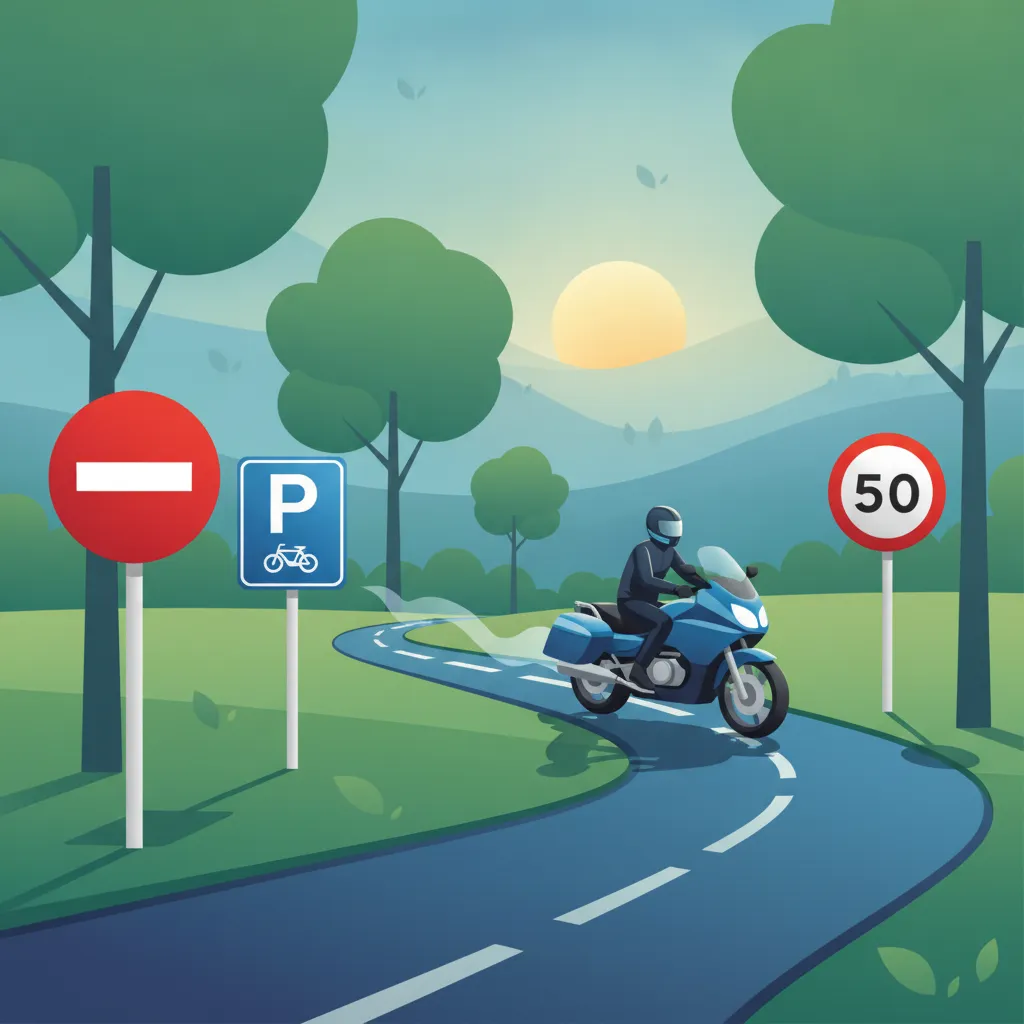
This lesson focuses on the correct identification and interpretation of regulatory and informative road signs that are particularly relevant to motorcyclists. It covers signs that dictate speed limits, prohibit overtaking, and indicate compulsory routes or turns. You will learn to recognize different sign categories based on their distinct shapes and colors as defined by Belgian traffic law.
This lesson examines the operation of traffic light systems in Belgium, clarifying the meaning of red, amber, and green signals, including flashing lights and directional arrows. It details a motorcyclist's legal obligations when approaching and navigating signal-controlled intersections. The content also addresses specialized signals for pedestrians and trams that riders must recognize and respond to correctly.
Night driving presents unique challenges, including reduced visibility and glare from oncoming vehicles. This lesson covers proper headlight usage, eye adaptation, and techniques for driving safely at night. It also addresses tunnel navigation, focusing on speed limits, appropriate lighting, and understanding emergency procedures inside tunnels.
Explore how reflective materials, high-visibility clothing, and strategic placement enhance rider and motorcycle conspicuity in Belgium. Learn practical tips for being seen day and night.
This lesson explains how clothing choices significantly enhance a rider's visibility to other road users. It details the benefits of wearing bright, fluorescent colors for daytime conspicuity and the function of retro-reflective materials for nighttime safety. The content provides practical guidance on selecting appropriate apparel and maintaining its reflective properties to ensure maximum effectiveness.
This lesson focuses on the unique hazards associated with riding after dark. It emphasizes the importance of a fully functional lighting system and the use of reflective gear to be seen by others. The content explains how darkness affects depth perception and peripheral vision, requiring riders to reduce their speed to compensate for shorter sight distances and potential fatigue.
This lesson focuses on the specific challenges of riding in adverse conditions such as rain, fog, and darkness, which severely reduce visibility. It provides practical strategies for riders to increase their own conspicuity through the use of lights and reflective gear. The content also explains how to adapt riding behavior, such as reducing speed and increasing following distance, to safely manage these high-risk situations.
This lesson addresses the unique challenges of riding after dark, focusing on the correct use of high and low beam headlights to maximize visibility. It offers techniques for coping with glare from other vehicles and for adapting to the body's natural reduction in visual acuity at night. The content also emphasizes the heightened risk of fatigue during night rides and strategies to manage it.
This lesson details the specific precautions and techniques required for riding in rain and fog. It explains how water on the road affects tyre grip and braking distances, and how to avoid aquaplaning. You will learn the correct use of lights to be seen in low visibility and how to adjust your speed and following distance accordingly.
This lesson examines the operation of traffic light systems in Belgium, clarifying the meaning of red, amber, and green signals, including flashing lights and directional arrows. It details a motorcyclist's legal obligations when approaching and navigating signal-controlled intersections. The content also addresses specialized signals for pedestrians and trams that riders must recognize and respond to correctly.
This lesson provides a comprehensive overview of the mandatory lighting systems for all Category AM vehicles under Belgian law. It details the required functions of headlamps, rear lights, brake lights, and turn signals, explaining their importance for communication and visibility. Learners will understand the legal standards for this equipment and how to perform simple pre-ride checks to ensure all lights are functioning correctly.
This lesson focuses on the correct identification and interpretation of regulatory and informative road signs that are particularly relevant to motorcyclists. It covers signs that dictate speed limits, prohibit overtaking, and indicate compulsory routes or turns. You will learn to recognize different sign categories based on their distinct shapes and colors as defined by Belgian traffic law.
Find clear answers to common questions learners have about Visibility Enhancements and Lighting Regulations. Learn how the lesson is structured, which driving theory objectives it supports, and how it fits into the overall learning path of units and curriculum progression in Belgium. These explanations help you understand key concepts, lesson flow, and exam focused study goals.
Yes, Belgian law requires motorcyclists to have their low-beam headlight switched on at all times, day or night, while the engine is running to ensure maximum visibility to other traffic.
For the exam, focus on gear that meets European safety standards (CE marking) and includes reflective elements. The exam tests your understanding of why these materials are crucial for being seen in low-visibility conditions.
Because motorcycles are smaller than cars, they are often overlooked. Improving visibility through lighting, bright gear, and correct lane positioning is your primary defense against accidents caused by other drivers not seeing you.
In Belgium, you must adapt your lights to conditions. Using your low-beam is standard, but knowing when to use fog lights (if equipped) and ensuring your lenses are clean is vital for both legality and your personal safety.
Ready to focus your Belgian driving theory revision? Utilize our powerful search tool to pinpoint exact topics, road signs, or difficulty levels. Engage with practice questions that directly address your learning needs and solidify your understanding of Belgian traffic laws for your upcoming exam.