
This lesson guides you through the essential protective equipment required for motorcyclists on Belgian roads. You will learn about legal standards for safety gear, how to select clothing for different weather conditions, and why proper protection is vital for your safety and exam success.
Lesson content overview
Riding a motorcycle is an exhilarating experience, offering a unique sense of freedom and connection with the road. However, it also comes with inherent risks. As part of your Comprehensive Belgian Motorcycle Theory Course for Licence A, A1 & A2, understanding and utilizing appropriate protective clothing and gear is paramount. This lesson will detail the essential equipment designed to minimize injury severity in the event of an accident, covering everything from specialized jackets and pants to gloves and boots, emphasizing critical materials like those with high abrasion resistance and integrated impact protectors. We will also explore relevant Belgian regulations and guidance on selecting gear for varying weather conditions.
The primary purpose of motorcycle protective gear is to create a physical barrier between your body and the environment, especially during an accident. While no gear can guarantee complete immunity from injury, well-chosen and properly worn equipment significantly reduces the severity of potential abrasions, impacts, and environmental exposure. It acts as your first and most critical line of defense, connecting directly to overall rider safety, accident prevention, and adherence to legal requirements.
In a fall or collision, a rider's body can come into contact with the road surface or other objects at speed. Without adequate protection, this can lead to severe road rash, broken bones, and other traumatic injuries. Protective gear is engineered to disperse impact forces, resist tearing from friction, and provide structural support, thereby mitigating these risks.
One of the most common types of injury in a motorcycle accident is abrasion, often referred to as 'road rash,' which occurs when skin slides across a rough surface like asphalt. Abrasion-resistant materials are specifically engineered to withstand this friction, preventing the outer layers of your skin from being scraped away.
The ability of a material to withstand friction, scraping, rubbing, and general wear from sliding on surfaces without tearing or wearing through. This property is crucial for protective motorcycle gear.
The practical meaning of using gear made from these materials is a dramatic reduction in skin damage during an accident. It means the difference between minor scrapes and severe, deep wounds that can take months to heal, require skin grafts, or lead to permanent scarring and infection. It is a common misunderstanding to believe that any thick jacket or pair of jeans suffices; only certified materials specifically designed for motorcycle use offer adequate protection.
While abrasion resistance protects your skin, impact protectors are designed to absorb and dissipate the kinetic energy from direct impacts, such as hitting the ground, another vehicle, or an obstacle. These protectors are strategically placed in areas most vulnerable to injury during a fall or collision.
A built-in or removable protective pad, typically made from viscoelastic foam or similar energy-absorbing materials, designed to reduce the force transmitted to the body during a collision or fall.
For impact protectors to be effective, they must meet specific safety standards. In Europe, this is indicated by CE certification (Conformité Européenne). CE-certified protectors are rigorously tested to ensure they can absorb a specified amount of impact energy without transferring excessive force to the wearer.
There are different levels of CE certification for impact protectors:
It's crucial to look for this certification when purchasing gear. Assuming all motorcycle jackets have adequate protectors is a common misconception; many entry-level jackets may only come with basic foam pads that offer minimal protection. Always check for removable CE-certified protectors in key areas.
Impact protectors are integrated into gear in areas most susceptible to injury:
Proper positioning of these protectors within the garment is vital. They should fit snugly and remain in place, even during movement, to provide effective protection when needed.
Comprehensive protection requires covering your entire body with specialized gear. A complete integrated gear system typically includes a motorcycle jacket, pants, gloves, and boots. Each component is designed to protect specific body parts while working together to offer overall safety.
A dedicated motorcycle jacket is far more than just outerwear. It's engineered to protect your torso, arms, and shoulders from abrasion and impact.
Standard trousers offer virtually no protection in a motorcycle accident. Motorcycle-specific pants are designed to safeguard your hips, thighs, and knees.
Your hands are often the first part of your body to hit the ground in a fall. Motorcycle gloves provide essential protection for your hands and wrists.
Appropriate footwear is critical, as feet and ankles are highly susceptible to injury. Motorcycle boots protect your feet, ankles, and lower shins.
Wearing regular shoes, trainers, or sandals while riding a motorcycle offers virtually no protection and drastically increases the risk of severe foot and ankle injuries in an accident.
When riding on public roads in Belgium, specific protective equipment is legally mandated for all motorcyclists, including those holding A, A1, and A2 licences. Adhering to these regulations is not only a legal requirement but a fundamental aspect of your safety.
According to Belgian traffic regulations, the following items are mandatory for motorcyclists:
While other protective gear components are not strictly mandatory by Belgian law, they are highly recommended by safety experts and driving instructors for your own protection:
It is always advisable to confirm any specific mandatory gear requirements with the latest official Belgian driving code or relevant authorities, as regulations can be updated.
Riding in Belgium means encountering diverse weather conditions. Choosing weather-appropriate gear is crucial not only for comfort but also for maintaining focus and safety. Being too hot, too cold, or soaking wet can distract a rider and impair their ability to control the motorcycle safely.
Summer (Warm/Hot Weather):
Winter (Cold Weather):
Rain (Wet Weather):
Neglecting weather-appropriate gear can lead to discomfort, fatigue, and even dangerous conditions like hypothermia in cold, wet weather, or heatstroke in extreme heat. Your ability to concentrate on the road is directly affected by your comfort levels.
The effectiveness of your protective gear is significantly enhanced when components work together as an integrated gear system and fit correctly.
A combination of motorcycle jacket, pants, gloves, and boots that are designed to be compatible and function synergistically to provide comprehensive protection and comfort.
A well-fitting, integrated gear system offers maximum protection by ensuring all vulnerable areas are covered and that protective elements remain in their intended positions during an incident. It also contributes to rider comfort, reducing fatigue on longer rides.
Understanding the reasoning behind proper gear selection can dramatically improve your safety awareness. Many riders, especially beginners, make common mistakes that compromise their protection.
Protective clothing and gear are indispensable for any motorcyclist in Belgium. This lesson emphasizes several critical concepts:
This lesson covers the essential protective gear every Belgian motorcyclist needs, emphasizing that the primary purpose of gear is to create a physical barrier against road rash and impact injuries. Key materials like leather, Cordura, Kevlar, and Dyneema offer varying levels of abrasion resistance, while CE-certified impact protectors at shoulders, elbows, hips, and knees absorb collision energy. Belgian law mandates a helmet and protective boots covering the ankles, though a full protective jacket, pants, and gloves are strongly recommended. Selecting weather-appropriate gear—breathable for summer, insulated for winter, and waterproof for rain—is essential for maintaining rider focus and safety. Proper fit and integrated systems with jacket-to-pant connections ensure protectors remain positioned correctly during a crash.
A short set of high-value points that capture the most important learning from this lesson.
Motorcycle protective gear is engineered to minimize injury severity by providing abrasion resistance and impact absorption in crashes
Abrasion-resistant materials like leather, Cordura, Kevlar, and Dyneema prevent road rash by withstanding friction against road surfaces
CE-certified impact protectors (Level 1 or Level 2) are tested to absorb collision energy and must meet European safety standards
Belgian law mandates an approved helmet and protective boots covering the ankles for all motorcyclists on public roads
Proper gear selection for weather conditions maintains rider comfort and concentration, directly affecting safety
Explore all units and lessons included in this driving theory course.
Only CE-certified motorcycle gear provides adequate protection—regular clothing offers virtually no defense in a crash
Impact protectors must stay properly positioned during a fall to be effective; loose gear allows protectors to shift away from vulnerable areas
An integrated gear system with jacket-to-pant connections prevents exposed skin gaps during a slide
Weather-inappropriate gear causes discomfort that impairs focus and reaction time on Belgian roads
CE Level 2 offers higher impact absorption than CE Level 1—racing gear typically uses the higher standard
Assuming denim or fashion leather jackets provide adequate protection—only certified abrasion-resistant materials are designed for motorcycle use
Removing or not checking for impact protectors assuming the jacket has adequate padding built in
Wearing trainers, sandals, or low-cut shoes instead of proper motorcycle boots leaves ankles legally non-compliant and vulnerable to crushing injuries
Choosing loose-fitting gear for comfort reasons without realizing it allows impact protectors to shift during a crash
Neglecting waterproof gear in Belgian rainy conditions, risking hypothermia and reduced dexterity
Lesson content overview
A short set of high-value points that capture the most important learning from this lesson.
Motorcycle protective gear is engineered to minimize injury severity by providing abrasion resistance and impact absorption in crashes
Abrasion-resistant materials like leather, Cordura, Kevlar, and Dyneema prevent road rash by withstanding friction against road surfaces
CE-certified impact protectors (Level 1 or Level 2) are tested to absorb collision energy and must meet European safety standards
Belgian law mandates an approved helmet and protective boots covering the ankles for all motorcyclists on public roads
Proper gear selection for weather conditions maintains rider comfort and concentration, directly affecting safety
Explore all units and lessons included in this driving theory course.
Only CE-certified motorcycle gear provides adequate protection—regular clothing offers virtually no defense in a crash
Impact protectors must stay properly positioned during a fall to be effective; loose gear allows protectors to shift away from vulnerable areas
An integrated gear system with jacket-to-pant connections prevents exposed skin gaps during a slide
Weather-inappropriate gear causes discomfort that impairs focus and reaction time on Belgian roads
CE Level 2 offers higher impact absorption than CE Level 1—racing gear typically uses the higher standard
Assuming denim or fashion leather jackets provide adequate protection—only certified abrasion-resistant materials are designed for motorcycle use
Removing or not checking for impact protectors assuming the jacket has adequate padding built in
Wearing trainers, sandals, or low-cut shoes instead of proper motorcycle boots leaves ankles legally non-compliant and vulnerable to crushing injuries
Choosing loose-fitting gear for comfort reasons without realizing it allows impact protectors to shift during a crash
Neglecting waterproof gear in Belgian rainy conditions, risking hypothermia and reduced dexterity
Explore search topics learners often look for when studying Protective Clothing and Gear Essentials. These topics reflect common questions about road rules, driving situations, safety guidance, and lesson level theory preparation for learners in Belgium.
Browse additional driving theory lessons that cover connected traffic rules, road signs, and common driving situations related to this topic. Improve your understanding of how different rules interact across everyday traffic scenarios.
Understand the mandatory protective clothing and footwear requirements for motorcycle riders in Belgium. This lesson details legal obligations for A, A1, and A2 licences, ensuring compliance with Belgian traffic law.
Beyond the mandatory helmet, this lesson explores other forms of personal protective equipment that significantly reduce the risk of injury. It explains the functions of specialized gloves, jackets, trousers, and boots, focusing on their abrasion resistance and impact protection qualities. Learners will understand how to choose gear that provides a balance of safety, weather protection, and comfort for different riding conditions.
This lesson provides a detailed overview of the Belgian motorcycle licence framework, explaining the distinctions between categories A1, A2, and the full A licence. It outlines the specific age and skill prerequisites for each level of certification. Furthermore, it covers the mandatory legal requirements such as obtaining a medical certificate, securing proper insurance, and completing the vehicle registration process.
This lesson covers the legal and safety requirements for motorcycle helmets in Belgium, with a focus on ECE certification standards. It explains the critical importance of a proper fit and how to correctly secure helmet straps for optimal effectiveness. You will also learn procedures for regular maintenance and how to inspect a helmet for damage that could compromise its protective capabilities.

This lesson focuses on techniques and equipment designed to enhance a rider's visibility on the road. It covers the effective use of reflective materials on clothing and the motorcycle itself, as well as the legal requirements for lighting under Belgian law. You will learn strategies to improve your conspicuity during the day, at night, and in adverse weather conditions.
This lesson covers the absolute legal requirement for all Category AM vehicle operators in Belgium to wear a safety helmet. It explains the specific safety standards and certifications that helmets must meet to be legally compliant. Learners will be taught how to select the correct size, achieve a secure fit, and conduct regular inspections to ensure the helmet's protective integrity is maintained.

This lesson explains the complete procedure for acquiring a Belgian motorcycle licence, from registering for the theory examination to successfully passing the practical test. It provides a comprehensive list of required documentation, such as identity proof and medical certificates, and clarifies the associated fees. You will also learn about the progression routes available for moving from A1 to A2 and ultimately to a full Category A licence.
This lesson focuses on the legal responsibilities mandated for all motorcyclists in Belgium, emphasizing strict adherence to the traffic code. It details a rider's obligation to conduct risk assessments, comply with speed limits, and maintain high safety standards. The content also clarifies the legal liability associated with traffic infractions and the importance of carrying correct documentation at all times.
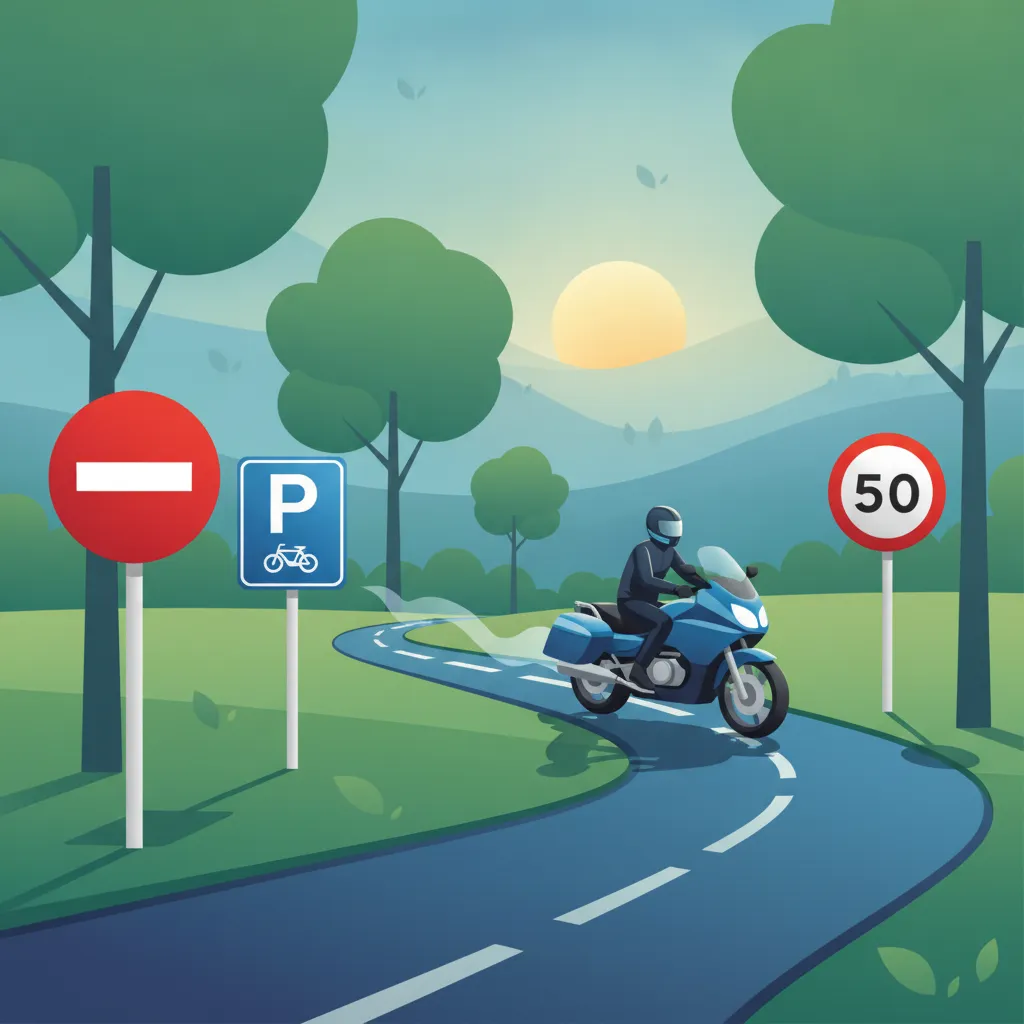
This lesson focuses on the correct identification and interpretation of regulatory and informative road signs that are particularly relevant to motorcyclists. It covers signs that dictate speed limits, prohibit overtaking, and indicate compulsory routes or turns. You will learn to recognize different sign categories based on their distinct shapes and colors as defined by Belgian traffic law.
Find clear answers to common questions learners have about Protective Clothing and Gear Essentials. Learn how the lesson is structured, which driving theory objectives it supports, and how it fits into the overall learning path of units and curriculum progression in Belgium. These explanations help you understand key concepts, lesson flow, and exam focused study goals.
Yes, for the practical motorcycle exam and during your training, you are legally required to wear protective clothing including a helmet, gloves, a jacket with long sleeves, long trousers, and boots that cover the ankles.
Your helmet must be approved and bear a specific safety label, typically ECE-approved. It must fit snugly, be securely fastened, and protect the entire head.
Yes, gloves must cover the entire hand and ideally have protective reinforcements. Boots must be specifically designed for motorcycling and must cover and protect your ankles to prevent injury.
While not every garment is strictly regulated in the theory exam, it is highly recommended to wear clothing with CE-certified impact protectors (armor) in the elbows, shoulders, back, and knees to provide vital protection.
Ready to focus your Belgian driving theory revision? Utilize our powerful search tool to pinpoint exact topics, road signs, or difficulty levels. Engage with practice questions that directly address your learning needs and solidify your understanding of Belgian traffic laws for your upcoming exam.