
This lesson details the mandatory safety standards for motorcycle helmets in Belgium. You will learn about ECE certification requirements and how to correctly select, wear, and maintain your protective headgear to ensure both legal compliance and maximum safety on the road.
Lesson content overview
For any motorcyclist in Belgium, understanding and adhering to the correct standards and practices for helmet use is not merely a recommendation but a fundamental pillar of safety and a strict legal requirement. A helmet is your most crucial piece of protective equipment, designed to absorb and dissipate impact energy in the event of a crash, significantly reducing the risk of severe head injuries. This lesson will guide you through the legal obligations, the importance of internationally recognized safety certifications, how to ensure your helmet fits perfectly, proper maintenance, and critical inspection procedures to guarantee its continued protective capabilities.
In Belgium, the law is unequivocal: all motorcyclists and their passengers must wear an approved protective helmet while riding. This legal mandate applies universally across all road types, from bustling city streets to high-speed motorways, and under all weather conditions. The primary objective of this regulation is to safeguard riders from the potentially devastating consequences of head injuries, which are a leading cause of fatality and severe disability in motorcycle accidents.
The term "approved helmet" is not open to interpretation; it specifically refers to helmets that comply with stringent European safety standards. Failure to comply with this regulation—whether by riding without a helmet, using an uncertified helmet, or wearing one incorrectly—can lead to legal penalties and, more importantly, severely compromise your safety on the road.
The cornerstone of helmet safety in Europe, and thus in Belgium, is the ECE certification. ECE stands for "Economic Commission for Europe," and its standard, specifically ECE Regulation 22 (currently 22.05 or the newer 22.06), is the internationally recognized benchmark for motorcycle helmet safety. This certification process involves rigorous testing to ensure helmets offer a minimum level of protection against impact, abrasion, and penetration.
When a helmet carries an ECE certification, it signifies that it has undergone and passed a series of demanding tests under controlled laboratory conditions. These tests assess various aspects of a helmet's protective capabilities, including:
The ECE standard is continually updated, with ECE 22.06 being the latest revision, introducing even stricter testing protocols and criteria. While ECE 22.05 helmets are still legal and safe to use, newer helmets will increasingly carry the ECE 22.06 designation.
To verify that a helmet meets these crucial safety standards, look for the official ECE approval identifier. This is typically found as a sticker stitched onto the chin strap or affixed to the inside of the helmet's shell. The sticker will display a capital 'E' followed by a number (e.g., E1 for Germany, E6 for Belgium, E11 for the UK), indicating the country where the helmet was certified. Crucially, it will also show "ECE R22.05" or "ECE R22.06," confirming the specific regulation it complies with. Sometimes, a green ribbon is also used as an additional visual indicator of certification.
Never purchase or use a helmet without a clear ECE certification mark. Such helmets have not been tested to the required European safety standards and cannot guarantee adequate protection in an accident.
Beyond certification, selecting the correct type of helmet is vital, as different designs offer varying levels of protection and features. Regardless of type, the ECE certification remains a non-negotiable requirement.
Helmets are not one-size-fits-all, and a helmet's effectiveness is intrinsically linked to its fit. Heads come in various shapes (e.g., round oval, intermediate oval, long oval), and helmet manufacturers design their products to conform to these different profiles. Choosing a helmet that matches your head shape and is the correct size is paramount for both comfort and safety. An ill-fitting helmet can shift during a crash, exposing vulnerable areas, or create uncomfortable pressure points during extended rides.
A properly fitting helmet is snug, comfortable, and stable. It should contour to your head shape without excessive movement or uncomfortable pressure points. Achieving this optimal fit is a crucial step in ensuring your helmet can perform its life-saving function effectively.
Measure Your Head: Use a cloth measuring tape to measure the circumference of your head at its largest point, typically about 2.5 cm (1 inch) above your eyebrows, just above your ears. This measurement will help you determine your approximate helmet size using the manufacturer's sizing chart.
Try It On: When trying on a helmet, it should feel snug all around your head, with no significant gaps between the liner and your scalp. The helmet should feel evenly distributed, without any specific pressure points that cause discomfort or pain.
Check for Movement: With the chin strap unfastened, try to rotate the helmet from side to side and up and down. If the helmet slides freely or easily rotates without moving your skin, it is too large. A properly fitting helmet should make your scalp and cheeks move slightly with the helmet.
Jaw and Cheek Pads: The cheek pads should press firmly but comfortably against your cheeks. If you can easily slide your fingers between your cheeks and the pads, they are too loose. Some helmets offer interchangeable cheek pads to fine-tune the fit.
Forehead Check: Ensure the helmet sits low enough on your forehead to protect it, but not so low that it obstructs your vision. You should be able to see clearly from edge to edge of your peripheral vision.
"Roll-Off" Test: With the chin strap securely fastened (as described below), try to roll the helmet off your head from the back. If it comes off easily, even with force, the helmet is too large or the strap is not properly adjusted. This test is critical to ensure the helmet will stay on during an impact.
Wear for a Few Minutes: Keep the helmet on for several minutes to identify any hidden pressure points or discomfort that might become apparent over time. A slight feeling of pressure that is evenly distributed is normal and will often subside as the padding conforms to your head, but sharp, localized pain indicates a poor fit.
When trying on helmets, always wear a balaclava or a hygienic cap. This is not only for hygiene but can also slightly compress your hair, giving a more accurate fit assessment.
Even the best-fitting, ECE-certified helmet is useless if it comes off during an accident. This is where the chin strap plays a critical role. The retention system, comprising the chin strap and its buckle, is designed to keep the helmet firmly in place on your head through all forces encountered during a ride or a crash.
Regardless of the buckle type, the chin strap must always be tightened snugly before riding.
A loose chin strap is as dangerous as not wearing a helmet at all. In an impact, a loose helmet can easily come off, offering no protection when it's needed most. Always double-check your strap before setting off.
Regular maintenance and proper storage are essential to preserve your helmet's protective capabilities and extend its lifespan. Neglecting these aspects can compromise the materials, leading to a reduction in safety over time.
Regularly inspect your helmet for any signs of wear or damage that could compromise its integrity:
Store your helmet in a cool, dry place, away from direct sunlight, extreme temperatures, and harsh chemicals. Prolonged exposure to UV light or heat can degrade the helmet's materials. Avoid hanging your helmet by its chin strap for extended periods, as this can stretch or deform the strap. A dedicated helmet bag or shelf is ideal.
Helmets do not last forever, and understanding when to replace yours is just as critical as choosing it correctly.
Most helmet manufacturers recommend replacing a helmet every five years from its date of manufacture (often indicated inside the helmet) or three years from the date of first use, whichever comes first. This guideline accounts for the natural degradation of materials like resins, adhesives, and EPS foam due to factors like sweat, hair oils, UV exposure, and general wear and tear, even if the helmet looks outwardly fine. These materials become less effective over time, reducing the helmet's ability to absorb impacts.
Always replace your helmet after any impact, regardless of whether there is visible damage.
The single most important rule regarding helmet replacement is to retire it immediately after it has sustained an impact. Even a seemingly minor drop onto a hard surface or a low-speed accident where the helmet makes contact can cause unseen damage to the internal EPS liner. This liner is designed to crush and absorb energy once. If it has already been compressed, even slightly, it loses its ability to protect effectively in a subsequent impact. The damage might not be visible from the outside, but the helmet's structural integrity will be compromised.
This applies even if you drop your helmet off your motorcycle seat onto the ground. While it might look fine, the internal foam could have suffered micro-fractures, rendering it less effective. It is a small price to pay for your head protection.
Understanding and avoiding common mistakes related to helmet use is vital for maximizing your safety.
The correct use and maintenance of an approved motorcycle helmet are non-negotiable aspects of safe motorcycling in Belgium. As a rider preparing for your Licence A, A1, or A2, internalizing these principles is critical for your own safety and for complying with the law. Always remember:
By making these practices an integral part of your riding routine, you significantly enhance your personal safety and contribute to safer roads for everyone.
This lesson covers the legal and safety requirements for motorcycle helmets in Belgium, emphasizing that ECE certification (ECE R22.05 or ECE R22.06) is mandatory for all riders. It details how to identify certified helmets using the approval sticker, explains the four main helmet types and their protection levels, and provides a seven-step procedure for achieving a proper fit including the critical roll-off test. The lesson also covers chin strap types (double D-ring and micrometric buckle), proper tightening techniques, maintenance procedures, and inspection criteria for shell, EPS liner, and visor damage. Most importantly, it stresses that helmets must be replaced after any impact and have a typical lifespan of five years from manufacture.
A short set of high-value points that capture the most important learning from this lesson.
In Belgium, wearing an ECE-certified helmet is mandatory for all motorcyclists and passengers on every road type and in all weather conditions.
ECE R22.05 or R22.06 certification ensures a helmet has passed rigorous European safety tests for impact absorption, retention integrity, and field of vision.
A properly fitting helmet should feel snug all around with no gaps, and must pass the roll-off test with the chin strap secured.
Modular helmets must always be ridden in the full-face, locked-down position to maintain their certified level of protection.
Always replace a helmet immediately after any impact, even if there is no visible external damage.
Explore all units and lessons included in this driving theory course.
Look for the ECE approval sticker on the chin strap showing the 'E' mark, country code, and ECE R22.05 or ECE R22.06 designation.
The EPS liner absorbs impact energy once during a crash and must be replaced after any impact, visible or not.
Replace helmets approximately every five years from manufacture date or three years from first use, whichever comes first.
The chin strap should allow only one or two fingers between the strap and your chin when properly tightened.
A helmet that slides freely on your head without moving your scalp is too loose and provides inadequate protection.
Using a helmet without an ECE certification sticker, as uncertified helmets have not been tested to European safety standards.
Wearing a helmet too loose or failing to tighten the chin strap, which allows the helmet to come off during a crash.
Continuing to use a helmet after a drop or minor impact because it looks undamaged from the outside.
Riding with a modular helmet in the open-face (flipped-up) position, which bypasses its certified protection.
Failing to replace a heavily scratched visor, which significantly impairs visibility especially in low light or rain.
Lesson content overview
A short set of high-value points that capture the most important learning from this lesson.
In Belgium, wearing an ECE-certified helmet is mandatory for all motorcyclists and passengers on every road type and in all weather conditions.
ECE R22.05 or R22.06 certification ensures a helmet has passed rigorous European safety tests for impact absorption, retention integrity, and field of vision.
A properly fitting helmet should feel snug all around with no gaps, and must pass the roll-off test with the chin strap secured.
Modular helmets must always be ridden in the full-face, locked-down position to maintain their certified level of protection.
Always replace a helmet immediately after any impact, even if there is no visible external damage.
Explore all units and lessons included in this driving theory course.
Look for the ECE approval sticker on the chin strap showing the 'E' mark, country code, and ECE R22.05 or ECE R22.06 designation.
The EPS liner absorbs impact energy once during a crash and must be replaced after any impact, visible or not.
Replace helmets approximately every five years from manufacture date or three years from first use, whichever comes first.
The chin strap should allow only one or two fingers between the strap and your chin when properly tightened.
A helmet that slides freely on your head without moving your scalp is too loose and provides inadequate protection.
Using a helmet without an ECE certification sticker, as uncertified helmets have not been tested to European safety standards.
Wearing a helmet too loose or failing to tighten the chin strap, which allows the helmet to come off during a crash.
Continuing to use a helmet after a drop or minor impact because it looks undamaged from the outside.
Riding with a modular helmet in the open-face (flipped-up) position, which bypasses its certified protection.
Failing to replace a heavily scratched visor, which significantly impairs visibility especially in low light or rain.
Explore search topics learners often look for when studying Helmet Standards and Proper Use. These topics reflect common questions about road rules, driving situations, safety guidance, and lesson level theory preparation for learners in Belgium.
Browse additional driving theory lessons that cover connected traffic rules, road signs, and common driving situations related to this topic. Improve your understanding of how different rules interact across everyday traffic scenarios.
Understand Belgian legal requirements for motorcycle helmets, including ECE certification standards. Learn essential tips on achieving a perfect fit, correct strap usage, and crucial maintenance and inspection procedures for ongoing protection.
This lesson covers the absolute legal requirement for all Category AM vehicle operators in Belgium to wear a safety helmet. It explains the specific safety standards and certifications that helmets must meet to be legally compliant. Learners will be taught how to select the correct size, achieve a secure fit, and conduct regular inspections to ensure the helmet's protective integrity is maintained.
This lesson details the essential protective gear that motorcyclists should wear, including specialized jackets, pants, gloves, and boots. It explains the importance of materials with high abrasion resistance and the function of integrated impact protectors. The content also addresses Belgian regulations concerning mandatory protective equipment and how to select appropriate gear for different weather conditions.
This lesson provides a detailed overview of the Belgian motorcycle licence framework, explaining the distinctions between categories A1, A2, and the full A licence. It outlines the specific age and skill prerequisites for each level of certification. Furthermore, it covers the mandatory legal requirements such as obtaining a medical certificate, securing proper insurance, and completing the vehicle registration process.
This lesson focuses on the legal responsibilities mandated for all motorcyclists in Belgium, emphasizing strict adherence to the traffic code. It details a rider's obligation to conduct risk assessments, comply with speed limits, and maintain high safety standards. The content also clarifies the legal liability associated with traffic infractions and the importance of carrying correct documentation at all times.

This lesson focuses on techniques and equipment designed to enhance a rider's visibility on the road. It covers the effective use of reflective materials on clothing and the motorcycle itself, as well as the legal requirements for lighting under Belgian law. You will learn strategies to improve your conspicuity during the day, at night, and in adverse weather conditions.

This lesson explains the complete procedure for acquiring a Belgian motorcycle licence, from registering for the theory examination to successfully passing the practical test. It provides a comprehensive list of required documentation, such as identity proof and medical certificates, and clarifies the associated fees. You will also learn about the progression routes available for moving from A1 to A2 and ultimately to a full Category A licence.
Beyond the mandatory helmet, this lesson explores other forms of personal protective equipment that significantly reduce the risk of injury. It explains the functions of specialized gloves, jackets, trousers, and boots, focusing on their abrasion resistance and impact protection qualities. Learners will understand how to choose gear that provides a balance of safety, weather protection, and comfort for different riding conditions.

This lesson provides a comprehensive guide to motorway riding, starting with the procedure for safely merging into high-speed traffic from a slip road. It details the importance of strict lane discipline, including the rules for overtaking and the proper use of lanes. You will also learn the correct technique for planning and executing a safe exit from the motorway.

This lesson provides a step-by-step guide to executing a safe overtaking maneuver in compliance with Belgian law. It covers the necessary pre-maneuver checks, proper signaling, and how to accurately judge the speed and distance of oncoming traffic. You will learn the correct procedure for passing a vehicle and safely returning to your original lane.

This lesson introduces the critical safety concept of maintaining a protective space or 'safety cushion' around your motorcycle. It explains the 'two-second rule' for following distances and the importance of maintaining adequate space to the sides. You will learn how to manage this space in varying traffic densities and to always identify a potential escape path.
Learn about frequent errors riders make regarding motorcycle helmet use in Belgium. Avoid issues like using uncertified helmets, improper fitting, incorrect strap fastening, and understand when helmets must be replaced to ensure maximum rider safety.
This lesson covers the absolute legal requirement for all Category AM vehicle operators in Belgium to wear a safety helmet. It explains the specific safety standards and certifications that helmets must meet to be legally compliant. Learners will be taught how to select the correct size, achieve a secure fit, and conduct regular inspections to ensure the helmet's protective integrity is maintained.
Beyond the mandatory helmet, this lesson explores other forms of personal protective equipment that significantly reduce the risk of injury. It explains the functions of specialized gloves, jackets, trousers, and boots, focusing on their abrasion resistance and impact protection qualities. Learners will understand how to choose gear that provides a balance of safety, weather protection, and comfort for different riding conditions.
This lesson provides a step-by-step guide to executing a safe overtaking maneuver in compliance with Belgian law. It covers the necessary pre-maneuver checks, proper signaling, and how to accurately judge the speed and distance of oncoming traffic. You will learn the correct procedure for passing a vehicle and safely returning to your original lane.
This lesson focuses on the legal responsibilities mandated for all motorcyclists in Belgium, emphasizing strict adherence to the traffic code. It details a rider's obligation to conduct risk assessments, comply with speed limits, and maintain high safety standards. The content also clarifies the legal liability associated with traffic infractions and the importance of carrying correct documentation at all times.
This lesson details the essential protective gear that motorcyclists should wear, including specialized jackets, pants, gloves, and boots. It explains the importance of materials with high abrasion resistance and the function of integrated impact protectors. The content also addresses Belgian regulations concerning mandatory protective equipment and how to select appropriate gear for different weather conditions.

This lesson provides essential guidance on the correct procedures to follow in the event of a breakdown or a crash. It covers how to secure the scene to prevent further incidents, the legal obligations to assist if you are involved or witness an accident, and how to effectively contact emergency services. The content also reviews the legally required emergency equipment, such as a high-visibility vest.

This lesson focuses on recognizing and staying out of the blind spots of other vehicles, especially large trucks and buses where 'no-zones' are significant. It provides practical strategies for managing your position on the road to ensure you remain visible to other drivers at all times. You will learn to anticipate lane changes and other maneuvers from vehicles that may not be aware of your presence.

This lesson is dedicated to warning signs, which are designed to alert drivers to potential dangers ahead. It covers the interpretation of signs indicating sharp curves, steep gradients, slippery surfaces, and the presence of pedestrians or animals. By understanding these warnings, riders can anticipate potential hazards and adjust their speed and position proactively for safer travel.
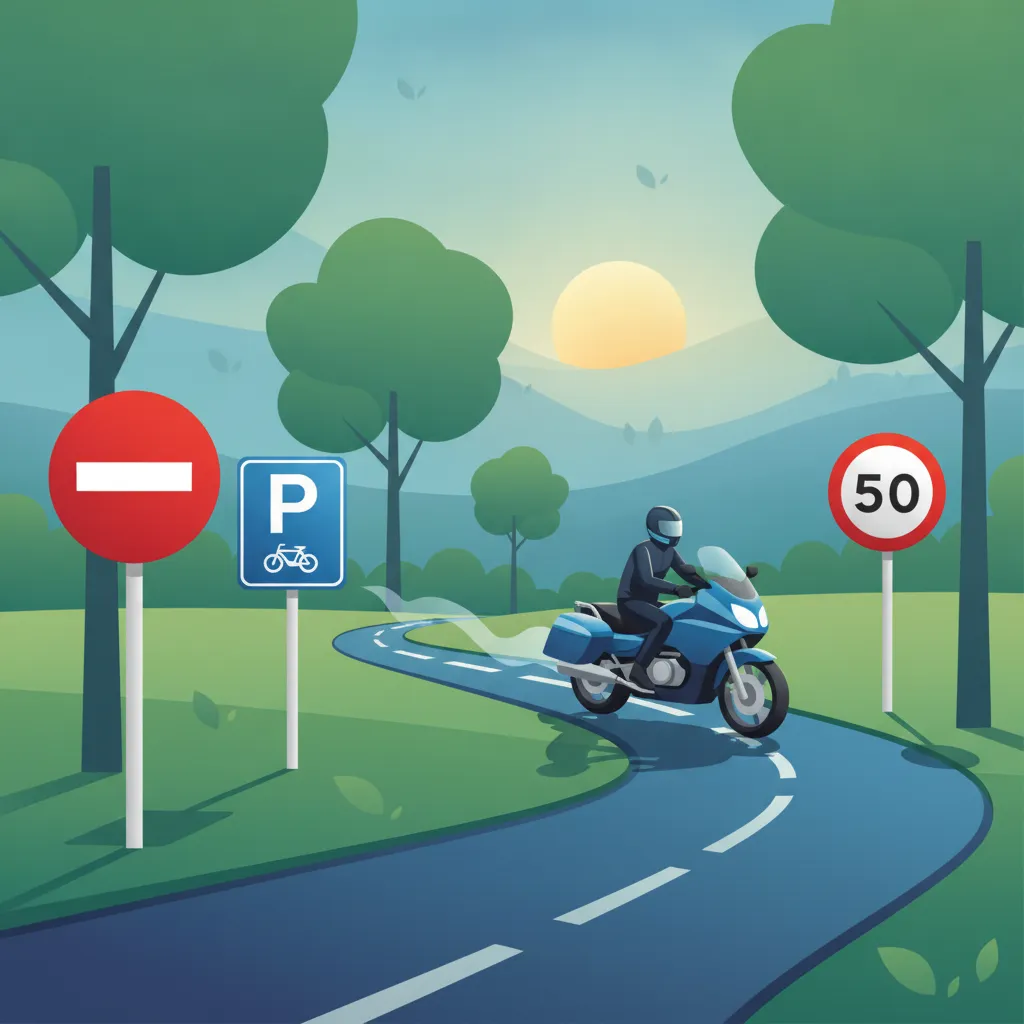
This lesson focuses on the correct identification and interpretation of regulatory and informative road signs that are particularly relevant to motorcyclists. It covers signs that dictate speed limits, prohibit overtaking, and indicate compulsory routes or turns. You will learn to recognize different sign categories based on their distinct shapes and colors as defined by Belgian traffic law.

This lesson details a motorcyclist's obligations when approaching various types of crossings, including marked pedestrian and bicycle lanes. It emphasizes the legal requirement to yield to vulnerable road users and the importance of thorough visual checks before proceeding. You will learn how to maintain a safe distance and anticipate the movements of pedestrians and cyclists in urban areas.
Find clear answers to common questions learners have about Helmet Standards and Proper Use. Learn how the lesson is structured, which driving theory objectives it supports, and how it fits into the overall learning path of units and curriculum progression in Belgium. These explanations help you understand key concepts, lesson flow, and exam focused study goals.
In Belgium, your motorcycle helmet must be ECE-approved (indicated by a label usually starting with E followed by a number). This ensures the helmet meets European safety standards required for legal road use.
A proper fit means the helmet sits snugly against your head and cheeks without causing painful pressure points. When you shake your head, the helmet should move with your skin, not slide independently; if it moves, it is likely too loose.
It is strongly advised against using a used helmet. You cannot be sure if it has suffered internal structural damage from a previous drop or crash, which would significantly reduce its ability to protect you in an accident.
The legal requirement for a certified helmet remains the same whether you are riding a category A1, A2, or A motorcycle. All riders and passengers on motorized two-wheelers must wear an ECE-approved helmet in Belgium.
Ready to focus your Belgian driving theory revision? Utilize our powerful search tool to pinpoint exact topics, road signs, or difficulty levels. Engage with practice questions that directly address your learning needs and solidify your understanding of Belgian traffic laws for your upcoming exam.