
This lesson focuses on navigating Iceland's challenging weather and light conditions. You'll learn essential techniques for maintaining vehicle stability in strong winds and how to use your headlights effectively during day, dusk, and night. Understanding these factors is crucial for safe driving and passing your Category B theory exam.
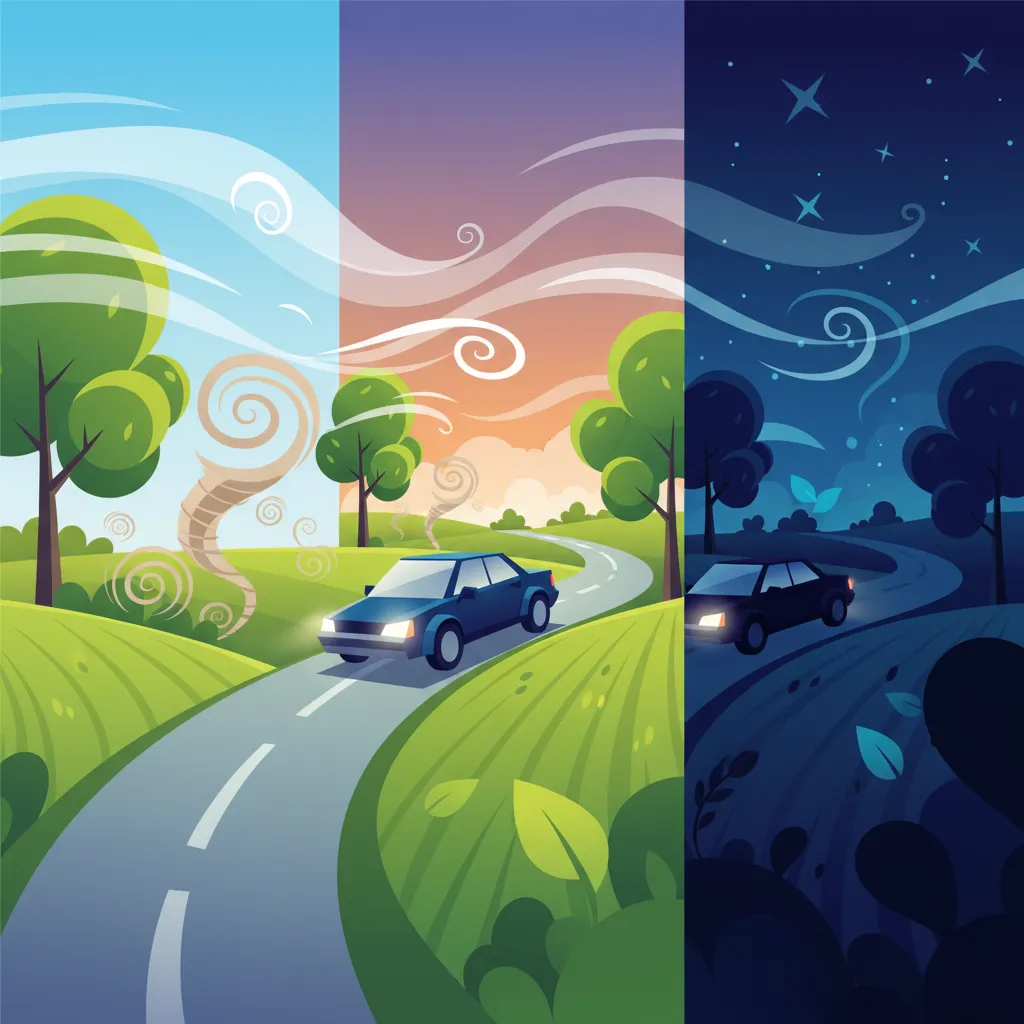
Lesson content overview
Driving in Iceland presents unique challenges, with rapidly changing weather and distinct light conditions that demand adaptability and skill from every driver. This lesson, part of the Official Icelandic Driving License B Theory Course, focuses on two critical environmental factors: strong winds and varying light, from bright daylight to the long, dark winter nights. Understanding how these elements affect your vehicle and visibility is essential for maintaining control, ensuring safety, and complying with Icelandic traffic regulations.
By learning to anticipate wind forces, correctly compensate for crosswinds, and appropriately use your vehicle's lighting system, you will develop the confidence and expertise needed to drive safely across Iceland's diverse landscapes. This knowledge is not just about passing your driving test; it's about making informed decisions that protect yourself and others on the road.
Wind is a powerful, invisible force that can significantly impact vehicle stability and control, especially in an exposed environment like Iceland. Knowing how different types of wind affect your car is the first step towards managing these challenges safely.
Wind can manifest in several ways, each with distinct effects on your vehicle:
When wind interacts with a moving vehicle, it creates aerodynamic forces. A crosswind, in particular, generates a lateral force that can cause the vehicle to drift. This force often creates a turning moment, known as vehicle yaw, which is a rotation around the vehicle's vertical axis. This yaw effect makes the vehicle want to turn into or away from the wind, requiring constant steering corrections to maintain a straight path.
The magnitude of these forces depends on several factors, including wind speed, the vehicle's speed, and its aerodynamic profile. Higher vehicle speeds amplify the effect of wind, making control more challenging.
Not all vehicles react to wind in the same way. High-profile vehicles are those with a large vertical surface area relative to their weight and wheelbase. These include:
These types of vehicles catch more wind, making them significantly more susceptible to lateral forces and yaw. Drivers of high-profile vehicles, or those towing anything, must exercise extra caution and be prepared to make more substantial adjustments when driving in windy conditions. A fully loaded vehicle may have a lower center of gravity, which helps stability, but if the load extends the vehicle's profile (like a tall load on a truck), it still increases wind resistance.
Effectively managing your vehicle in strong crosswinds is a crucial skill for safe driving in Iceland. Proactive measures and controlled reactions are key to maintaining stability and control.
The primary technique for crosswind compensation is to gently steer into the wind. If the wind is blowing from your right, you would apply a slight, continuous leftward pressure on the steering wheel. This counteracts the lateral force of the wind, helping your vehicle maintain its intended path within the lane.
Remember that steering adjustments should be subtle and continuous, not sudden jerks. Over-steering can lead to an oscillation effect, making the vehicle even more unstable.
Reducing your speed is one of the most effective ways to mitigate the impact of strong winds and gusts. The aerodynamic force exerted by wind increases exponentially with speed. By lowering your speed, you reduce both the wind's influence on your vehicle and the distance needed to react to unexpected gusts.
When winds are strong, especially on exposed roads or bridges, it is often advisable to reduce your speed significantly. Icelandic traffic regulations implicitly require drivers to adjust speed to suit conditions, and failing to do so in strong winds could be considered negligent if it leads to an accident.
While weather forecasts provide general wind information, real-time observation is crucial for assessing gust intensity. Here are some indicators:
The Beaufort Scale is a standardized scale for estimating wind speed based on observable effects on land and sea. For example, a "strong breeze" (Beaufort Force 6) with average winds up to 50 km/h can have gusts significantly higher, requiring caution.
A descriptive scale used to estimate wind speed based on observed effects on the sea and land, ranging from calm (Force 0) to hurricane (Force 12).
When towing a trailer or carrying a roof rack, your vehicle's wind sensitivity increases dramatically.
When towing or carrying a roof rack in windy conditions, it is imperative to reduce your speed significantly, avoid sudden steering maneuvers, and increase your following distance to give yourself more time to react. If trailer sway begins, gently reduce speed without braking harshly and maintain a straight steering input until stability is regained.
Proper headlight usage is not just a legal requirement but a fundamental safety measure, crucial for both seeing and being seen. Icelandic driving conditions, with their extreme variations in daylight hours between summer and winter, make this particularly vital.
During clear daylight hours, Icelandic law states that dipped beams are not generally mandatory. However, daytime running lights (DRLs) are common on modern vehicles and serve to make your car more visible to others.
Even on a clear day, consider turning on your dipped beams. It significantly increases your vehicle's conspicuity, making it easier for other road users to see you, especially when emerging from shadows or against a busy background.
Crucially, when visibility is reduced below 100 metres during the day due to conditions such as heavy rain, snow, or fog, dipped beams become mandatory according to § 35 of the Icelandic Road Traffic Law. This applies regardless of the time of day.
Dusk (after sunset) and dawn (before sunrise) are transitional periods when ambient light levels are low but not fully dark. During these times, natural visibility is significantly reduced, and the risk of not seeing or being seen increases.
Driving at night demands careful management of your headlight beams to ensure maximum visibility for yourself without dazzling other road users.
Icelandic traffic law specifies clear rules for headlight usage to ensure safety:
Within Built-Up Areas: Use dipped beams at all times, day or night, regardless of ambient light. This rule is crucial for urban safety and is often overlooked.
Reduced Visibility (Day or Night): When visibility drops below 100 metres due to rain, snow, fog, or heavy cloud cover, dipped beams are mandatory (§ 35 of the Icelandic Road Traffic Law).
Nighttime Rural Roads: Use high beams to maximize visibility on unlit rural roads, but you must switch to dipped beams when:
An oncoming vehicle is within 150 metres.
You are following another vehicle within 200 metres (to avoid dazzling the driver ahead through their rear-view mirror).
You stop or park on the road.
This is outlined in § 19 of the Icelandic Road Traffic Law, which prohibits dazzling other road users.
Parking: If parked on a road at night or in low visibility, use parking lights. If parking lights are not visible, dipped beams may be used.
Glare is visual discomfort or impairment caused by intense or misdirected light, whether from the sun, oncoming headlights, or reflections. Managing glare is critical for maintaining clear vision and safe driving.
Correctly aimed headlights are essential for both your visibility and for preventing glare to other drivers. Headlights that are aimed too high will dazzle oncoming traffic, while those aimed too low will reduce your effective illuminated distance.
Fog lights are auxiliary lights designed for specific low-visibility conditions and should not be used indiscriminately.
Never use high beams in fog, heavy rain, or snow. The powerful, upward-angled beam will reflect off the moisture/particles in the air, creating a wall of light that further reduces your visibility. Always use dipped beams with fog lights in these conditions.
Adherence to Icelandic traffic law is paramount. Violating lighting regulations or driving unsafely in windy conditions can lead to fines, penalties, and increased accident risk.
Fines can be issued for:
While there isn't a specific statutory speed limit solely for wind, Icelandic traffic law (e.g., § 8.1) requires drivers to adjust their speed and driving behaviour to suit road, weather, and traffic conditions. Failure to do so, resulting in loss of control or an accident, can lead to charges of negligent driving.
Ignoring wind and light conditions, or mismanaging them, is a significant contributor to road accidents.
Driving safely requires adapting your techniques to a complex interplay of factors.
Mastering driving in Iceland's variable wind and light conditions involves a blend of technical skill, observational awareness, and adherence to regulations.
These principles combine physics, human perception, and legal requirements into a comprehensive strategy for safe driving, ensuring you are well-prepared for the unique challenges of the Icelandic environment.
This lesson covers two critical environmental safety factors for Icelandic drivers: wind forces and light conditions. Wind affects vehicle stability through crosswinds causing lateral drift and yaw, with high-profile vehicles and trailers being especially vulnerable—managing this requires steering into the wind and reducing speed on exposed roads. For lighting, Icelandic law requires dipped beams in built-up areas at all times and whenever visibility drops below 100 metres, while high beams are for unlit rural roads but must be dimmed for traffic within 150 metres (oncoming) or 200 metres (following). Fog lights are restricted to severely reduced visibility only, and proper glare management protects your vision from sun and headlights. These skills are essential for safe driving in Iceland and for passing the Category B theory exam.
A short set of high-value points that capture the most important learning from this lesson.
Crosswinds and sudden gusts are the most dangerous wind types, creating lateral forces that push vehicles sideways and cause yaw rotation.
The primary crosswind technique is to gently steer into the wind while reducing speed, especially on exposed bridges and open roads.
High-profile vehicles (vans, trucks, vehicles with roof racks or trailers) are significantly more susceptible to wind forces and require extra caution.
Dipped beams are mandatory in built-up areas at all times, and whenever visibility drops below 100 metres due to rain, snow, or fog.
High beams must be dimmed to dipped beams when oncoming traffic is within 150 metres or when following another vehicle within 200 metres.
Explore all units and lessons included in this driving theory course.
Gusts can be significantly stronger than average wind speed, sometimes doubling the force—always expect the unexpected from wind gusts.
On rural unlit roads at night, high beams maximize visibility, but you must switch to dipped beams for 150m oncoming traffic and 200m following traffic.
Fog lights are only legal in severely reduced visibility (fog, heavy rain, snow); they must be switched off when conditions improve.
Trailer sway in strong crosswinds can become uncontrollable—reduce speed gently, maintain straight steering, and never brake harshly.
A dirty windshield amplifies glare from oncoming headlights or low sun, so keep both inside and outside surfaces clean.
Using high beams in fog, heavy rain, or snow—the upward-angled light reflects off moisture particles and creates a blinding wall of white light.
Driving at full speed across exposed bridges without reducing speed when strong crosswinds are present.
Leaving fog lights on after fog clears, which dazzles other drivers and obscures their brake lights.
Over-steering (making sudden jerky corrections) when reacting to a gust, which causes the vehicle to oscillate and become unstable.
Forgetting to switch to dipped beams within built-up areas at night, potentially dazzling pedestrians and other drivers.
Lesson content overview
A short set of high-value points that capture the most important learning from this lesson.
Crosswinds and sudden gusts are the most dangerous wind types, creating lateral forces that push vehicles sideways and cause yaw rotation.
The primary crosswind technique is to gently steer into the wind while reducing speed, especially on exposed bridges and open roads.
High-profile vehicles (vans, trucks, vehicles with roof racks or trailers) are significantly more susceptible to wind forces and require extra caution.
Dipped beams are mandatory in built-up areas at all times, and whenever visibility drops below 100 metres due to rain, snow, or fog.
High beams must be dimmed to dipped beams when oncoming traffic is within 150 metres or when following another vehicle within 200 metres.
Explore all units and lessons included in this driving theory course.
Gusts can be significantly stronger than average wind speed, sometimes doubling the force—always expect the unexpected from wind gusts.
On rural unlit roads at night, high beams maximize visibility, but you must switch to dipped beams for 150m oncoming traffic and 200m following traffic.
Fog lights are only legal in severely reduced visibility (fog, heavy rain, snow); they must be switched off when conditions improve.
Trailer sway in strong crosswinds can become uncontrollable—reduce speed gently, maintain straight steering, and never brake harshly.
A dirty windshield amplifies glare from oncoming headlights or low sun, so keep both inside and outside surfaces clean.
Using high beams in fog, heavy rain, or snow—the upward-angled light reflects off moisture particles and creates a blinding wall of white light.
Driving at full speed across exposed bridges without reducing speed when strong crosswinds are present.
Leaving fog lights on after fog clears, which dazzles other drivers and obscures their brake lights.
Over-steering (making sudden jerky corrections) when reacting to a gust, which causes the vehicle to oscillate and become unstable.
Forgetting to switch to dipped beams within built-up areas at night, potentially dazzling pedestrians and other drivers.
Explore search topics learners often look for when studying Wind Effects and Light Conditions (Day/Night). These topics reflect common questions about road rules, driving situations, safety guidance, and lesson level theory preparation for learners in Iceland.
Browse additional driving theory lessons that cover connected traffic rules, road signs, and common driving situations related to this topic. Improve your understanding of how different rules interact across everyday traffic scenarios.
Learn how to safely navigate Icelandic roads with strong winds and challenging light. This driving theory lesson covers crosswind stability, glare reduction, and correct headlight usage for day, dusk, and night.
This lesson addresses the challenges of driving in rain and fog, focusing on strategies to maintain visibility and vehicle control. Learners will explore the correct use of windshield wipers, defoggers, and appropriate headlight settings, including when to use fog lights. The content also covers the increased risk of hydroplaning, the importance of adjusting speed in wet conditions, and the need to extend following distances to account for longer stopping distances.
This lesson examines the specific techniques required for safe driving on snow-covered or icy roads in Iceland, covering the mandatory use of winter tires and the operation of anti-lock braking systems. Learners will study optimal low-speed cornering, proper braking distances on ice, and how to recover from a skid safely. By mastering these techniques, drivers can maintain control in challenging winter conditions and significantly reduce the risk of accidents on slippery surfaces.
This lesson helps learners develop an understanding of how drivers perceive and assess risks on Icelandic roads, particularly under variable weather and lighting conditions. The content discusses mental models used to anticipate the actions of other road users and the importance of identifying subtle hazards. By analysing environmental cues and applying systematic hazard perception strategies, students learn to enhance their situational awareness and make safer driving decisions.
This lesson details how various weather conditions impact moped stability, traction, and visibility. It provides practical strategies for handling crosswinds, avoiding hydroplaning in rain, and maintaining grip on icy or snowy surfaces. Riders will learn to assess weather-related risks and adapt their speed and control inputs to navigate challenging conditions safely.
This lesson focuses on the regulations governing highland travel and off-road restrictions, including environmental protections that prohibit off-road driving in certain zones. The lesson details how to interpret highland road signage, understand restrictions related to wildlife crossings like reindeer and sheep, and adhere to road width management guidelines. Learners are also instructed on using emergency contact points in sparsely populated regions.
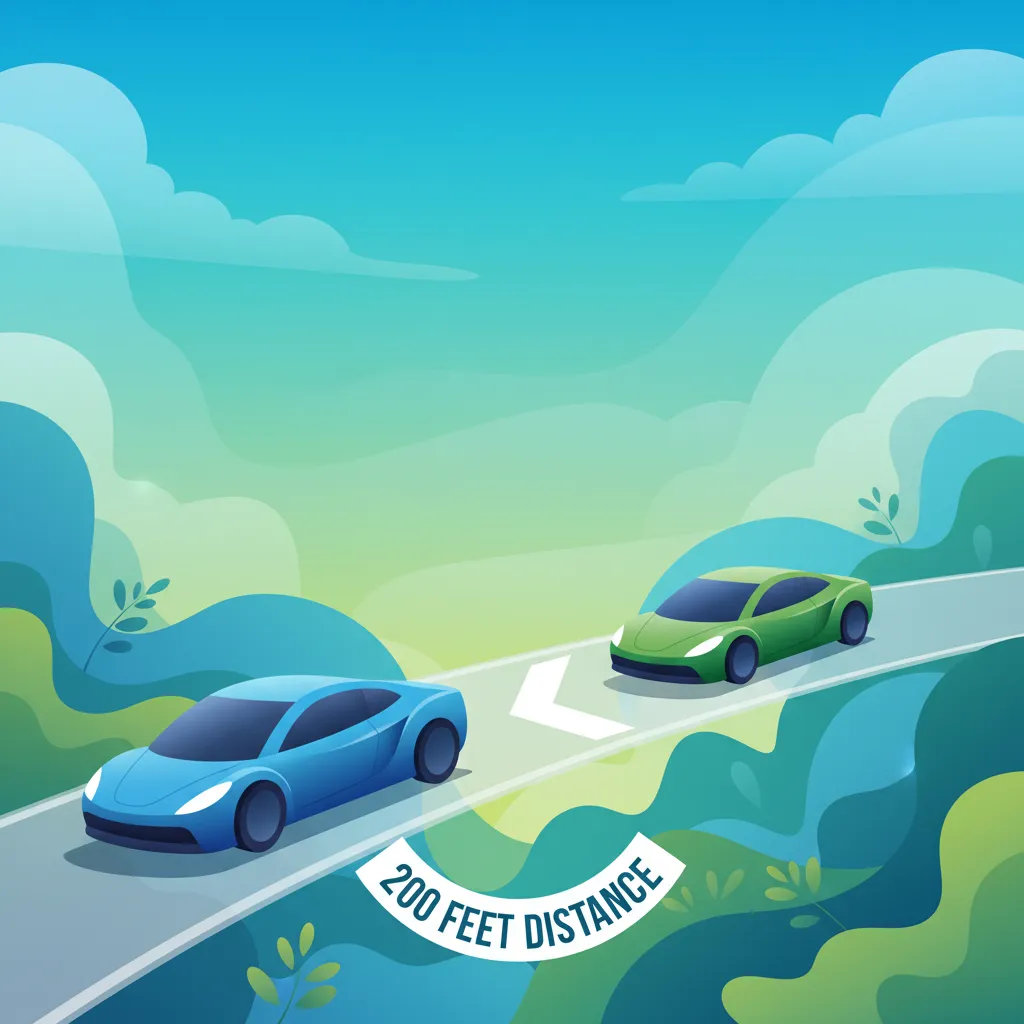
This lesson examines the calculation of safe following distances using the two-second rule and formulas that factor in vehicle speed and road conditions. The content explains how reaction time, weather conditions like ice or rain, and vehicle load affect braking zones. Students also learn specific techniques for stopping on hills and how to avoid tailgating, thereby maintaining sufficient safety margins under all Icelandic weather conditions.
This lesson outlines the speed limits applicable to various road types in Iceland, from urban streets to rural highways and special zones like tunnels. Learners will interpret speed sign markings, understand variable speed limits that adjust for weather, and recognize when temporary speed reductions are enforced. The content also covers speed monitoring devices and the legal consequences of exceeding limits, emphasizing speed awareness in all driving contexts.

This lesson explores the specific challenges of driving on Icelandic gravel roads, focusing on the reduced traction and vehicle dynamics associated with loose surfaces. The content explains how to adapt speed appropriately, maintain safe following distances, and use gentle braking to avoid skidding. Learners also study proper lane sharing etiquette, including how to safely pass other vehicles and manage loose stones that may be thrown, ensuring vehicle stability.
This lesson explores the proper use of lane markings to maintain correct vehicle centering and adherence to the prescribed traffic flow direction in Iceland. The content describes how to interpret solid and broken lines, maintain safe following distances within a lane, and avoid unintended lane departures. Learners also examine the legal prohibitions on using the road shoulder for general travel, ensuring compliance with lane discipline rules for overall traffic safety.

This lesson outlines the specific duties and limitations placed on learner drivers in Iceland, from the mandatory display of L-plates to the requirement for a qualified supervisor. Learners will study night-driving prohibitions, passenger rules for newly licensed drivers, and the legal limits on alcohol consumption during the learning phase. The content also covers the necessity of maintaining a training log and ensuring appropriate insurance coverage for the vehicle.
Understand the legal requirements for using headlights and fog lights in Iceland. This theory lesson details mandatory usage in built-up areas, low visibility, and nighttime conditions to ensure driver and road safety.
This lesson addresses the challenges of driving in rain and fog, focusing on strategies to maintain visibility and vehicle control. Learners will explore the correct use of windshield wipers, defoggers, and appropriate headlight settings, including when to use fog lights. The content also covers the increased risk of hydroplaning, the importance of adjusting speed in wet conditions, and the need to extend following distances to account for longer stopping distances.

This lesson dissects the three-color traffic light system, detailing the meaning of red, amber, and green signals, including flashing lights and directional arrows. It explains how signal timing impacts moped riders and the legal requirement to obey all signals at intersections. Proper interpretation is crucial for navigating signalized junctions safely and avoiding conflicts with other traffic.
This lesson focuses on the operation of traffic lights in Iceland, describing standard three-phase cycles (red, amber, green) and variations such as flashing amber for yielding. Learners will also explore dedicated signals for pedestrians, cyclists, and turning movements, including arrow indications. The lesson explains how signal timing integrates with right-of-way rules at intersections, ensuring drivers can interpret and respond to each light state to maintain safety.
This lesson categorizes Icelandic road signs into regulatory signs that dictate mandatory actions, warning signs that alert drivers to hazards, and informational signs that provide guidance. It explains the distinctive shapes and colour schemes for each category, such as circles for prohibitions and triangles for warnings. By mastering these conventions, students will be able to interpret sign intent instantly and adapt their driving behaviour accordingly to comply with legal obligations.
This lesson examines the set of safety equipment required by Icelandic law to be present in every passenger vehicle, focusing on seat belts, airbags, fire extinguishers, and reflective vests. The content explains the correct placement and usage protocols for each item, including how to operate a fire extinguisher and don a reflective vest. Additionally, learners are introduced to the legal requirement for an emergency triangle and a first-aid kit.
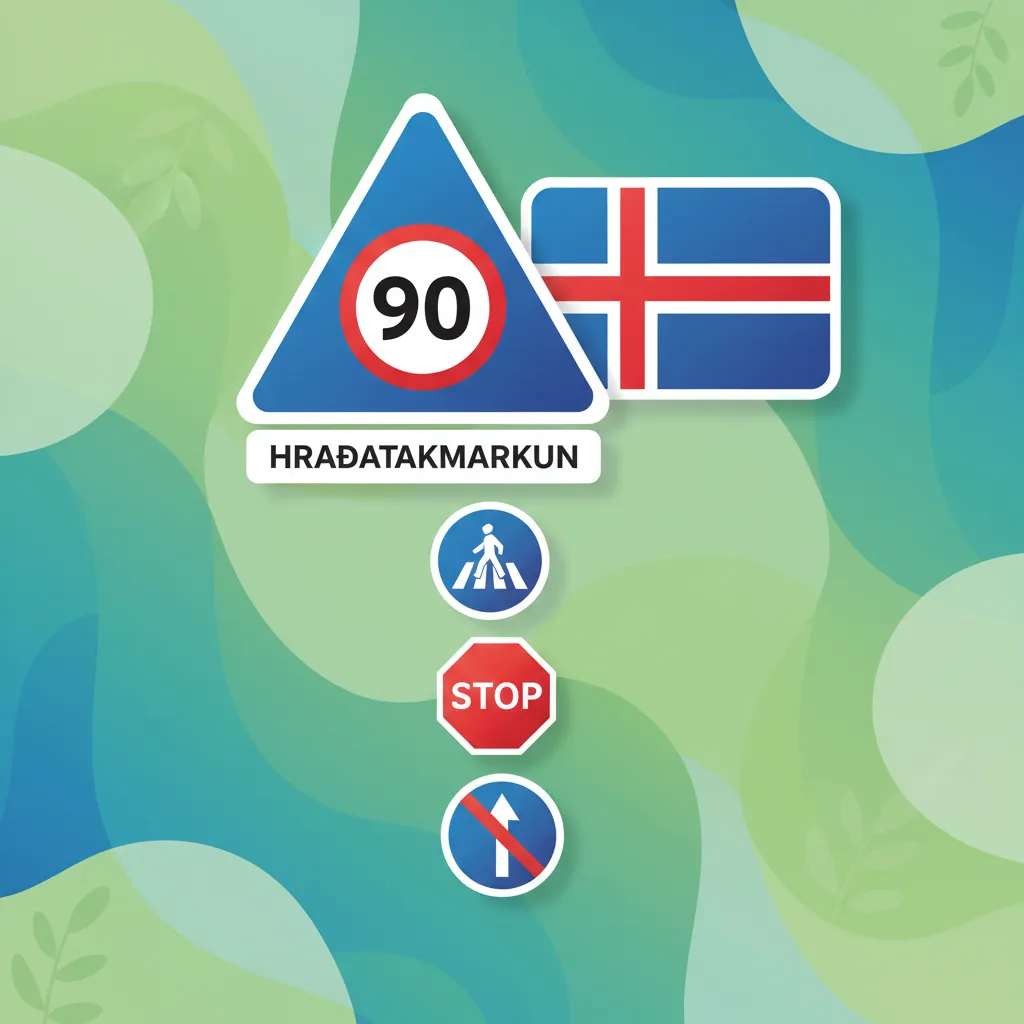
This lesson provides a contextual overview of Iceland's traffic law hierarchy, explaining how national statutes, road codes, and local rules interact. Learners will understand the precedence of national laws and how to interpret regulations in different jurisdictions. This knowledge ensures riders can correctly apply the relevant rules in any driving scenario, ensuring consistent legal compliance.
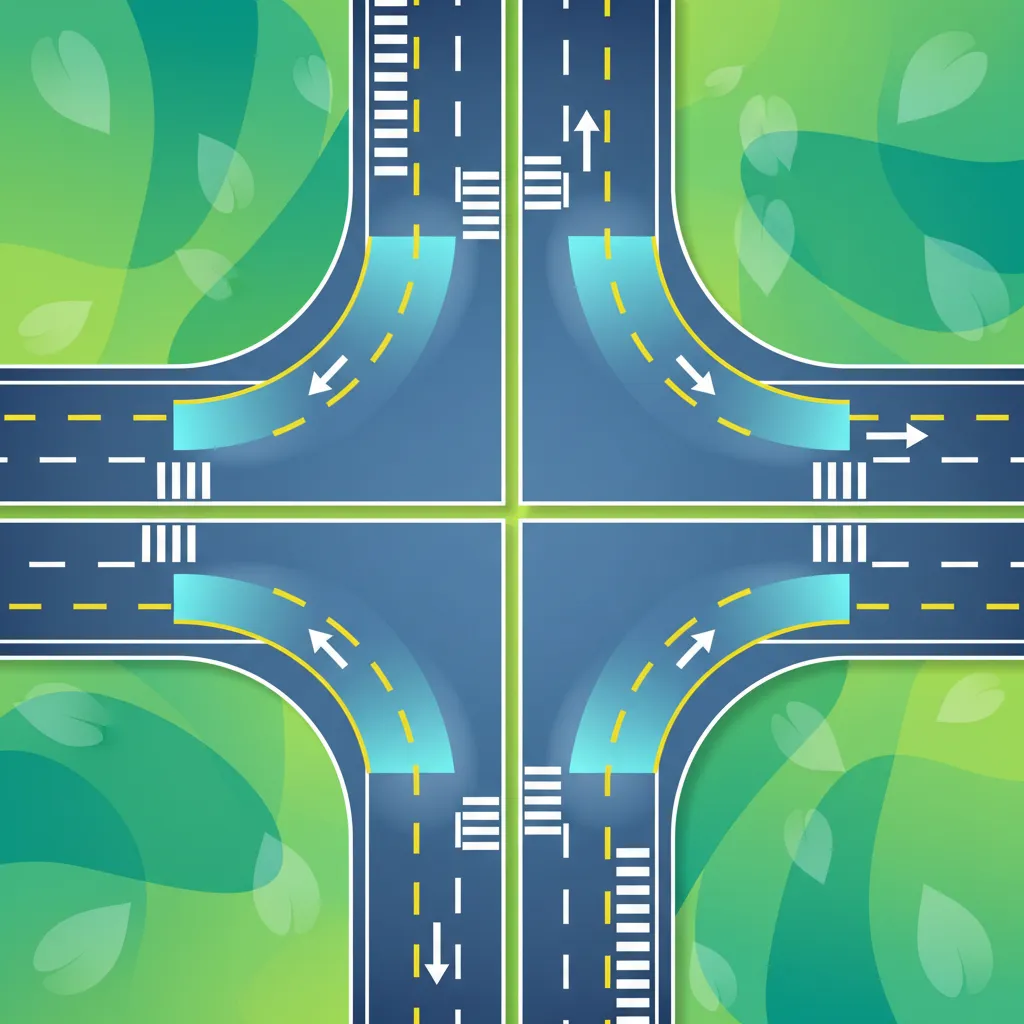
This lesson provides a comprehensive overview of the road markings found on Icelandic roads, from solid and broken lane lines to symbols indicating turning lanes and pedestrian crossings. The content details the visual meanings of each marking, such as solid lines indicating no crossing and broken lines permitting lane changes. Additionally, the lesson addresses the purpose of reflective markers and surface textures used in low-visibility or icy conditions, providing a framework for interpreting pavement cues.
This lesson outlines the specific duties and limitations placed on learner drivers in Iceland, from the mandatory display of L-plates to the requirement for a qualified supervisor. Learners will study night-driving prohibitions, passenger rules for newly licensed drivers, and the legal limits on alcohol consumption during the learning phase. The content also covers the necessity of maintaining a training log and ensuring appropriate insurance coverage for the vehicle.

This lesson focuses on interpreting road surface markings, including solid and broken lines that govern lane changes and positioning. Learners will understand the rules associated with turning arrows, pedestrian crossings, and markings for dedicated lanes. Correctly reading these markings is essential for maintaining proper lane discipline and navigating complex road layouts safely.
This lesson examines the calculation of safe following distances using the two-second rule and formulas that factor in vehicle speed and road conditions. The content explains how reaction time, weather conditions like ice or rain, and vehicle load affect braking zones. Students also learn specific techniques for stopping on hills and how to avoid tailgating, thereby maintaining sufficient safety margins under all Icelandic weather conditions.
Find clear answers to common questions learners have about Wind Effects and Light Conditions (Day/Night). Learn how the lesson is structured, which driving theory objectives it supports, and how it fits into the overall learning path of units and curriculum progression in Iceland. These explanations help you understand key concepts, lesson flow, and exam focused study goals.
Strong winds, especially crosswinds, can push your vehicle sideways. In Iceland, you must be prepared for gusts. Reduce your speed, keep both hands firmly on the steering wheel, and be ready to make small, corrective steering inputs. Pay extra attention to vulnerable vehicles like motorcycles and cyclists, and be aware of potential wind-blown debris or sudden gusts when overtaking or passing other vehicles.
High-beam headlights should only be used on unlit roads when there is no oncoming traffic and you are not following another vehicle. They significantly improve visibility at night. Remember to dip your headlights well in advance when approaching other vehicles to avoid dazzling the driver.
Yes, Iceland mandates the use of dipped headlights at all times, day and night, for all vehicles. This rule enhances visibility for other road users, especially during Iceland's periods of low light, such as during winter or in adverse weather conditions like fog or rain.
Common mistakes include not understanding the requirement for daytime dipped headlights, incorrect usage of high beams (e.g., using them in built-up areas or when following others), and underestimating the effect of wind on vehicle stability. The test expects you to demonstrate awareness of these specific Icelandic conditions.
In rain or fog, visibility is reduced, and road surfaces can become slippery. You should slow down, increase your following distance, use dipped headlights (and fog lights if necessary and conditions warrant), and be extra vigilant for hazards. Avoid sudden braking or steering movements.
Utilize our advanced practice set search to pinpoint the exact Icelandic driving theory topics you need to review. Filter by subject, difficulty, or question type to create a highly effective study plan and ensure you are fully prepared for your official driving licence test in Iceland.