
This lesson details the legal obligations for learner drivers in Iceland, ensuring you understand your responsibilities before getting behind the wheel. You will learn about required vehicle markings, the role of your supervisor, and specific restrictions that apply during your training phase. Mastering these rules is essential for both your safety on the road and success in the Icelandic Category B theory exam.
Lesson content overview
Becoming a driver in Iceland is an exciting journey, but it comes with significant responsibilities, particularly for learner drivers. The Icelandic Category B driving theory course emphasizes understanding these duties to ensure safety on the roads and compliance with national laws. This lesson details the specific obligations, restrictions, and procedural requirements placed on learner drivers in Iceland, providing a robust foundation for your driving education.
Understanding these obligations is not merely about passing a test; it's about safeguarding yourself, your supervising driver, other road users, and ensuring full compliance with Icelandic traffic legislation. Adhering to these rules is a prerequisite for successfully obtaining your full driving licence and becoming a responsible driver.
As a learner driver in Iceland, you are actively acquiring the practical skills and experience necessary to operate a vehicle safely and independently. This period of learning is governed by specific regulations designed to mitigate risks associated with inexperience. You are not yet a fully licensed driver, and your actions are subject to strict oversight and limitations.
Every obligation placed upon learner drivers serves a critical safety purpose. These rules enhance visibility to other road users, guarantee competent supervision during the learning process, limit exposure to inherently hazardous driving conditions, and provide a verifiable record of your training progress. By understanding the rationale behind each rule, you can better appreciate its importance and integrate safe practices from the outset of your driving career.
One of the most fundamental obligations for any learner driver in Iceland is the clear and continuous display of an "L-plate" on the vehicle. This visible identification is crucial for communication with other road users and for ensuring overall road safety.
An L-plate is a rectangular plate featuring the Latin letter "L" in black on a plain white background. It must be affixed to both the front and rear of the vehicle whenever a learner driver is at the wheel. The primary purpose of the L-plate is to inform other drivers, pedestrians, and cyclists that the vehicle is being operated by someone who is still learning. This notification prompts other road users to exercise patience, maintain greater distances, and adjust their driving behaviour accordingly.
L-plates can come in various forms, from permanent metal plates to removable reflective stickers. Regardless of the type, they must always be clean, upright, and legible. Any obstruction by dirt, damage, or other items is a violation and can result in fines. The rule applies to all learner-driver trips, regardless of whether a supervisor is present (though unsupervised driving is itself a violation in most contexts, as we will discuss).
For a learner, ensuring the L-plates are properly displayed before every journey becomes a routine check. Failure to do so not only risks a fine but also deprives other road users of crucial information, potentially leading to unsafe situations.
A common misunderstanding is confusing Icelandic "L-plates" with "P-plates" used for provisional drivers in some other countries. In Iceland, only the "L" plate is used during the learning phase. Another mistake is assuming that L-plates only need to be displayed during formal lessons. In fact, they are mandatory for any time a learner driver is operating a vehicle.
A cornerstone of learner driver obligations in Iceland is the requirement for a qualified supervisor. This individual plays a critical role in guiding you, intervening when necessary, and ensuring your safety and the safety of others.
A qualified supervisor is a person who meets specific statutory criteria established by Icelandic law. They must:
The supervisor's role is to provide immediate guidance and control, significantly reducing the likelihood of unsafe decisions or manoeuvres by the learner. They should be actively attentive to the road and the learner's actions, ready to offer instruction or even take physical control of the vehicle (e.g., by applying the emergency brake).
The supervisor is essentially a co-driver, offering an experienced pair of eyes and hands. They are responsible for ensuring the learner adheres to traffic laws, understands road conditions, and develops safe driving habits. This includes pointing out hazards, correcting mistakes, and generally educating the learner in real-time.
It is a common misconception that any licensed adult can supervise a learner. The specific age (25 years) and experience (5 years full licence) requirements in Iceland are strict and designed to ensure a high level of competency and maturity in the supervisor. Driving with an unqualified supervisor is a serious violation for both the learner and the supposed supervisor.
Supervision is mandatory for nearly all driving sessions for a learner driver, with limited exceptions (such as certain practical tests or driving school scenarios under direct instructor supervision). The presence of a qualified supervisor is paramount for allowing learners to gain experience safely.
Driving conditions change significantly after sunset, presenting increased challenges even for experienced drivers. For this reason, Icelandic law places restrictions on learner drivers operating a vehicle during periods of darkness.
Learner drivers are prohibited from operating a vehicle between sunset and sunrise unless they are accompanied by a qualified supervisor. This rule acknowledges that night conditions dramatically reduce visibility, impair depth perception, and increase reaction times due to the need to adjust to artificial lighting and shadows.
The specific times for sunset and sunrise are defined by the Icelandic Transport Authority (Samgöngustofa) and vary significantly throughout the year, especially given Iceland's high latitude. In winter, darkness can begin as early as mid-afternoon, while in summer, there may be very few hours of true darkness. Learners must be aware of these changing times and plan their practice sessions accordingly.
This prohibition means learners must carefully plan their driving practice during daylight hours or ensure that a qualified supervisor is present for any night-time driving. This conditional allowance for supervised night practice is crucial, as it allows learners to gain experience in varied light conditions, albeit with an experienced guide by their side to mitigate the heightened risks. Attempting to drive alone after sunset is a serious violation that can lead to fines and delay the issuance of a full licence.
Once you pass your driving test and receive your full Category B licence, you enter a probationary period. For the first six months after obtaining your full licence, specific restrictions apply to the passengers you may carry in your vehicle.
During this initial six-month period, newly licensed drivers may only carry immediate family members as passengers. This restriction is designed to reduce potential distractions and social pressure on a novice driver, allowing them to focus fully on the task of driving and adapt to independent motoring in various conditions.
The legal definition of "immediate family" is crucial here. Generally, this includes a spouse, registered partner, children, and parents. It is important to confirm the precise legal definition in Icelandic traffic law to avoid any misunderstandings.
This rule means that a newly licensed driver cannot, for example, pick up friends, non-family colleagues, or more distant relatives as passengers during their first six months of driving. Failing to adhere to this restriction is a violation of the conditions of your new licence and can lead to penalties. After the initial six-month period has elapsed, this restriction is lifted, and you may carry any passengers.
Always verify passenger eligibility before starting a journey during your probationary period. This small check can prevent legal issues and keep your focus where it needs to be: on the road.
One of the most critical safety regulations for learner drivers in Iceland is the absolute zero-tolerance policy regarding alcohol consumption. This rule is designed to eliminate any potential impairment during a crucial learning phase.
For learner drivers, the Blood Alcohol Concentration (BAC) limit is 0.0‰ (zero per mille). This means that absolutely no alcohol may be present in your blood while you are operating a vehicle. Even the smallest amount of alcohol constitutes a violation.
This is a stricter standard than for experienced, fully licensed drivers in Iceland, who have a permissible BAC limit of 0.2‰. The rationale is clear: any amount of alcohol, however small, can impair judgment, reaction time, and coordination. Learners, who are already in a state of acquiring basic driving skills and developing situational awareness, have less experience to compensate for any impairment. Therefore, complete abstinence from alcohol is mandatory when driving as a learner.
Enforcement is strict, typically through breathalyser tests or blood samples. A violation of the zero-tolerance policy can result in significant fines, suspension of your learner's permit, and a substantial delay in being eligible to obtain a full driving licence. It is imperative that learners understand and strictly adhere to this rule, completely avoiding alcoholic beverages before or during any driving session. This extends to seemingly innocuous items like certain non-alcoholic beverages that might contain trace amounts of alcohol, such as some kombuchas, which could technically breach the zero-tolerance threshold.
Keeping an accurate and up-to-date training log is a mandatory procedural requirement for all learner drivers in Iceland. This log serves as a verifiable record of your supervised driving practice.
The training log, which can be a physical logbook or an approved digital application, must document every supervised driving session. Each entry should include:
The primary purpose of the training log is to provide concrete evidence of sufficient supervised practice. It demonstrates that you have gained varied experience under different conditions, which is essential for developing comprehensive driving skills. Authorities may inspect this log at various stages of your learning process, and a complete, well-maintained log is usually a prerequisite for being allowed to take your final practical driving examination and for licence issuance.
Learners are responsible for consistently recording each session and ensuring their supervisor signs off. Incomplete entries, missing dates, or a failure to produce the log upon request can lead to delays in your licensing process or even a refusal to issue a licence until sufficient, verifiable practice is demonstrated. The training log is therefore not just a formality but a vital tool for structured learning and accountability.
Record every supervised driving session immediately after it concludes.
Ensure all required details are accurately filled: date, distance, conditions.
Have your qualified supervisor sign or approve each entry.
Keep the log in a safe place and bring it to any official appointments related to your driving licence application.
The final, but equally crucial, obligation pertains to ensuring that the vehicle used for learner driving has appropriate and valid insurance coverage. Driving without proper insurance is a serious legal offence.
It is mandatory for the vehicle used for learner driving to be explicitly insured to cover a learner driver. This often means that standard insurance policies may require a special endorsement, an add-on, or a separate policy rider to include a learner driver as a covered individual. You cannot assume that a vehicle's standard insurance policy automatically extends coverage to a learner driver.
Driving a vehicle without proper insurance that specifically covers the learner driver is a criminal offence. In the event of an accident, you would be personally liable for all damages, and face significant legal penalties.
This insurance guarantees financial responsibility in case of an accident, covering damages to third parties and, depending on the policy, also to the vehicle you are driving.
Before commencing any driving session as a learner, you or your supervisor must verify that the insurance policy explicitly accepts a learner driver as a listed or covered driver. It is also advisable to carry proof of this insurance coverage with you in the vehicle, as authorities may request to see it. This ensures that you are compliant with the law and protected against potential financial and legal repercussions in unforeseen circumstances.
To ensure you are fully prepared for your driving journey in Iceland, remember these core obligations:
By internalizing and consistently applying these rules, you will build a strong foundation for safe and responsible driving, progressing confidently towards obtaining your full Icelandic Category B driving licence.
This lesson covers the essential legal obligations for Icelandic learner drivers preparing for Category B. Key requirements include mandatory L-plate display on both vehicle ends, qualified supervision meeting strict criteria (age 25+, 5 years full licence), and prohibition on unsupervised night driving between sunset and sunrise. Learner drivers must maintain a 0.0‰ BAC ( stricter than the 0.2‰ limit for fully licensed drivers), keep a detailed training log documenting every session, and ensure the vehicle insurance explicitly covers them. Newly licensed drivers face additional passenger restrictions during their first six months, limiting them to immediate family members only.
A short set of high-value points that capture the most important learning from this lesson.
Learner drivers must display L-plates (black 'L' on white) on both front and rear of the vehicle during every driving session, regardless of whether it's a formal lesson.
A qualified supervisor must be at least 25 years old, hold a Category B licence for at least 5 years, and be seated in the front passenger seat with full capacity to intervene.
Night-driving prohibition applies between sunset and sunrise; supervised night driving is allowed but unsupervised is a serious violation.
During the first six months after obtaining a full licence, newly licensed drivers may only carry immediate family members as passengers.
Learner drivers are subject to a strict zero-tolerance BAC of 0.0‰, stricter than the 0.2‰ limit for fully licensed drivers.
Explore all units and lessons included in this driving theory course.
L-plates must be clean, upright, and legible on both front and rear; dirt or obstruction is a violation.
Supervisor requirements are strict: aged 25+, held full licence 5+ years, sober, and seated in the front passenger seat.
The training log must record every session with date, distance, conditions, and supervisor signature for final examination eligibility.
Vehicle insurance must explicitly cover the learner driver; standard policies do not automatically extend coverage.
Passenger restrictions (immediate family only) apply to newly licensed drivers during their first six months, not to learner drivers.
Confusing Icelandic L-plates with P-plates used in some other countries; only 'L' plates are valid in Iceland.
Assuming any fully licensed adult can supervise; the 25-year age minimum and 5-year licence experience requirement are strict legal criteria.
Believing standard vehicle insurance automatically covers learner drivers; a specific endorsement or rider is required.
Thinking night-driving restrictions apply only to formal lessons; they apply whenever a learner driver is at the wheel without a qualified supervisor.
Confusing passenger restrictions for newly licensed drivers with learner driver rules; the immediate family restriction applies after passing, not during learning.
Lesson content overview
A short set of high-value points that capture the most important learning from this lesson.
Learner drivers must display L-plates (black 'L' on white) on both front and rear of the vehicle during every driving session, regardless of whether it's a formal lesson.
A qualified supervisor must be at least 25 years old, hold a Category B licence for at least 5 years, and be seated in the front passenger seat with full capacity to intervene.
Night-driving prohibition applies between sunset and sunrise; supervised night driving is allowed but unsupervised is a serious violation.
During the first six months after obtaining a full licence, newly licensed drivers may only carry immediate family members as passengers.
Learner drivers are subject to a strict zero-tolerance BAC of 0.0‰, stricter than the 0.2‰ limit for fully licensed drivers.
Explore all units and lessons included in this driving theory course.
L-plates must be clean, upright, and legible on both front and rear; dirt or obstruction is a violation.
Supervisor requirements are strict: aged 25+, held full licence 5+ years, sober, and seated in the front passenger seat.
The training log must record every session with date, distance, conditions, and supervisor signature for final examination eligibility.
Vehicle insurance must explicitly cover the learner driver; standard policies do not automatically extend coverage.
Passenger restrictions (immediate family only) apply to newly licensed drivers during their first six months, not to learner drivers.
Confusing Icelandic L-plates with P-plates used in some other countries; only 'L' plates are valid in Iceland.
Assuming any fully licensed adult can supervise; the 25-year age minimum and 5-year licence experience requirement are strict legal criteria.
Believing standard vehicle insurance automatically covers learner drivers; a specific endorsement or rider is required.
Thinking night-driving restrictions apply only to formal lessons; they apply whenever a learner driver is at the wheel without a qualified supervisor.
Confusing passenger restrictions for newly licensed drivers with learner driver rules; the immediate family restriction applies after passing, not during learning.
Explore search topics learners often look for when studying Learner Driver Obligations. These topics reflect common questions about road rules, driving situations, safety guidance, and lesson level theory preparation for learners in Iceland.
Browse additional driving theory lessons that cover connected traffic rules, road signs, and common driving situations related to this topic. Improve your understanding of how different rules interact across everyday traffic scenarios.
Understand the specific duties, L-plate requirements, and mandatory supervision rules for learner drivers in Iceland. This theory lesson covers who can supervise and the importance of this guidance for safe learning.
This lesson focuses on the regulations governing highland travel and off-road restrictions, including environmental protections that prohibit off-road driving in certain zones. The lesson details how to interpret highland road signage, understand restrictions related to wildlife crossings like reindeer and sheep, and adhere to road width management guidelines. Learners are also instructed on using emergency contact points in sparsely populated regions.

This lesson explores the insurance landscape required for operating a vehicle in Iceland, emphasizing compulsory liability insurance and options for comprehensive coverage. The content explains the distinctions between third-party liability and full coverage policies, the documentation needed for proof of insurance, and the procedural steps for filing an accident claim. Learners also study the legal responsibilities associated with insurance renewal and risk assessment factors.

This lesson outlines the regulations governing pedestrian crossings, including zebra crossings, pedestrian traffic lights, and the driver’s obligations to yield. Learners will study how to identify crosswalk markings, interpret pedestrian signal phases, and understand the enhanced caution required in school zones and areas with high foot traffic. The content also emphasizes the need for drivers to anticipate vulnerable pedestrians and provide additional yielding in low-visibility conditions.

This lesson explores the health criteria mandated by Icelandic law for operating a vehicle, focusing on visual and auditory acuity, as well as overall physical capability. Students will study required medical certifications and understand acceptable vision levels and hearing standards necessary for safe driving. The lesson also outlines how chronic illnesses, medication side-effects, and mental health conditions can influence driver fitness and legal compliance.

This lesson explores the proper use of lane markings to maintain correct vehicle centering and adherence to the prescribed traffic flow direction in Iceland. The content describes how to interpret solid and broken lines, maintain safe following distances within a lane, and avoid unintended lane departures. Learners also examine the legal prohibitions on using the road shoulder for general travel, ensuring compliance with lane discipline rules for overall traffic safety.
This lesson examines the set of safety equipment required by Icelandic law to be present in every passenger vehicle, focusing on seat belts, airbags, fire extinguishers, and reflective vests. The content explains the correct placement and usage protocols for each item, including how to operate a fire extinguisher and don a reflective vest. Additionally, learners are introduced to the legal requirement for an emergency triangle and a first-aid kit.
This lesson outlines the speed limits applicable to various road types in Iceland, from urban streets to rural highways and special zones like tunnels. Learners will interpret speed sign markings, understand variable speed limits that adjust for weather, and recognize when temporary speed reductions are enforced. The content also covers speed monitoring devices and the legal consequences of exceeding limits, emphasizing speed awareness in all driving contexts.

This lesson focuses on the routine maintenance tasks essential for preserving vehicle safety and compliance in Iceland, including how to check tire pressure, assess brake wear, and monitor fluid levels. The content also outlines the periodic vehicle inspection process, the requirement for emissions testing, and the steps needed to renew vehicle registration. Understanding these procedures ensures the vehicle remains roadworthy and legally compliant.
This lesson examines the calculation of safe following distances using the two-second rule and formulas that factor in vehicle speed and road conditions. The content explains how reaction time, weather conditions like ice or rain, and vehicle load affect braking zones. Students also learn specific techniques for stopping on hills and how to avoid tailgating, thereby maintaining sufficient safety margins under all Icelandic weather conditions.
This lesson focuses on the operation of roundabouts, which are common in Icelandic towns and rural areas, and explains how drivers must yield to circulating traffic upon entry. The content covers how to interpret roundabout signage and follow lane markings to maintain correct positioning. Students also learn strategies for safe exit, handling multi-lane roundabouts, and recognizing deceptive entries that require heightened vigilance for smooth navigation.
Explore the strict rules for learner drivers in Iceland, including zero-tolerance alcohol policy, night-driving limitations, and passenger restrictions during the probationary period after obtaining a full licence.

This lesson details the legal blood alcohol concentration (BAC) limits applicable to drivers in Iceland and outlines the procedures used by police to enforce these limits. Learners will understand the specific BAC threshold, the operation of breathalyzer devices during roadside checks, and the signs of intoxication. The lesson also covers the penalties associated with exceeding limits, including fines, licence suspension, and the legal implications of refusing a test.
This lesson focuses on the regulations governing highland travel and off-road restrictions, including environmental protections that prohibit off-road driving in certain zones. The lesson details how to interpret highland road signage, understand restrictions related to wildlife crossings like reindeer and sheep, and adhere to road width management guidelines. Learners are also instructed on using emergency contact points in sparsely populated regions.
This lesson outlines the speed limits applicable to various road types in Iceland, from urban streets to rural highways and special zones like tunnels. Learners will interpret speed sign markings, understand variable speed limits that adjust for weather, and recognize when temporary speed reductions are enforced. The content also covers speed monitoring devices and the legal consequences of exceeding limits, emphasizing speed awareness in all driving contexts.
This lesson explores the regulations surrounding drug use and its impact on driver capability, examining prohibited substances, testing methods, and specific detection thresholds. Learners also study how prescription medications may affect driving and the legal penalties for drug-impaired driving, including licence revocation. The content emphasizes the importance of medical certification when using legally prescribed drugs that may impair performance.
This lesson explores the health criteria mandated by Icelandic law for operating a vehicle, focusing on visual and auditory acuity, as well as overall physical capability. Students will study required medical certifications and understand acceptable vision levels and hearing standards necessary for safe driving. The lesson also outlines how chronic illnesses, medication side-effects, and mental health conditions can influence driver fitness and legal compliance.
This lesson addresses the challenges of driving in rain and fog, focusing on strategies to maintain visibility and vehicle control. Learners will explore the correct use of windshield wipers, defoggers, and appropriate headlight settings, including when to use fog lights. The content also covers the increased risk of hydroplaning, the importance of adjusting speed in wet conditions, and the need to extend following distances to account for longer stopping distances.

This lesson examines how strong winds and varying light conditions affect vehicle handling and safety, including techniques for maintaining stability under cross-winds and assessing gust intensity. The content also explains proper headlight usage during daylight, dusk, and nighttime, addressing glare reduction strategies and when to employ high-beam headlights. By mastering these concepts, drivers can navigate Icelandic weather and lighting challenges confidently and safely.
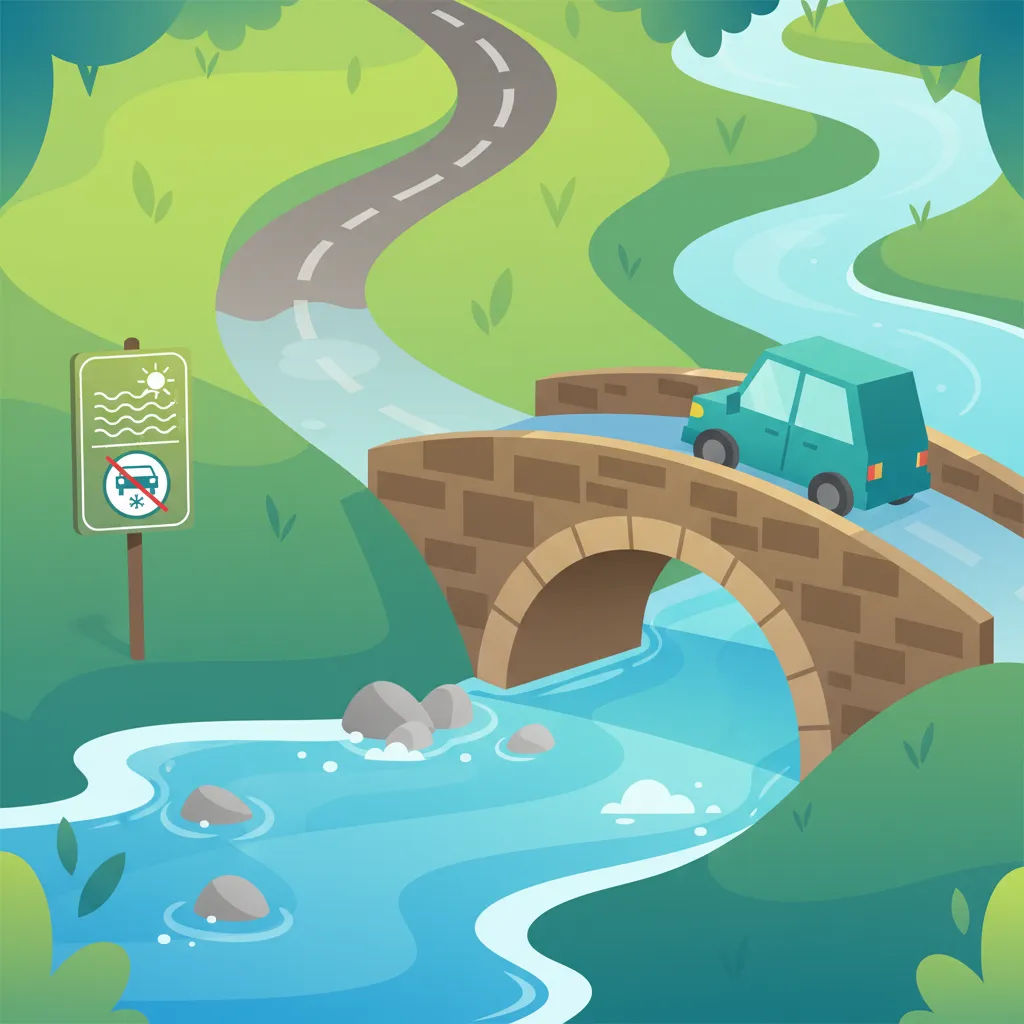
This lesson examines procedures for crossing single-lane bridges and water fords, paying particular attention to right-of-way rules and appropriate vehicle positioning. Learners will learn how to assess water depth before fording, understand seasonal restrictions that may affect access, and recognize signage indicating temporary closures. The lesson also covers the need for highland travel permits on certain routes and weight limits for bridges.
This lesson outlines the regulations governing pedestrian crossings, including zebra crossings, pedestrian traffic lights, and the driver’s obligations to yield. Learners will study how to identify crosswalk markings, interpret pedestrian signal phases, and understand the enhanced caution required in school zones and areas with high foot traffic. The content also emphasizes the need for drivers to anticipate vulnerable pedestrians and provide additional yielding in low-visibility conditions.
This lesson focuses on the rules governing vehicle parking throughout Iceland, including the correct use of parallel and angle parking and compliance with time-limited zones. Learners will review signage indicating disabled parking spaces, restrictions on roadside parking, and rules about parking on sidewalks or in narrow rural areas. The content also details the legal consequences and penalties for illegal parking and the impact of infractions on vehicle inspection records.
Find clear answers to common questions learners have about Learner Driver Obligations. Learn how the lesson is structured, which driving theory objectives it supports, and how it fits into the overall learning path of units and curriculum progression in Iceland. These explanations help you understand key concepts, lesson flow, and exam focused study goals.
A supervisor must be an experienced driver who occupies the passenger seat to provide guidance and ensure safety. They must meet specific criteria set by the Icelandic Transport Authority, including having held a valid licence for a minimum duration.
Yes, Icelandic law imposes certain limitations on learners, such as restrictions on driving during specific night hours or in certain weather conditions without proper supervision. Always verify the current, updated requirements in the official handbook.
Yes, the L-plate must be clearly displayed on the rear of the vehicle to alert other road users that the driver is a learner. Failure to display this can result in legal penalties.
Yes, you must ensure the vehicle has appropriate insurance coverage that explicitly covers learner drivers. Driving without proper insurance is a serious violation in Iceland.
Utilize our advanced practice set search to pinpoint the exact Icelandic driving theory topics you need to review. Filter by subject, difficulty, or question type to create a highly effective study plan and ensure you are fully prepared for your official driving licence test in Iceland.