
Welcome to the foundational lesson on priority rules, 'pierwszeństwo przejazdu,' for your Polish Category B driving theory test. Understanding who has the right of way at intersections is critical for safe driving and forms the basis for more complex traffic scenarios. This lesson will clarify the general principles that govern priority in Poland, setting you up for success in this key exam topic.
Lesson content overview
Navigating the roads safely and efficiently requires a clear understanding of who has the right to proceed at any given moment. In Polish traffic law, this concept is known as pierwszeństwo przejazdu, or right-of-way. Mastering these principles is fundamental for all drivers, especially when preparing for the Polish Category B theory test and for ensuring safety on the road.
This lesson delves into the core rules governing priority at intersections and other conflict points, explaining the general principle of yielding to traffic from the right, how road signs and markings modify this rule, and specific exceptions for vulnerable road users. A thorough grasp of these principles helps prevent collisions, promotes smooth traffic flow, and is legally mandated under the Polish Road Traffic Act.
The concept of right-of-way is perhaps the single most critical aspect of defensive driving and collision prevention. It establishes a predictable order of movement, particularly at junctions where paths intersect. Without clear rules on who goes first, traffic would quickly descend into chaos, leading to frequent stalemates and dangerous encounters.
The Polish legal framework for traffic prioritizes clarity and safety. By standardizing the right-of-way, drivers can anticipate the actions of others, reducing uncertainty and the need for stressful, last-minute decisions. This predictability is vital for maintaining a steady flow of traffic and minimizing the risk of accidents.
Knowing and correctly applying right-of-way rules is not merely about passing your theory exam; it's a critical skill for real-world driving. Intersections are notorious hotspots for accidents, with a significant percentage of collisions stemming from misunderstandings or violations of priority. A driver's ability to quickly assess a situation and correctly identify who has pierwszeństwo przejazdu can be the difference between a smooth passage and a dangerous incident.
For those undertaking the Polish Driving Theory – Comprehensive Category B License Preparation, a deep understanding of these rules is non-negotiable. It forms the bedrock upon which more complex traffic scenarios, such as roundabouts and multi-lane junctions, are built. Ignoring or misinterpreting right-of-way can lead to legal penalties, including fines and penalty points on your license, in addition to the inherent safety risks.
Polish traffic law outlines a clear hierarchy of rules that determine right-of-way. At the highest level are instructions from a police officer, followed by traffic lights, then road signs, road markings, and finally, general rules such as the "priority to the right" principle. This hierarchy ensures that explicit instructions (e.g., a stop sign) always override general guidelines (e.g., priority to the right).
This lesson will systematically break down each of these layers, explaining how they interact to establish who has the right to proceed. By understanding this structure, drivers can confidently navigate even complex situations where multiple rules might seem to apply.
At the heart of Poland's right-of-way system, especially in the absence of explicit instructions, is the Priority to the Right rule, known in Polish as prawo pierwszeństwa. This fundamental principle dictates that at any uncontrolled intersection (where there are no traffic lights, priority signs, or stop/yield signs), a driver must yield to any vehicle approaching from their right-hand side.
This rule ensures that a default, unambiguous method exists for determining priority, preventing deadlocks and reducing confusion. It is a cornerstone of traffic safety, minimizing the need for drivers to communicate verbally or through eye contact in potentially high-stress situations.
When approaching an intersection without any traffic lights, priority road signs, yield signs, or stop signs, drivers must immediately look to their right. If another vehicle is approaching from that direction, or is already in the intersection, you are required to yield. This means slowing down and, if necessary, stopping to allow that vehicle to proceed first.
Always assume the "priority to the right" rule applies unless explicitly overridden by signs, signals, or road markings. Being prepared to yield is crucial for safety.
This rule applies universally to vehicles, regardless of their size or perceived speed. For instance, if you are driving on a local residential street and approach a junction with another similar street, and a car approaches from your right, that car has priority.
Despite its simplicity, the "priority to the right" rule is frequently misunderstood or misapplied, leading to common violations. One common mistake is the belief that if you arrive at the intersection first, you automatically have priority, even if a vehicle is approaching from your right. This is incorrect; simultaneous arrival still dictates that the driver on the left must yield.
Another misconception arises when drivers assume they have priority because they are on a seemingly "main" road, even if no Droga z pierwszeństwem sign is present. Without explicit signage, all roads intersecting at an uncontrolled junction are considered equal in status, and the right-hand priority rule applies. It is vital to actively look for signs and not make assumptions based on road appearance.
While the "priority to the right" rule serves as a default, many intersections in Poland have specific traffic signs that override this general principle. These signs establish a clear hierarchy, ensuring safer and more efficient traffic flow, especially on busier roads.
One of the most important signs for establishing priority is the Priority Road sign.
This sign, characterized by its white diamond shape with a yellow center and black border, grants continuous right-of-way to vehicles traveling on the road where it is displayed. This means that if you are on a priority road, you generally do not need to yield to traffic from intersecting roads, regardless of whether they are on your right or left. Traffic entering from side roads onto a priority road will typically encounter a yield or stop sign.
It is crucial for drivers on a priority road to remain vigilant, as exceptions can exist (e.g., a stop sign temporarily placed on the priority road due to roadworks). However, the general expectation is that traffic on a priority road may proceed without interruption, making it a key element in managing traffic flow on main thoroughfares. Drivers on intersecting roads must yield to vehicles on the priority road.
The Yield sign explicitly instructs drivers to give way to traffic on the intersecting road.
This inverted white triangle with a red border signifies that you must reduce your speed and, if necessary, stop to allow all traffic on the main road or cross road to pass before you proceed. This applies whether the cross-traffic is coming from your right or left. The yield sign overrides the "priority to the right" rule for the approach it governs.
Drivers approaching a yield sign must not assume they can simply merge. The obligation is to yield to all traffic on the intersecting road. This often means stopping completely if the view is obstructed or if vehicles are approaching quickly. A "rolling stop," where the vehicle only slows down but does not come to a complete halt, is a common violation and can lead to dangerous situations.
The Stop sign is one of the most emphatic instructions in traffic law, requiring a complete cessation of movement.
This octagonal red sign with the word "STOP" in white means that you must bring your vehicle to a full and complete stop before the stop line, or if no line is present, before the crosswalk. If neither is present, stop at a point where you have a clear view of the intersecting traffic without entering the intersection itself. After stopping, you must check for traffic in all directions (left, right, and straight ahead) and only proceed when the way is absolutely clear and safe.
The Stop sign applies regardless of any other right-of-way rules. Even if you perceive that you might have had "priority to the right" under different circumstances, or if there appears to be no traffic, the stop sign demands a full stop. Failing to do so (performing a "rolling stop") is a serious violation and a common cause of accidents at dangerous junctions.
Beyond signs, road markings provide crucial visual cues and instructions that can reinforce or even modify default priority rules at intersections. These markings are an integral part of Polish traffic regulations and must be obeyed.
Road markings such as solid white lines and dashed white lines play a significant role in guiding drivers and influencing priority.
It's important to understand that road markings supplement signs. If a yield sign is present, a dashed line might allow you to maneuver, but the yield requirement remains paramount. If a stop line (a wide solid white line) is present, you must stop before it, as mandated by a stop sign or the general rule for stopping at intersections.
Specific road markings are designed to work in conjunction with stop and yield signs:
Always observe these markings. They are strategically placed to define the safe stopping or waiting point and are legally binding under the Polish Road Traffic Act (Ustawa Prawo o Ruchu Drogowym).
While vehicle-to-vehicle priority rules are critical, drivers must also be aware of situations where specific road users are granted absolute or enhanced priority, regardless of general intersection rules. These exceptions are in place to protect vulnerable individuals and facilitate critical services.
One of the most crucial special priority rules in Poland concerns pedestrians at marked crosswalks.
At any designated pedestrian crosswalk, marked by the P-10 sign (or typically indicated by white stripes on the road, often referred to as a "zebra crossing"), pedestrians who are already on the crosswalk or are about to enter it have absolute priority. This means drivers must stop and yield to them, even if the driver would otherwise have priority according to the "priority to the right" rule or a priority road sign.
Never assume a pedestrian will wait for you. Always be prepared to stop for pedestrians at marked crosswalks, regardless of your vehicle's speed or traffic flow.
This rule is strictly enforced to protect vulnerable road users and is a common focus in the Polish Category B theory exam. Failing to yield to pedestrians at a marked crosswalk is a serious offense with significant penalties.
Certain other categories of road users and vehicles also receive special priority:
Understanding these special priorities is essential for safe and responsible driving in diverse traffic environments.
All right-of-way principles discussed in this lesson are enshrined in Polish law, primarily within the Ustawa Prawo o Ruchu Drogowym (Road Traffic Act) and its implementing regulations (Rozporządzenie Ministra Infrastruktury). Adherence to these laws is not optional; it is mandatory for all road users.
The core principles of pierwszeństwo przejazdu are detailed in several articles of the Polish Road Traffic Act:
These legal foundations ensure consistency and enforceability. Violating these rules carries consequences designed to deter dangerous driving behaviors and maintain public safety.
Several common violations of right-of-way rules frequently lead to collisions and penalties:
Each of these violations can lead to severe legal sanctions, including fines and penalty points on your driving license, and can significantly increase your insurance premiums. More importantly, they pose a direct threat to the safety of yourself and other road users.
Right-of-way rules provide a clear framework, but their application requires contextual awareness. External factors such as weather, visibility, and even the type of vehicle you are driving can influence how you should approach and execute priority decisions.
Adverse weather conditions like heavy rain, fog, snow, or ice significantly reduce visibility and vehicle control. In such situations, drivers should exercise extreme caution, even when they theoretically have priority:
The environment and your vehicle's characteristics also play a role:
Understanding right-of-way rules is best solidified through practical application. Here are a few scenarios illustrating how pierwszeństwo przejazdu principles are applied in Polish traffic.
Imagine a rural crossroad with no traffic signs or road markings indicating priority. Car A is approaching from the north, wanting to go straight. Car B is approaching from the east, also wanting to go straight.
Consider an urban junction where a main road (Road X) is marked with a priority road sign (D-1). A side street (Road Y) intersects Road X, and traffic on Road Y encounters a yield sign (D-15). Car C is on Road X, and Car D is approaching from Road Y.
You are driving on a city street and approach a marked crosswalk (P-10). Several pedestrians are waiting at the curb and begin to step onto the crossing as you get close.
It's a foggy morning, and visibility is severely reduced. You are approaching an uncontrolled T-junction where you need to turn right. There are no signs, so "priority to the right" applies. A car is approaching from your right, but you can barely see it due to the fog.
Understanding and correctly applying the principles of pierwszeństwo przejazdu is undeniably one of the most critical aspects of learning to drive in Poland. From the foundational "priority to the right" rule at uncontrolled intersections to the explicit instructions given by priority road signs, yield signs, and stop signs, each regulation is designed to create a predictable and safe traffic environment.
This lesson has highlighted how road markings supplement these rules and underscored the absolute priority granted to vulnerable road users like pedestrians at marked crosswalks. Remember that these rules are legally binding under the Polish Road Traffic Act and require contextual adjustment based on weather, visibility, and vehicle type. By internalizing these concepts, you will not only be well-prepared for your Polish Category B theory test but also become a safer, more responsible driver on Polish roads.
The foundation of Polish priority rules is the 'priority to the right' (prawo pierwszeństwa), which requires yielding to traffic from your right at any uncontrolled intersection. This default rule sits at the bottom of a clear hierarchy where explicit instructions always override it—police signals, traffic lights, and road signs (D-1 for priority roads, D-15 for yield, D-10 for stop) take precedence. Road markings including stop lines and yield lines are legally binding indicators of required stopping positions. Special priority cases include absolute pedestrian priority at marked crosswalks (P-10) and emergency vehicles with activated blue lights, which must be yielded to regardless of any other rules in effect. Understanding when the general rule applies versus when signs override it is essential for safe driving and passing the Polish Category B theory exam.
A short set of high-value points that capture the most important learning from this lesson.
The 'priority to the right' rule (prawo pierwszeństwa) requires drivers to yield to vehicles approaching from the right at any uncontrolled intersection where no signs, signals, or markings establish priority.
Polish traffic law follows a clear priority hierarchy: police directions override all, then traffic lights, road signs (D-1, D-15, D-10), road markings, and finally general rules like priority to the right.
The D-1 Priority Road sign grants continuous right-of-way on that road, overriding the default priority-to-the-right rule for all intersecting traffic.
Pedestrians have absolute priority at marked crosswalks (P-10/zebra crossings), regardless of the vehicle's theoretical right-of-way under other rules.
Emergency vehicles with activated blue lights and sirens have absolute priority over all traffic, including vehicles on priority roads.
Explore all units and lessons included in this driving theory course.
Priority to the right applies only at uncontrolled intersections—places with no traffic lights, police directions, or priority signs like D-1, D-15, or D-10.
The D-1 sign establishes a priority road, D-15 requires yielding to cross-traffic, and D-10 requires a complete stop before proceeding.
Road markings including stop lines and yield lines are legally binding and indicate precise stopping or waiting points at intersections.
Vehicles on a priority road (marked by D-1) generally do not need to yield to traffic from intersecting roads, regardless of direction.
At marked pedestrian crosswalks (P-10), you must stop for pedestrians who are on or stepping onto the crossing, regardless of your priority status.
Assuming you have priority if you arrive at an uncontrolled intersection first—simultaneous arrival still requires you to yield to vehicles from your right.
Performing a 'rolling stop' at a stop sign instead of bringing the vehicle to a complete halt; this is a violation regardless of apparent traffic conditions.
Assuming you are on a 'main road' based on road appearance without a D-1 sign; all unmarked intersecting roads are equal, and priority to the right applies.
Failing to stop for pedestrians at marked crosswalks because you believe you have right-of-way or assume pedestrians will wait for you.
Confusing a priority road sign (D-1 diamond shape) with a yield sign (D-15 inverted triangle), leading to either unnecessary stops or failure to yield.
Lesson content overview
A short set of high-value points that capture the most important learning from this lesson.
The 'priority to the right' rule (prawo pierwszeństwa) requires drivers to yield to vehicles approaching from the right at any uncontrolled intersection where no signs, signals, or markings establish priority.
Polish traffic law follows a clear priority hierarchy: police directions override all, then traffic lights, road signs (D-1, D-15, D-10), road markings, and finally general rules like priority to the right.
The D-1 Priority Road sign grants continuous right-of-way on that road, overriding the default priority-to-the-right rule for all intersecting traffic.
Pedestrians have absolute priority at marked crosswalks (P-10/zebra crossings), regardless of the vehicle's theoretical right-of-way under other rules.
Emergency vehicles with activated blue lights and sirens have absolute priority over all traffic, including vehicles on priority roads.
Explore all units and lessons included in this driving theory course.
Priority to the right applies only at uncontrolled intersections—places with no traffic lights, police directions, or priority signs like D-1, D-15, or D-10.
The D-1 sign establishes a priority road, D-15 requires yielding to cross-traffic, and D-10 requires a complete stop before proceeding.
Road markings including stop lines and yield lines are legally binding and indicate precise stopping or waiting points at intersections.
Vehicles on a priority road (marked by D-1) generally do not need to yield to traffic from intersecting roads, regardless of direction.
At marked pedestrian crosswalks (P-10), you must stop for pedestrians who are on or stepping onto the crossing, regardless of your priority status.
Assuming you have priority if you arrive at an uncontrolled intersection first—simultaneous arrival still requires you to yield to vehicles from your right.
Performing a 'rolling stop' at a stop sign instead of bringing the vehicle to a complete halt; this is a violation regardless of apparent traffic conditions.
Assuming you are on a 'main road' based on road appearance without a D-1 sign; all unmarked intersecting roads are equal, and priority to the right applies.
Failing to stop for pedestrians at marked crosswalks because you believe you have right-of-way or assume pedestrians will wait for you.
Confusing a priority road sign (D-1 diamond shape) with a yield sign (D-15 inverted triangle), leading to either unnecessary stops or failure to yield.
Explore search topics learners often look for when studying General Right-of-Way Principles (pierwszeństwo przejazdu). These topics reflect common questions about road rules, driving situations, safety guidance, and lesson level theory preparation for learners in Poland.
Browse additional driving theory lessons that cover connected traffic rules, road signs, and common driving situations related to this topic. Improve your understanding of how different rules interact across everyday traffic scenarios.
Explore the critical exceptions to general right-of-way rules in Polish traffic. This lesson details how to safely yield to pedestrians at crosswalks, emergency vehicles, and public transport to ensure legal compliance and road safety.
This lesson focuses on areas with high pedestrian activity, requiring special caution. It covers the rules for 'living zones' (strefa zamieszkania), where pedestrians have priority and the speed limit is 20 km/h. The content also addresses regulations for school zones and other designated pedestrian areas to ensure the safety of the most vulnerable road users.
This lesson explores the priority hierarchy for buses at different intersections, roundabouts, and pedestrian crossings. Learners will understand how traffic signals and signs affect their approach and how to safely navigate roundabouts with correct lane discipline. Special attention is given to yielding to pedestrians, especially near bus stops.
This lesson addresses advanced scenarios, including multi-lane intersections and interactions with vulnerable road users. It reinforces the legal obligation to give absolute priority to pedestrians at marked crossings (zebra crossings). The content also covers navigating around traffic islands and using dedicated turning lanes in complex urban environments.
This lesson focuses on safe coexistence with cyclists and pedestrians, who are prevalent in urban areas. It covers the rules for driving alongside dedicated bicycle lanes and the legal requirement to yield to pedestrians at marked crossings. The content stresses the importance of constant awareness, especially when turning at intersections, to prevent conflicts with vulnerable road users.
This lesson prepares drivers for the event of a vehicle breakdown on a motorway or expressway. It details the correct procedure: pulling over to the emergency lane, activating hazard lights, and placing the warning triangle at the legally required distance. The importance of wearing a reflective vest when outside the vehicle is also a key safety point.
This lesson provides strategies for safely navigating the numerous intersections typical of urban environments. It reinforces the application of priority rules in situations with limited visibility and high traffic volume. Techniques for making turns in narrow streets and being aware of pedestrians and cyclists at junctions are central to the instruction.
This lesson introduces the fundamental principles of right-of-way on Polish roads, explaining how priority road signs determine the flow of traffic at intersections. Learners will explore the hierarchy of vehicle classes and the specific obligations that arise when approaching a yield line or a give-way sign. The content details the legal precedence of main road traffic over secondary road traffic, helping riders safely navigate intersections and avoid right-of-way infractions.
This lesson provides a detailed breakdown of traffic light operations in Poland. It explains the sequence of red, amber, and green lights, and the specific rules for turning when a green arrow signal is displayed. The meaning of a flashing amber light and the rules for pedestrian crossings at signalized intersections are also covered.
This lesson details the rules and best practices for driving on Poland's fastest roads. It covers the higher speed limits, the strict lane discipline of keeping right except to overtake, and prohibitions on stopping. The aim is to ensure drivers can handle the demands of sustained high-speed travel safely and efficiently.
This lesson defines what constitutes a 'built-up area' in Poland, marked by specific informational signs. It explains the default speed limit of 50 km/h that applies within these zones unless otherwise indicated. The content highlights the need for increased vigilance due to higher traffic density and the frequent presence of pedestrians.
Understand how to navigate Polish intersections, from the basic 'priority to the right' rule to interpreting priority, yield, and stop signs. Learn how road markings and signs dictate right-of-way to prevent collisions and ensure smooth traffic flow.
This lesson focuses on navigating intersections that are not controlled by traffic signals. It covers the interpretation of the 'Yield' sign (ustąp pierwszeństwa) and the application of the 'priority to the right' rule at junctions of equal roads. Safe decision-making and proper observation techniques are emphasized for these common scenarios.
This lesson provides a comprehensive breakdown of the right-of-way rules that govern intersections. It explains the clear directives given by traffic lights, stop signs, and yield signs, and clarifies the procedures at unmarked or uncontrolled intersections, where the 'priority to the right' rule often applies. Learners will understand the legal hierarchy of these rules to make correct, safe, and predictable decisions when navigating through any junction, reducing the risk of conflict with other traffic.
This lesson introduces the fundamental principles of right-of-way on Polish roads, explaining how priority road signs determine the flow of traffic at intersections. Learners will explore the hierarchy of vehicle classes and the specific obligations that arise when approaching a yield line or a give-way sign. The content details the legal precedence of main road traffic over secondary road traffic, helping riders safely navigate intersections and avoid right-of-way infractions.
This lesson addresses advanced scenarios, including multi-lane intersections and interactions with vulnerable road users. It reinforces the legal obligation to give absolute priority to pedestrians at marked crossings (zebra crossings). The content also covers navigating around traffic islands and using dedicated turning lanes in complex urban environments.
This lesson provides strategies for safely navigating the numerous intersections typical of urban environments. It reinforces the application of priority rules in situations with limited visibility and high traffic volume. Techniques for making turns in narrow streets and being aware of pedestrians and cyclists at junctions are central to the instruction.
This lesson explores the priority hierarchy for buses at different intersections, roundabouts, and pedestrian crossings. Learners will understand how traffic signals and signs affect their approach and how to safely navigate roundabouts with correct lane discipline. Special attention is given to yielding to pedestrians, especially near bus stops.
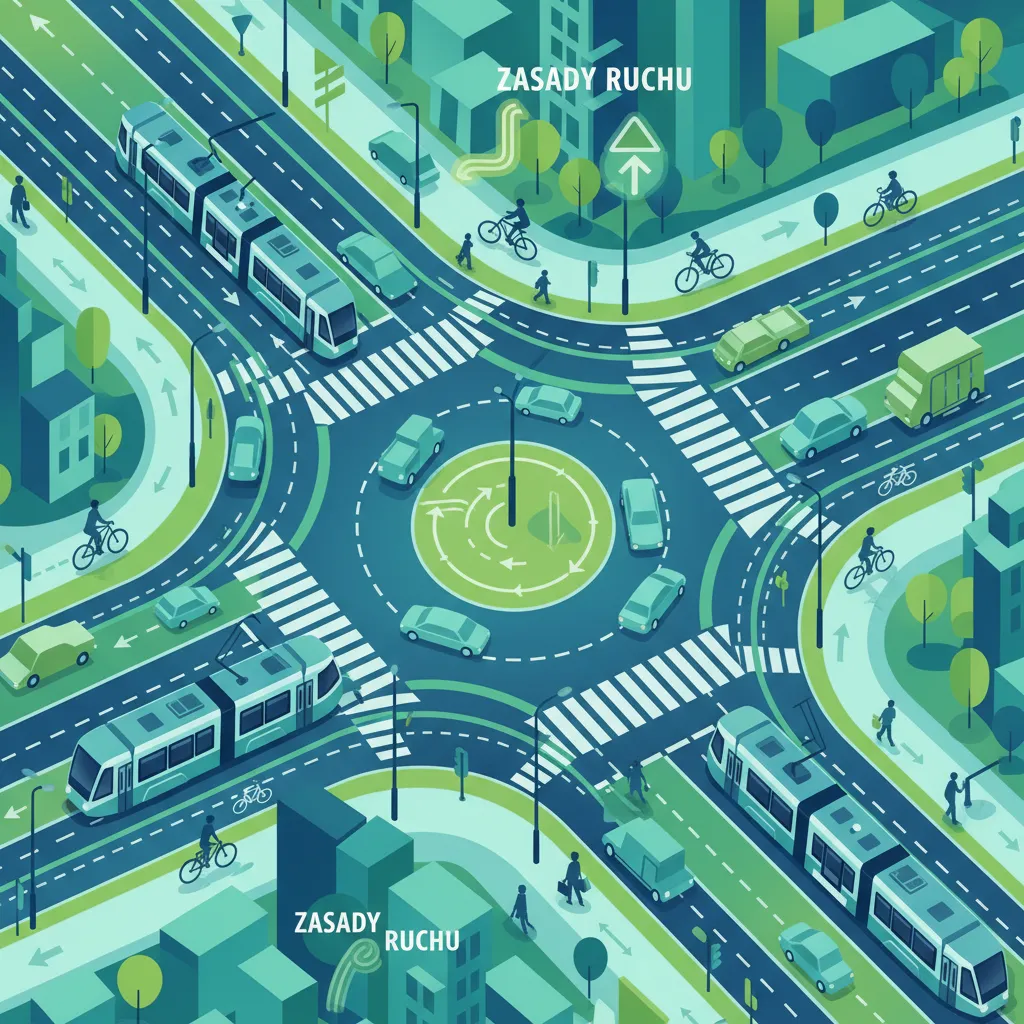
In this lesson, learners investigate complex junctions and intersections found across urban, rural, and highway environments, focusing on multi-lane configurations, traffic light coordination, and roundabout navigation. The content emphasizes priority rules, blind-spot assessment when merging, and safe lane selection for turning maneuvers. Learners will also consider interactions with cyclists and pedestrians, and the importance of adjusting approach speed for safe navigation.
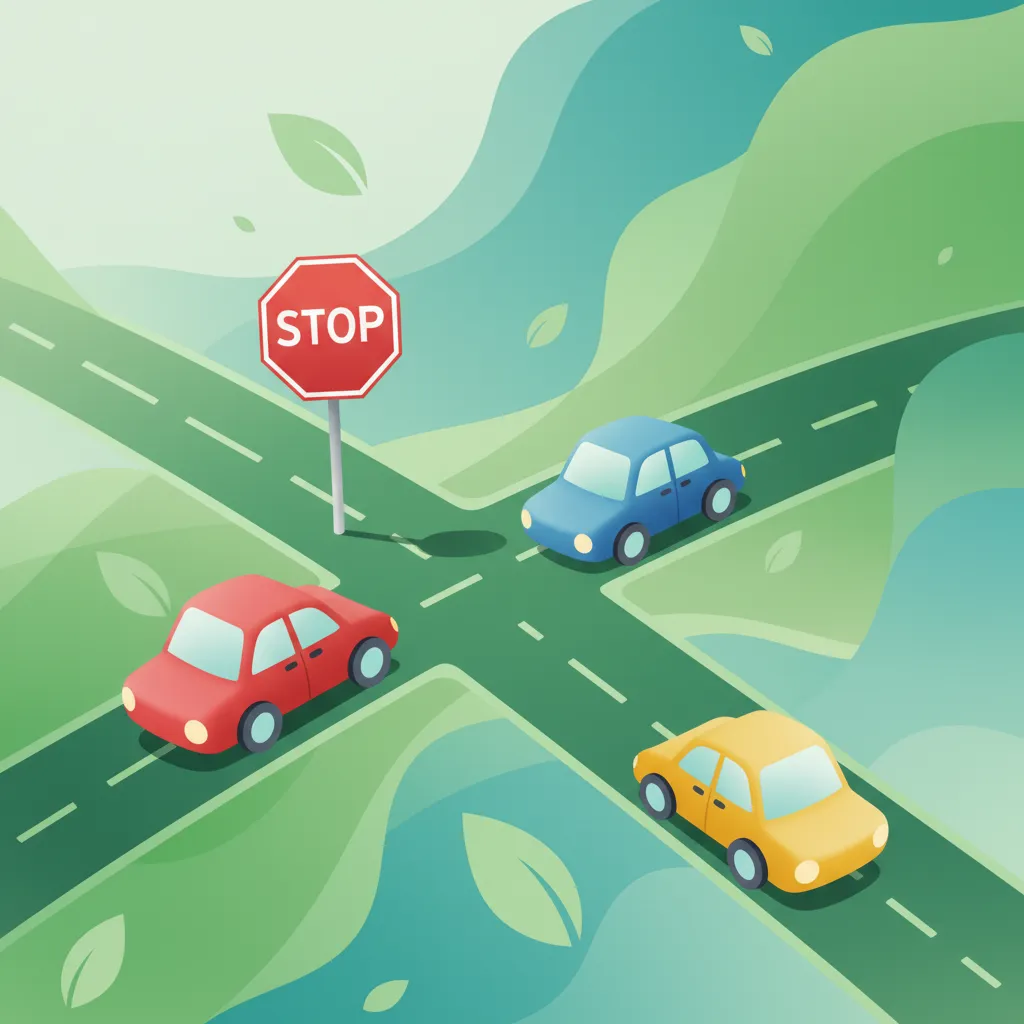
In this lesson, learners examine the specific actions required at stop signs and give-way intersections under Polish traffic regulations. The content explains the legal requirement for a full stop before the stop line, incorporating a visual scan of all directions before proceeding. It also covers the give-way protocol, where riders must yield to traffic already in the intersection or on the main road, emphasizing the need for correct positioning and observation.
This lesson provides a detailed breakdown of traffic light operations in Poland. It explains the sequence of red, amber, and green lights, and the specific rules for turning when a green arrow signal is displayed. The meaning of a flashing amber light and the rules for pedestrian crossings at signalized intersections are also covered.
This lesson focuses on areas with high pedestrian activity, requiring special caution. It covers the rules for 'living zones' (strefa zamieszkania), where pedestrians have priority and the speed limit is 20 km/h. The content also addresses regulations for school zones and other designated pedestrian areas to ensure the safety of the most vulnerable road users.
Find clear answers to common questions learners have about General Right-of-Way Principles (pierwszeństwo przejazdu). Learn how the lesson is structured, which driving theory objectives it supports, and how it fits into the overall learning path of units and curriculum progression in Poland. These explanations help you understand key concepts, lesson flow, and exam focused study goals.
The general rule for 'pierwszeństwo przejazdu' in Poland states that drivers must yield to vehicles approaching from their right at intersections of equal status, provided there are no specific signs or traffic signals dictating otherwise. This is often referred to as the 'right-hand rule'.
The 'yield to the right' rule does not apply when traffic signs (like stop, yield, or priority signs), traffic lights, or directions from a traffic controller indicate a different priority. It also doesn't apply on roundabouts or when entering a road from a private property or unpaved road, where different rules often apply.
The theory exam includes multiple-choice questions that present various intersection scenarios. You'll be shown diagrams and asked to identify which vehicle has the priority or who should yield, testing your understanding of the general rule and its exceptions.
In such a situation, the car on the left must yield to the car on the right. This is a direct application of the 'pierwszeństwo przejazdu' rule, ensuring predictable behaviour and preventing confusion.
Generally, tramways have priority over other vehicles, even when approaching from the left, unless signs or signals state otherwise. This is a significant exception to the general rule of yielding to the right and is crucial to remember for the exam.
Build custom practice sessions tailored precisely to your needs. Focus on areas requiring improvement, review specific Polish road signs, or master complex traffic rules to ensure full preparation for your official driving license exam.