
The P-14 marking, a series of small rectangles, signifies a conditional stop line. You'll commonly see this road marking before traffic lights, pedestrian crossings, or at equal intersections. It clearly indicates the exact point where you must stop your vehicle, whether it's due to a red light, to yield to pedestrians, or to manage traffic flow at junctions. Understanding its placement is crucial for safe driving and passing your theory exam in Poland.
Accurate interpretation of the P-14 conditional stop line is crucial for safe driving and passing your Polish driving theory test. This distinctive road marking dictates precise stopping points at controlled intersections and pedestrian crossings, preventing dangerous encroachments and ensuring compliance with Polish traffic rules.
The P-14 marking is a dashed line made of small rectangles. It is commonly found at intersections controlled by traffic lights or before pedestrian crossings. It shows where the vehicle should stop when the light is red or when yielding to a pedestrian. It is also used at equal intersections (skrzyżowanie równorzędne) to indicate the limit of the lane. It should not be confused with the P-13 yield triangles.
Marks the stopping point before traffic lights, pedestrian crossings, or at equal intersections.
Get clear, practical answers to the most common questions about the P-14 - Conditional Stop Line (Rectangles) road sign. Learn how the sign works, what rules it represents, and how it affects real driving situations. This FAQ strengthens your understanding and supports accurate decision making for the Polish driving theory exam in Poland.
The P-14 marking, made of small rectangles, indicates a conditional stopping point. You must stop your vehicle before this line when required by traffic signals, pedestrian crossing rules, or at equal intersections. It's a clear visual cue to halt your vehicle at the designated spot.
You must stop at the P-14 line when the traffic light is red, when pedestrians are on or entering a nearby crossing, or when you need to yield to traffic from the right at an equal intersection. Always ensure you stop completely before the line.
The P-14 marking is specifically a dashed line of small rectangles. While other signs or markings might indicate a stop, the P-14 is a ground marking that precisely defines the stopping point, especially useful at intersections and pedestrian crossings. It's different from continuous stop lines which might have different implications or be used with specific signs like 'Stop' (B-20).
Yes, if the traffic light is green and the way is clear, you can proceed past the P-14 line. However, if the traffic ahead is jammed and stopping on the line or beyond it would obstruct the intersection or a pedestrian crossing, you must wait behind the P-14 line, even if your light is green.
A common mistake is misunderstanding when to stop. Learners might stop too late, over the line, or not stop at all when required. Another trap is not realizing that even with a green light, you must not block an intersection. Always focus on stopping *before* the rectangles and ensuring the path is clear.
An equal intersection (skrzyżowanie równorzędne) is where no road has priority. When approaching such an intersection marked with P-14, you must stop before the line and yield to all vehicles approaching from your right, as well as any pedestrians. The P-14 line simply marks your stopping point in this priority situation.
A clear reference image of the P-14 - Conditional Stop Line (Rectangles) road sign used in Poland.
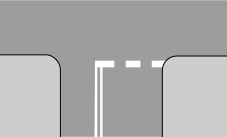
The P-14 - Conditional Stop Line (Rectangles) road sign may also be known by these alternative names or terms.
The P-14 - Conditional Stop Line (Rectangles) road sign is part of the Road Markings (P) category, which groups together signs with similar rules and functions.
Comparing similar road signs, like the P-14 conditional stop line with other markings, sharpens your recognition and memory. This focused theory test revision helps you avoid common mistakes when facing diverse traffic situations in Poland.

The P-1 Single Dashed Line: Your guide to safe lane changes and overtaking in Poland.
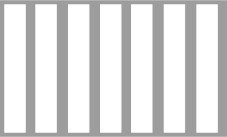
Understand the P-10 'Pedestrian Crossing' Road Sign and Your Obligations

Understand the P-11 Bicycle Crossing Road Sign and Cyclist Priority
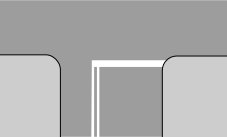
The P-12 Absolute Stop Line: You MUST stop here, no exceptions!
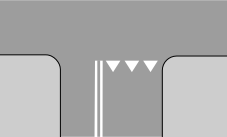
The P-13 'Conditional Stop Line' – Know When to Stop and Yield!

Prepare to yield: Understand the P-15 floor yield triangle road marking.

The P-16 'STOP' road marking means you must stop – even without a vertical sign!

P-17 Bus Stop Line: What This Zig-Zag Marking Means for Drivers
Deepen your understanding of specific road signs by reviewing official Polish traffic rules and associated real-world driving scenarios. These expert-led resources help you bridge the gap between visual recognition and practical exam application.
Navigating Polish intersections requires a clear understanding of priority rules, particularly the differing obligations imposed by the mandatory Stop sign (B-20) and the Yield sign (A-7). This article will break down the legal requirements for each sign, explaining precisely when and how you must act to ensure safety and compliance with Polish traffic law. Mastering these distinctions is vital for success in your driving theory exam and for safe driving.
Don't Be a Road Block: Master Minimum Speeds and Smooth Traffic Flow for Your Polish Exam!
Every vehicle registered in Poland must have valid third-party liability insurance (OC) at all times, regardless of whether the car is driven or parked in a private garage. This guide clarifies the automated enforcement process managed by the Insurance Guarantee Fund and the substantial financial risks associated with even a single-day lapse in coverage. By mastering these administrative requirements, you will be prepared to handle vehicle ownership duties confidently and avoid avoidable legal penalties.
Master Polish Crossing Markings for a Safer Drive and Exam Success.
The D-1 sign marks the beginning or the continuation of a route where drivers have priority over vehicles entering from side roads. It is characterized by a yellow diamond shape with a thick white border. In urban areas, this sign is typically placed before every intersection where the priority is maintained, while on rural roads, it confirms the road's status over longer stretches. If the priority road changes direction at an intersection, it will be accompanied by a T-6 supplementary plate showing the actual flow of traffic.
The A-29 sign is used when traffic lights are encountered in unexpected places, such as the first signal when entering a town, at a rural intersection, or during roadworks for 'one-way' shuttle traffic. It is also used if the traffic lights are not visible from a sufficient distance due to a curve or hill. It ensures drivers are not 'surprised' by a red light at high speed.
After reviewing the full list of Polish road signs, explore specific sign categories for in-depth understanding. Challenge your knowledge with practice questions focused on sign recognition and interpretation to solidify your preparation for the driving theory exam.
Browse All Polish Road Signs