
The P-5 marking, a double dashed line, signifies a reversible lane where traffic direction is controlled by overhead signals (S-4). These lanes manage 'tidal flow' traffic in cities, allowing more capacity in one direction during peak hours and the opposite direction during off-peak times. Always check the overhead signal before entering or remaining in a lane marked with P-5; a green arrow allows entry, while a red 'X' prohibits it.
The P-5 double dashed line signals a lane with flexible traffic direction, essential for adapting to peak-hour flow in Polish cities. Mastering this road marking is vital for safe driving knowledge and effective theory test revision, ensuring you correctly interpret lane usage alongside overhead signals.
The P-5 marking consists of two parallel broken lines. These are placed on both sides of a lane that can be 'opened' or 'closed' to traffic in a specific direction using S-4 overhead signals (red 'X' or green arrow). This system is used to manage tidal flow traffic in cities, where more lanes are needed in one direction during the morning rush and the opposite direction in the evening.
Indicates a reversible lane where the direction of traffic changes based on overhead signals.
Get clear, practical answers to the most common questions about the P-5 - Double Dashed Line road sign. Learn how the sign works, what rules it represents, and how it affects real driving situations. This FAQ strengthens your understanding and supports accurate decision making for the Polish driving theory exam in Poland.
The P-5 marking consists of two parallel broken lines and indicates a lane where the direction of traffic can be reversed. This is managed by overhead S-4 signals, which show either a green arrow for your direction of travel or a red 'X' prohibiting entry.
When approaching a lane marked with the P-5 double dashed lines, you must always check the overhead S-4 signal. A green arrow pointing down means the lane is open for your direction. A red 'X' means you must not enter that lane.
Reversible lanes marked with P-5 are designed to manage traffic flow, especially during rush hours. You can only use the lane if the overhead signal shows a green arrow for your direction. If you are already in the lane and the signal changes to a yellow flashing arrow, you must prepare to exit the lane safely.
A common mistake is not paying attention to the overhead S-4 signals. Drivers might assume the lane is open based on other traffic or forget to check the signal, leading to entering a lane against the direction of traffic, which is extremely dangerous. Always prioritize the overhead signal's instruction.
No, you can only cross or enter the lane marked with P-5 when the overhead signal indicates it is open for your direction. Crossing these lines when the lane is closed to your traffic flow, or entering when a red 'X' is displayed, is prohibited and unsafe.
If you are in a reversible lane marked with P-5 and the overhead signal changes to a yellow flashing arrow, it means the lane is about to close. You must then leave the lane as soon as it is safe to do so, following any instructions from variable message signs or traffic controllers.
A clear reference image of the P-5 - Double Dashed Line road sign used in Poland.

The P-5 - Double Dashed Line road sign may also be known by these alternative names or terms.
The P-5 - Double Dashed Line road sign is part of the Road Markings (P) category, which groups together signs with similar rules and functions.
Comparing signs like the double dashed line with others in the road markings category sharpens recognition and aids memory, crucial for theory test revision. Effective traffic sign comparison helps you distinguish subtle differences, leading to fewer errors and improved exam preparation.

The P-1 Single Dashed Line: Your guide to safe lane changes and overtaking in Poland.
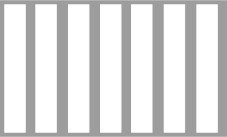
Understand the P-10 'Pedestrian Crossing' Road Sign and Your Obligations

Understand the P-11 Bicycle Crossing Road Sign and Cyclist Priority
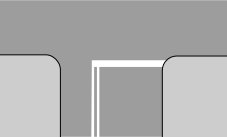
The P-12 Absolute Stop Line: You MUST stop here, no exceptions!
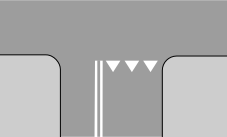
The P-13 'Conditional Stop Line' – Know When to Stop and Yield!
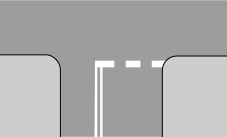
Know When to Stop: The P-14 Conditional Stop Line Explained

Prepare to yield: Understand the P-15 floor yield triangle road marking.

The P-16 'STOP' road marking means you must stop – even without a vertical sign!
Deepen your understanding of specific road signs by reviewing official Polish traffic rules and associated real-world driving scenarios. These expert-led resources help you bridge the gap between visual recognition and practical exam application.
Even a Second Can Be Fatal: Understand Microsleep to Drive Safely in Poland.
Navigating Polish roads requires a precise understanding of rules for overtaking slow-moving vehicles, especially on continuous solid lines. This article will detail when such maneuvers are legal, the legal obligations of tractor drivers, and the consequences of violations according to Polish traffic law. Mastering this topic is essential for safe driving and succeeding in your theory exam.
Don't Be a Road Block: Master Minimum Speeds and Smooth Traffic Flow for Your Polish Exam!
This article provides a comprehensive breakdown of vehicles and vehicle combinations permitted under the Polish Category T driving licence, directly referencing the "Prawo o ruchu drogowym". You will learn the exact definitions of agricultural tractors, slow-moving vehicles, and how trailers can be attached. Crucially, it addresses common confusions, distinguishing Category T from other vehicle categories to ensure you are fully prepared for your theory exam and safe driving practices.
The P-8a arrow is painted on the lane surface to regulate movement at an intersection. If you are in a lane with this arrow, you are legally forbidden from turning left or right. It is used to streamline traffic and prevent collisions that occur when drivers try to turn from a middle lane. Often, these arrows are combined (e.g., straight and right), meaning both directions are allowed from that specific lane.
The A-17 sign indicates locations where children between the ages of 7 and 15 are likely to be present. Unlike adults, children can be unpredictable and may suddenly run into the street without looking. This sign is a signal to slow down significantly and be extra alert. It is common near primary schools, daycare centers, and organized sports fields.
After reviewing the full list of Polish road signs, explore specific sign categories for in-depth understanding. Challenge your knowledge with practice questions focused on sign recognition and interpretation to solidify your preparation for the driving theory exam.
Browse All Polish Road Signs