
The P-6 marking, often called a 'Warning Line' or 'Long-dash line', is a special type of broken road marking in Poland. It features white dashes that are much longer than the gaps between them, acting as a crucial transition from a standard dashed line (P-1) to a solid line (P-2). Seeing this line means you must immediately prepare to return to your lane as an overtaking restriction or a potentially hazardous road section is imminent. This sign is vital for maintaining safe driving and passing your theory exam.
This Polish P-6 warning line signals an upcoming restriction or hazard, requiring drivers to finish overtaking and return to their lane. Mastering road sign meaning is crucial for your theory test revision and safe driving in Poland.
The P-6 line is a broken line where the white dashes are significantly longer than the gaps between them. It serves as a transition between a standard dashed line (P-1) and a solid line (P-2). When a driver sees the dashes getting longer, it is a clear warning to finish any overtaking maneuvers and return to their lane immediately because the road is about to become restricted or dangerous.
Indicates that a solid line or a dangerous section of the road is approaching.
Get clear, practical answers to the most common questions about the P-6 - Warning Line road sign. Learn how the sign works, what rules it represents, and how it affects real driving situations. This FAQ strengthens your understanding and supports accurate decision making for the Polish driving theory exam in Poland.
The P-6 Warning Line, characterized by long white dashes with short gaps, signals that a solid white line (P-2) or a restricted road section is approaching. It's a warning to finish any overtaking maneuvers safely and move back into your lane before the solid line begins.
Upon seeing the P-6 Warning Line, you must promptly complete any ongoing overtaking manoeuvre. If you haven't started an overtake, do not begin one. Ensure you return to your lane safely and well before the solid line starts, as overtaking will be prohibited there.
The P-6 Warning Line indicates that overtaking is about to become prohibited. Therefore, you should not start a new overtaking manoeuvre once you see this line. However, you are permitted to finish an overtake that you had already safely commenced before the P-6 line appeared, provided you can complete it and merge back into your lane before reaching the solid line.
A common trap is misinterpreting the P-6 line as simply another type of dashed line where overtaking is still permissible. Learners often forget that it's a warning sign specifically indicating an upcoming prohibition. Failing to finish an overtake promptly or starting a new one after seeing the P-6 line are typical exam errors.
A standard dashed line (P-1) indicates that overtaking is generally allowed when safe. The P-6 Warning Line, however, has significantly longer dashes and shorter gaps, serving as an advance warning that a solid line (P-2) where overtaking is prohibited is about to begin. It’s a signal to prepare for a change in road rules.
The P-6 line is crucial for safety as it provides drivers with advance notice of upcoming restrictions, such as solid lines marking junctions, bends, or other hazardous areas where overtaking is unsafe or illegal. It helps prevent dangerous last-minute manoeuvres and reduces the risk of head-on collisions.
A clear reference image of the P-6 - Warning Line road sign used in Poland.

The P-6 - Warning Line road sign may also be known by these alternative names or terms.
The P-6 - Warning Line road sign is part of the Road Markings (P) category, which groups together signs with similar rules and functions.
Master Polish traffic rules by comparing similar road signs, like the warning line, to enhance your sign recognition and reduce confusion. Effective theory test revision includes understanding the subtle distinctions between road markings for improved exam preparation.

The P-1 Single Dashed Line: Your guide to safe lane changes and overtaking in Poland.
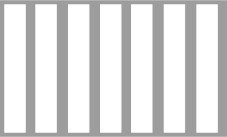
Understand the P-10 'Pedestrian Crossing' Road Sign and Your Obligations

Understand the P-11 Bicycle Crossing Road Sign and Cyclist Priority
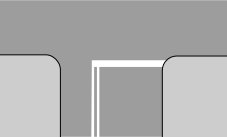
The P-12 Absolute Stop Line: You MUST stop here, no exceptions!
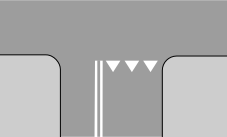
The P-13 'Conditional Stop Line' – Know When to Stop and Yield!
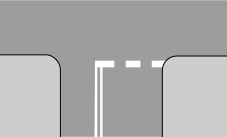
Know When to Stop: The P-14 Conditional Stop Line Explained

Prepare to yield: Understand the P-15 floor yield triangle road marking.

The P-16 'STOP' road marking means you must stop – even without a vertical sign!
Deepen your understanding of specific road signs by reviewing official Polish traffic rules and associated real-world driving scenarios. These expert-led resources help you bridge the gap between visual recognition and practical exam application.
Learning how to interact with law enforcement is a crucial part of your driver training in Poland, as it helps you understand the legal procedures governing roadside controls. This guide clarifies how officers identify themselves, what behaviors are expected of you as a driver, and how traffic enforcement impacts your penalty points and record. Mastery of these rules ensures you remain compliant with the law and prepared for any roadside situation you may encounter.
Master Your Rights and Obligations During a Polish Roadside Inspection
The A-30 sign serves as a vital warning for drivers to prepare for unexpected hazards that fall outside standard category signs. This guide clarifies how the sign is paired with supplementary plates to indicate risks like blind or deaf pedestrians, and outlines the mandatory safety behaviors required by Polish traffic law. You will learn the legal expectations for driver conduct to ensure you are fully prepared for hazard perception questions in your theory exam.
Master the Nuances of Driving in Polish Shared Spaces and Pedestrian-Priority Zones.
The D-6 sign identifies the exact location of a pedestrian crossing, commonly known as a 'zebra' crossing. It consists of a blue square with a white triangle and a black silhouette of a person walking. Drivers approaching this sign are legally required to reduce their speed and observe the sidewalk carefully. If a pedestrian is on the crossing or clearly about to enter it, the driver must stop to allow them to cross safely. In Poland, the regulations emphasize that the driver's duty to yield begins as soon as the pedestrian is 'entering' the crossing.
The R-4 sign is a general informational marker. It can show the name of the trail, its total length, or its logo. It is often used as a 'welcome' sign or to identify a route that is part of a larger network (like the Green Velo or EuroVelo). It confirms to the cyclist that the path they are on is an officially recognized and maintained route.
After reviewing the full list of Polish road signs, explore specific sign categories for in-depth understanding. Challenge your knowledge with practice questions focused on sign recognition and interpretation to solidify your preparation for the driving theory exam.
Browse All Polish Road Signs