
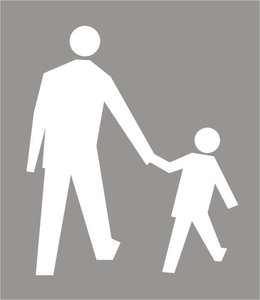
The P-26 marking, showing a white walking person symbol, designates a path exclusively for pedestrians. This road marking, often seen in urban areas, clearly indicates that only people on foot are permitted to use this space. It's crucial for ensuring pedestrian safety by separating them from cyclists and vehicles. As this is a clear designation of a pedestrian-only area, drivers must be aware that entering it is prohibited and could lead to dangerous situations.
This sign indicates a path or road section exclusively for pedestrians, crucial for safety in shared spaces. Master this road sign meaning for your theory test revision and ensure clear traffic sign interpretation.
The P-26 marking is a white silhouette of a walking person. It is used to identify a path or a section of the road where only pedestrians are allowed. It is the horizontal counterpart to the C-16 vertical sign. This segregation is vital in mixed-use areas to protect people on foot from bicycles and motorized vehicles.
Marks a road or path intended exclusively for pedestrians.
Get clear, practical answers to the most common questions about the P-26 - Pedestrian Path Symbol road sign. Learn how the sign works, what rules it represents, and how it affects real driving situations. This FAQ strengthens your understanding and supports accurate decision making for the Polish driving theory exam in Poland.
The P-26 symbol is used to mark a road or path that is intended solely for pedestrians. Its main purpose is to ensure the safety of people walking by creating a dedicated space free from bicycles and motorized traffic. It clearly communicates that this area is for foot traffic only.
No, you are strictly forbidden from riding a bicycle, scooter, or any other wheeled vehicle on a path marked with the P-26 pedestrian symbol. This marking signifies an exclusive pedestrian zone, and allowing bicycles or scooters would compromise the safety of walkers.
Under no circumstances should a car or any other motorized vehicle enter or use a path marked with the P-26 symbol. This marking is for pedestrians, and motorized vehicles are prohibited from entering these designated areas to prevent accidents and ensure pedestrian safety.
A common mistake is assuming that bicycles or scooters are allowed on the P-26 marked path, or that it's acceptable to briefly drive onto it if no pedestrians are present. Learners should remember that the P-26 symbol indicates a strict pedestrian-only zone, and any deviation from walking is prohibited.
The P-26 marking is the horizontal, ground-based counterpart to the vertical C-16 sign, which also denotes a pedestrian path. Both signs serve the same function: to designate an area exclusively for pedestrians and to prohibit other traffic.
A clear reference image of the P-26 - Pedestrian Path Symbol road sign used in Poland.
The P-26 - Pedestrian Path Symbol road sign may also be known by these alternative names or terms.
The P-26 - Pedestrian Path Symbol road sign is part of the Road Markings (P) category, which groups together signs with similar rules and functions.
Reviewing related road signs, like this P-26 Pedestrian Path Symbol, alongside similar ones helps solidify your knowledge. Effective traffic sign comparison is key for accurate recognition and reduces confusion during your theory test revision.

The P-1 Single Dashed Line: Your guide to safe lane changes and overtaking in Poland.
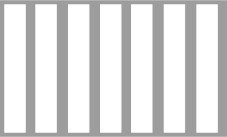
Understand the P-10 'Pedestrian Crossing' Road Sign and Your Obligations

Understand the P-11 Bicycle Crossing Road Sign and Cyclist Priority
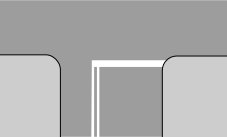
The P-12 Absolute Stop Line: You MUST stop here, no exceptions!
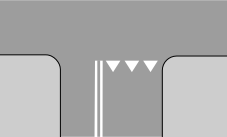
The P-13 'Conditional Stop Line' – Know When to Stop and Yield!
Know When to Stop: The P-14 Conditional Stop Line Explained

Prepare to yield: Understand the P-15 floor yield triangle road marking.

The P-16 'STOP' road marking means you must stop – even without a vertical sign!
Deepen your understanding of specific road signs by reviewing official Polish traffic rules and associated real-world driving scenarios. These expert-led resources help you bridge the gap between visual recognition and practical exam application.
To obtain a Category C driving licence in Poland, you must undergo specific medical (badania lekarskie) and psychological (badania psychologiczne) assessments. This article explains why these rigorous checks are vital for ensuring you are fit and capable of safely driving heavy goods vehicles and what they entail for your application.
Learn about the new helmet law taking effect in Poland on June 3, 2026. This essential update clarifies who must wear a helmet – specifically individuals under 16 on bicycles, electric scooters, and UTOs – and what the consequences are for non-compliance. Understanding these regulations is vital for all road users and is relevant for the Polish driving theory exam.
Master Roadworks: Prioritize Temporary Markings for a Safer Drive and Exam Pass.
Master Bus and Priority Lane Usage for Your Polish Driving Exam
The C-16 sign indicates a road or path reserved solely for people on foot. It is used in areas with high pedestrian volume, such as city centers or park paths, to ensure their safety and comfort. Motorized vehicles and cyclists are not allowed to enter these zones, creating a car-free environment.
The B-11 sign is used on roads with heavy traffic where wide, slow-moving pedal-powered vehicles like rickshaws or cargo bikes could cause dangerous bottle-necks. These vehicles are wider than standard bicycles and take up a significant portion of the lane, which is why they are restricted in high-flow areas.
After reviewing the full list of Polish road signs, explore specific sign categories for in-depth understanding. Challenge your knowledge with practice questions focused on sign recognition and interpretation to solidify your preparation for the driving theory exam.
Browse All Polish Road Signs