
The P-12 road marking, known as the Absolute Stop Line, is a critical indicator that you must bring your vehicle to a complete halt. This thick white line, painted across your lane, is always paired with a STOP sign (B-20) or Border Control sign. Your primary responsibility is to stop your vehicle *before* or *at* this line. This rule applies even if the road ahead appears clear; a rolling stop is strictly prohibited and a common exam trap.
This section explains the P-12 Absolute Stop Line, a critical marking that mandates a complete halt before proceeding. Grasping its precise meaning is essential for successful theory test revision and safe Polish road navigation.
The P-12 is a thick, solid white line painted across the lane. It is used with vertical signs B-20 (STOP) or B-32 (Border Control). The driver must stop such that the front of the vehicle does not cross the line. Stopping is mandatory regardless of whether other traffic is visible. After stopping at the line, the driver may move forward slightly if visibility is obstructed, but the initial 'complete halt' must occur at or before this line.
Indicates the exact place where a vehicle must come to a complete halt in conjunction with a STOP sign.
Get clear, practical answers to the most common questions about the P-12 - Absolute Stop Line road sign. Learn how the sign works, what rules it represents, and how it affects real driving situations. This FAQ strengthens your understanding and supports accurate decision making for the Polish driving theory exam in Poland.
The P-12 Absolute Stop Line is a road marking indicating the exact point where you must come to a complete stop. It is always used in conjunction with a STOP (B-20) or Border Control sign. You must halt your vehicle at or before this line, even if the intersection or crossing seems clear.
When you see the P-12 line, you must slow down and bring your vehicle to a complete standstill at or before the line. After stopping, check for oncoming traffic in both directions, and only proceed when it is safe to do so. Moving forward slightly *after* the stop to improve visibility is permissible, but the initial complete halt is mandatory.
No, a rolling stop is absolutely not permitted at the P-12 Absolute Stop Line. The definition requires a complete halt. Failing to stop fully is a serious traffic violation and a common mistake learners make during their theory test. Always ensure your wheels stop turning.
If the P-12 line is obscured, such as by snow or debris, you must stop your vehicle at a point where you have a clear view of the intersection or crossing. You still need to comply with the spirit of the STOP sign, which is to halt completely before proceeding when safe.
Yes, after coming to a complete stop at or before the P-12 line, you may move forward slowly if visibility is restricted. This allows you to gain a better view of the intersection. However, the crucial initial action remains a full and complete stop at the designated line.
The most common exam trap is failing to perform a complete stop, opting for a rolling stop instead. Another is stopping too far past the line, which could obstruct traffic or the crossing. Always remember that the P-12 line dictates the *point* of your mandatory stop.
A clear reference image of the P-12 - Absolute Stop Line road sign used in Poland.
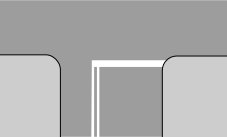
The P-12 - Absolute Stop Line road sign may also be known by these alternative names or terms.
The P-12 - Absolute Stop Line road sign is part of the Road Markings (P) category, which groups together signs with similar rules and functions.
Comparing the 'Absolute Stop Line' (P-12) with other road markings helps solidify your understanding and reduces confusion for your theory test revision. Effective traffic sign comparison is key to improving sign recognition and ensuring safe driving practices in Poland.

The P-1 Single Dashed Line: Your guide to safe lane changes and overtaking in Poland.
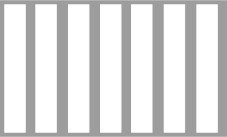
Understand the P-10 'Pedestrian Crossing' Road Sign and Your Obligations

Understand the P-11 Bicycle Crossing Road Sign and Cyclist Priority
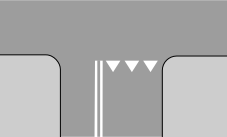
The P-13 'Conditional Stop Line' – Know When to Stop and Yield!
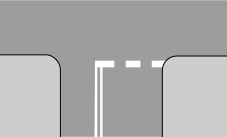
Know When to Stop: The P-14 Conditional Stop Line Explained

Prepare to yield: Understand the P-15 floor yield triangle road marking.

The P-16 'STOP' road marking means you must stop – even without a vertical sign!

P-17 Bus Stop Line: What This Zig-Zag Marking Means for Drivers
Deepen your understanding of specific road signs by reviewing official Polish traffic rules and associated real-world driving scenarios. These expert-led resources help you bridge the gap between visual recognition and practical exam application.
Navigating Polish intersections requires a clear understanding of priority rules, particularly the differing obligations imposed by the mandatory Stop sign (B-20) and the Yield sign (A-7). This article will break down the legal requirements for each sign, explaining precisely when and how you must act to ensure safety and compliance with Polish traffic law. Mastering these distinctions is vital for success in your driving theory exam and for safe driving.
This article provides a detailed explanation of how Polish traffic signs A-7 ('Ustąp Pierwszeństwa' - Yield), B-20 ('STOP'), and D-1 ('Droga z Pierwszeństwem' - Priority Road) dictate right-of-way at intersections. Understanding the nuances of these signs is a fundamental aspect of the Polish driving theory exam, and mastering them will significantly improve your preparedness for real-world driving scenarios.
Master the Critical First Steps After a Road Accident
Navigate Tram Intersections Like a Pro: Essential for Your Polish Driving Exam.
The B-32 sign is used at international border crossings or special customs zones. It is a mandatory stop sign. You must wait at the designated line or before the sign until an officer signals you to proceed. Variants of this sign (B-32a to B-32f) can indicate stops for Border Control, Damaged Barriers, Toll Collection, or Police Checks.
The F-6 sign is placed before an intersection to inform drivers that a specific hazard or legal restriction (indicated by a miniature symbol) is located on one of the branching roads. This prevents drivers from making a turn into a street that they cannot navigate (e.g., due to a low bridge or a 'no entry' for their vehicle type). It is a crucial planning tool for drivers of large or specialized vehicles.
After reviewing the full list of Polish road signs, explore specific sign categories for in-depth understanding. Challenge your knowledge with practice questions focused on sign recognition and interpretation to solidify your preparation for the driving theory exam.
Browse All Polish Road Signs