
The P-7a sign, known as the intermittent edge line, marks the boundary of the drivable roadway and separates it from the shoulder. Unlike a solid line, this broken white line indicates that crossing it is permitted for specific reasons, such as stopping briefly or turning off the main road. It's crucial for night driving and adverse weather conditions, providing a clear visual cue to stay within the safe lane. While it allows access to the shoulder for emergencies or exits, it strictly prohibits using the shoulder as a regular lane for bypassing traffic.
Proper P-7a intermittent edge line interpretation is crucial for navigating Polish roads safely, clearly distinguishing between the carriageway and shoulder. Mastering this traffic sign explanation will prevent errors during stopping or turning, directly supporting your Polish driving theory test revision.
The P-7a is a dashed white line located on the side of the road. It marks the boundary of the drivable surface. Because it is intermittent (broken), it indicates that vehicles are permitted to cross it to reach the shoulder, enter a driveway, or use a roadside parking area. It helps drivers stay on the road during the night or in heavy rain by reflecting light and providing a clear visual border.
Defines the edge of the roadway and separates it from the shoulder, but allows crossing for stopping or turning.
Get clear, practical answers to the most common questions about the P-7a - Intermittent Edge Line road sign. Learn how the sign works, what rules it represents, and how it affects real driving situations. This FAQ strengthens your understanding and supports accurate decision making for the Polish driving theory exam in Poland.
The P-7a sign indicates the edge of the roadway. It's a broken white line that you can cross to move onto the shoulder or enter a driveway or parking area. It signifies the boundary of the usable driving surface.
Yes, you are allowed to cross the P-7a line to pull over onto the shoulder for a safe emergency stop or to let an emergency vehicle pass. However, you should avoid stopping in a way that obstructs the main roadway.
You must not use the shoulder area beyond the P-7a line as a regular driving lane to bypass traffic. You also shouldn't cross the line at high speed without first checking if the shoulder surface is stable enough to support your vehicle.
The key difference is that the P-7a, being intermittent, permits crossing for specific purposes like stopping or turning, whereas a solid edge line (P-7b) generally prohibits crossing and strictly delineates the roadway edge. You'll typically see P-7b on expressways and motorways for enhanced safety.
Yes, theory exams often test your understanding of when crossing an edge line is permitted versus prohibited. Misinterpreting the P-7a as a complete barrier, or trying to use the shoulder to overtake, are common mistakes that could lead to a failed exam.
A clear reference image of the P-7a - Intermittent Edge Line road sign used in Poland.

The P-7a - Intermittent Edge Line road sign may also be known by these alternative names or terms.
The P-7a - Intermittent Edge Line road sign is part of the Road Markings (P) category, which groups together signs with similar rules and functions.
Comparing signs like the intermittent edge line with others helps solidify your understanding and reduces errors during your theory test revision. Reviewing similar road signs side-by-side is a key strategy for effective traffic sign comparison and sign recognition.

The P-1 Single Dashed Line: Your guide to safe lane changes and overtaking in Poland.
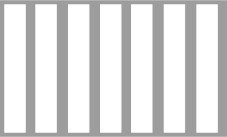
Understand the P-10 'Pedestrian Crossing' Road Sign and Your Obligations

Understand the P-11 Bicycle Crossing Road Sign and Cyclist Priority
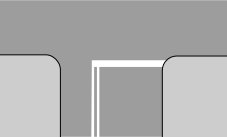
The P-12 Absolute Stop Line: You MUST stop here, no exceptions!
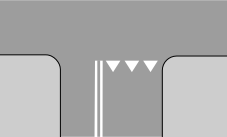
The P-13 'Conditional Stop Line' – Know When to Stop and Yield!
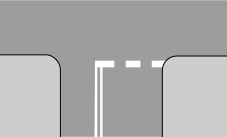
Know When to Stop: The P-14 Conditional Stop Line Explained

Prepare to yield: Understand the P-15 floor yield triangle road marking.

The P-16 'STOP' road marking means you must stop – even without a vertical sign!
Deepen your understanding of specific road signs by reviewing official Polish traffic rules and associated real-world driving scenarios. These expert-led resources help you bridge the gap between visual recognition and practical exam application.
The A-30 sign serves as a vital warning for drivers to prepare for unexpected hazards that fall outside standard category signs. This guide clarifies how the sign is paired with supplementary plates to indicate risks like blind or deaf pedestrians, and outlines the mandatory safety behaviors required by Polish traffic law. You will learn the legal expectations for driver conduct to ensure you are fully prepared for hazard perception questions in your theory exam.
Master Your Rights and Obligations During a Polish Roadside Inspection
Learning how to interact with law enforcement is a crucial part of your driver training in Poland, as it helps you understand the legal procedures governing roadside controls. This guide clarifies how officers identify themselves, what behaviors are expected of you as a driver, and how traffic enforcement impacts your penalty points and record. Mastery of these rules ensures you remain compliant with the law and prepared for any roadside situation you may encounter.
Don't Be a Road Block: Master Minimum Speeds and Smooth Traffic Flow for Your Polish Exam!
The F-1 sign is used to indicate the physical location of an active border crossing. It is typically a rectangular blue sign with white lettering. While internal borders within the Schengen Area often lack permanent checks, this sign remains relevant for crossings into non-Schengen countries or during periods of reinstated border controls. It serves to alert the driver to prepare necessary travel documents and potentially slow down for inspection by border guard or customs officials.
The G-4 sign is identical to the G-3 but features an additional partial cross (a 'V' shape) underneath. This indicates that the crossing has multiple tracks. This is a critical warning because drivers often wait for one train to pass and then immediately pull out, only to be hit by a second train traveling in the opposite direction on the adjacent track. It marks the safety boundary for the entire multi-track zone.
After reviewing the full list of Polish road signs, explore specific sign categories for in-depth understanding. Challenge your knowledge with practice questions focused on sign recognition and interpretation to solidify your preparation for the driving theory exam.
Browse All Polish Road Signs