
The P-7b road sign, a continuous white line at the edge of the roadway, clearly marks the boundary between the carriageway and the shoulder. This sign prohibits motorized vehicles from crossing onto the shoulder, reserving it for emergency use only. You'll typically encounter this sign on high-speed roads and motorways to ensure traffic flow and safety by keeping the shoulder clear for breakdowns or emergency services. Always stay to the left of this line during normal driving.
Mastering the P-7b solid edge line is vital for safe driving in Poland, as it clearly defines roadway limits and prohibits unauthorized access to the shoulder. Accurate road sign interpretation of this marking is essential for your Polish driving theory test and for navigating various road conditions responsibly.
The P-7b is a continuous white line at the edge of the roadway. It indicates that the shoulder beyond the line is not intended for regular vehicle use and crossing it is generally prohibited. This is common on highways and high-speed roads where the shoulder is strictly for emergency use. For motorized vehicle drivers, this line acts as a 'no-entry' boundary to the roadside area, ensuring the shoulder remains clear for broken-down cars or emergency services.
Marks the edge of the road and prohibits motorized vehicles from crossing onto the shoulder.
Get clear, practical answers to the most common questions about the P-7b - Solid Edge Line road sign. Learn how the sign works, what rules it represents, and how it affects real driving situations. This FAQ strengthens your understanding and supports accurate decision making for the Polish driving theory exam in Poland.
The P-7b sign is a continuous white line marking the edge of the road. It signifies that the area to its right, the shoulder, is not part of the regular driving lane and is off-limits to motorized vehicles under normal circumstances. This ensures the shoulder remains clear for emergencies.
No, absolutely not. The P-7b sign explicitly prohibits motorized vehicles from crossing this solid line to drive on the shoulder, even to bypass traffic jams. The shoulder is strictly for emergency stops or official use.
Crossing the P-7b solid edge line is only permitted in genuine emergencies. This includes situations like a mechanical failure where you must pull over safely, or a medical crisis requiring immediate access to the shoulder for assistance or evacuation.
When driving and encountering the P-7b sign, your primary instruction is to stay to the left of the line. Use it as a guide to keep your vehicle positioned correctly on the roadway, especially in conditions of poor visibility, and do not cross it unless it's a critical emergency.
The P-7b is a continuous white line marking the edge of the roadway and prohibiting vehicles from crossing onto the shoulder. A similar narrow version, P-7d, serves the same purpose but may be used on different classes of roads. The key is that both are solid and indicate no crossing is allowed onto the shoulder.
A clear reference image of the P-7b - Solid Edge Line road sign used in Poland.

The P-7b - Solid Edge Line road sign may also be known by these alternative names or terms.
The P-7b - Solid Edge Line road sign is part of the Road Markings (P) category, which groups together signs with similar rules and functions.
Understanding how similar road signs relate helps prevent confusion and boosts retention for your theory test revision. Comparing traffic signs side-by-side sharpens your recognition skills, making exam preparation more effective.

The P-1 Single Dashed Line: Your guide to safe lane changes and overtaking in Poland.
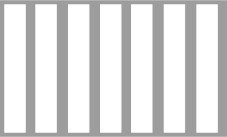
Understand the P-10 'Pedestrian Crossing' Road Sign and Your Obligations

Understand the P-11 Bicycle Crossing Road Sign and Cyclist Priority
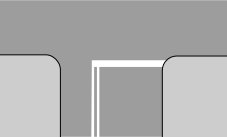
The P-12 Absolute Stop Line: You MUST stop here, no exceptions!
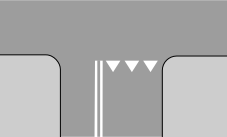
The P-13 'Conditional Stop Line' – Know When to Stop and Yield!
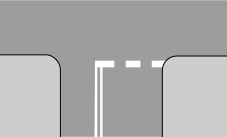
Know When to Stop: The P-14 Conditional Stop Line Explained

Prepare to yield: Understand the P-15 floor yield triangle road marking.

The P-16 'STOP' road marking means you must stop – even without a vertical sign!
Deepen your understanding of specific road signs by reviewing official Polish traffic rules and associated real-world driving scenarios. These expert-led resources help you bridge the gap between visual recognition and practical exam application.
Navigate Polish roads with confidence by understanding critical cyclist priority rules at junctions and crossings. This guide explains your legal obligations as a driver to yield to cyclists, a common area of confusion and potential exam pitfalls. Learn the nuances of right-of-way at intersections and designated cyclist passages to drive safely and pass your theory test.
Master Polish Crossing Markings for a Safer Drive and Exam Success.
Navigate Tram Intersections Like a Pro: Essential for Your Polish Driving Exam.
When selling a car in Poland, you have specific legal duties regarding insurance and registration that must be met promptly. This article clarifies these seller obligations, including the crucial 14-day window to inform your insurer and the 30-day deadline to notify the relevant communication department, ensuring a smooth and compliant transfer of ownership for both parties.
The D-34b sign acts as a summary for a rest area or a nearby town. Instead of multiple separate signs, it groups symbols together on one large blue board. For example, it might show symbols for a petrol station, a restaurant, and a hotel simultaneously. This allows drivers to see at a glance what services are available at an upcoming exit or stop without cluttering the roadside with too many individual signs.
The E-22c sign acts as a 'menu' of tourism. It lists several sites (e.g., 'Stare Miasto', 'Zamek', 'Muzeum') and their corresponding symbols. This sign is typically found at the entrance to a city or a large park to help visitors decide what to see. It provides a helpful overview of the cultural and recreational opportunities in the vicinity.
After reviewing the full list of Polish road signs, explore specific sign categories for in-depth understanding. Challenge your knowledge with practice questions focused on sign recognition and interpretation to solidify your preparation for the driving theory exam.
Browse All Polish Road Signs