
The P-1 marking, a single dashed white line, indicates that you can cross it to change lanes or overtake, provided it's safe to do so. This line is crucial for organizing traffic flow on Polish roads, separating lanes going in the same or opposite directions. Always use your indicators and ensure your maneuver doesn't endanger other drivers, especially when encountering wider variations like P-1e which might signal an upcoming lane ending or a specialized lane.
This essential road marking clarifies when and how to safely change lanes or overtake other vehicles. Mastering its meaning is crucial for successful theory test revision and safe driving in Poland.
The P-1 marking consists of white dashes where the length of the dash is shorter than or equal to the space between them. It is used to organize traffic into orderly lanes moving in the same or opposite directions. A wider version of this line (P-1e) often indicates a specialized lane, such as a slow-moving vehicle lane, a vanishing lane that is about to end, or a lane dedicated to vehicles exiting toward another road or junction.
Divides the roadway into separate lanes, allowing drivers to cross it for overtaking or changing lanes when safe.
Get clear, practical answers to the most common questions about the P-1 - Single Dashed Line road sign. Learn how the sign works, what rules it represents, and how it affects real driving situations. This FAQ strengthens your understanding and supports accurate decision making for the Polish driving theory exam in Poland.
The P-1 marking is a broken white line that divides traffic lanes. It signifies that you are permitted to cross it to change lanes or overtake slower vehicles, as long as the maneuver is safe and does not impede other road users.
You can cross the P-1 line to safely overtake a slower vehicle, change to a different lane to prepare for a turn, or merge back into your lane after completing an overtake on multi-lane roads. Always check mirrors, signal your intentions, and ensure there's a sufficient gap in traffic.
You must not cross the P-1 line without signaling your lane change or overtake using your indicators. It is also forbidden to cross if doing so would create an immediate hazard for faster vehicles in the adjacent lane, or to straddle the line for an extended period instead of staying within your lane.
The P-1 marking is commonly used on various types of roads in Poland to delineate lanes, including urban streets and rural roads. Wider versions, like P-1e, may appear in specific situations such as indicating a lane that is about to end or a dedicated lane for specific vehicle types.
A common trap is forgetting to signal your intentions before crossing the P-1 line. Another is assuming you can cross at any time; remember that safety and ensuring you don't force other drivers to react suddenly are paramount, even though the line permits crossing.
A clear reference image of the P-1 - Single Dashed Line road sign used in Poland.

The P-1 - Single Dashed Line road sign may also be known by these alternative names or terms.
The P-1 - Single Dashed Line road sign is part of the Road Markings (P) category, which groups together signs with similar rules and functions.
Reviewing related road markings like the P-1 single dashed line alongside similar signs aids sign recognition and improves theory test revision. Understanding the distinctions between various lane markings ensures safer driving and fewer errors, which is crucial for passing your Polish driving theory exam.
Understand the P-10 'Pedestrian Crossing' Road Sign and Your Obligations

Understand the P-11 Bicycle Crossing Road Sign and Cyclist Priority
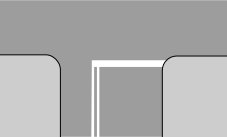
The P-12 Absolute Stop Line: You MUST stop here, no exceptions!
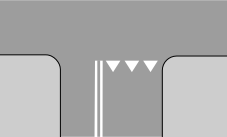
The P-13 'Conditional Stop Line' – Know When to Stop and Yield!
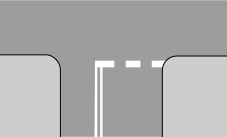
Know When to Stop: The P-14 Conditional Stop Line Explained

Prepare to yield: Understand the P-15 floor yield triangle road marking.

The P-16 'STOP' road marking means you must stop – even without a vertical sign!

P-17 Bus Stop Line: What This Zig-Zag Marking Means for Drivers
Deepen your understanding of specific road signs by reviewing official Polish traffic rules and associated real-world driving scenarios. These expert-led resources help you bridge the gap between visual recognition and practical exam application.
Learners often struggle to differentiate between binding regulatory signs and mere safety advice, which can lead to confusion during the official theory exam. This guide clarifies the specific role of Polish B-33 prohibitive signs versus international speed recommendations, helping you distinguish between legal mandates and situational safety advice. You will learn to identify key sign types, understand their legal weight, and recognize why adjusting your speed to road conditions remains a fundamental requirement of the Polish driving system.
When selling a car in Poland, you have specific legal duties regarding insurance and registration that must be met promptly. This article clarifies these seller obligations, including the crucial 14-day window to inform your insurer and the 30-day deadline to notify the relevant communication department, ensuring a smooth and compliant transfer of ownership for both parties.
Master Your Rights and Obligations During a Polish Roadside Inspection
Ensure Road Safety: Master Slow Vehicle Overtaking Etiquette for Your Polish Exam.
The D-6 sign identifies the exact location of a pedestrian crossing, commonly known as a 'zebra' crossing. It consists of a blue square with a white triangle and a black silhouette of a person walking. Drivers approaching this sign are legally required to reduce their speed and observe the sidewalk carefully. If a pedestrian is on the crossing or clearly about to enter it, the driver must stop to allow them to cross safely. In Poland, the regulations emphasize that the driver's duty to yield begins as soon as the pedestrian is 'entering' the crossing.
The P-6 line is a broken line where the white dashes are significantly longer than the gaps between them. It serves as a transition between a standard dashed line (P-1) and a solid line (P-2). When a driver sees the dashes getting longer, it is a clear warning to finish any overtaking maneuvers and return to their lane immediately because the road is about to become restricted or dangerous.
After reviewing the full list of Polish road signs, explore specific sign categories for in-depth understanding. Challenge your knowledge with practice questions focused on sign recognition and interpretation to solidify your preparation for the driving theory exam.
Browse All Polish Road Signs