
The P-10 marking, commonly known as a 'zebra crossing', uses distinct white stripes to indicate a pedestrian crossing. In Poland, drivers must always yield to pedestrians who are on or clearly entering the crossing. This sign emphasizes pedestrian priority and requires drivers to approach at a safe, controllable speed. Remember, overtaking near these crossings is strictly forbidden and carries severe penalties.
Master the P-10 'Pedestrian Crossing' road sign meaning for your Polish theory test revision, understanding its specific implications for driver behaviour and yielding to pedestrians. This traffic sign explanation is crucial for safe urban driving and avoiding penalties.
The P-10 marking consists of thick white parallel stripes (zebra pattern). In Poland, drivers are required to yield to pedestrians who are already on the crossing AND to those who are clearly entering it. Drivers must approach at a speed that allows them to stop safely. Overtaking on or immediately before a pedestrian crossing is strictly prohibited and carries very heavy fines and penalty points.
Indicates a 'zebra' crossing where pedestrians have priority when entering or walking on the crossing.
Get clear, practical answers to the most common questions about the P-10 - Pedestrian Crossing road sign. Learn how the sign works, what rules it represents, and how it affects real driving situations. This FAQ strengthens your understanding and supports accurate decision making for the Polish driving theory exam in Poland.
The P-10 marking signifies a pedestrian crossing, often called a 'zebra crossing' due to its striped pattern. It means pedestrians have priority. You must stop or slow down significantly to allow them to cross safely if they are on the crossing or stepping onto it.
As a driver, you must always yield to pedestrians on or entering the P-10 crossing. This means stopping if necessary and approaching at a speed that allows you to stop safely. Overtaking other vehicles on or just before the crossing is prohibited. You also cannot stop or park within 10 meters of the crossing.
Yes, overtaking another vehicle on or immediately before the pedestrian crossing is strictly prohibited. Additionally, failing to stop for a pedestrian entering or on the crossing, and stopping or parking your vehicle on the crossing or within 10 meters of it, are also forbidden.
Even if a P-10 crossing appears empty, you should always approach with caution and at a reduced speed. Pedestrians, especially children or the elderly, may be hidden from view or about to step onto the crossing. Be prepared to stop suddenly. Slowing down significantly is always a good practice.
Yes, the P-10 road marking is usually accompanied by the vertical D-6 sign. This supplementary sign reinforces the presence of a pedestrian crossing and serves as an additional warning to drivers.
A common trap is forgetting that you must yield not only to pedestrians already on the crossing but also to those who are clearly about to step onto it. Another trap is confusing the rules for stopping distance, as you must be able to stop safely, not just slow down.
A clear reference image of the P-10 - Pedestrian Crossing road sign used in Poland.
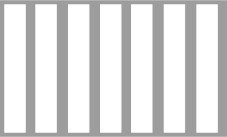
The P-10 - Pedestrian Crossing road sign may also be known by these alternative names or terms.
The P-10 - Pedestrian Crossing road sign is part of the Road Markings (P) category, which groups together signs with similar rules and functions.
Reviewing related road signs side-by-side sharpens your recognition skills for the Polish theory test. Understanding the nuances between similar traffic signs aids in accurate identification and reduces exam errors during your revision.

The P-1 Single Dashed Line: Your guide to safe lane changes and overtaking in Poland.

Understand the P-11 Bicycle Crossing Road Sign and Cyclist Priority
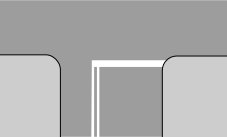
The P-12 Absolute Stop Line: You MUST stop here, no exceptions!
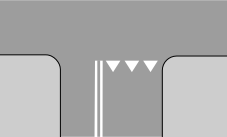
The P-13 'Conditional Stop Line' – Know When to Stop and Yield!
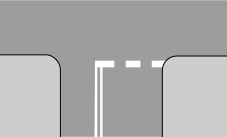
Know When to Stop: The P-14 Conditional Stop Line Explained

Prepare to yield: Understand the P-15 floor yield triangle road marking.

The P-16 'STOP' road marking means you must stop – even without a vertical sign!

P-17 Bus Stop Line: What This Zig-Zag Marking Means for Drivers
Deepen your understanding of specific road signs by reviewing official Polish traffic rules and associated real-world driving scenarios. These expert-led resources help you bridge the gap between visual recognition and practical exam application.
Master Polish Crossing Markings for a Safer Drive and Exam Success.
Navigate Tram Intersections Like a Pro: Essential for Your Polish Driving Exam.
Learning how to interact with law enforcement is a crucial part of your driver training in Poland, as it helps you understand the legal procedures governing roadside controls. This guide clarifies how officers identify themselves, what behaviors are expected of you as a driver, and how traffic enforcement impacts your penalty points and record. Mastery of these rules ensures you remain compliant with the law and prepared for any roadside situation you may encounter.
Learn the exact Polish traffic regulations for yielding to pedestrians at crossings, a crucial element of the national driving theory test. We clarify what constitutes 'yielding' and the significant consequences of non-compliance, including a common €1500 PLN fine and 10 penalty points. This essential knowledge will help you navigate pedestrian areas safely and pass your theory exam.
The E-19a sign is a specialized directional sign. It is used at intersections before a city to offer a route that goes *around* the urban area. Bypasses are usually faster, have fewer traffic lights, and are designed for transit traffic. This sign is essential for heavy trucks and long-distance travelers who want to avoid city-center congestion and narrow streets.
Similar to its counterpart C-1, the C-3 sign consists of a blue circle with a white arrow pointing left. It is positioned to direct traffic into a leftward path before the sign itself. This is common at intersections where the road ahead becomes a one-way street in the opposite direction or where a central barrier prevents further straight travel.
After reviewing the full list of Polish road signs, explore specific sign categories for in-depth understanding. Challenge your knowledge with practice questions focused on sign recognition and interpretation to solidify your preparation for the driving theory exam.
Browse All Polish Road Signs