
The P-21 marking, often called a 'painted island' or 'no-drive zone', is a crucial Polish road sign indicating an area you must never drive, stop, or park on. It uses diagonal white stripes to demarcate sections of the road that are legally equivalent to a physical barrier, typically used to guide traffic safely around obstacles, islands, or to create safe turning radii for larger vehicles. Ignoring this marking by driving or stopping on it is a serious error, both in real traffic and during your driving test.
Master the P-21 'Excluded Surface' marking, a crucial element for your Polish theory test revision. This explanation covers its meaning and why it's vital to never drive on these painted areas for successful driving licence theory exam preparation.
The P-21 marking consists of diagonal white stripes within a bordered area. It is used to channel traffic, separate lanes, or provide a buffer zone near obstacles or islands. It is legally equivalent to a physical island. Drivers must never drive onto this area, as it is often placed to ensure safe turning radii for large vehicles or to prevent dangerous merging maneuvers.
A painted area of the road that is completely off-limits for driving, stopping, or parking.
Get clear, practical answers to the most common questions about the P-21 - Excluded Surface road sign. Learn how the sign works, what rules it represents, and how it affects real driving situations. This FAQ strengthens your understanding and supports accurate decision making for the Polish driving theory exam in Poland.
The P-21 marking's main purpose is to designate an area of the road that drivers must absolutely avoid. It's used to channel traffic safely, prevent vehicles from driving into hazardous areas, or to ensure proper lane separation, acting as a visual guide or a physical barrier equivalent.
You are prohibited from driving, stopping, or parking your vehicle on any part of the P-21 excluded surface. This includes cutting across the stripes to shorten a turn, overtaking other vehicles by using this area, or stopping there for any reason. It is a no-drive zone.
A very common mistake learners make is driving over the P-21 marking, even slightly, when attempting to make a turn or navigate a tight junction. This is a significant error that can lead to point deductions on the driving exam. Always stay within the clearly marked traffic lanes.
While you must never drive onto the P-21 marking itself, you can use its visual boundary to help you correctly position your vehicle for a turn. The marking is often placed to indicate the correct, safe path around an obstacle or island, helping you maintain the proper lane and turning radius.
Yes, you will often drive near the P-21 marking as it's designed to guide traffic. You must, however, stay strictly within the open lanes of travel. The marking serves to create a safe passage, and you follow the intended traffic flow around it, not over it.
A clear reference image of the P-21 - Excluded Surface road sign used in Poland.
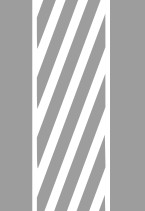
The P-21 - Excluded Surface road sign may also be known by these alternative names or terms.
The P-21 - Excluded Surface road sign is part of the Road Markings (P) category, which groups together signs with similar rules and functions.
Comparing related road signs like 'Excluded Surface' with other markings helps solidify your theory test revision. Effective traffic sign comparison sharpens your recognition skills, reducing errors on your driving theory exam.

The P-1 Single Dashed Line: Your guide to safe lane changes and overtaking in Poland.
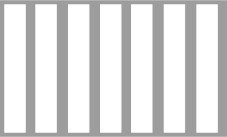
Understand the P-10 'Pedestrian Crossing' Road Sign and Your Obligations

Understand the P-11 Bicycle Crossing Road Sign and Cyclist Priority
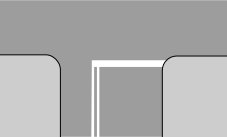
The P-12 Absolute Stop Line: You MUST stop here, no exceptions!
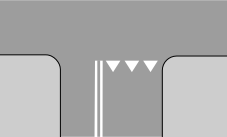
The P-13 'Conditional Stop Line' – Know When to Stop and Yield!
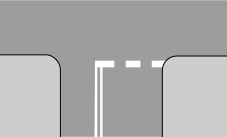
Know When to Stop: The P-14 Conditional Stop Line Explained

Prepare to yield: Understand the P-15 floor yield triangle road marking.

The P-16 'STOP' road marking means you must stop – even without a vertical sign!
Deepen your understanding of specific road signs by reviewing official Polish traffic rules and associated real-world driving scenarios. These expert-led resources help you bridge the gap between visual recognition and practical exam application.
When selling a car in Poland, you have specific legal duties regarding insurance and registration that must be met promptly. This article clarifies these seller obligations, including the crucial 14-day window to inform your insurer and the 30-day deadline to notify the relevant communication department, ensuring a smooth and compliant transfer of ownership for both parties.
Learning how to interact with law enforcement is a crucial part of your driver training in Poland, as it helps you understand the legal procedures governing roadside controls. This guide clarifies how officers identify themselves, what behaviors are expected of you as a driver, and how traffic enforcement impacts your penalty points and record. Mastery of these rules ensures you remain compliant with the law and prepared for any roadside situation you may encounter.
Don't Be a Road Block: Master Minimum Speeds and Smooth Traffic Flow for Your Polish Exam!
Master Your Rights and Obligations During a Polish Roadside Inspection
The D-43 sign is the city skyline with a red diagonal line. It signals that you are entering a rural environment. For most vehicles, the speed limit increases to 90 km/h (for single carriageways). However, you should still be cautious of farm vehicles, wild animals, and hidden driveways that are common in rural Poland. This sign also marks where you can once again use your horn for purposes other than immediate danger, such as before overtaking in low visibility.
The T-9 plate is paired with A-22 (Dangerous descent) or A-23 (Steep climb). A 10% slope means the road rises or falls 10 meters for every 100 meters of horizontal travel. This information is vital for heavy vehicles (to choose the right gear for engine braking) and for all drivers in winter, as steep slopes become impassable or extremely dangerous when icy.
After reviewing the full list of Polish road signs, explore specific sign categories for in-depth understanding. Challenge your knowledge with practice questions focused on sign recognition and interpretation to solidify your preparation for the driving theory exam.
Browse All Polish Road Signs