
The P-4 sign, known as a 'Podwójna ciągła' or double solid line, is a crucial road marking in Poland that separates opposing traffic directions. Its primary purpose is to strictly prohibit crossing or driving over these lines from either side, aiming to prevent dangerous head-on collisions, especially on busy roads or at high-risk locations. You must treat this line as an absolute boundary and never cross it to overtake, turn, or make a U-turn, unless specifically permitted in very rare circumstances for cyclists or horse-drawn carriages without touching the lines.
This essential road marking's meaning is crucial for safe driving and passing your theory test. Understanding the P-4 double solid line's strict prohibition on crossing ensures you navigate high-danger zones safely and comply with Polish traffic rules, avoiding severe penalties.
The P-4 'Podwójna ciągła' is one of the most critical safety markings on Polish roads. It consists of two parallel continuous white lines. It is used on roads with multiple lanes or in high-danger zones to prevent head-on collisions. It effectively acts as a wall that separates oncoming traffic. Crossing this line is heavily penalized as it often indicates that visibility is too poor or the road is too narrow for safe overtaking.
Separates opposite directions of traffic and strictly forbids crossing or driving over the lines from either side.
Get clear, practical answers to the most common questions about the P-4 - Double Solid Line road sign. Learn how the sign works, what rules it represents, and how it affects real driving situations. This FAQ strengthens your understanding and supports accurate decision making for the Polish driving theory exam in Poland.
The P-4 sign consists of two parallel continuous white lines marking the road. It signifies a strict separation between opposite directions of traffic and absolutely forbids crossing or driving over these lines from either side to prevent head-on collisions.
No, you are strictly prohibited from crossing the P-4 double solid lines to overtake any vehicle, including slow-moving ones, regardless of traffic conditions. This is a critical safety rule to avoid head-on collisions.
Generally, no. However, in very specific situations, you might be allowed to overtake a cyclist or a horse-drawn carriage if you can do so without any part of your vehicle touching the lines. Turning left across double solid lines into a driveway is also forbidden.
You will commonly encounter the P-4 double solid line on roads where there's a high risk of head-on collisions. This includes sections with poor visibility such as hills and bridges, near pedestrian crossings on busy roads, or on roads with multiple lanes that need clear separation.
A common trap is assuming you can cross the double solid lines if traffic appears clear or the vehicle you want to overtake is very slow. The P-4 sign signifies an absolute prohibition on crossing, and drivers must understand that any crossing is illegal and dangerous.
You are forbidden from crossing the double lines to overtake, performing U-turns over the lines, or turning left into a driveway or side road if it requires crossing these solid lines. It serves as a clear boundary that must not be breached.
A clear reference image of the P-4 - Double Solid Line road sign used in Poland.

The P-4 - Double Solid Line road sign may also be known by these alternative names or terms.
The P-4 - Double Solid Line road sign is part of the Road Markings (P) category, which groups together signs with similar rules and functions.
Comparing similar road signs, like different line markings, sharpens your theory test revision and improves sign recognition accuracy. Understanding subtle differences prevents mistakes and builds confidence for your exam preparation.

The P-1 Single Dashed Line: Your guide to safe lane changes and overtaking in Poland.
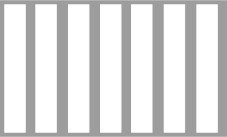
Understand the P-10 'Pedestrian Crossing' Road Sign and Your Obligations

Understand the P-11 Bicycle Crossing Road Sign and Cyclist Priority
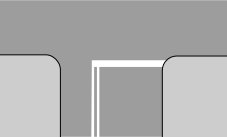
The P-12 Absolute Stop Line: You MUST stop here, no exceptions!
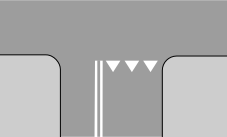
The P-13 'Conditional Stop Line' – Know When to Stop and Yield!
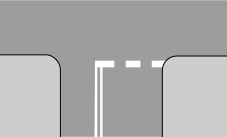
Know When to Stop: The P-14 Conditional Stop Line Explained
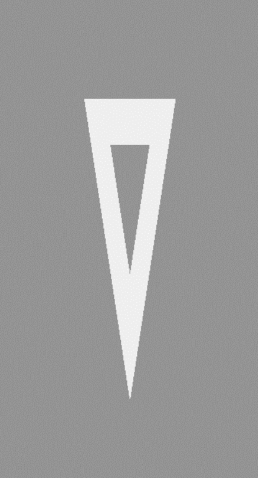
Prepare to yield: Understand the P-15 floor yield triangle road marking.
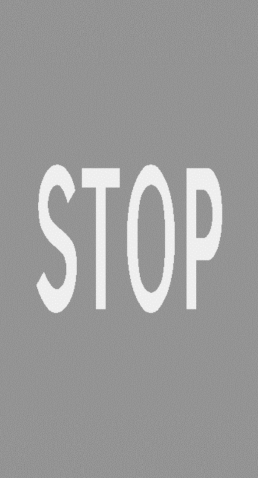
The P-16 'STOP' road marking means you must stop – even without a vertical sign!
Deepen your understanding of specific road signs by reviewing official Polish traffic rules and associated real-world driving scenarios. These expert-led resources help you bridge the gap between visual recognition and practical exam application.
Learn the critical distinctions between the Polish A-16 warning sign and the D-6 pedestrian crossing sign. This guide explains your legal responsibilities when approaching these areas, including the mandatory speed reduction and yielding requirements. Understand the significant penalties, such as hefty fines and accumulating penalty points, especially the 'recydywa' (repeat offender) system in Poland, which can lead to immediate license suspension.
Master Polish Crossing Markings for a Safer Drive and Exam Success.
When selling a car in Poland, you have specific legal duties regarding insurance and registration that must be met promptly. This article clarifies these seller obligations, including the crucial 14-day window to inform your insurer and the 30-day deadline to notify the relevant communication department, ensuring a smooth and compliant transfer of ownership for both parties.
Master split-second decisions to avoid collisions and confidently pass your Polish driving exam.
The P-7b is a continuous white line at the edge of the roadway. It indicates that the shoulder beyond the line is not intended for regular vehicle use and crossing it is generally prohibited. This is common on highways and high-speed roads where the shoulder is strictly for emergency use. For motorized vehicle drivers, this line acts as a 'no-entry' boundary to the roadside area, ensuring the shoulder remains clear for broken-down cars or emergency services.
The P-2 marking is a continuous white line that signifies a higher level of restriction than a dashed line. It is typically placed in areas where lane changes are dangerous, such as approaching intersections, on sharp curves with limited visibility, or in tunnels. The line acts as a legal barrier that drivers must not traverse. A wider version (P-2b) is often used to delineate the edge of specialized lanes or safety zones.
After reviewing the full list of Polish road signs, explore specific sign categories for in-depth understanding. Challenge your knowledge with practice questions focused on sign recognition and interpretation to solidify your preparation for the driving theory exam.
Browse All Polish Road Signs