
The P-13 marking, often called 'shark teeth', is a road sign that tells you where to stop if you need to yield to traffic on a main road. It's typically seen with the 'Yield' (A-7) sign. Unlike a solid stop line, you only stop here if other vehicles on the priority road make it necessary. If the road is clear, you can proceed without stopping, but always be ready to yield.
The P-13 'Conditional Stop Line' requires careful attention to yield the right of way. Master its meaning for effective theory test revision and safe driving practice in Poland.
The P-13 marking consists of a row of small white triangles with their points facing toward the approaching driver (often called 'shark's teeth'). It is used in conjunction with the A-7 'Yield' sign. Unlike the solid STOP line, you only need to stop here if there are vehicles on the priority road that require you to wait. If the road is clear, you may proceed without stopping, though you must still be prepared to do so.
Indicates the place where you should stop to yield the right of way if other vehicles are approaching.
Get clear, practical answers to the most common questions about the P-13 - Conditional Stop Line (Triangles) road sign. Learn how the sign works, what rules it represents, and how it affects real driving situations. This FAQ strengthens your understanding and supports accurate decision making for the Polish driving theory exam in Poland.
The P-13 marking, known as 'shark teeth', indicates a position where you must yield to other traffic. You need to stop if vehicles on the priority road make it unsafe to proceed. If the road is clear, you may pass without stopping, but you must still be prepared to stop if necessary.
No, you only stop at the P-13 line if there is traffic on the priority road that you need to yield to. If the priority road is clear, you can proceed without stopping, though you must do so cautiously and be prepared to stop if traffic appears.
A solid STOP line (usually associated with the B-20 'Stop' sign) requires you to stop completely, regardless of traffic conditions. The P-13 'Conditional Stop Line' (shark teeth), usually with the 'Yield' (A-7) sign, only requires a stop if necessary to yield to priority traffic.
A common mistake is stopping unnecessarily when the priority road is clear, causing traffic delays. Conversely, drivers might fail to stop or slow down sufficiently when they should, leading to dangerous situations. Always be prepared to stop and yield when approaching this marking.
You will commonly find the P-13 marking at intersections or junctions where you are required to yield. It's used in conjunction with the 'Yield' (A-7) sign to clearly mark the point where you must give way to vehicles on the main or priority road.
A clear reference image of the P-13 - Conditional Stop Line (Triangles) road sign used in Poland.
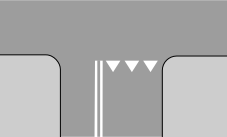
The P-13 - Conditional Stop Line (Triangles) road sign may also be known by these alternative names or terms.
The P-13 - Conditional Stop Line (Triangles) road sign is part of the Road Markings (P) category, which groups together signs with similar rules and functions.
Reviewing similar road signs side-by-side aids in distinguishing subtle differences, crucial for accurate recognition during your theory test revision. Mastering this traffic sign comparison sharpens your recognition skills, reducing errors and building confidence for the exam.

The P-1 Single Dashed Line: Your guide to safe lane changes and overtaking in Poland.
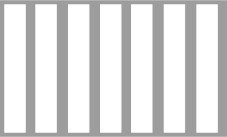
Understand the P-10 'Pedestrian Crossing' Road Sign and Your Obligations
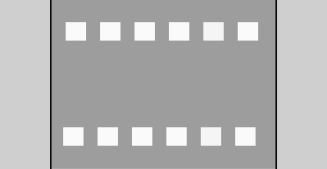
Understand the P-11 Bicycle Crossing Road Sign and Cyclist Priority
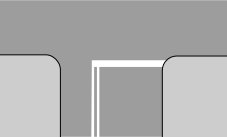
The P-12 Absolute Stop Line: You MUST stop here, no exceptions!
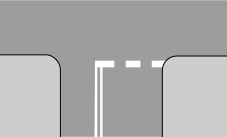
Know When to Stop: The P-14 Conditional Stop Line Explained

Prepare to yield: Understand the P-15 floor yield triangle road marking.

The P-16 'STOP' road marking means you must stop – even without a vertical sign!
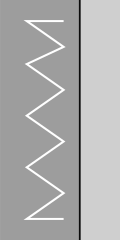
P-17 Bus Stop Line: What This Zig-Zag Marking Means for Drivers
Deepen your understanding of specific road signs by reviewing official Polish traffic rules and associated real-world driving scenarios. These expert-led resources help you bridge the gap between visual recognition and practical exam application.
Clear windows are not just about personal comfort; they are a fundamental requirement for road safety and a focus area for your theoretical knowledge. You will learn how to effectively use your vehicle's climate control and ventilation systems to manage cabin moisture, ensuring you are prepared for challenging weather scenarios. Understanding these procedures helps you maintain proper visibility and stay compliant with Polish road safety standards during your journey.
Know Your Obligations: What to Do After a Road Incident in Poland.
Navigating Polish roundabouts can be confusing, but this guide breaks down the essential priority rules based on common signage. Learn how signs C-12 and A-7 determine right-of-way, and what to do on the rare unmarked roundabouts. Gaining a solid understanding of these principles is key to safe driving and succeeding in your Polish theory exam.
Don't Be a Road Block: Master Minimum Speeds and Smooth Traffic Flow for Your Polish Exam!
The P-27 marking, often called a 'sharrow' (shared arrow), consists of a bicycle symbol with two chevrons above it. It is used on roads where a dedicated bike lane is not present. It informs cyclists where they should position themselves for safety (usually away from the 'door zone' of parked cars) and reminds motorists that cyclists are likely to be present and sharing the lane. It also indicates the correct direction of travel for the cyclist.
The A-17 sign indicates locations where children between the ages of 7 and 15 are likely to be present. Unlike adults, children can be unpredictable and may suddenly run into the street without looking. This sign is a signal to slow down significantly and be extra alert. It is common near primary schools, daycare centers, and organized sports fields.
After reviewing the full list of Polish road signs, explore specific sign categories for in-depth understanding. Challenge your knowledge with practice questions focused on sign recognition and interpretation to solidify your preparation for the driving theory exam.
Browse All Polish Road Signs