
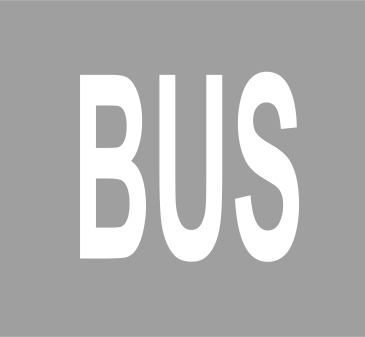
This P-22 road marking, commonly seen in Polish cities, signifies a lane exclusively for public transport like buses and trams. While generally off-limits to private cars, certain authorized vehicles such as taxis or emergency services may also use it, as indicated by accompanying vertical signs. Observing this marking is crucial for ensuring public transport operates efficiently and on schedule, and for avoiding theory exam pitfalls.
Properly recognizing the P-22 'BUS' road marking is crucial for navigating Polish city streets safely and legally. This specific traffic sign explanation details who can use these lanes and clarifies common questions for your driving theory test preparation, ensuring you avoid fines.
The word 'BUS' painted on the road identifies a lane dedicated to public transit. In many Polish cities, taxis, emergency services, and sometimes motorcycles or electric cars are also allowed to use these lanes (this will be specified by vertical signs). Regular car drivers must stay out of these lanes to ensure buses can bypass traffic jams and stay on schedule.
Indicates a lane reserved for public transport vehicles (buses, trams) and authorized others.
Get clear, practical answers to the most common questions about the P-22 - BUS Lane Marking road sign. Learn how the sign works, what rules it represents, and how it affects real driving situations. This FAQ strengthens your understanding and supports accurate decision making for the Polish driving theory exam in Poland.
The P-22 marking, which is the word 'BUS' painted on the road, designates a lane specifically reserved for public transport vehicles. This is to allow buses and trams to bypass traffic congestion and maintain their schedules. Private car drivers must not use this lane unless specific exceptions are clearly indicated.
Generally, only buses and trams are allowed in the P-22 BUS lane. However, depending on local regulations and specific vertical signs displayed nearby, taxis, emergency vehicles, electric cars, or even motorcycles might be permitted. Always check for additional signage before entering a BUS lane.
Prohibited actions include driving a private combustion-engine car in the BUS lane during restricted hours, using it to overtake other traffic, or parking in it. These actions can severely disrupt public transport services and lead to penalties. Always respect the lane's dedicated purpose.
Yes, there are exceptions. You may briefly enter a BUS lane if the road marking includes a dashed line, which typically indicates you can enter it to prepare for a right turn. Additionally, if your vehicle is specifically authorized by vertical signs (e.g., an electric car), you may be allowed to use the lane.
Understanding the P-22 BUS lane marking is important for the theory test because it tests your knowledge of traffic rules in urban environments and your ability to recognize dedicated lanes. Failing to know who can use these lanes and when can lead to incorrect answers about priority and lane usage, costing you points on the exam.
A clear reference image of the P-22 - BUS Lane Marking road sign used in Poland.
The P-22 - BUS Lane Marking road sign may also be known by these alternative names or terms.
The P-22 - BUS Lane Marking road sign is part of the Road Markings (P) category, which groups together signs with similar rules and functions.
Comparing signs like the P-22 'BUS' lane marking with other road markings helps solidify your understanding and prevents common errors during your theory test revision. Mastering similar road signs and traffic sign comparison is key to passing your exam.

The P-1 Single Dashed Line: Your guide to safe lane changes and overtaking in Poland.
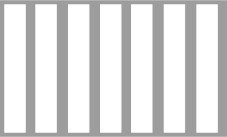
Understand the P-10 'Pedestrian Crossing' Road Sign and Your Obligations

Understand the P-11 Bicycle Crossing Road Sign and Cyclist Priority
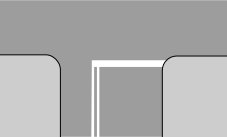
The P-12 Absolute Stop Line: You MUST stop here, no exceptions!
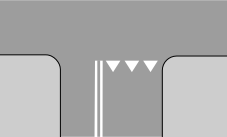
The P-13 'Conditional Stop Line' – Know When to Stop and Yield!
Know When to Stop: The P-14 Conditional Stop Line Explained

Prepare to yield: Understand the P-15 floor yield triangle road marking.

The P-16 'STOP' road marking means you must stop – even without a vertical sign!
Deepen your understanding of specific road signs by reviewing official Polish traffic rules and associated real-world driving scenarios. These expert-led resources help you bridge the gap between visual recognition and practical exam application.
This article provides a comprehensive breakdown of vehicles and vehicle combinations permitted under the Polish Category T driving licence, directly referencing the "Prawo o ruchu drogowym". You will learn the exact definitions of agricultural tractors, slow-moving vehicles, and how trailers can be attached. Crucially, it addresses common confusions, distinguishing Category T from other vehicle categories to ensure you are fully prepared for your theory exam and safe driving practices.
Don't Be a Road Block: Master Minimum Speeds and Smooth Traffic Flow for Your Polish Exam!
Even a Second Can Be Fatal: Understand Microsleep to Drive Safely in Poland.
Learn why driving in Poland with a foreign license is illegal if your Polish driving privileges have been revoked. This article explains the fundamental principle that driving entitlements are personal and singular under Polish law, as reinforced by court rulings, helping you understand the strict requirements for legal driving.
The F-19 sign designates a lane for exclusive use by certain vehicles, most commonly buses (BUS), taxis, or emergency services. It is used to prioritize public transport and improve its efficiency in congested urban areas. Regular motorists are usually prohibited from driving in these lanes, though they may be allowed to enter briefly to perform a right turn at an intersection if markings allow.
The D-15 sign identifies a location where regular bus services stop to pick up and drop off passengers. It features a black bus silhouette on a blue background within a white rectangle. Beyond public transport, this sign also allows for the stopping of school buses and other vehicles performing regular passenger transport. Drivers should be particularly careful when passing a stopped bus, as passengers (especially children) may step out from behind the vehicle to cross the street.
After reviewing the full list of Polish road signs, explore specific sign categories for in-depth understanding. Challenge your knowledge with practice questions focused on sign recognition and interpretation to solidify your preparation for the driving theory exam.
Browse All Polish Road Signs