
The P-16 marking is the word 'STOP' painted on the road in elongated white letters. This sign's primary purpose is to visually reinforce the mandatory stop requirement indicated by the vertical B-20 sign. It acts as a crucial reminder, ensuring you are aware of the need to stop completely, especially if the vertical sign is obscured or missed. Look out for this marking as it often precedes the solid P-12 stop line, where your actual stop is required.
This crucial road marking, the 'STOP' text on the pavement, reinforces the vertical B-20 sign, demanding a complete stop before proceeding. Understanding this visual cue is vital for safe driving and successful theory test revision, ensuring you never miss a mandatory stop requirement.
The P-16 marking is the word 'STOP' written in elongated white letters on the pavement. It serves as a powerful visual reinforcement of the vertical B-20 sign. It ensures that the driver is aware of the absolute stopping requirement, even if the vertical sign is missed. It is typically followed shortly by the P-12 solid stop line.
The word 'STOP' painted on the road to reinforce the mandatory stop requirement from a vertical B-20 sign.
Get clear, practical answers to the most common questions about the P-16 - STOP Text Marking road sign. Learn how the sign works, what rules it represents, and how it affects real driving situations. This FAQ strengthens your understanding and supports accurate decision making for the Polish driving theory exam in Poland.
The P-16 marking is the word 'STOP' written on the road surface. It's a visual reinforcement of the vertical B-20 STOP sign, meaning you must be prepared to make a full stop. Its elongated letters are designed to appear correctly proportioned to approaching drivers.
As soon as you see the P-16 'STOP' marking, you should begin to slow down and prepare to stop. This marking is a strong indicator that a vertical B-20 STOP sign is nearby, and it will typically be followed shortly by a solid stop line (P-12), where you must bring your vehicle to a complete halt.
The P-16 marking is a mandatory instruction, reinforcing the B-20 sign. You must treat it as a regulatory warning that a complete stop is required at the upcoming solid line. It's not optional, and ignoring it can lead to dangerous situations and theory test failures.
A common trap is not understanding that the P-16 text is a precursor to the actual stop line, and that the stop must be made at the line itself, not at the text. Learners might also forget that the text still mandates a stop even if the vertical B-20 sign is partially obscured, especially in adverse weather conditions.
You do not stop at the 'STOP' text itself. The P-16 marking serves as a visual cue and reinforcement. The actual mandatory stop must be performed at the solid white stop line (P-12) that typically follows the 'STOP' text marking.
A clear reference image of the P-16 - STOP Text Marking road sign used in Poland.

The P-16 - STOP Text Marking road sign may also be known by these alternative names or terms.
The P-16 - STOP Text Marking road sign is part of the Road Markings (P) category, which groups together signs with similar rules and functions.
Reviewing closely related Polish road signs like the P-16 STOP Text Marking alongside other stop indicators helps solidify your understanding. Practicing traffic sign comparison and sign recognition is key to mastering the theory test revision and avoiding common errors.

The P-1 Single Dashed Line: Your guide to safe lane changes and overtaking in Poland.
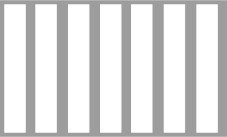
Understand the P-10 'Pedestrian Crossing' Road Sign and Your Obligations
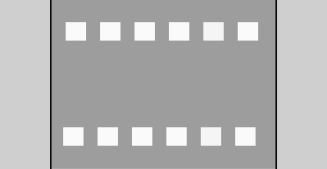
Understand the P-11 Bicycle Crossing Road Sign and Cyclist Priority
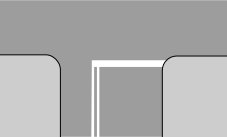
The P-12 Absolute Stop Line: You MUST stop here, no exceptions!
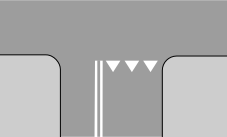
The P-13 'Conditional Stop Line' – Know When to Stop and Yield!
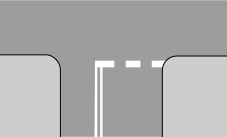
Know When to Stop: The P-14 Conditional Stop Line Explained

Prepare to yield: Understand the P-15 floor yield triangle road marking.

P-17 Bus Stop Line: What This Zig-Zag Marking Means for Drivers
Deepen your understanding of specific road signs by reviewing official Polish traffic rules and associated real-world driving scenarios. These expert-led resources help you bridge the gap between visual recognition and practical exam application.
For any student preparing for the Polish driving theory exam, recognizing the risks posed by aggressive behaviors like speeding and driving under the influence is essential. This guide highlights the impact of these dangers on road safety while reinforcing the legal standards and defensive attitudes that examiners look for in candidates. You will learn why awareness of other road users is just as vital as following official traffic signs and regulations.
Learners must understand that a vehicle’s technical state directly impacts safety in real-world traffic. This article explains how to identify early warning signs of transmission wear, such as acceleration delays or gear shifting issues, helping you maintain a roadworthy vehicle and prepare for technical theory questions.
Master Your Rights and Obligations During a Polish Roadside Inspection
Don't Be a Road Block: Master Minimum Speeds and Smooth Traffic Flow for Your Polish Exam!
The D-40 sign marks the entrance to a 'Strefa Zamieszkania'. Inside this zone, pedestrians are allowed to use the entire width of the road and have absolute priority over vehicles. The speed limit is strictly 20 km/h. Drivers must be extremely vigilant as children are legally allowed to play on the street without adult supervision. Additionally, parking is only permitted in designated spaces, and all speed bumps are considered 'marked' by this entry sign.
This sign is a variation of the priority warning, specifically highlighting a junction on the right. Drivers on the side road are required to yield (usually marked by an A-7 or B-20 sign). It is used to ensure the driver on the main road is aware of potential traffic merging or crossing from the right, which is often a 'blind spot' or a common source of side-impact collisions.
After reviewing the full list of Polish road signs, explore specific sign categories for in-depth understanding. Challenge your knowledge with practice questions focused on sign recognition and interpretation to solidify your preparation for the driving theory exam.
Browse All Polish Road Signs