
The P-18 road marking in Poland designates individual parking stalls using white lines, which can be arranged parallel, perpendicular, or diagonally. Proper use of these markings ensures maximum vehicle capacity and prevents obstruction of traffic and sidewalks. When you see this marking, always ensure your entire vehicle fits completely within the designated lines, as specified by Polish traffic regulations.
This section clarifies the function of the P-18 'Parking Space' marking, crucial for understanding where and how to park legally in Poland. Familiarize yourself with this sign's meaning for your theory test revision and safe driving practice.
The P-18 marking uses white lines to outline the boundaries of a parking stall. These can be parallel, perpendicular, or diagonal to the curb. Properly following these markings ensures that the maximum number of vehicles can fit in the area and that they do not obstruct the roadway or sidewalks. In many urban zones, parking is only legal within these clearly defined lines.
Designates an individual spot or an area where vehicle parking is permitted.
Get clear, practical answers to the most common questions about the P-18 - Parking Space road sign. Learn how the sign works, what rules it represents, and how it affects real driving situations. This FAQ strengthens your understanding and supports accurate decision making for the Polish driving theory exam in Poland.
The P-18 marking in Poland indicates a designated parking space. It uses white lines to outline the exact area where a vehicle may be parked, helping to organise parking and ensure traffic flow.
You must park your entire vehicle, including bumpers, squarely within the white lines of the P-18 space. Parking across the lines, occupying more than one space, or leaving any part of your vehicle outside the marked area is prohibited.
Yes, it's common for the P-18 marking to be accompanied by signs like D-18, which provide further information about parking. These signs might indicate paid parking, time limits, or specific vehicle types allowed to park there.
A common mistake is assuming that any space with white lines is automatically legal parking. Learners might forget to check for other regulatory signs (like D-18) or fail to understand that the P-18 marking itself requires the vehicle to be fully contained within the lines. Overhanging bumpers or wheels are a frequent reason for failing this question in the exam.
Yes, folding in your side mirrors is often allowed and can be helpful when parking in tight P-18 spaces, especially if they are close to other vehicles or the curb. This action can help ensure your vehicle fits entirely within the marked area and avoid obstructing passing traffic.
A clear reference image of the P-18 - Parking Space road sign used in Poland.

The P-18 - Parking Space road sign may also be known by these alternative names or terms.
The P-18 - Parking Space road sign is part of the Road Markings (P) category, which groups together signs with similar rules and functions.
Reviewing adjacent or similar road signs, like distinguishing different parking space markings, sharpens your recognition skills and reduces errors. Master traffic sign comparison to prepare effectively for your theory test revision and improve overall driving knowledge in Poland.

The P-1 Single Dashed Line: Your guide to safe lane changes and overtaking in Poland.
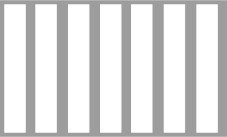
Understand the P-10 'Pedestrian Crossing' Road Sign and Your Obligations

Understand the P-11 Bicycle Crossing Road Sign and Cyclist Priority

The P-12 Absolute Stop Line: You MUST stop here, no exceptions!
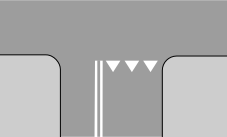
The P-13 'Conditional Stop Line' – Know When to Stop and Yield!
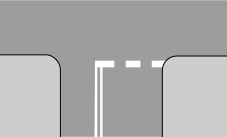
Know When to Stop: The P-14 Conditional Stop Line Explained

Prepare to yield: Understand the P-15 floor yield triangle road marking.

The P-16 'STOP' road marking means you must stop – even without a vertical sign!
Deepen your understanding of specific road signs by reviewing official Polish traffic rules and associated real-world driving scenarios. These expert-led resources help you bridge the gap between visual recognition and practical exam application.
Even a Second Can Be Fatal: Understand Microsleep to Drive Safely in Poland.
Don't Be a Road Block: Master Minimum Speeds and Smooth Traffic Flow for Your Polish Exam!
Navigating Polish roads requires a precise understanding of rules for overtaking slow-moving vehicles, especially on continuous solid lines. This article will detail when such maneuvers are legal, the legal obligations of tractor drivers, and the consequences of violations according to Polish traffic law. Mastering this topic is essential for safe driving and succeeding in your theory exam.
Navigating the different Polish driving licence categories for motorcycles can be complex. This guide breaks down the specific requirements for AM, A1, A2, and A licences, including the minimum age and the exact types of vehicles you can operate with each. Gaining a clear understanding of these categories is essential for success in your Polish driving theory exam and for safe riding on Polish roads.
The D-50 sign marks a 'Zatoka'—a short, paved area off the main road. It is strictly for vehicles that have broken down or for drivers in a medical emergency. If the sign includes an 'SOS' symbol, it means the bay is equipped with an emergency phone and a fire extinguisher. These are crucial on roads without a continuous hard shoulder or inside long tunnels where stopping on the roadway would be fatal.
The A-17 sign indicates locations where children between the ages of 7 and 15 are likely to be present. Unlike adults, children can be unpredictable and may suddenly run into the street without looking. This sign is a signal to slow down significantly and be extra alert. It is common near primary schools, daycare centers, and organized sports fields.
After reviewing the full list of Polish road signs, explore specific sign categories for in-depth understanding. Challenge your knowledge with practice questions focused on sign recognition and interpretation to solidify your preparation for the driving theory exam.
Browse All Polish Road Signs