
The P-8a directional arrow, painted directly on the road surface, clearly indicates that traffic in this lane must proceed straight ahead through the intersection. This sign is crucial for managing traffic flow and preventing accidents, especially in busy junctions. If you are in a lane marked with only this arrow, you are legally prohibited from turning left or right. Always look ahead early to ensure you are in the correct lane for your intended direction of travel, or prepare to change lanes safely before this marking appears.
The P-8a directional arrow on the road surface strictly requires drivers to proceed straight ahead, prohibiting any turns. Understanding this road sign meaning is vital for preventing collisions, managing traffic flow, and excelling in your Polish driving theory test.
The P-8a arrow is painted on the lane surface to regulate movement at an intersection. If you are in a lane with this arrow, you are legally forbidden from turning left or right. It is used to streamline traffic and prevent collisions that occur when drivers try to turn from a middle lane. Often, these arrows are combined (e.g., straight and right), meaning both directions are allowed from that specific lane.
Mandates that traffic in the lane where the arrow is painted must only proceed straight ahead.
Get clear, practical answers to the most common questions about the P-8a - Directional Arrow: Straight Ahead road sign. Learn how the sign works, what rules it represents, and how it affects real driving situations. This FAQ strengthens your understanding and supports accurate decision making for the Polish driving theory exam in Poland.
The P-8a road marking is a straight-ahead directional arrow painted on the lane. It legally requires drivers in that lane to continue straight through the intersection and prohibits any turns. It's a crucial sign for lane discipline and traffic management.
No, you absolutely cannot turn left or right if you are in a lane marked exclusively with the P-8a straight-ahead arrow. Doing so is a traffic violation. If you intend to turn, you must be in a lane with appropriate arrows (e.g., straight and left, or straight and right) or a lane marking that permits your intended manoeuvre.
If you find yourself in a lane marked only with the P-8a straight-ahead arrow and realise you need to turn, you must continue straight ahead. You should then look for a safe place to make a U-turn or find an alternative route that allows for your intended turn, rather than attempting an illegal manoeuvre.
A common exam trap is assuming you can turn from any lane, or not noticing the arrow in time to switch lanes. Learners might also try to turn from a lane that's only for going straight, especially if the intersection looks complex. Always remember that lane markings are legal instructions, not suggestions.
Yes, the P-8a arrow is often combined with other directional arrows within the same lane. For example, you might see an arrow indicating 'straight ahead and right turn' or 'straight ahead and left turn'. In such cases, you are permitted to proceed in any of the indicated directions from that lane.
You should actively look for the P-8a road marking well in advance of the intersection. The general advice is to spot it early enough to safely change lanes if necessary. This is particularly important as you approach the intersection where lane lines may become solid, making lane changes impossible or dangerous.
A clear reference image of the P-8a - Directional Arrow: Straight Ahead road sign used in Poland.
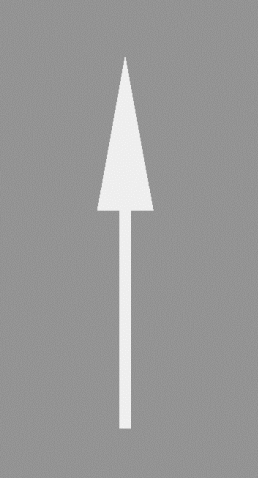
The P-8a - Directional Arrow: Straight Ahead road sign may also be known by these alternative names or terms.
The P-8a - Directional Arrow: Straight Ahead road sign is part of the Road Markings (P) category, which groups together signs with similar rules and functions.
Reviewing adjacent and similar road signs, like variations of directional arrows, sharpens your recognition and reduces confusion for the theory test. This focused comparison aids in mastering traffic sign recognition and theory test revision.

The P-1 Single Dashed Line: Your guide to safe lane changes and overtaking in Poland.
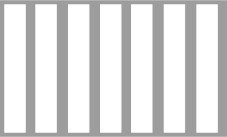
Understand the P-10 'Pedestrian Crossing' Road Sign and Your Obligations

Understand the P-11 Bicycle Crossing Road Sign and Cyclist Priority
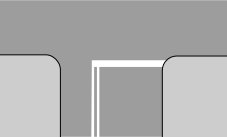
The P-12 Absolute Stop Line: You MUST stop here, no exceptions!
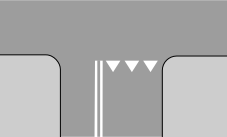
The P-13 'Conditional Stop Line' – Know When to Stop and Yield!
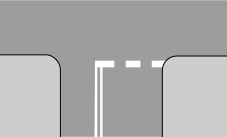
Know When to Stop: The P-14 Conditional Stop Line Explained

Prepare to yield: Understand the P-15 floor yield triangle road marking.

The P-16 'STOP' road marking means you must stop – even without a vertical sign!
Deepen your understanding of specific road signs by reviewing official Polish traffic rules and associated real-world driving scenarios. These expert-led resources help you bridge the gap between visual recognition and practical exam application.
Mastering Lane Discipline and Priority at Polish Intersections with Arrow Signals
Master Polish Road Arrows and Lane Discipline for Exam Success
Learning how to interact with law enforcement is a crucial part of your driver training in Poland, as it helps you understand the legal procedures governing roadside controls. This guide clarifies how officers identify themselves, what behaviors are expected of you as a driver, and how traffic enforcement impacts your penalty points and record. Mastery of these rules ensures you remain compliant with the law and prepared for any roadside situation you may encounter.
This article provides a comprehensive breakdown of vehicles and vehicle combinations permitted under the Polish Category T driving licence, directly referencing the "Prawo o ruchu drogowym". You will learn the exact definitions of agricultural tractors, slow-moving vehicles, and how trailers can be attached. Crucially, it addresses common confusions, distinguishing Category T from other vehicle categories to ensure you are fully prepared for your theory exam and safe driving practices.
The A-8 sign prepares the driver for a roundabout. It is used especially when the roundabout might not be visible from a distance or on roads where drivers previously had priority. You must follow the direction of the arrows (counter-clockwise) and generally yield to traffic already in the circle. Roundabouts are designed to improve safety by slowing down traffic and reducing the severity of collisions.
The C-5 sign features a white arrow pointing vertically upward on a blue background. It mandates that vehicles proceed only in a straight direction at the nearest intersection or where a change of direction is possible. It is frequently used on high-traffic roads to prevent congestion caused by turning vehicles or to stop drivers from entering narrow side streets that cannot handle current traffic volumes.
After reviewing the full list of Polish road signs, explore specific sign categories for in-depth understanding. Challenge your knowledge with practice questions focused on sign recognition and interpretation to solidify your preparation for the driving theory exam.
Browse All Polish Road Signs