
In Spain, giving way, or 'ceder el paso', is a critical driving principle designed to prevent collisions and ensure smooth traffic flow. This page explains the specific rules governing priority at various traffic points, including intersections, pedestrian crossings, and merging lanes, as dictated by DGT regulations. You will learn to identify situations where you must allow other road users to proceed first.
Theory topic content overview
Read the full theory topic guide for Spanish Give Way Rules with structured, easy-to-scan content built for learners in Spain. This detailed section explains the exact rule, meaning, traffic context, comparison points, and exam logic behind this Spanish driving theory topic so you can study faster, understand the concept more clearly, and avoid common interpretation mistakes on the theory test.
Giving way, known as "ceder el paso" or priority of passage ("prioridad de paso") in Spanish traffic law, is a fundamental driving principle in Spain. It means allowing another road user to proceed first at a point of potential conflict to ensure safety and maintain smooth traffic flow. When you are obliged to give way, you must adjust your speed, and if necessary, stop your vehicle to avoid forcing the other driver or road user to abruptly change their trajectory or speed. This is a core concept for safe driving and a frequent focus of the DGT theory exam.
Understanding and correctly applying give way rules is paramount in Spain for several critical reasons:
In Spain, the order of priority at any given point is determined by a strict hierarchy:
Ceda el paso, STOP, Calzada con prioridad) dictate the right of way.Ceda el paso triangle, STOP line) reinforce or provide priority information.Spanish roads use specific vertical signs and road markings to indicate priority:
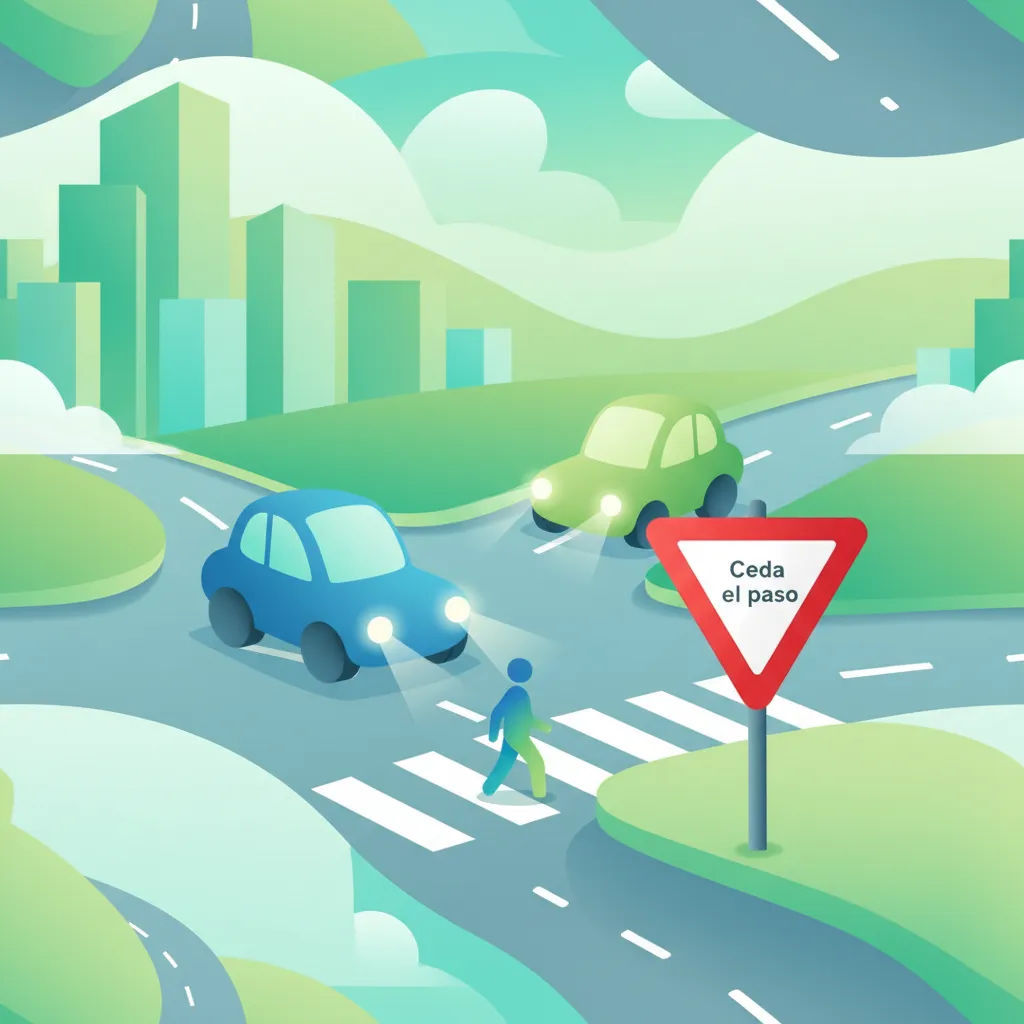
This triangular sign, with a red border and white background, signifies that you must give way to vehicles on the road you are approaching or the lane you intend to join.
Ceda el paso sign.The octagonal STOP sign, with white lettering on a red background, imposes a stricter obligation than Ceda el paso.
This diamond-shaped sign, with a white border and yellow background, indicates that vehicles on the road you are currently driving on have priority at upcoming intersections. This sign will typically be followed by a Fin de prioridad (R-4) sign at some point.
When an intersection lacks specific signs, lights, or agents, the DGT applies general rules to determine priority. This is a common area for exam questions.
Glorietas): Vehicles already circulating inside a roundabout always have priority over those attempting to enter it. This is a critical rule in Spain.Autopistas / Autovías): Vehicles already travelling on a motorway or dual carriageway have priority over those trying to merge onto it from an acceleration lane.Give way rules extend beyond vehicles to other vulnerable road users:
pasos de peatones), regardless of whether they have started crossing or are just about to step onto the crossing. You also generally yield to pedestrians when turning into a street if they are crossing the road you are entering.pasos para ciclistas) and when they are travelling in a marked cycle lane that crosses your path. When turning, you must give way to cyclists continuing straight or crossing the road you intend to enter.Ceda el paso vs. STOPThis is perhaps the most critical distinction in Spanish driving theory and practice:
Ceda el paso (Yield): Requires you to be prepared to stop and yield, but you only stop if necessary to let priority traffic pass. If the way is clear, you can proceed without stopping.STOP (Detención obligatoria): Demands a full, complete stop every single time, regardless of whether there is traffic. You must then yield before proceeding.Ceda el paso as a STOP sign: Stopping unnecessarily at a Ceda el paso when the way is clear can impede traffic flow.STOP sign: Rolling through a STOP sign (even if you check for traffic) is an immediate failure in a practical exam and a serious infraction.obstruyendo la circulación transversal). This is a serious offense.Ceda el paso at a busy intersection: You see the Ceda el paso sign (R-1). You reduce speed, check for traffic from both left and right on the main road. If a vehicle is approaching from the left at speed, you smoothly apply brakes and wait. If the road is clear, you can proceed without stopping, maintaining appropriate speed.Glorieta): You approach a roundabout with a Ceda el paso sign. You check traffic already circulating inside the roundabout from your left. You must yield to them. Only when there is a safe gap, without forcing others to brake, do you enter.Mastering give way rules is about more than just remembering signs; it's about anticipating potential conflicts, showing clear intent, and prioritizing safety. Always assume the most vulnerable road user has priority, and when in doubt, it's always safer to yield. For your DGT exam and for driving safely across Spain, internalize the hierarchy of priority, understand the critical difference between Ceda el paso and STOP, and know the specific exceptions to the right-hand rule at unmarked intersections.
This topic covers the essential give way rules governed by DGT regulations, teaching learners when and how to yield at intersections, roundabouts, and pedestrian crossings in Spain. The hierarchy of priority ranges from traffic agents at the top down to general rules at unmarked junctions, with the critical distinction between Ceda el paso (yield) and STOP (full stop) signs forming a key exam focus. Learners must memorize both the right-hand rule and its specific exceptions, including priority for paved roads over unpaved, trams, vehicles already in roundabouts, and motorway traffic. Common errors include stopping unnecessarily at yield signs, failing to stop fully at STOP signs, misjudging roundabout entry priority, and entering blocked intersections.
A short set of high-value points that capture the most important ideas from this theory explanation.
Priority in Spain follows a strict hierarchy: traffic agents, then traffic lights, then vertical signs, then road markings, and finally general rules.
The Ceda el paso (R-1) sign requires you to be prepared to stop, but you only stop if necessary; unlike STOP, you can proceed without stopping if the way is clear.
At unmarked intersections, the right-hand rule applies unless overridden by specific exceptions like paved roads having priority over unpaved roads.
Vehicles already inside a roundabout (glorieta) always have priority over those attempting to enter, regardless of approach angle.
You must yield to pedestrians at marked crossings whether they have already started crossing or are just about to step onto it.
STOP sign (R-2) always demands a complete stop before the line, followed by a yield check, unlike Ceda el paso which allows proceeding without stopping.
Six key exceptions override the right-hand rule: paved over unpaved roads, rail vehicles, roundabouts, motorways, emergency vehicles, and vehicles making certain manoeuvres.
Trams and rail vehicles always have absolute priority over other road users at any crossing.
Entering a blocked intersection (obstruyendo la circulación transversal) is prohibited under Articles 26.2 and 59.1 even if you have priority.
Cyclists have priority at marked cycle crossings and when travelling in a cycle lane that crosses your path.
Treating Ceda el paso as a STOP sign and stopping unnecessarily when the road is clear, which impedes traffic flow.
Rolling through a STOP sign without coming to a complete stop, which is a serious infraction and automatic exam failure.
Failing to yield to vehicles already circulating inside a roundabout when entering, a frequent error at Spanish glorietas.
Assuming the right-hand rule always applies at unmarked intersections and ignoring exceptions like paved roads or tram priority.
Entering an intersection without sufficient space to clear it, blocking cross-traffic even when you technically have priority.
Start with a short, direct summary of Spanish Give Way Rules before reading the full explanation below.
Giving way means allowing another road user to proceed first to avoid conflict, often involving slowing down or stopping. In Spain, these rules are clearly defined by DGT and apply at intersections, when approaching 'Ceda el paso' or 'STOP' signs, at pedestrian crossings, and in roundabouts. Drivers must clearly signal their intention and ensure their action does not force others to change speed or direction abruptly.
Review the most important terms, rule signals, and traffic concepts linked to Spanish Give Way Rules.
Explore related theory topic pages connected to Spanish Give Way Rules and continue with the next useful rule explanation.
See the common search queries learners use when trying to understand Spanish Give Way Rules in Spain.

Continue your preparation by exploring specific Spanish driving theory topics in depth. Review road signs, understand priority rules, and master DGT traffic laws. This section provides the essential knowledge to pass your exam and drive safely across Spain.
Explore Spanish Driving Theory TopicsTheory topic content overview
A short set of high-value points that capture the most important ideas from this theory explanation.
Priority in Spain follows a strict hierarchy: traffic agents, then traffic lights, then vertical signs, then road markings, and finally general rules.
The Ceda el paso (R-1) sign requires you to be prepared to stop, but you only stop if necessary; unlike STOP, you can proceed without stopping if the way is clear.
At unmarked intersections, the right-hand rule applies unless overridden by specific exceptions like paved roads having priority over unpaved roads.
Vehicles already inside a roundabout (glorieta) always have priority over those attempting to enter, regardless of approach angle.
You must yield to pedestrians at marked crossings whether they have already started crossing or are just about to step onto it.
STOP sign (R-2) always demands a complete stop before the line, followed by a yield check, unlike Ceda el paso which allows proceeding without stopping.
Six key exceptions override the right-hand rule: paved over unpaved roads, rail vehicles, roundabouts, motorways, emergency vehicles, and vehicles making certain manoeuvres.
Trams and rail vehicles always have absolute priority over other road users at any crossing.
Entering a blocked intersection (obstruyendo la circulación transversal) is prohibited under Articles 26.2 and 59.1 even if you have priority.
Cyclists have priority at marked cycle crossings and when travelling in a cycle lane that crosses your path.
Treating Ceda el paso as a STOP sign and stopping unnecessarily when the road is clear, which impedes traffic flow.
Rolling through a STOP sign without coming to a complete stop, which is a serious infraction and automatic exam failure.
Failing to yield to vehicles already circulating inside a roundabout when entering, a frequent error at Spanish glorietas.
Assuming the right-hand rule always applies at unmarked intersections and ignoring exceptions like paved roads or tram priority.
Entering an intersection without sufficient space to clear it, blocking cross-traffic even when you technically have priority.
Start with a short, direct summary of Spanish Give Way Rules before reading the full explanation below.
Giving way means allowing another road user to proceed first to avoid conflict, often involving slowing down or stopping. In Spain, these rules are clearly defined by DGT and apply at intersections, when approaching 'Ceda el paso' or 'STOP' signs, at pedestrian crossings, and in roundabouts. Drivers must clearly signal their intention and ensure their action does not force others to change speed or direction abruptly.
Review the most important terms, rule signals, and traffic concepts linked to Spanish Give Way Rules.
Explore related theory topic pages connected to Spanish Give Way Rules and continue with the next useful rule explanation.
See the common search queries learners use when trying to understand Spanish Give Way Rules in Spain.
Continue your preparation by exploring specific Spanish driving theory topics in depth. Review road signs, understand priority rules, and master DGT traffic laws. This section provides the essential knowledge to pass your exam and drive safely across Spain.
Explore Spanish Driving Theory TopicsUse this exam-focused revision tip to understand how Spanish Give Way Rules is likely to appear in theory questions for learners in Spain. This section helps you identify the most testable part of the rule, avoid common traps, and remember the concept more effectively during Spanish driving theory exam preparation.
Pay close attention to diagrams showing unmarked intersections or situations where traffic signals are out. The DGT exam frequently tests your knowledge of the 'right-hand rule' and specific exceptions, like vehicles on paved roads having priority over those on unpaved roads, or trams having priority.
Read direct answers to the most common learner questions about Spanish Give Way Rules in Spain. This FAQ focuses on rule confusion, practical meaning, comparison with similar concepts, and the exact uncertainties that appear most often in Spanish driving theory revision and exam preparation.
'Ceda el paso' literally means 'Give Way' or 'Yield'. It is a triangular road sign (R-1) that obliges drivers to yield to vehicles approaching on the road they are joining or crossing. Unlike a 'STOP' sign, a full stop is not always required if the way is clear and safe.
In Spain, at an intersection with no traffic signals, signs, or road markings, you must generally give way to vehicles approaching from your right. This is a fundamental rule of 'prioridad de paso' (priority of passage) unless specific exceptions apply.
No, a full stop is not strictly mandatory at a 'Ceda el paso' sign if the visibility is good and you can clearly see there is no traffic on the priority road. However, you must slow down sufficiently to assess the situation and be prepared to stop if necessary, demonstrating your intention to yield.
In Spanish roundabouts ('glorietas'), vehicles already circulating inside the roundabout always have priority over those attempting to enter it. Drivers wishing to enter must wait for a safe gap in traffic.
At designated pedestrian crossings, you must always give way to pedestrians who are crossing or clearly intending to cross. You must stop your vehicle far enough from the crossing to allow them to cross safely and comfortably.
The 'Ceda el paso' (R-1) sign requires you to yield, but you only stop if necessary to do so safely. The 'Detención obligatoria' (R-2 - STOP) sign mandates a complete stop before the stop line or intersection, regardless of traffic, before safely proceeding.
Failing to give way is considered a serious infringement under Spanish traffic law (DGT). It can result in significant fines, penalty points on your driving license, and, more importantly, can cause serious accidents due to disrupting the expected flow of traffic.
Use our powerful search functionality to pinpoint specific Spanish DGT driving theory practice sets. Filter by road sign categories, traffic law topics, or question difficulty to build custom study sessions and reinforce your knowledge precisely where it matters for your official exam.