
This lesson guides you through the complex dynamics of reversing heavy vehicle combinations, a vital skill for professional drivers. By mastering these maneuvers, you will ensure precision and safety while navigating narrow spaces in accordance with Danish road regulations.

Lesson content overview
Reversing a large vehicle combination, such as a tractor-trailer or semitrailer, is one of the most challenging maneuvers a professional driver will face. Unlike reversing a solo car, the trailer reacts in a counter-intuitive way, requiring specialized skills and a deep understanding of vehicle dynamics. Mastering this technique is not just about convenience; it's a critical safety imperative for all heavy goods vehicle (HGV) drivers holding a Category C license in Denmark.
This comprehensive lesson will break down the essential principles and techniques for safely and accurately reversing with trailers and semitrailers. We will cover everything from precise steering inputs to effective use of mirrors and cameras, emphasizing the importance of planning and control. Proper execution reduces the risk of collisions, load shifts, and ensures the safety of everyone around the vehicle.
Reversing a heavy vehicle combination fundamentally differs from reversing a rigid vehicle. The articulated nature introduces complexities that demand specific skills and a keen awareness of the vehicle's footprint. The trailer's independent movement requires the driver to think ahead and employ specific steering techniques to guide its path.
When you reverse a tractor-trailer, the towing vehicle and the trailer behave as two separate units connected at a pivot point. Steering the towing vehicle in one direction causes the trailer to initially move in the opposite direction, a phenomenon known as counter-steering. This counter-intuitive response, combined with the sheer length and weight of the combination, makes precise maneuvering challenging.
Additionally, the overall length of the vehicle significantly impacts turning radius and sweep path. The rear of the trailer will always follow a larger arc than the towing vehicle, meaning more space is required for any turning maneuver, including reversing. This calls for constant vigilance and precise control to avoid striking obstacles or veering off course.
For professional drivers operating heavy goods vehicles, mastering reversing techniques is not merely an advanced skill but a fundamental requirement. Many common driving scenarios, such as docking at loading bays, maneuvering in confined industrial yards, or navigating urban delivery points, necessitate precise reverse movements.
Improper reversing can lead to severe consequences, including costly collisions with infrastructure, other vehicles, or property. More critically, it poses significant risks to pedestrians and cyclists who may be in blind spots. Mishandling a heavy vehicle during reversal can also destabilize the load, leading to shifts that compromise vehicle integrity and road safety. Therefore, the ability to execute these maneuvers safely and efficiently is paramount for obtaining and maintaining a Category C license.
Effective reversing with a trailer builds upon several foundational concepts learned in earlier stages of your heavy vehicle training. Understanding the nuances of trailer coupling and how it influences combination behaviour is essential, as the secure connection directly impacts steering response and stability. Similarly, a thorough grasp of blind spots in combinations is vital, especially when reversing, as visibility is inherently limited.
Furthermore, knowledge of load securing and distribution is critical. An improperly secured load can shift dramatically during reversing, especially during braking or sudden steering corrections, leading to dangerous instability or even jackknifing. This lesson will draw upon these prerequisites, integrating them into a holistic approach to safe reversing.
Successful reversing with a trailer or semitrailer relies on adhering to several core principles. These guidelines ensure that the driver maintains control, maximizes visibility, and minimizes risk throughout the maneuver. Each principle is interconnected, contributing to a smooth, safe, and precise reversal.
The most fundamental principle of reversing an articulated vehicle is to control the trailer's path using precise steering inputs on the towing vehicle. Unlike a rigid vehicle where the front and rear follow the same general path, with a combination, the trailer follows a wider radius. To make the trailer move to the left, you must initially turn the towing vehicle's steering wheel to the right. Conversely, to move the trailer to the right, you steer the towing vehicle to the left. These initial "counter-steering" inputs are subtle but crucial.
The goal is to initiate the trailer's turn, then straighten the towing vehicle to push the trailer back in a straight line or continue the arc. This requires constant, small adjustments rather than large, abrupt turns, which can quickly lead to loss of control or jackknifing.
Speed management is paramount when reversing a heavy vehicle combination. The golden rule is to always maintain a very low, constant speed – often referred to as "creep speed" – typically below 5 km/h. This minimal speed provides several critical advantages:
Abrupt acceleration or deceleration while reversing should be avoided, as these can destabilize the trailer and the load.
Due to the size and articulation of a heavy vehicle combination, direct rear visibility is extremely limited, often non-existent. Therefore, constant and effective use of all available visual aids is absolutely essential. This includes:
Drivers must continuously scan all mirrors and camera displays, rather than focusing on just one, to build a complete mental picture of the trailer's path and surroundings.
Before initiating any reversing maneuver, especially in confined or complex environments, a professional driver must plan the entire path. This involves:
Planning helps prevent last-minute, panicked corrections and significantly reduces the risk of error.
The stability of the cargo within the trailer is a often overlooked, yet crucial, aspect of safe reversing. An unsecured or poorly distributed load can shift significantly during the dynamic forces of a reversing maneuver, particularly during braking or sudden changes in direction.
Such shifts can alter the combination's center of gravity, leading to:
Therefore, before any reversing maneuver, ensure that the load is correctly secured according to regulations and that its weight is distributed evenly to maintain optimal stability.
Mastering reversing with a trailer requires understanding specific techniques and concepts. These are the building blocks for safe and efficient maneuvering in various professional driving scenarios.
Counter-steering is the most critical technique for controlling a reversing trailer. When you want the rear of the trailer to move to the left, you initially turn the steering wheel of the towing vehicle to the right. This pushes the coupling point to the right, which in turn causes the front of the trailer to pivot to the left, and thus the rear of the trailer to swing left. Once the trailer starts to turn in the desired direction, you must then straighten the towing vehicle's wheels (or even turn slightly in the direction of the turn) to prevent over-articulation and guide the trailer along its intended path.
Imagine you are backing into a loading bay on your left.
One of the most common mistakes is over-correcting. Turning the steering wheel too sharply or holding the "counter" turn for too long can cause the angle between the tractor and trailer to become too severe, leading to jackknifing. This dangerous situation occurs when the trailer swings completely around, aligning itself sharply against the towing vehicle, potentially damaging both vehicles and their connection. It can also cause the combination to become stuck or even overturn. Always use gentle, progressive steering inputs and rely on the mirrors for feedback.
Blind spots are significantly larger and more numerous in heavy vehicle combinations compared to smaller vehicles. When reversing, these blind spots become even more critical, as the driver's focus is often on the trailer's trajectory, potentially overlooking unseen areas.
The primary blind spots during reversing include:
To compensate for these limited visibility areas, a driver must adopt a systematic approach to checking for obstacles and vulnerable road users:
Load securing is a continuous responsibility, not just at the start of a journey. Reversing maneuvers, despite being at low speeds, involve dynamic forces that can test the integrity of load restraints.
When you brake while reversing, or make a sudden steering correction, the inertia of the cargo can cause it to shift. If the load moves significantly, it can:
Before beginning a complex or long reversing maneuver, especially if the load has been recently changed or the journey has involved significant movement, it's good practice to:
Visually inspect all load securing devices (straps, chains, chocks).
Ensure the load is evenly distributed and not leaning significantly.
If practical and safe, gently test brakes to feel for any abnormal load shift before critical maneuvers.
Speed control, as mentioned, is a critical element for successful and safe trailer reversing. It directly influences your ability to react and make precise adjustments.
Operating at creep speed gives you maximum time to observe, process, and react to the trailer's movements and any changes in the environment. It allows for:
For manual transmission vehicles, effective clutch control is essential for maintaining creep speed. Use a combination of clutch slippage and light brake application to keep the vehicle moving at a snail's pace. Avoid relying solely on the clutch or engaging it fully, as this can lead to jerky movements. For automatic transmissions, careful modulation of the brake pedal is key. Always use gentle, progressive braking actions.
Optimizing your visual aids is non-negotiable for safe reversing. The effectiveness of your mirrors and cameras directly correlates with your ability to perceive the trailer's path and avoid hazards.
Before starting any reversing maneuver, always check and adjust your mirrors.
Many modern heavy vehicles come equipped with advanced camera systems, including rear-view cameras and sometimes side cameras. These are invaluable tools for reversing:
In Denmark, specific rules and guidelines govern the operation of heavy vehicles, including procedures for reversing with trailers and semitrailers. Adherence to these regulations is mandatory for all Category C license holders and is crucial for maintaining safety on public and private roads.
Danish traffic law (Færdselsloven) generally mandates that drivers operate their vehicles at a speed appropriate to the circumstances, and this is especially emphasized for reversing.
While there might not be a single, fixed numerical speed limit explicitly stated for all reversing maneuvers, the overarching principle is that the speed must be slow and controlled, allowing for immediate stops and precise adjustments. For heavy vehicle combinations, this almost always translates to a creep speed of typically less than 5 km/h to maintain full control and avoid hazards. Rapid reversing is strictly prohibited due to the inherent dangers.
According to Danish regulations, a driver must at all times ensure an unobstructed view of the path their vehicle will take, particularly when reversing. This rule applies rigorously to heavy vehicle combinations where blind spots are extensive.
Danish law, consistent with European standards, imposes strict regulations on load securing for heavy goods vehicles. These regulations are designed to prevent load shift, spillage, and instability during transit and maneuvering.
Violations of load securing regulations can lead to significant fines and immediate enforcement action, as well as being a serious safety risk.
Even experienced drivers can fall prey to common errors when reversing heavy vehicle combinations. Awareness of these pitfalls is the first step towards avoiding them.
Attempting to reverse at excessive speeds is arguably the most frequent and dangerous mistake. It dramatically reduces reaction time, magnifies steering inputs, and makes it incredibly difficult to correct the trailer's path. High speed increases the likelihood of:
Failing to properly check and account for blind spots is a leading cause of collisions during reversing. Drivers might rely too heavily on one mirror, forget to check the opposite side, or neglect to use available camera systems. This often leads to striking:
Making large, sudden turns of the steering wheel, rather than small, progressive corrections, is a recipe for disaster. Abrupt inputs cause the trailer to react violently and unpredictably, making it extremely difficult to maintain a smooth, controlled arc. This is a direct cause of over-correction and jackknifing.
Starting a reverse maneuver without first assessing the environment and planning the path often results in needing multiple pull-forwards and restarts. This wastes time, increases fuel consumption, and, more importantly, raises the risk of errors under pressure. Lack of spatial awareness can lead to misjudging distances to obstacles or the trailer's swing path.
Reversing is rarely performed under ideal conditions. Professional drivers must be able to adapt their techniques to a range of environmental and situational factors to maintain safety and efficiency.
Pedestrians and cyclists are particularly vulnerable when heavy vehicles are reversing. They may not hear the reversing beepers, may assume the driver has seen them, or may enter the blind spot unexpectedly.
The skill of reversing with trailers and semitrailers is deeply intertwined with several other critical aspects of heavy vehicle operation. A holistic understanding of these connections enhances overall safety and efficiency:
To solidify your understanding, consider these common scenarios where reversing skills are put to the test:
Urban Loading Bay: You must reverse a fully loaded semitrailer into a narrow loading dock located on the left side of a busy urban street or industrial yard. This requires precise counter-steering, maintaining a constant creep speed, and continuously checking both mirrors and any available rear-view cameras. You must be acutely aware of potential pedestrians or cyclists, and the precise position of the dock. Careful planning to allow for multiple forward adjustments will be crucial.
Residential Street Parking (with small trailer): Although primarily a C-license lesson, the principles apply. Imagine reversing a lorry with a smaller box trailer out of a narrow industrial driveway onto a residential street. A parked car is directly across the street to your right. You must execute a controlled right-hand reverse turn, constantly checking your left mirror for approaching traffic and your right mirror/blind spot for the parked car. Counter-steering principles are vital here to guide the trailer's rear clear of the parked car.
Industrial Yard with Obstacles: Reversing under a low overhead pipe or into a tight spot between two large containers in an industrial yard. This scenario demands extreme precision in both horizontal and vertical clearance. You must use precise steering to guide the trailer, constantly monitoring overhead obstacles and side clearances. A pre-maneuver walk-around to measure clearances and identify any ground hazards is essential. The vehicle's laden height must also be considered.
Reversing with trailers and semitrailers is an advanced skill that is fundamental for any heavy goods vehicle driver holding a Category C license in Denmark. It requires a blend of theoretical understanding and practical application, emphasizing patience, precision, and continuous awareness.
By consistently applying the core principles of controlled speed, precise counter-steering, comprehensive blind spot management through mirrors and cameras, meticulous planning, and ensuring load stability, drivers can execute these challenging maneuvers safely and efficiently. Remember to always adjust your technique to account for varying weather conditions, lighting, road types, and vehicle load states, with particular vigilance for vulnerable road users. Mastery of these techniques not only ensures compliance with Danish regulations but, more importantly, underpins your professional responsibility for safety on the roads.
Reversing a tractor-trailer combination requires counter-steering—turning the towing vehicle opposite to the desired trailer direction to guide its path—combined with maintaining a very low creep speed below 5 km/h for maximum control and reaction time. Effective use of mirrors and cameras is critical since heavy vehicle blind spots are extensive and change as the articulation angle changes during the maneuver. Thorough pre-maneuver planning, including physically walking around the vehicle to identify obstacles and ground hazards, helps prevent collisions and reduces last-minute corrections. Load security must always be verified before reversing, as dynamic forces during braking or steering can cause cargo to shift and destabilize the combination. For Danish Category C drivers, these techniques are essential for safely navigating confined spaces like loading docks and urban delivery zones while meeting visibility and speed requirements under Danish traffic regulations.
A short set of high-value points that capture the most important learning from this lesson.
Counter-steering is essential: initially steer the tractor opposite to the desired trailer direction to initiate the turn
Maintain creep speed below 5 km/h to maximize control, reaction time, and prevent jackknifing
Continuously scan all mirrors and cameras to monitor blind spots and track the trailer's actual path
Always plan the entire reversing path and physically inspect the area before starting any maneuver
Verify load security before reversing to prevent dangerous cargo shifts that can destabilize the combination
Explore all units and lessons included in this driving theory course.
The tractor and trailer behave as two separate units connected at the articulation point, requiring different steering logic than rigid vehicles
The rear of the trailer follows a wider arc than the tractor, meaning more space is needed for any turning maneuver including reversing
Jackknifing occurs when the angle between tractor and trailer becomes too acute; stop and pull forward to straighten rather than forcing the turn
Convex mirrors expand your field of view but distort actual distances; use them as supplements to standard mirrors
Danish law requires unobstructed visibility and appropriate slow speed when reversing heavy vehicle combinations
Reversing at excessive speed, which dramatically reduces reaction time and greatly increases the risk of jackknifing and collisions
Inadequate blind spot checks by relying on only one mirror or neglecting to use available camera systems
Making large, abrupt steering corrections instead of small, progressive inputs that keep the trailer moving smoothly
Starting a reverse maneuver without first assessing the environment, which often leads to multiple pull-forwards and panicked corrections
Over-correcting the steering during counter-steering, causing the articulation angle to become too severe
Lesson content overview
A short set of high-value points that capture the most important learning from this lesson.
Counter-steering is essential: initially steer the tractor opposite to the desired trailer direction to initiate the turn
Maintain creep speed below 5 km/h to maximize control, reaction time, and prevent jackknifing
Continuously scan all mirrors and cameras to monitor blind spots and track the trailer's actual path
Always plan the entire reversing path and physically inspect the area before starting any maneuver
Verify load security before reversing to prevent dangerous cargo shifts that can destabilize the combination
Explore all units and lessons included in this driving theory course.
The tractor and trailer behave as two separate units connected at the articulation point, requiring different steering logic than rigid vehicles
The rear of the trailer follows a wider arc than the tractor, meaning more space is needed for any turning maneuver including reversing
Jackknifing occurs when the angle between tractor and trailer becomes too acute; stop and pull forward to straighten rather than forcing the turn
Convex mirrors expand your field of view but distort actual distances; use them as supplements to standard mirrors
Danish law requires unobstructed visibility and appropriate slow speed when reversing heavy vehicle combinations
Reversing at excessive speed, which dramatically reduces reaction time and greatly increases the risk of jackknifing and collisions
Inadequate blind spot checks by relying on only one mirror or neglecting to use available camera systems
Making large, abrupt steering corrections instead of small, progressive inputs that keep the trailer moving smoothly
Starting a reverse maneuver without first assessing the environment, which often leads to multiple pull-forwards and panicked corrections
Over-correcting the steering during counter-steering, causing the articulation angle to become too severe
Explore search topics learners often look for when studying Reversing with Trailers and Semitrailers. These topics reflect common questions about road rules, driving situations, safety guidance, and lesson level theory preparation for learners in Denmark.
Browse additional driving theory lessons that cover connected traffic rules, road signs, and common driving situations related to this topic. Improve your understanding of how different rules interact across everyday traffic scenarios.
Explore advanced strategies for reversing heavy articulated vehicles in Denmark. Learn to master complex steering inputs, manage blind spots effectively, and adapt to challenging urban and rural environments for safe maneuvering.

This lesson delves into the unique dynamics of articulated vehicles, focusing on the behavior of the combination around its articulation point. It explains the concept of off-tracking, where the trailer's wheels follow a tighter path than the tractor's, and its implications for negotiating turns and corners. Understanding these dynamics is crucial for safe maneuvering in confined spaces and preventing collisions with curbs or other obstacles.
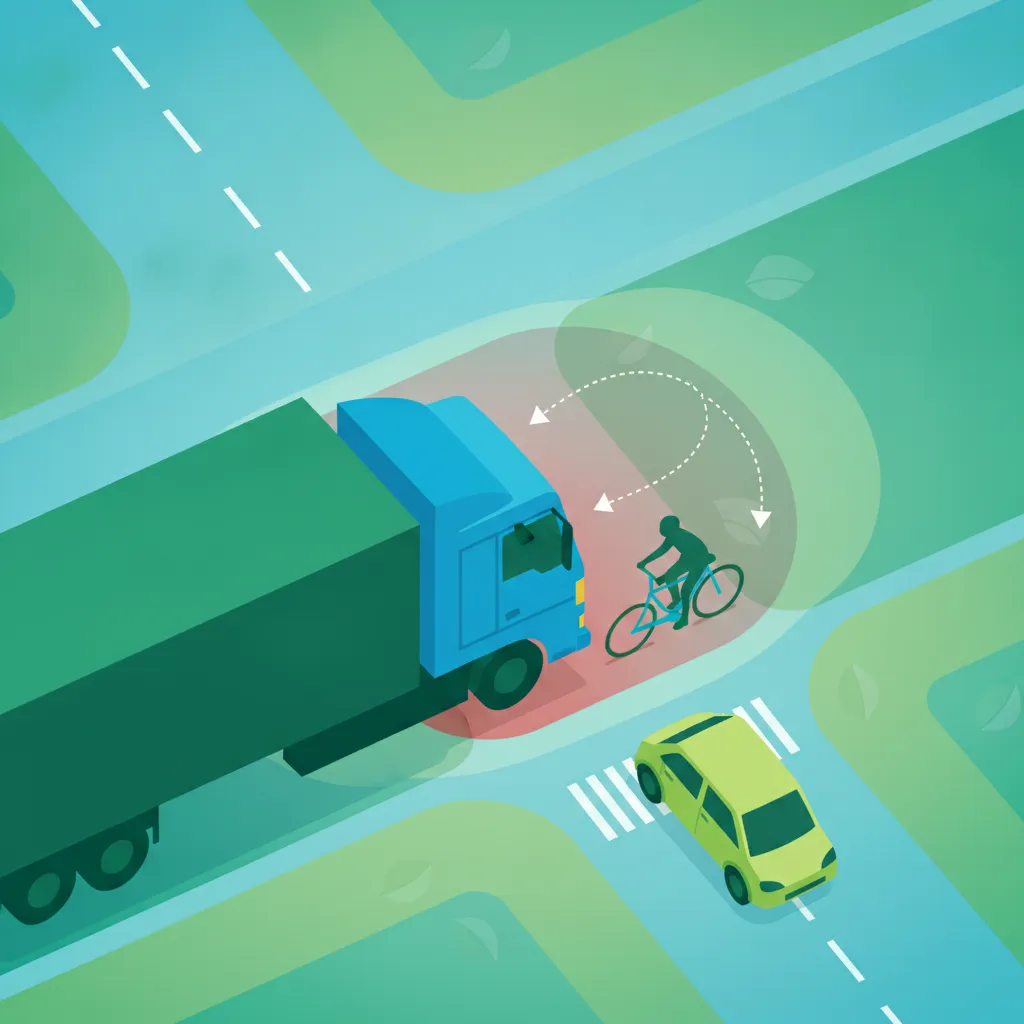
This lesson maps out the extensive blind spots, or 'no-zones,' that exist around a tractor-trailer combination, particularly to the sides and rear. It teaches the proper techniques for adjusting all mirrors to minimize these areas and explains how modern camera systems provide critical visibility. Understanding and compensating for these blind spots is a fundamental skill for preventing collisions, especially during lane changes and turns.

This lesson addresses the causes and prevention of trailer sway and jack-knifing, two critical loss-of-control events. It explains how factors like improper braking, high speeds, crosswinds, and poor load distribution can trigger these dangerous situations. Learners will study avoidance strategies, including proper speed management and smooth steering inputs, as well as corrective actions to regain control if sway begins.

This lesson explains the concept of off-tracking, where the rear wheels follow a tighter path than the front wheels during a turn. It provides techniques for positioning the bus correctly before a turn to avoid striking curbs or obstacles. The content also outlines the systematic safety checks and procedures for reversing, including the proper use of mirrors, cameras, and a guide.

This lesson addresses the specific skills required to navigate around public transport and heavy goods vehicles safely. You will learn the rules for bus lanes, recognize when buses have priority at stops, and understand the unique challenges posed by large vehicles, such as wider turning circles and larger blind spots. The material also provides clear protocols for overtaking these vehicles while maintaining adequate safety margins.

This lesson teaches the proper application of auxiliary speed control devices, such as retarders and engine brakes. It focuses on their use for maintaining a safe, controlled speed on long downhill gradients, which helps prevent service brake overheating and fade. The content also covers Danish regulations related to these systems and their benefits for reducing brake wear and improving overall safety.

This lesson addresses the unique environment of bus terminals, focusing on safe, low-speed maneuvering around other vehicles and pedestrians. It also introduces the theory for combination vehicles (Category DE), including the principles of coupling and uncoupling trailers. The content emphasizes the different handling characteristics and increased turning radius associated with articulated buses or buses with trailers.

This lesson focuses on the practical skills needed to maneuver a large vehicle in confined environments such as urban delivery zones and loading docks. It teaches how to accurately judge the required space, understand the vehicle's turning radius, and use reference points to position the vehicle precisely. The content covers strategies for navigating tight corners and avoiding fixed obstacles, which is essential for damage-free urban operations.

This lesson covers the correct techniques for various turning manoeuvres, including how to signal, position your vehicle, and judge gaps in traffic. It also details the legal and safety protocols for overtaking, emphasizing the importance of assessing speed, distance, and oncoming traffic. A thorough understanding of these procedures is crucial for navigating intersections and two-lane roads safely.
Understand the frequent errors drivers make when reversing heavy vehicles and the potential hazards involved, including jackknifing and collisions. Learn how to identify and avoid these risks based on Danish traffic law.

This lesson provides a clear, safety-oriented protocol for handling a vehicle breakdown or tyre failure. It covers how to safely maneuver the vehicle to the roadside, the correct use of hazard lights and warning triangles to alert other traffic, and procedures for contacting assistance. Adhering to these steps, as required by Danish law, is critical for protecting yourself and other road users from further incident.
This lesson maps out the extensive blind spots, or 'no-zones,' that exist around a tractor-trailer combination, particularly to the sides and rear. It teaches the proper techniques for adjusting all mirrors to minimize these areas and explains how modern camera systems provide critical visibility. Understanding and compensating for these blind spots is a fundamental skill for preventing collisions, especially during lane changes and turns.
This lesson addresses the specific skills required to navigate around public transport and heavy goods vehicles safely. You will learn the rules for bus lanes, recognize when buses have priority at stops, and understand the unique challenges posed by large vehicles, such as wider turning circles and larger blind spots. The material also provides clear protocols for overtaking these vehicles while maintaining adequate safety margins.

This lesson covers the safe and correct method for attaching a trailer to your vehicle, including all necessary safety checks. It explains the importance of proper load distribution to maintain trailer stability and prevent dangerous swaying. The content also revisits the critical rules for passenger safety, with a focus on selecting and using the correct child restraint systems according to Danish law.
This lesson addresses the causes and prevention of trailer sway and jack-knifing, two critical loss-of-control events. It explains how factors like improper braking, high speeds, crosswinds, and poor load distribution can trigger these dangerous situations. Learners will study avoidance strategies, including proper speed management and smooth steering inputs, as well as corrective actions to regain control if sway begins.
This lesson explains the concept of off-tracking, where the rear wheels follow a tighter path than the front wheels during a turn. It provides techniques for positioning the bus correctly before a turn to avoid striking curbs or obstacles. The content also outlines the systematic safety checks and procedures for reversing, including the proper use of mirrors, cameras, and a guide.

This lesson introduces the various types of trailers and semitrailers used in commercial transport, from rigid drawbar trailers to articulated semitrailers. It explains their distinct characteristics, including legal dimensional limits, typical axle configurations, and maximum loading capacities as defined by Danish regulations. Understanding these differences is fundamental for selecting the right combination for a given load and ensuring legal operation.

This lesson focuses on the rules and best practices for operating heavy vehicles on motorways and interchanges. It details Danish regulations regarding lane usage and speed limits for lorries, and explains safe techniques for merging into and exiting high-speed traffic. Maintaining a safe and appropriate following distance to allow for longer stopping distances is a key focus of the content.

This lesson emphasizes the professional driver's heightened responsibility to protect vulnerable road users. It revisits Danish regulations concerning cyclist priority, particularly during right turns, and details the correct procedures for maintaining safe overtaking distances. The content focuses on developing advanced situational awareness, using mirrors and cameras effectively, and anticipating the behavior of pedestrians and cyclists in urban environments.
This lesson delves into the unique dynamics of articulated vehicles, focusing on the behavior of the combination around its articulation point. It explains the concept of off-tracking, where the trailer's wheels follow a tighter path than the tractor's, and its implications for negotiating turns and corners. Understanding these dynamics is crucial for safe maneuvering in confined spaces and preventing collisions with curbs or other obstacles.
Find clear answers to common questions learners have about Reversing with Trailers and Semitrailers. Learn how the lesson is structured, which driving theory objectives it supports, and how it fits into the overall learning path of units and curriculum progression in Denmark. These explanations help you understand key concepts, lesson flow, and exam focused study goals.
Reversing at high speeds makes it difficult to correct the trailer's angle if it begins to veer off course. Slow, deliberate movements allow you to monitor your mirrors and cameras continuously, which is crucial for preventing jack-knifing.
Always perform a visual check of your surroundings, ensuring that no pedestrians or cyclists are in your blind spots. You should have a clear plan for your path and, if possible, seek assistance from a spotter if visibility is limited.
You must steer in the opposite direction of the trailer's swing to guide it back into the desired path. Making small, smooth steering inputs is key to regaining control without overcorrecting.
Yes, urban areas contain vulnerable road users like cyclists. You must always yield to them and ensure your maneuver does not block traffic or create hazardous situations at intersections.
Use our powerful search tool to pinpoint specific Danish driving theory topics, road signs, or traffic situations you need to review. Start exploring relevant practice sets now to reinforce your knowledge and build confidence for your upcoming driving licence exam.