
This lesson focuses on the critical skill of executing right turns while sharing the road with cyclists in heavy vehicles. As part of our Category C course, you will learn to manage blind spots and vehicle off-tracking to ensure the safety of vulnerable road users, a key competency for both your practical driving and the Danish theory exam.

Lesson content overview
Operating a heavy goods vehicle (HGV) within urban environments presents a unique set of challenges, particularly when executing right-turn manoeuvres. This is a high-risk situation that demands exceptional awareness and adherence to specific traffic regulations, especially concerning vulnerable road users like cyclists. For drivers seeking a Category C License in Denmark, mastering these manoeuvres is not only a legal requirement but also a fundamental aspect of professional responsibility. This lesson delves into the critical elements of safely navigating right turns, focusing on Danish traffic laws, understanding vehicle dynamics such as off-tracking, and implementing robust defensive driving strategies to prevent collisions with cyclists.
One of the most crucial aspects of performing a safe right turn in Denmark, especially with a heavy vehicle, is a clear understanding of cyclist priority. Danish traffic law places a strong emphasis on protecting vulnerable road users, and this is particularly evident in turning situations. As a heavy vehicle driver, assuming you always have priority can lead to dangerous situations and serious accidents.
In most urban intersections across Denmark, cyclists who are proceeding straight ahead, or turning left, generally have priority over motor vehicles that intend to turn right across their path. This means that if a cyclist is on your right side, approaching the intersection and intending to continue straight, you, as the turning heavy vehicle driver, must yield to them. This rule is designed to safeguard cyclists, who are often less visible and more susceptible to severe injury in a collision.
Always remember that unless specific road signs or lane markings explicitly indicate otherwise, cyclists have priority when you, as a heavy vehicle driver, are making a right turn.
The general rule of cyclist priority applies broadly, but understanding its nuances is key. For instance, when you are turning right on a road without a dedicated cycle lane, you must still check for cyclists who might be proceeding straight on the main carriageway. If there is a marked cycle lane that you must cross to complete your right turn, cyclists within that lane will almost certainly have priority. At traffic light intersections, the traffic signals will dictate priority. If the motor vehicle lane has a green light but a separate red arrow for cyclists, then cyclists must wait, and you may proceed with extreme caution. However, it is vital to always verify the specific signage and signals at each intersection.
It is a common mistake for heavy vehicle drivers to assume they have priority or to not thoroughly check for cyclists in their blind spots, especially when focused on the turn itself. Always err on the side of caution and ensure the path is clear before commencing your turn.
Heavy vehicles, particularly those with trailers or multiple axles, do not turn in the same way as smaller passenger cars. A critical concept to understand for safe right turns is 'off-tracking'. Failing to account for off-tracking is a leading cause of collisions during right-turn manoeuvres.
Off-tracking is the phenomenon where the rear wheels of a vehicle, especially a long or articulated vehicle, follow a shorter turning radius than the front wheels. This means the rear of the vehicle cuts the corner more sharply than the front.
For a heavy goods vehicle, such as a lorry with a semitrailer or a combination vehicle, off-tracking is significantly more pronounced than in a rigid truck or a car. The longer the wheelbase and the more articulation points, the greater the off-tracking effect. When turning right, this means the rear wheels, and particularly the rear of a trailer, will move inwards towards the kerb or the centre of the turn, sweeping a wider area than the front of the vehicle.
The practical implication of off-tracking is that the area swept by the rear of your vehicle can overlap with spaces where cyclists might be positioned. A cyclist riding alongside your vehicle, even if they appear visible in your mirrors initially, can quickly enter the swept path of your trailer or rear wheels as you begin to turn. This creates a dangerous "squeeze" hazard, where the cyclist is trapped between the turning vehicle and the kerb, or simply struck by the trailer.
Understanding off-tracking necessitates drivers to modify their approach to right turns. You cannot simply follow the path your front wheels take; you must always anticipate where the rear of your vehicle will travel. This often requires initiating the turn from a wider position in your lane to give the rear of the vehicle sufficient space, thereby preventing it from encroaching on cycle lanes or footpaths.
Another significant challenge for heavy vehicle drivers, directly impacting right-turn safety, is the presence of extensive blind zones. These areas around your vehicle are invisible to you, even with multiple mirrors. Cyclists, due to their smaller size and proximity, can easily disappear into these zones.
Blind zones, often referred to as 'no-zones', are areas around your vehicle that are not directly visible to the driver, either through the windscreen or mirrors. For a heavy goods vehicle, these zones are much larger and more numerous than in a passenger car. The right side of a heavy vehicle is particularly critical during right turns.
Areas around a vehicle that are not visible to the driver through mirrors alone, requiring additional checks to ensure no objects or vulnerable road users are present.
The primary blind zone of concern for right turns extends down the entire right side of the vehicle, from the front bumper, along the side of the cab, and along the entire length of any trailers. A cyclist positioned anywhere in this long, narrow strip might be completely invisible in your side mirrors. This blind spot is compounded by the vehicle's structure, pillars, and load.
Given the dangers posed by blind spots, heavy vehicle drivers must employ systematic and proactive defensive scanning techniques. Relying solely on mirrors is insufficient and dangerous.
Initial Mirror Checks (Far & Near): Well before the turn, check your main and wide-angle right-side mirrors repeatedly. Look for cyclists approaching from behind or alongside.
Internal Mirror Check (if applicable): If equipped, use internal mirrors to check for cyclists who might have passed the front of your vehicle.
Head Turns (Crucial "Lifesaver"): Just before committing to the turn, perform a quick, deliberate head turn to the right. This "lifesaver" check allows you to see into the blind spot area not covered by mirrors, confirming no cyclist is alongside your cab or just ahead of your rear wheels.
Blind Spot Mirrors: Utilise any convex or specific blind spot mirrors your vehicle is equipped with, but understand their limitations (they distort distance).
Continuous Scanning: Once the turn begins, continue to scan your right-side mirrors to monitor the trajectory of your vehicle and any cyclists who might have been initially behind you but are now catching up.
Develop a habit of a systematic scanning pattern: left mirror, centre mirror, right mirror, then a full head turn to the right before initiating any right turn. Repeat this sequence as needed until the manoeuvre is complete.
Drivers have a legal duty to ensure the way is clear before turning. This means actively looking for cyclists and other vulnerable road users. Ignoring this duty can have severe legal consequences in the event of a collision.
Proper positioning of your heavy vehicle is paramount for safely executing a right turn and mitigating the risks associated with off-tracking and blind spots. The goal is to create sufficient space for your vehicle to complete the turn without encroaching on cyclist paths and to ensure maximum visibility of your surroundings.
For heavy goods vehicles, especially those with long trailers, initiating a right turn from the furthest right position in the lane is often not ideal. To account for off-tracking, you might need to position your vehicle slightly to the left within your lane before starting the turn. This creates a wider initial turning radius for your front wheels, allowing the rear of your vehicle to follow without cutting the corner too sharply.
This strategic positioning, often called "swinging wide," is crucial. However, it must be done with extreme caution. Moving left within your lane before turning right can momentarily create an inviting gap on your right side, which cyclists might perceive as an opportunity to pass. This is why clear, timely signalling and thorough scanning are indispensable. Always ensure no cyclist attempts to pass on your right as you prepare to move slightly left to widen your turn.
Reducing your speed early and appropriately is fundamental to safe right turns. A slower speed provides more time for you to react, for cyclists to react to your intentions, and for you to make any necessary adjustments to your trajectory. High speed not only reduces reaction time but also exacerbates the effects of off-tracking, making it harder to control the vehicle's path precisely.
As you enter the turn, maintain a consistent, slow speed. Guide your vehicle smoothly through the arc, continuously monitoring your mirrors (especially the right side) to ensure your trailer's path is clear of any cyclists. Avoid sharp, abrupt turns. The goal is a controlled, predictable trajectory that gives other road users confidence in your actions. Keep a safe distance from the kerb to prevent your rear wheels from mounting it or striking street furniture, and crucially, to prevent trapping cyclists.
Effective communication with other road users, particularly cyclists, is a non-negotiable aspect of safe driving. For heavy vehicles, where manoeuvres are larger and less agile, clear and timely signalling of your intentions is even more critical.
Activating your right-turn indicator well in advance of the intersection is a legal requirement and a vital safety measure. In Denmark, drivers must signal their intention to turn right using the appropriate indicator lights at least 50 metres before the junction. This early warning gives cyclists ample time to register your intention and adjust their speed or position accordingly.
It's not enough to simply activate the signal; you must maintain it throughout the entire manoeuvre until the turn is completed and your vehicle is straightened in the new lane. A common mistake is signalling too late, or cancelling the signal prematurely, which can confuse cyclists and other drivers about your true intentions. Your vehicle's positioning, combined with your indicator, should leave no doubt about your planned trajectory.
Adherence to specific traffic regulations is mandatory for all drivers, but particularly for those operating heavy goods vehicles, which pose a greater risk in collisions. In Denmark, these rules are enshrined in the Road Traffic Act (Færdselsloven) and associated executive orders.
Here are some key regulations specifically relevant to heavy vehicle right turns with cyclists:
These regulations are not mere suggestions; they are legally binding requirements designed to enhance road safety and prevent tragic incidents. Violations can lead to severe penalties, including fines, points on your license, and even license suspension, particularly in the event of an accident.
Despite clear rules and guidelines, right-turn collisions involving heavy vehicles and cyclists continue to occur. These incidents often stem from common errors or misunderstandings. Being aware of these pitfalls is the first step in avoiding them.
Safe driving is not a static set of rules; it's an adaptive practice. Various external and internal factors can significantly impact the safety of a right turn, requiring drivers to adjust their approach.
Successfully and safely executing right-turn manoeuvres with a heavy goods vehicle in Denmark requires a comprehensive understanding of traffic laws, vehicle dynamics, and defensive driving principles. It is a manoeuvre that demands unwavering attention and proactive decision-making.
Always remember:
By diligently applying these principles, heavy vehicle drivers can significantly reduce the risk of collisions, ensuring safer urban roads for everyone, especially cyclists.
Executing safe right turns in heavy vehicles around cyclists requires mastering three interconnected skills: understanding cyclist priority under Danish law, accounting for vehicle off-tracking physics, and performing systematic blind spot scanning including head checks. The lesson emphasizes that heavy vehicle drivers must position strategically, signal 50 metres in advance, reduce speed significantly, and continuously monitor mirrors during the entire turn. Danish traffic law places the responsibility on the driver to ensure no cyclists are endangered, with serious legal consequences for negligence.
A short set of high-value points that capture the most important learning from this lesson.
Cyclists generally have priority over heavy vehicles turning right in Danish urban intersections unless explicit signs indicate otherwise
Off-tracking means the rear of a heavy vehicle cuts a tighter corner than the front, requiring wider initial positioning to avoid sweeping across cycle lanes
Mirrors alone are insufficient for detecting cyclists in right-side blind zones; a physical head check (lifesaver) is mandatory before turning
Right-turn indicators must be activated at least 50 metres before the junction and maintained throughout the entire manoeuvre
Strategic lane positioning—often starting slightly left—creates space for the rear wheels to follow safely without encroaching on cyclists
Explore all units and lessons included in this driving theory course.
The long right-side blind zone of a heavy goods vehicle can completely hide cyclists even when they are alongside or just behind the cab
Heavier loads and articulated vehicles increase off-tracking severity, requiring earlier speed reduction and wider turning paths
Assume cyclists are present in blind spots even when mirrors show nothing, treating non-visibility as potential danger
In Denmark, failing to yield to cyclists during right turns can result in fines, license points, and severe consequences if a collision occurs
Conditions like rain, darkness, or narrow intersections require extra scanning vigilance and further speed reduction beyond normal
Relying solely on mirrors and skipping the physical head check, missing cyclists positioned in the large right-side blind zone
Activating the right-turn indicator too close to the intersection, giving cyclists insufficient time to react or adjust their path
Turning too sharply without accounting for where the trailer's rear wheels will travel, causing it to sweep across a cycle lane
Moving left within the lane to widen the turn without checking for cyclists who may try to pass on the right side during this maneuver
Assuming that a clear mirror view means a clear path, ignoring that the swept path of the trailer extends inward during the turn
Lesson content overview
A short set of high-value points that capture the most important learning from this lesson.
Cyclists generally have priority over heavy vehicles turning right in Danish urban intersections unless explicit signs indicate otherwise
Off-tracking means the rear of a heavy vehicle cuts a tighter corner than the front, requiring wider initial positioning to avoid sweeping across cycle lanes
Mirrors alone are insufficient for detecting cyclists in right-side blind zones; a physical head check (lifesaver) is mandatory before turning
Right-turn indicators must be activated at least 50 metres before the junction and maintained throughout the entire manoeuvre
Strategic lane positioning—often starting slightly left—creates space for the rear wheels to follow safely without encroaching on cyclists
Explore all units and lessons included in this driving theory course.
The long right-side blind zone of a heavy goods vehicle can completely hide cyclists even when they are alongside or just behind the cab
Heavier loads and articulated vehicles increase off-tracking severity, requiring earlier speed reduction and wider turning paths
Assume cyclists are present in blind spots even when mirrors show nothing, treating non-visibility as potential danger
In Denmark, failing to yield to cyclists during right turns can result in fines, license points, and severe consequences if a collision occurs
Conditions like rain, darkness, or narrow intersections require extra scanning vigilance and further speed reduction beyond normal
Relying solely on mirrors and skipping the physical head check, missing cyclists positioned in the large right-side blind zone
Activating the right-turn indicator too close to the intersection, giving cyclists insufficient time to react or adjust their path
Turning too sharply without accounting for where the trailer's rear wheels will travel, causing it to sweep across a cycle lane
Moving left within the lane to widen the turn without checking for cyclists who may try to pass on the right side during this maneuver
Assuming that a clear mirror view means a clear path, ignoring that the swept path of the trailer extends inward during the turn
Explore search topics learners often look for when studying Safe Right-Turn Manoeuvres with Cyclists. These topics reflect common questions about road rules, driving situations, safety guidance, and lesson level theory preparation for learners in Denmark.
Browse additional driving theory lessons that cover connected traffic rules, road signs, and common driving situations related to this topic. Improve your understanding of how different rules interact across everyday traffic scenarios.
Learn the specific Danish traffic laws and best practices for heavy vehicle drivers executing right turns, focusing on cyclist priority and safe manoeuvres. Understand legal obligations and defensive driving techniques.

This lesson emphasizes the professional driver's heightened responsibility to protect vulnerable road users. It revisits Danish regulations concerning cyclist priority, particularly during right turns, and details the correct procedures for maintaining safe overtaking distances. The content focuses on developing advanced situational awareness, using mirrors and cameras effectively, and anticipating the behavior of pedestrians and cyclists in urban environments.
This lesson provides critical guidance for driving in environments with heavy cycle traffic, typical of Danish cities. It focuses on identifying and yielding to cyclists in dedicated bike lanes, especially when turning right across their path. The content emphasizes advanced observation skills to detect cyclists in blind spots and the importance of giving adequate space.

This lesson provides detailed guidance on navigating pedestrian crossings (fodgængerfelter) and areas with high cyclist traffic. It clarifies your legal obligation to stop for pedestrians at zebra crossings and the proper speed to approach these zones. A central theme is understanding the rights of vulnerable road users and how to yield safely to them in accordance with Danish traffic law.

This lesson focuses on the safe integration of cyclists and pedestrians within the traffic system, a key feature of Danish roads. It covers the specific rights and common behaviors of cyclists, including those on e-bikes and cargo bikes, and explains procedures for yielding to pedestrians. The content emphasizes maintaining safe distances and heightened awareness to prevent accidents and promote harmonious road sharing.

This lesson addresses the specific skills required to navigate around public transport and heavy goods vehicles safely. You will learn the rules for bus lanes, recognize when buses have priority at stops, and understand the unique challenges posed by large vehicles, such as wider turning circles and larger blind spots. The material also provides clear protocols for overtaking these vehicles while maintaining adequate safety margins.

This lesson addresses the critical skill of safely coexisting with cyclists and cargo bikes, which are prevalent in Denmark. It explains how to maintain a safe distance, overtake properly, and be vigilant for cyclists, especially when turning right. Understanding the infrastructure of cycle lanes and predicting cyclist behavior is a key focus.

This lesson provides in-depth guidance on safely interacting with cyclists and e-bike riders, a daily reality in Danish cities. It explains how to provide adequate space when overtaking, how to anticipate their movements at intersections, and how to respect their right-of-way in designated lanes. Understanding these dynamics is essential for preventing common accidents and ensuring a safe urban driving experience for everyone.

This lesson focuses on safe interactions with Denmark's large population of cyclists and other vulnerable road users. It covers the rules for passing cyclists, yielding at pedestrian crossings, and the specific hazard of turning across a bike lane. Developing heightened awareness for these interactions is critical for urban riding.

This lesson focuses on the rules and best practices for operating heavy vehicles on motorways and interchanges. It details Danish regulations regarding lane usage and speed limits for lorries, and explains safe techniques for merging into and exiting high-speed traffic. Maintaining a safe and appropriate following distance to allow for longer stopping distances is a key focus of the content.

This lesson covers the correct techniques for various turning manoeuvres, including how to signal, position your vehicle, and judge gaps in traffic. It also details the legal and safety protocols for overtaking, emphasizing the importance of assessing speed, distance, and oncoming traffic. A thorough understanding of these procedures is crucial for navigating intersections and two-lane roads safely.
Understand the critical blind spots in heavy vehicles and learn advanced scanning techniques for safe urban manoeuvres like right turns. Covers off-tracking and collision avoidance strategies for Category C drivers.
This lesson provides an in-depth analysis of the size and location of blind spots around a typical passenger bus. It teaches systematic scanning patterns that incorporate all mirrors, cameras, and direct head checks to maintain situational awareness. The content highlights high-risk areas where cyclists, pedestrians, or small vehicles can become hidden from view, especially during turns.
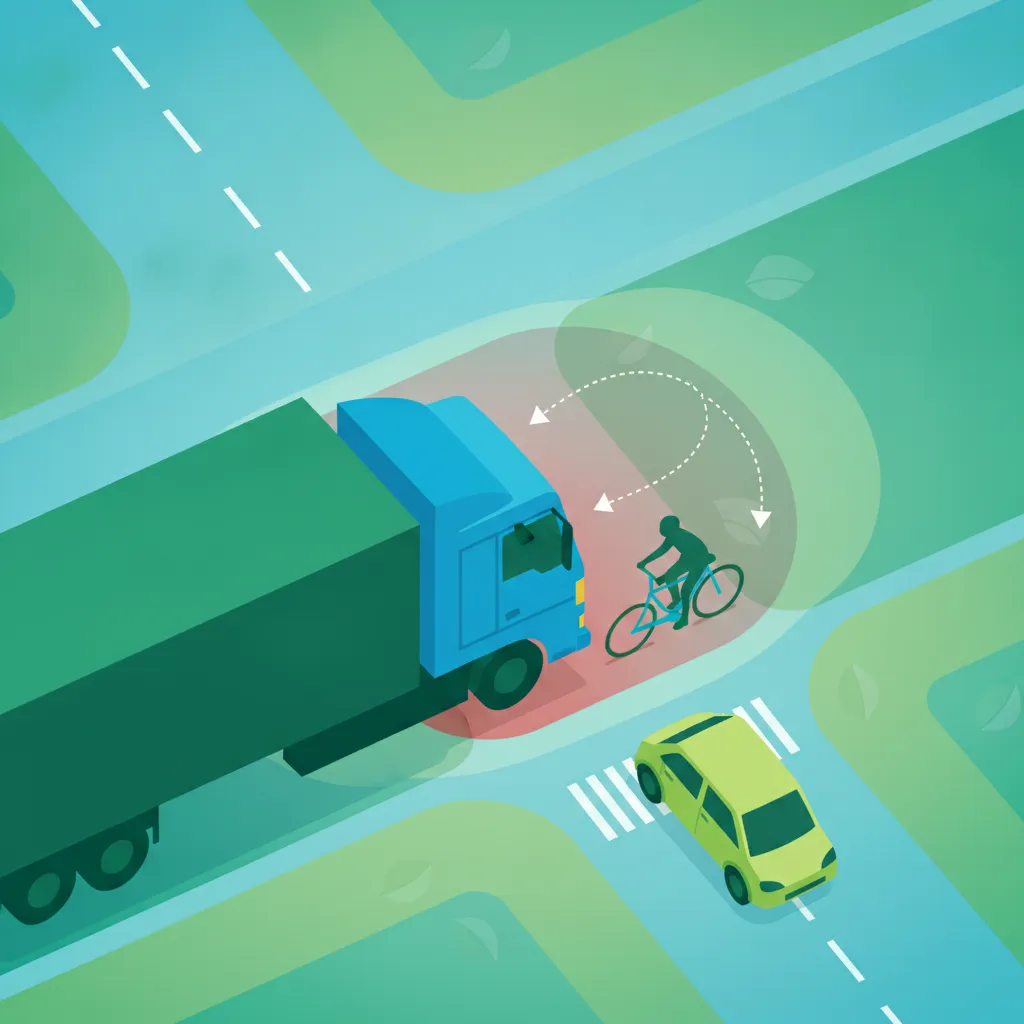
This lesson maps out the extensive blind spots, or 'no-zones,' that exist around a tractor-trailer combination, particularly to the sides and rear. It teaches the proper techniques for adjusting all mirrors to minimize these areas and explains how modern camera systems provide critical visibility. Understanding and compensating for these blind spots is a fundamental skill for preventing collisions, especially during lane changes and turns.

This lesson covers the core principles of defensive driving in an urban context. It teaches drivers how to anticipate the actions of other road users, maintain safe following distances in dense traffic, and navigate complex intersections with multiple signals. The content emphasizes heightened awareness of pedestrians, cyclists, and unexpected events common in Danish city environments.

This lesson provides an in-depth look at the blind spots of other vehicles and how to manage them. It teaches riders to recognize the large 'no-zones' around trucks and buses where they cannot be seen. Strategies include avoiding lingering in these areas and positioning the motorcycle for maximum visibility.

This lesson focuses on the practical skills needed to maneuver a large vehicle in confined environments such as urban delivery zones and loading docks. It teaches how to accurately judge the required space, understand the vehicle's turning radius, and use reference points to position the vehicle precisely. The content covers strategies for navigating tight corners and avoiding fixed obstacles, which is essential for damage-free urban operations.
This lesson addresses the specific skills required to navigate around public transport and heavy goods vehicles safely. You will learn the rules for bus lanes, recognize when buses have priority at stops, and understand the unique challenges posed by large vehicles, such as wider turning circles and larger blind spots. The material also provides clear protocols for overtaking these vehicles while maintaining adequate safety margins.
This lesson provides critical guidance for driving in environments with heavy cycle traffic, typical of Danish cities. It focuses on identifying and yielding to cyclists in dedicated bike lanes, especially when turning right across their path. The content emphasizes advanced observation skills to detect cyclists in blind spots and the importance of giving adequate space.

This lesson teaches the effective use of mirrors and on-board camera systems for comprehensive spatial awareness. It explains how to correctly adjust all mirrors to minimize blind spots and how to integrate camera views into a regular scanning routine. The content emphasizes the importance of combining mirror checks with direct observation to detect vulnerable road users hidden in blind zones.
This lesson emphasizes the professional driver's heightened responsibility to protect vulnerable road users. It revisits Danish regulations concerning cyclist priority, particularly during right turns, and details the correct procedures for maintaining safe overtaking distances. The content focuses on developing advanced situational awareness, using mirrors and cameras effectively, and anticipating the behavior of pedestrians and cyclists in urban environments.

This lesson explains the relationship between a bus's dimensions—length, width, and height—and its maneuverability. It covers key concepts such as turning radius, rear overhang, and swept path, which are critical for navigating turns and tight spaces safely. Learners will also understand how these physical characteristics create significant blind spots that require specific observation techniques to manage.
Find clear answers to common questions learners have about Safe Right-Turn Manoeuvres with Cyclists. Learn how the lesson is structured, which driving theory objectives it supports, and how it fits into the overall learning path of units and curriculum progression in Denmark. These explanations help you understand key concepts, lesson flow, and exam focused study goals.
Due to the size of the vehicle, heavy goods vehicles have significant blind spots and experience off-tracking, meaning the rear wheels follow a tighter path than the front. This can trap cyclists who are positioned to the right, leading to serious accidents.
Drivers must ensure that no cyclists are in the direct path or the adjacent cycle lane before starting a right turn. If a cycle lane exists, you must exercise extreme caution and yield to cyclists continuing straight.
You must conduct multiple checks in your front, side, and blind-spot mirrors. Specifically, look for cyclists approaching from behind or alongside your vehicle before and during the rotation of your steering wheel.
You must take a wider approach before starting the turn, ensuring your trailer does not cut the corner. Always monitor your side mirrors to ensure the rear of the vehicle is following the intended safe path.
Use our powerful search tool to pinpoint specific Danish driving theory topics, road signs, or traffic situations you need to review. Start exploring relevant practice sets now to reinforce your knowledge and build confidence for your upcoming driving licence exam.