
This lesson explains the system of low-emission zones (Umweltzonen) in German cities, which are designed to improve air quality. You will learn to identify these zones, understand the various emissions stickers required based on your vehicle, and follow the regulations necessary to enter these areas legally.
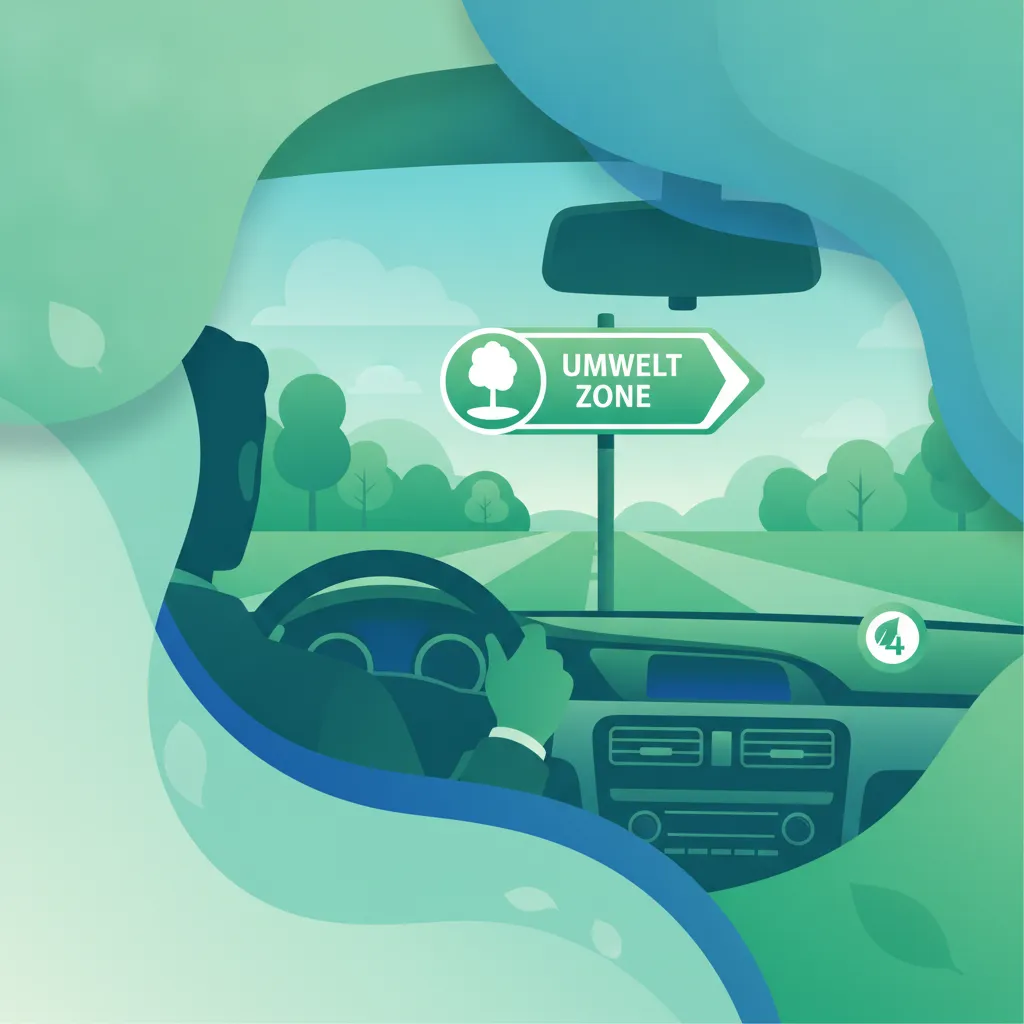
Lesson content overview
As a driver in Germany, it is crucial to understand the system of environmental zones, known locally as "Umweltzonen." These zones are a fundamental part of urban traffic management aimed at improving air quality and public health. Navigating these areas correctly requires knowledge of specific traffic signs, vehicle emission standards, and the proper use of emission stickers. This lesson provides a comprehensive overview of these regulations, ensuring you can drive legally and responsibly within German cities.
Environmental zones, or Umweltzonen, are specially designated urban areas where vehicle entry is restricted based on their pollutant emissions. The primary goal of establishing these zones is to reduce fine particulate matter (Feinstaub) and nitrogen oxide (NOx) concentrations in city air, which are harmful to human health and the environment. By limiting access to only cleaner vehicles, German cities aim to improve air quality, especially in densely populated areas.
The implementation of Umweltzonen is rooted in German environmental protection legislation, aligning with broader European Union directives on air quality. This framework allows local authorities to establish and enforce these zones, integrating legal, technical, and logistical components to achieve cleaner urban environments. For drivers, this means that your vehicle's emission performance directly impacts where you can drive. These zones influence route planning, parking choices, and overall driver behavior, contributing to a more sustainable approach to urban mobility.
The central element of the Umweltzone system is the Feinstaubplakette, or emission sticker. This small, colored, adhesive plaque is affixed to your vehicle's windshield and serves as visual proof of its emission class. It allows authorities and automated systems to quickly identify whether a vehicle meets the required environmental standards for entry into a specific zone. Without a valid and correctly displayed sticker, entry into an Umweltzone is prohibited, regardless of your vehicle's actual emission class.
There are three main types of emission stickers, each color-coded to represent different levels of a vehicle's emissions:
Green Sticker (Grüne Plakette): This is the most common and widely required sticker. It signifies that your vehicle meets higher emission standards. Generally, this sticker is issued to:
Yellow Sticker (Gelbe Plakette): This sticker is for vehicles with slightly lower emission standards than those qualifying for the green sticker. It typically covers:
Red Sticker (Rote Plakette): This sticker is for vehicles with the lowest emission standards in the system. It typically covers:
It's important to note that vehicles that do not meet even the red sticker standards (e.g., older, highly polluting vehicles) do not receive any sticker and are strictly prohibited from entering any Umweltzone.
Your vehicle's eligibility for a specific emission sticker is determined by its Euro emission standard. This is a European classification system that defines the permissible emission levels for new vehicles sold within the EU. The higher the Euro number (e.g., Euro 6 is cleaner than Euro 1), the lower the vehicle's emissions.
You can usually find your vehicle's Euro emission standard in its registration documents (Fahrzeugschein or Zulassungsbescheinigung Teil I). For example, a Euro 5 diesel car will almost certainly qualify for a green sticker, while a much older Euro 2 diesel car might only receive a yellow or no sticker. It is a common misconception that all cars automatically qualify for a green sticker; older vehicles, especially diesels, may not meet the necessary criteria.
A series of European Union standards that define the maximum acceptable limits for exhaust emissions of new light-duty vehicles (cars and vans) and heavy-duty vehicles (trucks and buses). Higher Euro numbers indicate stricter emission limits.
Recognizing the start and end of an Umweltzone is critical for compliance. These zones are clearly marked with specific traffic signs as outlined in the German Road Traffic Act (StVO).
Sign 350.01 marks the beginning of an Umweltzone. It is a rectangular sign with a red border, depicting a vehicle silhouette against a white background, often accompanied by smaller supplementary signs below it. These supplementary signs show the required emission sticker colors (e.g., a green circle) or a specific text indicating exemptions. Upon seeing this sign, you must ensure your vehicle has the required emission sticker (almost always green) visibly affixed to its windshield to be allowed to proceed.
Failing to display the correct sticker when entering an area marked by Sign 350.01 is a violation, even if your vehicle technically meets the emission standards. The sticker itself is the proof of compliance.
Sign 350.02 marks the end of an Umweltzone. This sign is identical to Sign 350.01 but features a diagonal black line running through it, indicating the termination of the restriction. Once you pass this sign, the emission-based entry restrictions no longer apply for the direction of travel. This sign is important for clearly demarcating the boundaries of the zone. Drivers without a green sticker who need to leave an Umweltzone must do so before reaching this sign if they have inadvertently entered the zone without permission.
Adhering to Umweltzone regulations is a mandatory aspect of driving in Germany. Non-compliance can lead to significant penalties.
The emission sticker must be permanently and visibly affixed to the inside of your vehicle's windshield. It should be placed in a way that does not obstruct your view of the road, typically on the lower passenger side or upper passenger side. The sticker is non-transferable; it is specific to the vehicle whose license plate number is printed on it. If you get a new vehicle, even if it has the same emission class, you will need to obtain a new sticker. A sticker that is dirty, damaged, or not properly affixed may be considered invalid by enforcement officers, leading to potential fines.
Entering an Umweltzone without a valid and properly displayed emission sticker, or with an incorrect sticker, constitutes an administrative offense. The penalty for such a violation is generally a fine.
Currently, the fine for non-compliance with Umweltzone regulations is typically around €100. In addition to the monetary fine, driving into an Umweltzone without the required sticker may also result in a point being added to your driving record in Flensburg.
While the rules are strict, certain vehicles may be exempt from the sticker requirement or eligible for special permits:
If you believe your vehicle qualifies for an exemption, always verify the specific local regulations of the Umweltzone you plan to enter. Do not assume automatic exemption.
Drivers often make mistakes regarding Umweltzonen due to a lack of awareness or misinterpretation of the rules:
The application of Umweltzone rules can sometimes be influenced by external factors:
The establishment and enforcement of Umweltzonen are integral to broader environmental and public health strategies. By restricting vehicles with higher particulate matter and nitrogen oxide emissions, these zones contribute significantly to:
Awareness of Umweltzonen regulations encourages drivers to consider their vehicle's environmental impact, promoting more responsible and sustainable driving choices.
Here are some practical examples to illustrate the rules:
The system of Umweltzonen in Germany is designed to protect public health and the environment by controlling vehicle emissions in urban areas.
German Umweltzonen restrict vehicle access based on emission standards to improve urban air quality. The system uses color-coded Feinstaubplaketten (emission stickers) - green for Euro 4 diesel/Euro 3 petrol vehicles, yellow for Euro 3 diesel/Euro 2 petrol, and red for Euro 2 diesel/Euro 1 petrol - with most zones now requiring only the green sticker. Entry is governed by Sign 350.01 (zone start) and Sign 350.02 (zone end), and drivers must display their sticker visibly on the windshield as the sole proof of compliance. Violations incur approximately €100 fines plus Flensburg points, while exemptions apply to electric vehicles, historic cars with H-Kennzeichen, and emergency services, though local rules should always be confirmed.
A short set of high-value points that capture the most important learning from this lesson.
Umweltzonen are designated urban areas where vehicle entry is restricted based on emission standards to reduce fine particulate matter and NOx pollution
The Feinstaubplakette (emission sticker) is mandatory for entry - it must be visibly affixed to the windshield as proof of compliance
Most German Umweltzonen now require a green sticker, issued to Euro 4 diesel or Euro 3 gasoline vehicles
Sign 350.01 marks the start of an environmental zone; Sign 350.02 marks its end
Non-compliance results in an automatic fine of approximately €100 plus a point in Flensburg
Explore all units and lessons included in this driving theory course.
Green sticker = Euro 4 diesel or Euro 3 petrol (required for most zones); Yellow = Euro 3 diesel or Euro 2 petrol (rarely accepted); Red = Euro 2 diesel or Euro 1 petrol (not permitted)
The sticker is non-transferable and linked to a specific license plate - a new vehicle requires a new sticker even if the emission class is the same
Stickers must be permanently affixed and clearly visible; a dirty, obscured, or damaged sticker may be considered invalid
Exemptions exist for electric vehicles (BEV), historic vehicles (H-Kennzeichen), and emergency vehicles, but local regulations should always be verified
Foreign emission stickers are not valid in German Umweltzonen - only the German Feinstaubplakette is accepted
Assuming all modern cars qualify for a green sticker - older diesel vehicles may not meet Euro 4 requirements
Entering an Umweltzone without affixing the sticker or with an improperly displayed sticker, even if the vehicle technically qualifies
Believing the environmental zone only applies at the immediate intersection rather than the defined urban area beyond it
Using a sticker from a previous vehicle or assuming stickers are transferable when changing cars
Driving a rental car into an Umweltzone without first confirming the appropriate sticker is displayed
Lesson content overview
A short set of high-value points that capture the most important learning from this lesson.
Umweltzonen are designated urban areas where vehicle entry is restricted based on emission standards to reduce fine particulate matter and NOx pollution
The Feinstaubplakette (emission sticker) is mandatory for entry - it must be visibly affixed to the windshield as proof of compliance
Most German Umweltzonen now require a green sticker, issued to Euro 4 diesel or Euro 3 gasoline vehicles
Sign 350.01 marks the start of an environmental zone; Sign 350.02 marks its end
Non-compliance results in an automatic fine of approximately €100 plus a point in Flensburg
Explore all units and lessons included in this driving theory course.
Green sticker = Euro 4 diesel or Euro 3 petrol (required for most zones); Yellow = Euro 3 diesel or Euro 2 petrol (rarely accepted); Red = Euro 2 diesel or Euro 1 petrol (not permitted)
The sticker is non-transferable and linked to a specific license plate - a new vehicle requires a new sticker even if the emission class is the same
Stickers must be permanently affixed and clearly visible; a dirty, obscured, or damaged sticker may be considered invalid
Exemptions exist for electric vehicles (BEV), historic vehicles (H-Kennzeichen), and emergency vehicles, but local regulations should always be verified
Foreign emission stickers are not valid in German Umweltzonen - only the German Feinstaubplakette is accepted
Assuming all modern cars qualify for a green sticker - older diesel vehicles may not meet Euro 4 requirements
Entering an Umweltzone without affixing the sticker or with an improperly displayed sticker, even if the vehicle technically qualifies
Believing the environmental zone only applies at the immediate intersection rather than the defined urban area beyond it
Using a sticker from a previous vehicle or assuming stickers are transferable when changing cars
Driving a rental car into an Umweltzone without first confirming the appropriate sticker is displayed
Explore search topics learners often look for when studying Environmental Zones and Low Emission Areas. These topics reflect common questions about road rules, driving situations, safety guidance, and lesson level theory preparation for learners in Germany.
Browse additional driving theory lessons that cover connected traffic rules, road signs, and common driving situations related to this topic. Improve your understanding of how different rules interact across everyday traffic scenarios.
Understand the purpose and rules of environmental zones ('Umweltzonen') in Germany. Learn about the different emissions stickers ('Feinstaubplakette') and vehicle entry requirements for cleaner urban air. Essential theory for driving in German cities.
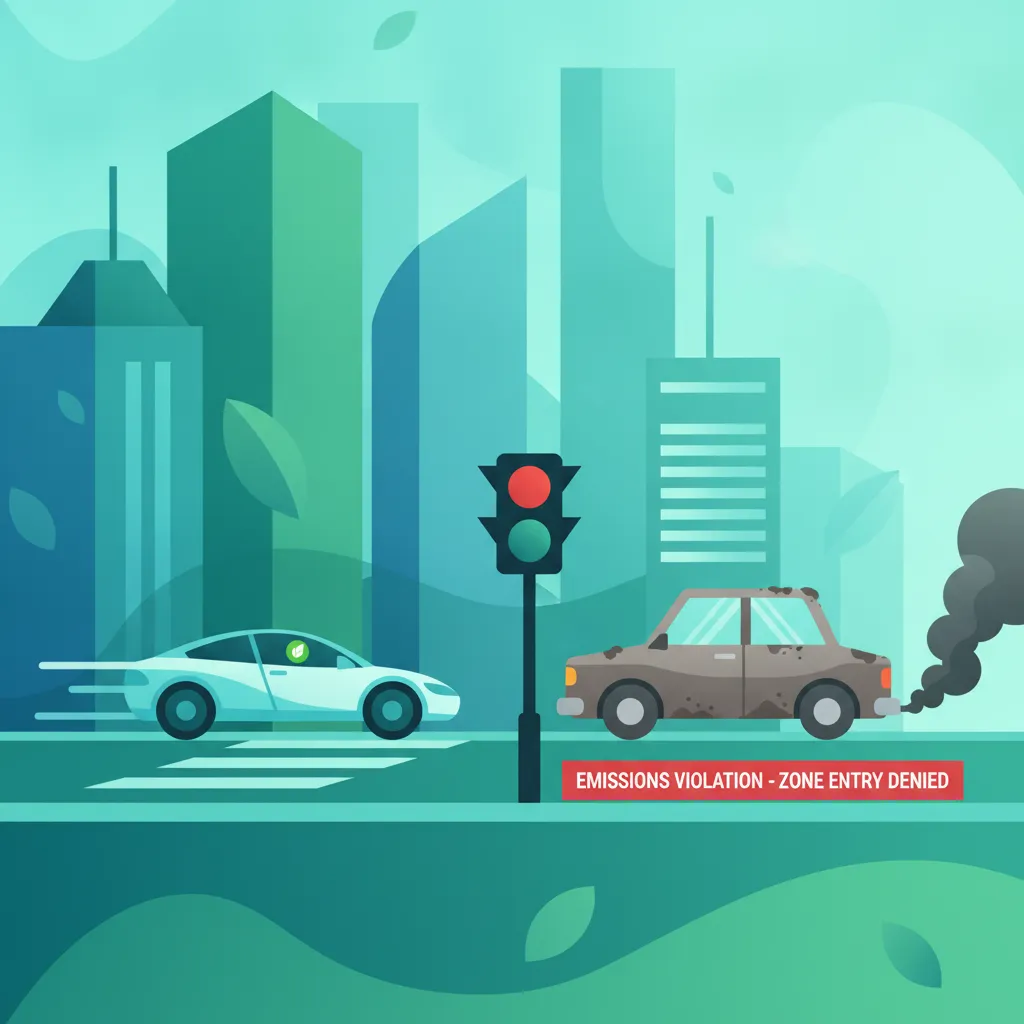
This lesson addresses the concept of environmental zones in German cities, explaining the requirements for emission stickers and the impact on heavy vehicles. It discusses the legal consequences of non-compliance, such as fines, and the importance of ensuring the vehicle meets emission standards. The content covers planning routes to avoid restricted zones if necessary.
This lesson focuses on the principles of 'eco-driving,' a driving style that minimizes fuel consumption and environmental impact. It teaches techniques such as gentle acceleration, anticipating traffic flow to avoid unnecessary braking, using higher gears at lower speeds, and utilizing engine braking. These methods not only save fuel and reduce emissions but also lead to a smoother and safer driving experience.

This lesson examines the ethical and environmental responsibilities of heavy vehicle drivers, including the impact of emissions, fuel consumption, and noise pollution. It explains the principles of sustainable logistics and making environmentally conscious decisions while operating heavy vehicles. The content also covers the broader implications of transportation on public health and resource usage.
This lesson clarifies the legal distinction between 'stopping' ('Halten') and 'parking' ('Parken') in Germany and explains the specific rules for each. You will learn to identify areas where stopping and parking are prohibited through signs and road markings. The lesson also covers the correct use of parking aids like the blue parking disc ('Parkscheibe') and paid parking systems.

This lesson provides a comprehensive guide to a vehicle's lighting systems, explaining the purpose and correct usage of each type of light. It covers dipped and main beam headlights, fog lights, and the legally required use of lights during the day or in poor visibility. You will also review the function of brake lights, indicators, and hazard warning lights for communication and safety.
This lesson examines the dynamics of delivery traffic within urban areas and industrial estates, focusing on right-of-way rules and loading zone usage. It discusses the importance of adhering to delivery windows and managing traffic flow to minimize congestion. The content also highlights the challenges of navigating narrow aisles and loading docks.

This lesson outlines the legal requirements for vehicle roadworthiness, including mandatory periodic inspections (TÜV) and the issuance of safety certificates. It explains the standards for emissions, safety devices, and the proper documentation of defects. The content underscores the importance of complying with inspection intervals and addressing repair obligations promptly.
This lesson outlines the driver's legal responsibility to ensure their vehicle is in a safe and roadworthy condition before every journey. It covers essential pre-drive checks, such as verifying lights, tyres, and fluid levels (oil, coolant, washer fluid). The lesson also explains the mandatory equipment that must be carried in the vehicle, including a warning triangle, high-visibility vest, and first-aid kit.
Explore German regulations for driving in urban areas, focusing on air quality measures like environmental zones. This lesson covers how vehicle emissions impact city driving and the specific rules to follow for compliance. Understand related traffic signs and legal obligations.
This lesson explores the complex and fast-paced nature of urban traffic environments. It covers topics such as high traffic density, frequent pedestrian crossings, and complex intersections that require heightened awareness. Learners will develop strategies for adapting their speed and lane positioning to navigate these challenges safely, especially during peak rush hour periods and in areas with traffic calming measures.
This lesson focuses on complex traffic environments where different types of road users share the same space. It provides guidance on situations like driving on streets with integrated tram tracks or where bus and bicycle lanes are part of the roadway. The content emphasizes understanding the specific priority rules and being extra vigilant to anticipate potential conflicts in these busy, shared zones.
This lesson examines the dynamics of delivery traffic within urban areas and industrial estates, focusing on right-of-way rules and loading zone usage. It discusses the importance of adhering to delivery windows and managing traffic flow to minimize congestion. The content also highlights the challenges of navigating narrow aisles and loading docks.
This lesson covers the regulations and safe techniques for overtaking other vehicles in urban environments. It emphasizes the importance of thorough observation, including mirror and blind spot checks, before committing to the maneuver. Learners will understand how to choose a safe gap, manage their speed differential, and maintain strict lane discipline throughout the overtaking process.
This lesson provides a thorough explanation of traffic light systems ('Lichtzeichenanlagen') used in Germany. It details the meaning of red, amber, and green lights and the correct response to each phase of the signal sequence. The lesson also covers special signals, such as the green arrow for turning right on red, pedestrian and cyclist signals, and the authority of signals given by a police officer, which override all other signs.
This lesson addresses the concept of environmental zones in German cities, explaining the requirements for emission stickers and the impact on heavy vehicles. It discusses the legal consequences of non-compliance, such as fines, and the importance of ensuring the vehicle meets emission standards. The content covers planning routes to avoid restricted zones if necessary.
This lesson provides a complete guide to driving on the German Autobahn. It covers the correct procedure for entering and exiting via acceleration and deceleration lanes, the strict lane discipline rule of keeping right ('Rechtsfahrgebot'), and the principle of overtaking only on the left. It also explains the recommended speed limit and the critical procedure for forming an emergency corridor ('Rettungsgasse') in a traffic jam.
This lesson examines the specific hazards associated with driving on rural roads. It covers how to handle narrow lanes, sharp bends, and poor road surfaces, as well as how to anticipate and safely interact with slow-moving agricultural vehicles or livestock. Strategies for speed adaptation due to limited visibility and the risks associated with overtaking in these conditions are thoroughly discussed.
This lesson introduces the concept of defensive driving ('vorausschauendes Fahren'), a proactive approach focused on anticipating and mitigating potential risks. It teaches techniques for scanning the road ahead, identifying potential hazards early, and managing the space around your vehicle to create a safety buffer. The goal is to develop a mindset that prioritizes safety and collision avoidance above all else.
This lesson provides an overview of the German system for penalizing traffic offenses. It explains the catalogue of fines ('Bußgeldkatalog'), the system of demerit points ('Punkte in Flensburg') for more serious violations, and the conditions under which a temporary driving ban ('Fahrverbot') or a full revocation of the license can be imposed. Understanding these consequences reinforces the importance of lawful driving.
Find clear answers to common questions learners have about Environmental Zones and Low Emission Areas. Learn how the lesson is structured, which driving theory objectives it supports, and how it fits into the overall learning path of units and curriculum progression in Germany. These explanations help you understand key concepts, lesson flow, and exam focused study goals.
In most cases, yes, vehicles must display a valid sticker. Some vehicles, such as motorcycles, emergency vehicles, and those with specific disabled permits, are exempt from the sticker requirement even if they are within the restricted area.
Driving into an Umweltzone without the required emissions sticker is a traffic violation. You may be issued a fine and, depending on the specific enforcement, you could receive penalty points in the central traffic register.
The sticker color represents the vehicle's pollution class, which is often tied to its age and engine type. The green sticker, which is required for most zones, indicates the lowest level of fine particulate emissions.
Yes, environmental zones are marked with a round traffic sign showing a red circle, the word Umwelt, and a sticker symbol. A supplementary sign below usually indicates which sticker colors are permitted to enter.
Begin your targeted revision now. Use our practice search to quickly find specific German driving theory questions. Filter by StVO rules, road signs, or hazard perception to create your focused study plan. Master challenging areas and prepare confidently for your theoretical driving test.