
The W-5 road sign, featuring a tank tread icon, is a critical indicator for the maximum weight limit (MLC) on bridges for tracked vehicles, like tanks or APCs. This sign is rarely seen as it applies to specific military scenarios where two such heavy vehicles might need to cross simultaneously. Drivers should pay close attention to its meaning, especially during military movements, and observe any marshals managing crossings. Understanding this sign is important for recognizing the strict weight regulations imposed on certain infrastructure.
This crucial W-5 sign specifies the maximum military load classification (MLC) for tracked vehicles crossing a bridge, ensuring safe passage and preventing structural damage. Proper interpretation is vital for military convoy planning and is a key area for theory test revision on road signs.
The W-5 sign features a tank tread icon and a black number. It is rarely seen because few bridges are strong enough and wide enough for two modern battle tanks to pass each other simultaneously. It indicates the maximum MLC for each tracked vehicle. This sign is essential for high-intensity military movements where rapid deployment of armor is required.
Shows the MLC limit for two-way movement of tracked (tank) military vehicles.
Get clear, practical answers to the most common questions about the W-5 - Bridge Class - Two-Way Tracked Vehicles road sign. Learn how the sign works, what rules it represents, and how it affects real driving situations. This FAQ strengthens your understanding and supports accurate decision making for the Polish driving theory exam in Poland.
The W-5 sign indicates the Bridge Class for two-way movement of tracked military vehicles. It specifies the maximum weight a bridge can safely support for such vehicles, particularly when two might cross at once. The black number on the sign represents the maximum MLC (Military Load Classification) permitted.
This sign is specifically for operators of tracked vehicles such as tanks, Armoured Personnel Carriers (APCs), or self-propelled artillery. Wheeled vehicles are often explicitly prohibited from crossing bridges marked with this sign.
You must not cross if the combined weight of two tracked vehicles exceeds the bridge's safety margin. Avoid jerky steering movements, as they can put undue lateral stress on the bridge. Always respect any 'No Entry' for wheeled vehicles if indicated.
Maintain a steady, slow pace to minimise rhythmic loading on the bridge. Ensure your vehicle is centered on the bridge to distribute the heavy load evenly. If a military marshal is present, follow their signals for managing the crossing.
No, the W-5 sign is rarely encountered by civilian drivers. It is designed for specific military logistical planning where bridges must accommodate the simultaneous passage of heavy tracked vehicles. Most civilian bridges are not designed to handle such loads or configurations.
Yes, the theory exam may test your understanding of specific signs related to vehicle weight limits, especially if they pertain to military operations or unique infrastructure restrictions. Questions might focus on what the sign represents (MLC for tracked vehicles) and the necessary precautions.
A clear reference image of the W-5 - Bridge Class - Two-Way Tracked Vehicles road sign used in Poland.
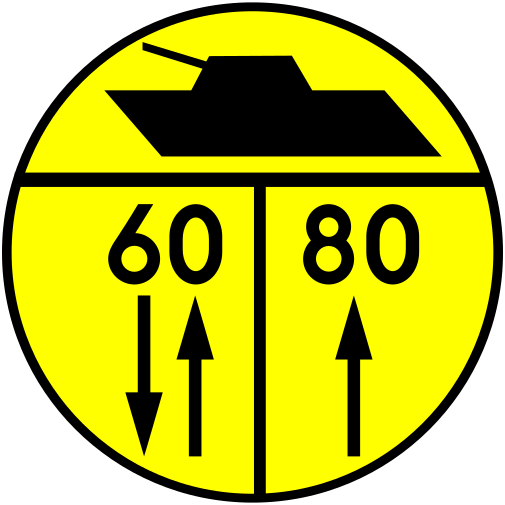
The W-5 - Bridge Class - Two-Way Tracked Vehicles road sign may also be known by these alternative names or terms.
The W-5 - Bridge Class - Two-Way Tracked Vehicles road sign is part of the Additional Railway Crossing Signs (G) category, which groups together signs with similar rules and functions.
Mastering Polish road signs involves understanding their distinctions. Comparing similar signs like the 'Bridge Class - Two-Way Tracked Vehicles' with others helps solidify your memory for theory test revision and accurate sign recognition.

Prepare for tram signals ahead with the AT-1 warning sign.

Understand the AT-2 Tram-Activated Signal: Know when trams are coming!
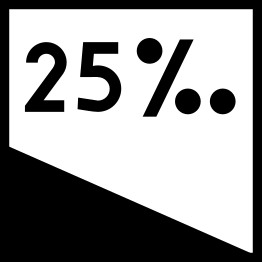
Understand the AT-3 Dangerous Tram Descent warning sign for trams.
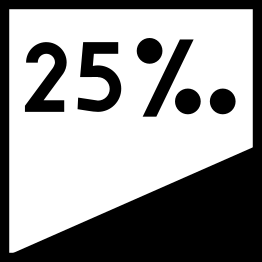
Warning: Steep Tram Ascent Ahead (AT-4)

Understand the AT-5 sign: Tram Collision Movement Warning for Turning Trams
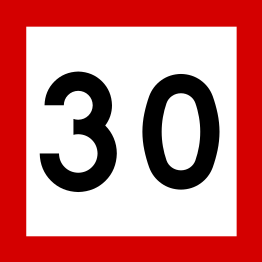
What the BT-1 Tram Speed Limit sign means and how to obey it.

BT-2: Tram Speed Limit Restriction Ends Here

BT-3 Tram Switch Lock: Don't Enter Until Clear!
Deepen your understanding of specific road signs by reviewing official Polish traffic rules and associated real-world driving scenarios. These expert-led resources help you bridge the gap between visual recognition and practical exam application.
Learn the critical distinctions between the Polish A-16 warning sign and the D-6 pedestrian crossing sign. This guide explains your legal responsibilities when approaching these areas, including the mandatory speed reduction and yielding requirements. Understand the significant penalties, such as hefty fines and accumulating penalty points, especially the 'recydywa' (repeat offender) system in Poland, which can lead to immediate license suspension.
Master Polish Crossing Markings for a Safer Drive and Exam Success.
Learning how to interact with law enforcement is a crucial part of your driver training in Poland, as it helps you understand the legal procedures governing roadside controls. This guide clarifies how officers identify themselves, what behaviors are expected of you as a driver, and how traffic enforcement impacts your penalty points and record. Mastery of these rules ensures you remain compliant with the law and prepared for any roadside situation you may encounter.
Master Polish Railway Crossing Rules to Drive Safely and Pass Your Exam!
The F-4 sign is placed at bridges or culverts to inform drivers of the name of the river, stream, or canal they are currently traversing. It is a blue sign with white text. Beyond simple geographical interest, it helps drivers cross-reference their location with maps and provides a landmark for emergency services in case of accidents occurring on or near a bridge.
The D-6 sign identifies the exact location of a pedestrian crossing, commonly known as a 'zebra' crossing. It consists of a blue square with a white triangle and a black silhouette of a person walking. Drivers approaching this sign are legally required to reduce their speed and observe the sidewalk carefully. If a pedestrian is on the crossing or clearly about to enter it, the driver must stop to allow them to cross safely. In Poland, the regulations emphasize that the driver's duty to yield begins as soon as the pedestrian is 'entering' the crossing.
After reviewing the full list of Polish road signs, explore specific sign categories for in-depth understanding. Challenge your knowledge with practice questions focused on sign recognition and interpretation to solidify your preparation for the driving theory exam.
Browse All Polish Road Signs