
The G-1b road sign, featuring two red diagonal stripes, is a crucial indicator on the right side of the road that you are approaching a railway crossing. Placed at the two-thirds mark between the initial warning sign and the crossing itself, it signifies you are now at the halfway point of the countdown. This sign demands increased vigilance, prompting you to reduce your speed and prepare for potential stops or immediate hazards as you draw nearer to the tracks.
This G-1b sign signifies the middle distance to a railway crossing, serving as a vital intermediate warning for drivers. Recognizing this sign in your theory test revision is key for safe navigation and understanding Polish traffic rules.
The G-1b marker post features two diagonal red stripes and is placed on the right side of the road. It is located exactly halfway between the three-stripe marker (G-1a) and the one-stripe marker (G-1c). This sign provides a critical intermediate update on the vehicle's proximity to the tracks, ensuring the driver remains focused on the hazardous crossing ahead and continues to adjust their speed downward.
Indicates the middle distance to the railway crossing, positioned between the first and last markers.
Get clear, practical answers to the most common questions about the G-1b - Two-Stripe Marker Post (Right Side) road sign. Learn how the sign works, what rules it represents, and how it affects real driving situations. This FAQ strengthens your understanding and supports accurate decision making for the Polish driving theory exam in Poland.
The G-1b sign is a railway approach marker post with two red diagonal stripes. It's placed on the right side of the road exactly halfway between the three-stripe marker (G-1a) and the one-stripe marker (G-1c), signalling that you are nearing a railway crossing.
When you see the G-1b sign, it means you are getting very close to the railway crossing. You must continue to reduce your speed, stay alert, and be prepared to stop if you see flashing red lights, moving barriers, or a train approaching. Do not try to rush across the tracks.
Yes, avoid accelerating or attempting to 'beat' a train; the crossing is very close. It’s also crucial not to drift towards the centre of the road; maintain your lane strictly. Using cruise control is not advisable here, as you need full manual control to safely manage your speed.
With the G-1b sign, it's vital to double-check both directions for any sign of an approaching train. Ensure your windows are clear of obstructions like fog so you have a perfect line of sight to the crossing signals and the tracks.
The G-1b sign is part of a series of countdown marker posts (G-1a, G-1b, G-1c) that progressively warn you of an upcoming railway crossing. The G-1a has three stripes, the G-1b has two, and the G-1c has one, each indicating you are closer to the hazard.
A clear reference image of the G-1b - Two-Stripe Marker Post (Right Side) road sign used in Poland.

The G-1b - Two-Stripe Marker Post (Right Side) road sign may also be known by these alternative names or terms.
The G-1b - Two-Stripe Marker Post (Right Side) road sign is part of the Additional Railway Crossing Signs (G) category, which groups together signs with similar rules and functions.
Reviewing similar road signs side-by-side is crucial for accurate recognition and fewer errors on your theory test. Compare traffic sign variations to solidify your understanding and improve sign recognition for the Polish licence process.

Prepare for tram signals ahead with the AT-1 warning sign.

Understand the AT-2 Tram-Activated Signal: Know when trams are coming!
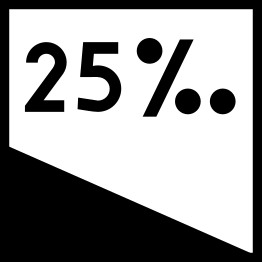
Understand the AT-3 Dangerous Tram Descent warning sign for trams.
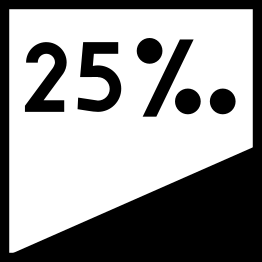
Warning: Steep Tram Ascent Ahead (AT-4)

Understand the AT-5 sign: Tram Collision Movement Warning for Turning Trams
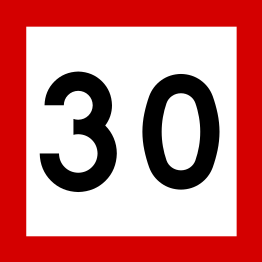
What the BT-1 Tram Speed Limit sign means and how to obey it.

BT-2: Tram Speed Limit Restriction Ends Here

BT-3 Tram Switch Lock: Don't Enter Until Clear!
Deepen your understanding of specific road signs by reviewing official Polish traffic rules and associated real-world driving scenarios. These expert-led resources help you bridge the gap between visual recognition and practical exam application.
Learners often struggle to differentiate between binding regulatory signs and mere safety advice, which can lead to confusion during the official theory exam. This guide clarifies the specific role of Polish B-33 prohibitive signs versus international speed recommendations, helping you distinguish between legal mandates and situational safety advice. You will learn to identify key sign types, understand their legal weight, and recognize why adjusting your speed to road conditions remains a fundamental requirement of the Polish driving system.
Learn the critical distinctions between the Polish A-16 warning sign and the D-6 pedestrian crossing sign. This guide explains your legal responsibilities when approaching these areas, including the mandatory speed reduction and yielding requirements. Understand the significant penalties, such as hefty fines and accumulating penalty points, especially the 'recydywa' (repeat offender) system in Poland, which can lead to immediate license suspension.
Know Your Obligations: What to Do After a Road Incident in Poland.
Don't Be a Road Block: Master Minimum Speeds and Smooth Traffic Flow for Your Polish Exam!
This sign is found at T-junctions or intersections where the road directly ahead is closed to traffic, or where driving straight would lead into a restricted area like a tram-only lane or a pedestrian square. It forces the driver to choose between two diverging paths, ensuring that no one accidentally continues into a prohibited forward zone.
The T-32 plate is used with the D-37 sign. It shows a distance (e.g., '5 m'). If traffic comes to a stop inside the tunnel, you MUST leave this amount of space between your bumper and the car ahead. This is for fire safety: it provides enough room for emergency vehicles to maneuver and prevents a 'chain reaction' of fire if one car catches alight.
After reviewing the full list of Polish road signs, explore specific sign categories for in-depth understanding. Challenge your knowledge with practice questions focused on sign recognition and interpretation to solidify your preparation for the driving theory exam.
Browse All Polish Road Signs