
The AT-5 road sign is a critical warning specifically for tram drivers at complex intersections. It means that even if the tram has a green signal to turn, it must yield to any traffic (vehicles or pedestrians) proceeding straight ahead from the opposite direction. This sign is essential for preventing dangerous 't-bone' collisions. In Poland, as with similar traffic systems, tram drivers must exercise extreme caution and ensure the path is clear before completing a turn across oncoming traffic.
Master the AT-5 sign, crucial for Polish theory test revision, by understanding its warning for turning trams to yield to straight-moving traffic. This road sign explanation details how to interpret complex intersections and ensures safe decision-making during your driving licence process.
The AT-5 sign is a vital safety marker for tram drivers at complex intersections. It informs the driver that although they have a 'Go' signal to turn (left or right), the opposing traffic (cars, pedestrians, or other trams) also has a green light to go straight. Under traffic laws, the turning vehicle must yield. This sign prevents the tram driver from assuming they have exclusive priority just because they have a green signal.
Warns that when turning, the tram driver must yield to traffic going straight on the same signal phase.
Get clear, practical answers to the most common questions about the AT-5 - Tram Collision Movement Warning road sign. Learn how the sign works, what rules it represents, and how it affects real driving situations. This FAQ strengthens your understanding and supports accurate decision making for the Polish driving theory exam in Poland.
The AT-5 sign indicates that when a tram is turning, it must yield to all traffic moving straight ahead from the opposite direction, even if the tram has a green signal. The tram driver must not assume they have priority.
The primary purpose of the AT-5 sign is to prevent collisions, specifically 't-bone' or 'broadside' impacts, at intersections where trams are turning across the path of oncoming traffic that also has a green light.
When approaching an intersection with the AT-5 sign, a tram driver must slow down, be extra vigilant, and yield to any vehicles or pedestrians moving straight ahead from the opposite direction. They should only proceed with the turn once the path is clear and safe.
A common trap in the theory exam is assuming that a green signal always grants priority for turning. The AT-5 sign highlights a specific situation where a turning tram must yield to straight-moving traffic. Learners should remember that size doesn't grant automatic priority; yielding is key.
While the AT-5 sign is specifically aimed at tram drivers, the principle of yielding to straight-moving traffic when turning is a general rule for all vehicles in Poland. Car drivers should always be aware of trams and ensure they are not turning across the path of oncoming vehicles.
A clear reference image of the AT-5 - Tram Collision Movement Warning road sign used in Poland.

The AT-5 - Tram Collision Movement Warning road sign may also be known by these alternative names or terms.
The AT-5 - Tram Collision Movement Warning road sign is part of the Additional Railway Crossing Signs (G) category, which groups together signs with similar rules and functions.
Mastering Polish traffic signs involves understanding their nuances. Comparing this tram warning sign with similar ones sharpens your sign recognition and aids theory test revision for fewer errors.

Prepare for tram signals ahead with the AT-1 warning sign.

Understand the AT-2 Tram-Activated Signal: Know when trams are coming!
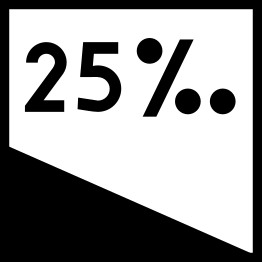
Understand the AT-3 Dangerous Tram Descent warning sign for trams.
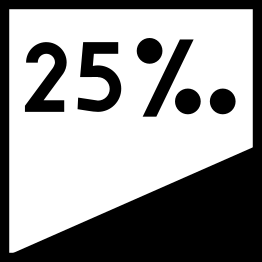
Warning: Steep Tram Ascent Ahead (AT-4)
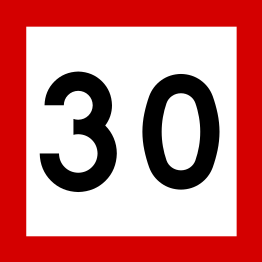
What the BT-1 Tram Speed Limit sign means and how to obey it.

BT-2: Tram Speed Limit Restriction Ends Here

BT-3 Tram Switch Lock: Don't Enter Until Clear!
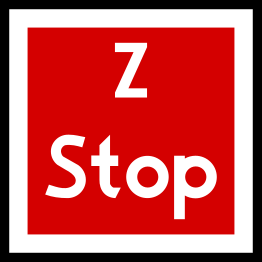
Stop and manually check the tram switch with the BT-4 sign.
Deepen your understanding of specific road signs by reviewing official Polish traffic rules and associated real-world driving scenarios. These expert-led resources help you bridge the gap between visual recognition and practical exam application.
Engine overheating is a serious technical failure that every driver must be able to identify and manage to prevent severe vehicle damage. This guide covers the essential role of the cooling system, explains how to monitor coolant levels, and details the correct safety measures to take when a temperature warning light appears on your dashboard. You will gain the theoretical knowledge necessary to pass the specialist section of your driving theory exam while learning how to keep your vehicle operating safely on Polish roads.
Discover the new Polish regulations that permit 17-year-olds to start their driving journey with a Category B license. This guide clarifies the essential conditions for supervised driving, focusing on the qualifications of the accompanying driver and the specific restrictions young drivers must adhere to. Gaining this knowledge is crucial for passing the Polish theory exam and ensuring safe, legal driving practices from day one.
Decipher Priority at Busy Polish City Intersections.
Master the Art of Reading the Road: Anticipate Driver Behavior and Stay Safe.
The T-6d plate is found on side roads. It indicates that the priority road is perpendicular to you and that there may be other subordinate roads at the same intersection that are offset or staggered. This gives the driver a full situational map. Since you are on a thin line, you yield to everyone on the thick line. You also need to coordinate with other drivers on thin lines using standard priority rules (like yielding to the right).
The T-11 plate is used with A-30 (Other danger) to alert drivers that the road ends at water where a ferry service operates. This is critical for preventing drivers from accidentally driving into a river or lake, especially at night or in fog. It also prompts the driver to prepare for boarding procedures, such as stopping at a ticket booth or queuing in a specific lane.
After reviewing the full list of Polish road signs, explore specific sign categories for in-depth understanding. Challenge your knowledge with practice questions focused on sign recognition and interpretation to solidify your preparation for the driving theory exam.
Browse All Polish Road Signs