
The G-1c sign, also known as a one-stripe marker post, is your final visual cue before reaching a railway crossing. Placed on the right side of the road, its single red stripe indicates you are now very close to the tracks, typically 50-80 meters away. As part of Poland's system of railway approach warnings, this sign demands immediate reduction of speed and a high state of readiness to stop, ensuring you can react safely to barriers, lights, or approaching trains.
This final marker post (G-1c) signifies you are moments from railway tracks, demanding immediate attention and readiness to stop. Proper recognition is crucial for safe navigation and passing the theory test revision for Polish road signs.
The G-1c is the final marker post before the railway tracks, featuring a single diagonal red stripe. It is placed on the right side of the road at approximately 1/3 of the distance from the initial warning sign to the crossing. Passing this sign means you are usually within 50 to 80 meters of the tracks. At this stage, the driver should be at a slow, safe speed, ready to come to an absolute halt if required by lights, barriers, or a Stop sign.
Indicates the closest distance to the railway crossing, signaling that the tracks are immediately ahead.
Get clear, practical answers to the most common questions about the G-1c - One-Stripe Marker Post (Right Side) road sign. Learn how the sign works, what rules it represents, and how it affects real driving situations. This FAQ strengthens your understanding and supports accurate decision making for the Polish driving theory exam in Poland.
The G-1c road sign is a marker post with a single red stripe, indicating the final approach to a railway crossing. Seeing this sign means you are very close to the tracks, usually between 50 and 80 meters away, and must be prepared to stop.
Upon seeing the G-1c sign, you should immediately reduce your speed to a slow, safe pace. Be alert for any traffic signals like flashing red lights or lowering barriers, and be ready to stop completely before the railway crossing. Ensure you have a clear view of the tracks and any approaching trains.
The G-1c is the last marker before the actual crossing, featuring a single stripe. It follows other signs (like G-1a with three stripes, G-1b with two stripes) which indicate progressively closer distances to the railway. The G-1c signifies that the tracks are immediately ahead.
A common trap is not understanding that the G-1c sign means imminent proximity to the tracks. Learners might not slow down sufficiently or fail to be fully prepared to stop. Always remember that by the time you see the single stripe, you must be ready to halt if necessary, and never attempt to cross if there isn't enough space on the other side.
No, it is strictly prohibited to shift gears while driving over railway tracks. If you are in a manual vehicle, choose your gear before crossing. This is a crucial safety rule to prevent stalling on the tracks, which could have catastrophic consequences.
A clear reference image of the G-1c - One-Stripe Marker Post (Right Side) road sign used in Poland.

The G-1c - One-Stripe Marker Post (Right Side) road sign may also be known by these alternative names or terms.
The G-1c - One-Stripe Marker Post (Right Side) road sign is part of the Additional Railway Crossing Signs (G) category, which groups together signs with similar rules and functions.
Reviewing related road signs like the G-1c marker helps solidify understanding and prevents confusion. Comparing similar traffic signs aids in accurate recognition for your theory test revision.

Prepare for tram signals ahead with the AT-1 warning sign.

Understand the AT-2 Tram-Activated Signal: Know when trams are coming!
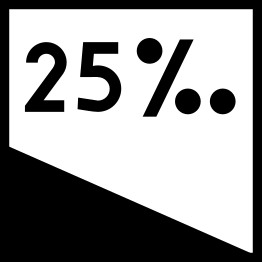
Understand the AT-3 Dangerous Tram Descent warning sign for trams.
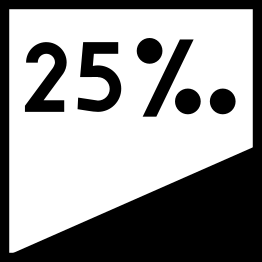
Warning: Steep Tram Ascent Ahead (AT-4)

Understand the AT-5 sign: Tram Collision Movement Warning for Turning Trams
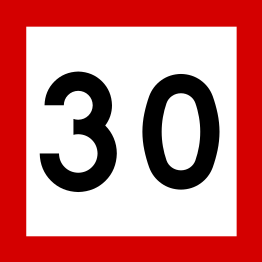
What the BT-1 Tram Speed Limit sign means and how to obey it.

BT-2: Tram Speed Limit Restriction Ends Here

BT-3 Tram Switch Lock: Don't Enter Until Clear!
Deepen your understanding of specific road signs by reviewing official Polish traffic rules and associated real-world driving scenarios. These expert-led resources help you bridge the gap between visual recognition and practical exam application.
Navigate Tram Intersections Like a Pro: Essential for Your Polish Driving Exam.
Learn why driving in Poland with a foreign license is illegal if your Polish driving privileges have been revoked. This article explains the fundamental principle that driving entitlements are personal and singular under Polish law, as reinforced by court rulings, helping you understand the strict requirements for legal driving.
Master Polish Crossing Markings for a Safer Drive and Exam Success.
Navigating Polish intersections requires a deep understanding of how trams, known locally as 'tramwaje', are prioritized. This guide breaks down the specific rules governing tram priority, particularly in equal priority ('skrzyżowania równorzędne') situations, ensuring you know exactly when to yield. Mastering these nuances is essential for safe urban driving and achieving a high score on your driving theory test.
The G-1a marker post is a white rectangular sign with three diagonal red stripes sloping down toward the roadway. It is placed on the right side of the road, usually at the same location as the A-9 (with barriers) or A-10 (without barriers) warning signs. This marker serves as the first step in a visual countdown, notifying the driver that the railway tracks are approximately 150 to 240 meters ahead on high-speed roads, or 50 to 100 meters on lower-speed roads.
The P-8a arrow is painted on the lane surface to regulate movement at an intersection. If you are in a lane with this arrow, you are legally forbidden from turning left or right. It is used to streamline traffic and prevent collisions that occur when drivers try to turn from a middle lane. Often, these arrows are combined (e.g., straight and right), meaning both directions are allowed from that specific lane.
After reviewing the full list of Polish road signs, explore specific sign categories for in-depth understanding. Challenge your knowledge with practice questions focused on sign recognition and interpretation to solidify your preparation for the driving theory exam.
Browse All Polish Road Signs