
The BT-2 sign signifies the termination of a previously imposed speed restriction specifically for trams. After passing this sign, trams are permitted to resume their normal operating speed as determined by their route or transit authority regulations. This 'cancel tram limit' sign, often depicted as a gray circle with crossing lines, is crucial for ensuring trams can navigate their lines safely and efficiently without undue speed constraints.
The BT-2 sign, 'End of Tram Speed Limit', signals where trams can resume their standard speeds in Polish traffic rules, cancelling prior restrictions. Correct sign interpretation is vital for driving theory test revision and maintaining awareness around railway crossings, ensuring safe interactions with public transport.
The BT-2 sign marks the end of the restricted-speed section for the tram. From this point on, the tram may resume the standard speed permitted for that line or specified by the transit authority's internal regulations. It is represented by a gray circle with diagonal black lines crossing out the previous speed limit concept.
Cancels the speed restriction previously set by the BT-1 sign.
Get clear, practical answers to the most common questions about the BT-2 - End of Tram Speed Limit road sign. Learn how the sign works, what rules it represents, and how it affects real driving situations. This FAQ strengthens your understanding and supports accurate decision making for the Polish driving theory exam in Poland.
The BT-2 road sign, also known as 'End of Tram Speed Limit', indicates that any speed restriction previously applied to trams has now ended. Trams can now travel at their normal, permitted speed for that particular route.
As a car driver, you don't directly interact with this sign; it is for trams. However, be aware that a tram you are following may now accelerate. Continue to drive safely and predictably, and never ignore other signals or hazards, even if the tram's speed limit has been lifted.
Yes, while the specific restriction indicated by a BT-1 sign is cancelled, trams are still expected to adhere to general speed limits for their operational area and the specific rules set by their transit authority. The BT-2 sign simply removes a previous, specific restriction.
A common trap is confusing this sign with general speed limit signs that apply to all vehicles. The BT-2 specifically applies only to trams, cancelling a tram-specific speed limit. Learners might incorrectly assume it means the general speed limit is now lifted for everyone.
The BT-1 sign imposes a speed limit on trams in a specific section. The BT-2 sign acts as a direct cancellation for that restriction, signaling the end of that special speed zone for trams. It allows trams to return to their standard operational speeds.
A clear reference image of the BT-2 - End of Tram Speed Limit road sign used in Poland.

The BT-2 - End of Tram Speed Limit road sign may also be known by these alternative names or terms.
The BT-2 - End of Tram Speed Limit road sign is part of the Additional Railway Crossing Signs (G) category, which groups together signs with similar rules and functions.
Reviewing similar road signs side-by-side aids in distinguishing subtle differences and improves memory recall for your theory test revision. Practise your traffic sign comparison skills to build confidence and reduce mistakes on exam day.

Prepare for tram signals ahead with the AT-1 warning sign.

Understand the AT-2 Tram-Activated Signal: Know when trams are coming!
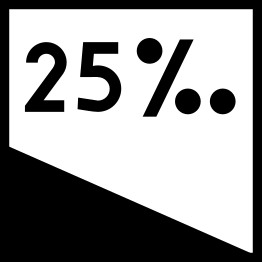
Understand the AT-3 Dangerous Tram Descent warning sign for trams.
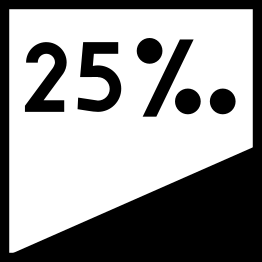
Warning: Steep Tram Ascent Ahead (AT-4)

Understand the AT-5 sign: Tram Collision Movement Warning for Turning Trams
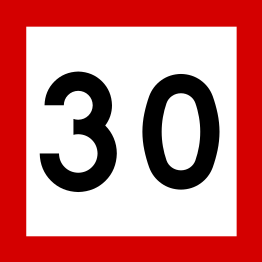
What the BT-1 Tram Speed Limit sign means and how to obey it.

BT-3 Tram Switch Lock: Don't Enter Until Clear!
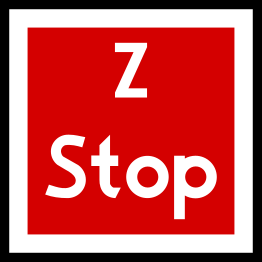
Stop and manually check the tram switch with the BT-4 sign.
Deepen your understanding of specific road signs by reviewing official Polish traffic rules and associated real-world driving scenarios. These expert-led resources help you bridge the gap between visual recognition and practical exam application.
Navigate Poland's roads with confidence by understanding the yellow square road sign featuring a black circle. This essential guide explains its function as an emergency detour indicator for highways and main routes, helping you avoid common mistakes and pass your theory exam. Learn how to follow the indicated path correctly and ensure safe transit during road disruptions.
Learn the critical distinctions between the Polish A-16 warning sign and the D-6 pedestrian crossing sign. This guide explains your legal responsibilities when approaching these areas, including the mandatory speed reduction and yielding requirements. Understand the significant penalties, such as hefty fines and accumulating penalty points, especially the 'recydywa' (repeat offender) system in Poland, which can lead to immediate license suspension.
Master Polish Crossing Markings for a Safer Drive and Exam Success.
Master the Rules: Avoid Fines and Accidents Caused by Improper Loading.
The D-2 sign officially cancels the priority status previously granted by the D-1 sign. It appears as the standard yellow diamond but is crossed out with a thick black diagonal line. This sign is usually placed before an intersection with another priority road, an equal-priority intersection (where the 'right-hand rule' applies), or a roundabout. It serves as a critical warning for drivers to transition from 'priority' mindset to 'yielding' mindset.
The D-6 sign identifies the exact location of a pedestrian crossing, commonly known as a 'zebra' crossing. It consists of a blue square with a white triangle and a black silhouette of a person walking. Drivers approaching this sign are legally required to reduce their speed and observe the sidewalk carefully. If a pedestrian is on the crossing or clearly about to enter it, the driver must stop to allow them to cross safely. In Poland, the regulations emphasize that the driver's duty to yield begins as soon as the pedestrian is 'entering' the crossing.
After reviewing the full list of Polish road signs, explore specific sign categories for in-depth understanding. Challenge your knowledge with practice questions focused on sign recognition and interpretation to solidify your preparation for the driving theory exam.
Browse All Polish Road Signs