
The G-1a marker post, featuring three red diagonal stripes, is a crucial warning sign placed on the right side of the road, typically near railway crossings. It serves as part of a visual countdown, indicating the distance to the tracks – approximately 150-240 meters on high-speed roads or 50-100 meters on lower-speed roads. When you see this sign, it signals that you must begin slowing down and actively preparing to stop for an approaching train.
This explanation details the G-1a marker post, a vital visual cue indicating proximity to railway tracks. Grasping its meaning is essential for safe driving and successful theory test revision, especially when combined with other railway warning signs.
The G-1a marker post is a white rectangular sign with three diagonal red stripes sloping down toward the roadway. It is placed on the right side of the road, usually at the same location as the A-9 (with barriers) or A-10 (without barriers) warning signs. This marker serves as the first step in a visual countdown, notifying the driver that the railway tracks are approximately 150 to 240 meters ahead on high-speed roads, or 50 to 100 meters on lower-speed roads.
Indicates the furthest distance from a railway crossing, typically placed directly under the warning sign.
Get clear, practical answers to the most common questions about the G-1a - Three-Stripe Marker Post (Right Side) road sign. Learn how the sign works, what rules it represents, and how it affects real driving situations. This FAQ strengthens your understanding and supports accurate decision making for the Polish driving theory exam in Poland.
The G-1a sign, also known as the Three-Stripe Marker Post, is a distance marker for railway crossings. Its primary purpose is to warn drivers that they are approaching a level crossing and to help them gauge the remaining distance to the tracks, prompting them to adjust their speed accordingly.
The G-1a sign has three red stripes, indicating the furthest distance to the railway crossing. As you get closer to the crossing, you will see similar marker posts with fewer stripes (G-1b with two stripes, and G-1c with one stripe). Each stripe represents a further reduction in distance, acting as a visual countdown.
Upon seeing the G-1a sign, you must acknowledge that a railway crossing is near. Begin to reduce your speed gradually, check your surroundings for trains, listen for warnings, and prepare to stop. It's also a good time to check your mirrors and ensure drivers behind you are aware of the upcoming hazard.
Yes, the G-1a sign acts as a trigger to cease risky maneuvers. You should not begin overtaking any vehicle, especially multi-track ones, once you pass this marker. Furthermore, maintaining high speeds is prohibited; you must initiate a controlled deceleration to ensure you can stop safely if necessary.
No, the G-1a sign indicates that you should have already decided whether to overtake or not. Once you pass the G-1a marker post, you must not begin an overtaking maneuver, particularly of multi-track vehicles. The priority is to prepare for the railway crossing by slowing down.
A common trap is confusing the distance markers (G-1a, G-1b, G-1c) with other railway crossing signs or misjudging the required reaction speed. Learners might also forget that these signs require a progressive reduction in speed and increased vigilance, not just a sudden brake application at the crossing itself.
A clear reference image of the G-1a - Three-Stripe Marker Post (Right Side) road sign used in Poland.

The G-1a - Three-Stripe Marker Post (Right Side) road sign may also be known by these alternative names or terms.
The G-1a - Three-Stripe Marker Post (Right Side) road sign is part of the Additional Railway Crossing Signs (G) category, which groups together signs with similar rules and functions.
Comparing signs like the G-1a marker post with similar warning signs helps solidify your understanding and improve recall for the theory test. Effective traffic sign comparison is key to navigating Polish roads and passing your driving theory exam.

Prepare for tram signals ahead with the AT-1 warning sign.

Understand the AT-2 Tram-Activated Signal: Know when trams are coming!
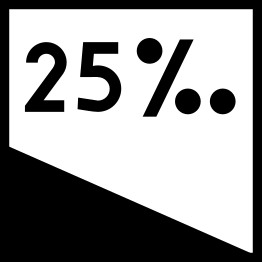
Understand the AT-3 Dangerous Tram Descent warning sign for trams.
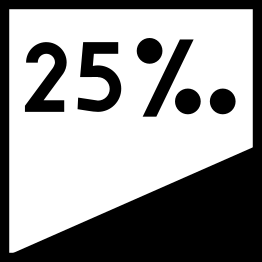
Warning: Steep Tram Ascent Ahead (AT-4)

Understand the AT-5 sign: Tram Collision Movement Warning for Turning Trams
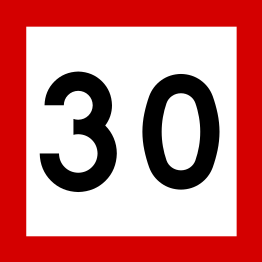
What the BT-1 Tram Speed Limit sign means and how to obey it.

BT-2: Tram Speed Limit Restriction Ends Here

BT-3 Tram Switch Lock: Don't Enter Until Clear!
Deepen your understanding of specific road signs by reviewing official Polish traffic rules and associated real-world driving scenarios. These expert-led resources help you bridge the gap between visual recognition and practical exam application.
Learn why driving in Poland with a foreign license is illegal if your Polish driving privileges have been revoked. This article explains the fundamental principle that driving entitlements are personal and singular under Polish law, as reinforced by court rulings, helping you understand the strict requirements for legal driving.
Learning how to interact with law enforcement is a crucial part of your driver training in Poland, as it helps you understand the legal procedures governing roadside controls. This guide clarifies how officers identify themselves, what behaviors are expected of you as a driver, and how traffic enforcement impacts your penalty points and record. Mastery of these rules ensures you remain compliant with the law and prepared for any roadside situation you may encounter.
Master Your Rights and Obligations During a Polish Roadside Inspection
Master Roadworks: Prioritize Temporary Markings for a Safer Drive and Exam Pass.
The G-1c is the final marker post before the railway tracks, featuring a single diagonal red stripe. It is placed on the right side of the road at approximately 1/3 of the distance from the initial warning sign to the crossing. Passing this sign means you are usually within 50 to 80 meters of the tracks. At this stage, the driver should be at a slow, safe speed, ready to come to an absolute halt if required by lights, barriers, or a Stop sign.
The T-1 plate is used in conjunction with warning signs (Group A) when the hazard is not located at the standard distance defined by traffic regulations. In built-up areas, warning signs are usually 50–100m before the danger, and 150–300m outside built-up areas. If the danger is closer or further away, this plate specifies the distance in meters (e.g., '200 m') to ensure the driver has adequate time to react and adjust their speed.
After reviewing the full list of Polish road signs, explore specific sign categories for in-depth understanding. Challenge your knowledge with practice questions focused on sign recognition and interpretation to solidify your preparation for the driving theory exam.
Browse All Polish Road Signs