
The G-3 sign, also known as St. Andrew's Cross, warns of a single railway track crossing without barriers or with automatic signals. This crucial traffic sign marks the mandatory stopping point. You must stop completely before this sign or at least 5 meters from the nearest rail if no Stop line (P-12) is present, especially if a train is approaching. Always proceed with caution after checking for oncoming trains, even in the absence of signals.
This sign, the G-3 St. Andrew's Cross, specifically warns of a single railway track crossing and dictates your legal stopping point. Proper recognition and interpretation are vital for safe driving and successful theory test revision.
The G-3 sign consists of two crossed white boards with red borders. It is placed immediately before the tracks at a level crossing without barriers (Category D) or with automatic signals (Category C). It marks the legal point where a driver must stop when a train is approaching. If there is no Stop line (P-12), you must stop your vehicle no closer than 5 meters from the nearest rail, or directly before this sign.
Indicates a level crossing with a single railway track and marks the required stopping point.
Get clear, practical answers to the most common questions about the G-3 - St. Andrew's Cross (Single Track) road sign. Learn how the sign works, what rules it represents, and how it affects real driving situations. This FAQ strengthens your understanding and supports accurate decision making for the Polish driving theory exam in Poland.
The G-3 sign signifies a railway level crossing with a single track. It indicates the precise point where you must bring your vehicle to a complete stop if required, typically when a train is approaching or when instructed by other signals. It's essential for safety to be aware of this sign and know when to halt.
When you encounter the G-3 St. Andrew's Cross sign, you must be prepared to stop. If there are flashing red lights, a siren, or you can see/hear an approaching train, you must stop your vehicle before the sign or at least 5 meters from the nearest rail. Never cross until the train has completely passed and you've checked for any possibility of another train.
A common trap is not stopping fully when required, or stopping too close to the tracks, which is dangerous. Learners may also forget to check for a second train on the other track after the first has passed. It's vital to remember that the G-3 sign demands a complete stop under specific conditions, not just a slowdown.
The G-3 sign indicates a railway crossing with a *single* track. The G-4 sign, which also features crossed boards but is typically used in multiples, indicates a crossing with *multiple* railway tracks. When encountering G-4, you must be extra vigilant as there may be several parallel tracks.
You should only proceed past the G-3 sign if no train is approaching and there are no signals (like flashing red lights) requiring you to stop. However, even in such cases, it's crucial to look both left and right before crossing the track to ensure it's safe. The sign serves as a warning and a potential stopping point.
A clear reference image of the G-3 - St. Andrew's Cross (Single Track) road sign used in Poland.
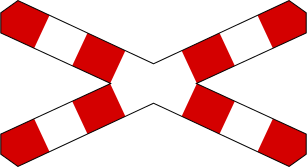
The G-3 - St. Andrew's Cross (Single Track) road sign may also be known by these alternative names or terms.
The G-3 - St. Andrew's Cross (Single Track) road sign is part of the Additional Railway Crossing Signs (G) category, which groups together signs with similar rules and functions.
Studying related road signs together, such as different types of St. Andrew's Cross signals, helps solidify your understanding and reduces confusion. Effective traffic sign comparison is key for theory test revision and mastering Polish road rules.

Prepare for tram signals ahead with the AT-1 warning sign.

Understand the AT-2 Tram-Activated Signal: Know when trams are coming!
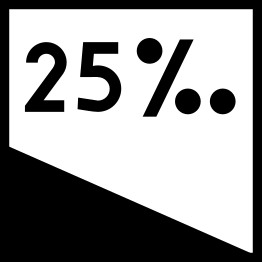
Understand the AT-3 Dangerous Tram Descent warning sign for trams.
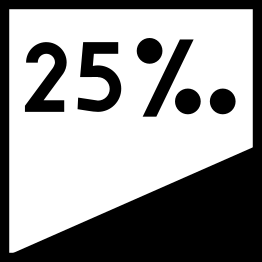
Warning: Steep Tram Ascent Ahead (AT-4)

Understand the AT-5 sign: Tram Collision Movement Warning for Turning Trams
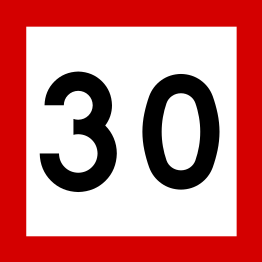
What the BT-1 Tram Speed Limit sign means and how to obey it.

BT-2: Tram Speed Limit Restriction Ends Here

BT-3 Tram Switch Lock: Don't Enter Until Clear!
Deepen your understanding of specific road signs by reviewing official Polish traffic rules and associated real-world driving scenarios. These expert-led resources help you bridge the gap between visual recognition and practical exam application.
Learning to assess the state of your transmission fluid is a vital skill for every driver, helping you identify early warning signs of mechanical wear or contamination. By understanding what constitutes healthy fluid versus signs of potential damage, you can take proactive steps to protect your vehicle and improve driving safety. This guide focuses on observation and basic checks, aligning with the technical knowledge required for responsible vehicle ownership.
Master Polish Crossing Markings for a Safer Drive and Exam Success.
Navigate Tram Intersections Like a Pro: Essential for Your Polish Driving Exam.
This article provides a detailed explanation of how Polish traffic signs A-7 ('Ustąp Pierwszeństwa' - Yield), B-20 ('STOP'), and D-1 ('Droga z Pierwszeństwem' - Priority Road) dictate right-of-way at intersections. Understanding the nuances of these signs is a fundamental aspect of the Polish driving theory exam, and mastering them will significantly improve your preparedness for real-world driving scenarios.
The A-9 sign informs drivers that they are approaching a railway crossing protected by full or half-barriers. This sign is always accompanied by 'countdown' marker posts (G-1) to show the distance to the tracks. Even with barriers, drivers must remain vigilant for light signals or malfunctions. If the barriers are down or the lights are flashing red, you must stop and wait.
The E-2a is a rectangular board usually mounted on the shoulder. It serves as the final confirmation of which way to turn at a junction. It can list multiple cities in one direction and include road numbers. Unlike arrow-shaped signs, this board provides a broader overview of the directions available at that specific point in the journey. It is a staple of standard national and local road navigation.
After reviewing the full list of Polish road signs, explore specific sign categories for in-depth understanding. Challenge your knowledge with practice questions focused on sign recognition and interpretation to solidify your preparation for the driving theory exam.
Browse All Polish Road Signs