
The BT-1 sign is a prohibition sign specifically for trams, indicating a maximum permitted speed. Similar to speed limit signs for cars, it restricts how fast trams can travel on certain track sections. This limit is crucial for safety on curves, bridges, or busy areas and remains in effect until the next track junction or an 'End of Limit' sign.
Master the BT-1 'Tram Speed Limit' sign to correctly interpret speed restrictions in Poland, a crucial element for your theory test revision. This detailed explanation covers its specific meaning and application, helping you navigate complex traffic situations safely and legally.
The BT-1 sign is the tram equivalent of the B-33 speed limit. It is used to restrict the speed of trams on specific sections of track, such as tight curves, over old bridges, or through areas with high pedestrian activity. The limit applies from the sign until the next intersection (track split) or until the BT-2 'End of Limit' sign is reached.
Prohibits the tram from exceeding the speed specified on the sign.
Get clear, practical answers to the most common questions about the BT-1 - Tram Speed Limit road sign. Learn how the sign works, what rules it represents, and how it affects real driving situations. This FAQ strengthens your understanding and supports accurate decision making for the Polish driving theory exam in Poland.
The BT-1 sign's purpose is to enforce a maximum speed for trams on specific track segments where higher speeds could be dangerous. This could be due to sharp bends, track condition, or proximity to pedestrians. It ensures trams operate within safe velocity limits in these areas.
A tram must not exceed the numerical speed indicated on the BT-1 sign. Drivers must adjust their speed so the speedometer reading is at or below the value shown on the sign. This applies at all times, regardless of whether the tram is running late.
The speed restriction imposed by the BT-1 sign remains in effect until the tram reaches a track intersection or junction where the route splits, or until the driver encounters the BT-2 'End of Limit' sign. After this point, the general speed limits for trams apply again.
Yes, during night hours or adverse weather conditions like rain, snow, or fog, visibility and traction are reduced. This means the safety margin is smaller, making it even more critical to strictly adhere to the BT-1 speed limit and avoid any acceleration before clearing the restricted zone.
No, the BT-1 sign is specifically designed for and applies only to trams. It is the tram equivalent of the B-33 speed limit sign used for other vehicles. Other road users are not directly affected by this sign, although they should be aware of tram movements.
A clear reference image of the BT-1 - Tram Speed Limit road sign used in Poland.
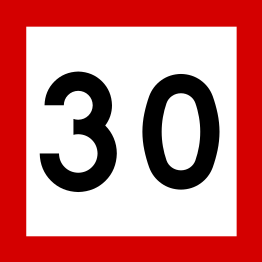
The BT-1 - Tram Speed Limit road sign may also be known by these alternative names or terms.
The BT-1 - Tram Speed Limit road sign is part of the Additional Railway Crossing Signs (G) category, which groups together signs with similar rules and functions.
Comparing the 'Tram Speed Limit' sign with other speed restriction signs helps solidify your understanding and reduces confusion. Effective traffic sign comparison is key to better sign recognition and essential for your theory test revision.

Prepare for tram signals ahead with the AT-1 warning sign.

Understand the AT-2 Tram-Activated Signal: Know when trams are coming!
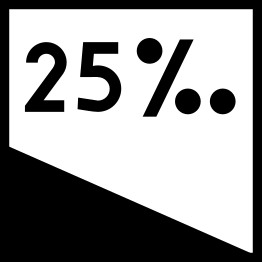
Understand the AT-3 Dangerous Tram Descent warning sign for trams.
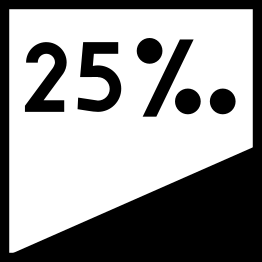
Warning: Steep Tram Ascent Ahead (AT-4)

Understand the AT-5 sign: Tram Collision Movement Warning for Turning Trams
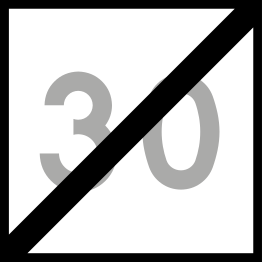
BT-2: Tram Speed Limit Restriction Ends Here

BT-3 Tram Switch Lock: Don't Enter Until Clear!
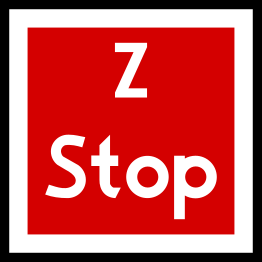
Stop and manually check the tram switch with the BT-4 sign.
Deepen your understanding of specific road signs by reviewing official Polish traffic rules and associated real-world driving scenarios. These expert-led resources help you bridge the gap between visual recognition and practical exam application.
Prepare for your Polish driving theory exam by thoroughly understanding prohibitory signs, starting with the critical 'Zakaz Wjazdu' (B-2) marker. This article breaks down what this sign prohibits, common situations where it's used, and potential exceptions, ensuring you can confidently interpret and act upon these important traffic controls to drive safely and pass your test.
This article will demystify the B-33 speed limit sign in Poland, explaining how it functions as a prohibitory sign that overrides general speed regulations. You'll learn why these specific signs are critical for the theory exam and how to interpret their requirements to drive safely and legally. Understanding these nuances is key to succeeding in your Polish driving theory test.
Master Polish Pedestrian Priority Rules in Shared Spaces and Residential Areas
Master crucial stopping rules to pass your Polish driving theory exam with confidence.
The B-30 sign marks the point where the 'No Honking' restriction ends. Beyond this sign, you are back to the standard rules: in rural areas, you can use the horn to signal intent to overtake or warn others, while in built-up areas, the general ban on unnecessary honking still applies legally even without signs.
The B-35 sign allows for a very brief stop—up to 60 seconds—to drop off a passenger or quickly unload a bag. Anything longer than 1 minute is legally considered 'parking' (postój) and is prohibited. The ban applies to the side of the road where the sign is placed and lasts until the next intersection.
After reviewing the full list of Polish road signs, explore specific sign categories for in-depth understanding. Challenge your knowledge with practice questions focused on sign recognition and interpretation to solidify your preparation for the driving theory exam.
Browse All Polish Road Signs