
The G-4 road sign, often called the St. Andrew's Cross for multiple tracks, is a critical warning indicating a railway crossing with two or more railway lines. Unlike the single-track version, this sign demands extra vigilance, as you must always ensure the entire crossing is clear before proceeding. Polish traffic rules emphasize that waiting for one train to pass is not enough; you must check for a second train on adjacent tracks before crossing.
This sign specifically warns of a railway crossing with two or more tracks, demanding extra caution and awareness of trains on adjacent lines. Essential for passing your theory test, this explanation helps you master multi-track interpretation for safe driving.
The G-4 sign is identical to the G-3 but features an additional partial cross (a 'V' shape) underneath. This indicates that the crossing has multiple tracks. This is a critical warning because drivers often wait for one train to pass and then immediately pull out, only to be hit by a second train traveling in the opposite direction on the adjacent track. It marks the safety boundary for the entire multi-track zone.
Indicates a level crossing with two or more railway tracks.
Get clear, practical answers to the most common questions about the G-4 - St. Andrew's Cross (Multiple Tracks) road sign. Learn how the sign works, what rules it represents, and how it affects real driving situations. This FAQ strengthens your understanding and supports accurate decision making for the Polish driving theory exam in Poland.
The G-4 sign warns that you are approaching a railway level crossing that has more than one set of railway tracks. It's crucial to remember that two or more tracks are present, meaning more than one train could potentially use the crossing.
The primary danger is that a driver might incorrectly assume it's safe to cross after one train has passed, only to be struck by a second train on an adjacent track travelling in the same or opposite direction. The G-4 sign highlights this specific hazard of multiple tracks.
Upon seeing the G-4 sign, you should approach with extreme caution. Slow down, be prepared to stop, and always wait until the crossing is completely clear of all trains and you have confirmed no other train is approaching on any of the multiple tracks. It's advisable to keep your vehicle in a low gear for quick clearance.
A common trap is assuming that seeing a single train pass means the crossing is safe. The G-4 sign specifically tests your understanding that multiple tracks mean multiple potential trains. Always remember to look for trains on other tracks before proceeding, especially if a stopping signal is involved.
No, you should never stop your vehicle in the 'gap' between the tracks. The intention is to clear all tracks in one continuous movement. Stopping in the middle could trap you if a train appears on another track, and it obstructs the safe operation of the crossing.
A clear reference image of the G-4 - St. Andrew's Cross (Multiple Tracks) road sign used in Poland.
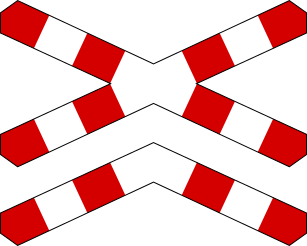
The G-4 - St. Andrew's Cross (Multiple Tracks) road sign may also be known by these alternative names or terms.
The G-4 - St. Andrew's Cross (Multiple Tracks) road sign is part of the Additional Railway Crossing Signs (G) category, which groups together signs with similar rules and functions.
Reviewing similar traffic signs side-by-side enhances your recognition skills and helps prevent confusion on your theory test revision. Comparing signs like the St. Andrew's Cross variations aids in memorising subtle differences for accurate exam preparation.

Prepare for tram signals ahead with the AT-1 warning sign.

Understand the AT-2 Tram-Activated Signal: Know when trams are coming!
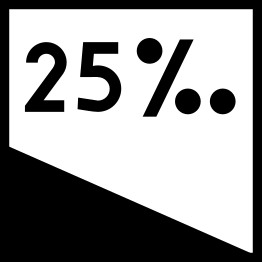
Understand the AT-3 Dangerous Tram Descent warning sign for trams.
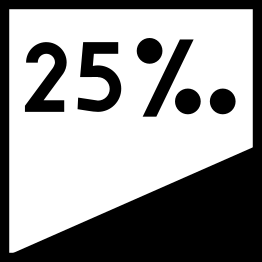
Warning: Steep Tram Ascent Ahead (AT-4)

Understand the AT-5 sign: Tram Collision Movement Warning for Turning Trams
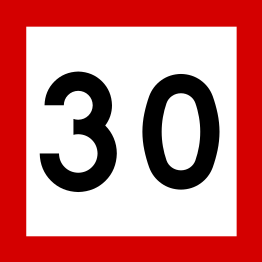
What the BT-1 Tram Speed Limit sign means and how to obey it.

BT-2: Tram Speed Limit Restriction Ends Here

BT-3 Tram Switch Lock: Don't Enter Until Clear!
Deepen your understanding of specific road signs by reviewing official Polish traffic rules and associated real-world driving scenarios. These expert-led resources help you bridge the gap between visual recognition and practical exam application.
Don't Be a Road Block: Master Minimum Speeds and Smooth Traffic Flow for Your Polish Exam!
Even a Second Can Be Fatal: Understand Microsleep to Drive Safely in Poland.
Navigating the different Polish driving licence categories for motorcycles can be complex. This guide breaks down the specific requirements for AM, A1, A2, and A licences, including the minimum age and the exact types of vehicles you can operate with each. Gaining a clear understanding of these categories is essential for success in your Polish driving theory exam and for safe riding on Polish roads.
Learning how to interact with law enforcement is a crucial part of your driver training in Poland, as it helps you understand the legal procedures governing roadside controls. This guide clarifies how officers identify themselves, what behaviors are expected of you as a driver, and how traffic enforcement impacts your penalty points and record. Mastery of these rules ensures you remain compliant with the law and prepared for any roadside situation you may encounter.
The D-11 sign is used to designate a specific lane for public transport vehicles. Its purpose is to allow buses and trolleybuses to bypass traffic congestion in busy urban areas. The sign is blue with a white bus silhouette and an arrow pointing to the lane it applies to. In many cities, additional text like 'TAXI' or 'MOP' may be included on the sign to allow other specific vehicles to use the lane as well.
The AT-2 sign indicates that the upcoming intersection features an 'actuated' signal. As the tram approaches a sensor in the track, the traffic light system is informed and will eventually provide a 'Go' phase for the tram. This sign tells the driver that they don't necessarily need to wait for a fixed cycle, but should be prepared for the system to detect and process their arrival.
After reviewing the full list of Polish road signs, explore specific sign categories for in-depth understanding. Challenge your knowledge with practice questions focused on sign recognition and interpretation to solidify your preparation for the driving theory exam.
Browse All Polish Road Signs